Eurytides marcelluszebra swallowtail
Geographic Range
Eurytides marcellus range throughout the eastern United States, although are most abundant in the southeast. (Pyle, 1981; Tveten and Tveten, 1996)
Habitat
The zebra swallowtail prefers corridors of wooded land alongside bodies of water such as riversides, lakeshores, marshes and open moist woods. (Holland, 1910; Pyle, 1981)
- Habitat Regions
- temperate
- Terrestrial Biomes
- forest
- Other Habitat Features
- riparian
Physical Description
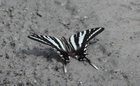
The zebra swallowtail butterfly has a wing span of 5-9 cm. It has long, triangular wings with swordlike tails. The color and size varies between spring and summer butterflies. The early spring zebra swallowtail is smaller with pale greenish-white wings which are crossed by black stripes and bands. They also have shorter tails. The summer zebra swallowtail is larger with light blue-green wings, which are crossed by black stripes and bands, and have longer tails. The hindwings of both the spring and summer zebra swallowtail have two deep blue spots at the base and a red spot closer to the body.
Caterpillars are generally hairless. They have a forked gland called the osmeterium that can protrude from the back of the head if the butterfly is alarmed. This releases a bad smell that is used as defense mechanism. There are two color morphologies of caterpillars. The first is green with yellow and black bands, and the other is dark brown with orange and white bands. (Holland, 1910; Parenti, 1977; Pyle, 1981; Tveten and Tveten, 1996)
- Other Physical Features
- ectothermic
- heterothermic
- bilateral symmetry
-
- Range wingspan
- 5 to 9 cm
- 1.97 to 3.54 in
Development
In the life cycle of the butterfly, it takes about one month for the zebra swallowtail to mature from an egg to an adult. The chrysalis, or pupa, is attached to a stem or leaf by the tail and by a girdle of silk around the thorax. It hangs head upward in this position. (Holland, 1910; Parenti, 1972; Tveten and Tveten, 1996)
- Development - Life Cycle
- metamorphosis
Reproduction
Males usually patrol places near host plants searching for females. Small aggregations of patrolling males often form close to mud puddles or moist stream banks. (Holland, 1910; Parenti, 1972; Tveten and Tveten, 1996)
Female zebra swallowtails lay their eggs singly on the underside of pawpaw leaves. (Holland, 1910; Parenti, 1972; Tveten and Tveten, 1996)
- Key Reproductive Features
- fertilization
- oviparous
Lifespan/Longevity
An adult Eurytides marcellus butterfly can live up to 6 months in its natural environment. (Holland, 1910; Parenti, 1972; Tveten and Tveten, 1996)
-
- Range lifespan
Status: wild - 6 (high) months
- Range lifespan
-
- Typical lifespan
Status: wild - 6 (high) months
- Typical lifespan
Behavior
The zebra swallowtail flies near the ground using shallow wingbeats. Its flight has been described as bat-like and erratic. (Tveten and Tveten, 1996)
- Key Behaviors
- flies
- diurnal
Food Habits
The zebra swallowtail rarely strays away from the habitats where various species of pawpaw are found. The common food plants for the larvae are the pawpaw and dwarf pawpaw. Some larvae will eat other caterpillars found on the same plant. The adult zebra swallowtail will eat nectar from a variety of flowers. Adults generally eat from taller flowers, because they have a long, flexible "tongue" called a proboscis and can feed from longer, tubed flowers. (Col, 1999; Holland, 1910; Stokes, et al., 1991; Tveten and Tveten, 1996)
- Primary Diet
- herbivore
- Animal Foods
- insects
- Plant Foods
- leaves
- wood, bark, or stems
- nectar
Economic Importance for Humans: Positive
Economic benefits from this species have yet to be discovered.
Economic Importance for Humans: Negative
Currently it does not adversely affect humans.
Conservation Status
This butterfly needs no special protective status.
-
- IUCN Red List
- No special status
-
- US Federal List
- No special status
-
- CITES
- No special status
-
- State of Michigan List
- No special status
Other Comments
The zebra swallowtail was first grouped under the genus name Papilio. Then it was later renamed Graphium marcellus. Today it is known by its Latin name Eurytides marcellus. Zebra swallowtails are called swallowtails because their "tails" are long on their hindwings. These look similar to the long, pointed tails on swallows Hirundinidae. . (Col, 1999)
Contributors
Sara Diamond (editor), Animal Diversity Web.
Matthew Wund (editor), University of Michigan-Ann Arbor.
Leticia Davila (author), Southwestern University, Stephanie Fabritius (editor), Southwestern University.
Glossary
- Nearctic
-
living in the Nearctic biogeographic province, the northern part of the New World. This includes Greenland, the Canadian Arctic islands, and all of the North American as far south as the highlands of central Mexico.

- bilateral symmetry
-
having body symmetry such that the animal can be divided in one plane into two mirror-image halves. Animals with bilateral symmetry have dorsal and ventral sides, as well as anterior and posterior ends. Synapomorphy of the Bilateria.
- diurnal
-
- active during the day, 2. lasting for one day.
- ectothermic
-
animals which must use heat acquired from the environment and behavioral adaptations to regulate body temperature
- fertilization
-
union of egg and spermatozoan
- folivore
-
an animal that mainly eats leaves.
- forest
-
forest biomes are dominated by trees, otherwise forest biomes can vary widely in amount of precipitation and seasonality.
- herbivore
-
An animal that eats mainly plants or parts of plants.
- heterothermic
-
having a body temperature that fluctuates with that of the immediate environment; having no mechanism or a poorly developed mechanism for regulating internal body temperature.
- internal fertilization
-
fertilization takes place within the female's body
- metamorphosis
-
A large change in the shape or structure of an animal that happens as the animal grows. In insects, "incomplete metamorphosis" is when young animals are similar to adults and change gradually into the adult form, and "complete metamorphosis" is when there is a profound change between larval and adult forms. Butterflies have complete metamorphosis, grasshoppers have incomplete metamorphosis.
- native range
-
the area in which the animal is naturally found, the region in which it is endemic.
- nectarivore
-
an animal that mainly eats nectar from flowers
- oviparous
-
reproduction in which eggs are released by the female; development of offspring occurs outside the mother's body.
- riparian
-
Referring to something living or located adjacent to a waterbody (usually, but not always, a river or stream).
- temperate
-
that region of the Earth between 23.5 degrees North and 60 degrees North (between the Tropic of Cancer and the Arctic Circle) and between 23.5 degrees South and 60 degrees South (between the Tropic of Capricorn and the Antarctic Circle).
References
Col, J. 1999. "Enchanted Learning" (On-line). Accessed February 18, 2001 at http://www.enchantedlearning.com/subjects/butterfly/species/Zebrasw.shtml.
Holland, W. 1910. The Butterfly Book. Garden City, New York: Doubleday, Page and Company.
Parenti, U. 1972. Butterflies and Moths. London: Orbis Publishing Limited.
Parenti, U. 1977. The World of Butterflies and Moths. New York, New York: G. P. Putman's Sons.
Pyle, R. 1981. The Audubon Society Field Guide to North American Butterflies. New York, New York: Alfred A. Knopf, Inc..
Stokes, D., L. Stokes, E. Williams. 1991. The Butterfly Book. New York, New York: Little, Brown and Company.
Tveten, J., G. Tveten. 1996. Butterflies of Houston and Southeast Texas. Austin, Texas: University of Texas Press.