Eurycea rathbuniTexas Blind Salamander


Geographic Range
The Texas Cave Salamander is limited to the San Marcos, Texas area. (Bockstanz and Cannatella, 1999)
Habitat
Eurycea rathbuni is only found in subterranean water systems in Edwards Plateau in Texas. The Edwards Plateau is characterized by springs and caves and lies at an elevation of 600-750 meters. It has been found in wells but is usually restricted to caves (Duellman 1999). (Deullman, 1999)
- Habitat Regions
- temperate
- freshwater
- Other Habitat Features
- caves
Physical Description
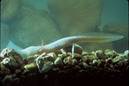
Eurycea rathbuni is characterized by a very broad, flat head and snout. The four limbs are very thin and elongate. The tail is laterally compressed and finned, tapering at its end. The eyes are vestigial and lie beneath the animal's skin. External gills are bright red and always present. The forelimbs have four digits while the hind limbs have five. Eurycea rathbuni is neotenic and thus bright red gills are present throughout the lifecycle. It has twelve costal grooves as well. Adults range in length from 3.25 to 5.375 inches (University of Texas; Potter and Sweet 1981). (Potter and Sweet, 1981)
- Other Physical Features
- ectothermic
- heterothermic
- bilateral symmetry
- Sexual Dimorphism
- sexes alike
Development
- Development - Life Cycle
- neotenic/paedomorphic
- metamorphosis
Reproduction
Little is known about the reproduction of Eurycea rathbuni. The species is known to be acyclic with females maturing and reproducing throughout the year, unresponsive to seasonal cues. This breeding cycle is typical of many cave dwelling species (Lofts 1974). Breeding of this species has been observed in the laboratory. The females assumes an active role in stimulating the male to mate. Her behavior is characterized by rubbing her chin along the male's back. If this fails to stimulate the male then she may scratch at him or fan her tail at him. She may even resort to nipping at his sides if he further ignores her advances. The male will deposit a spermatophore on a rock or substrate and the female will then pick it up with her cloaca (Bechler 1988).
- Key Reproductive Features
- iteroparous
- year-round breeding
- gonochoric/gonochoristic/dioecious (sexes separate)
- sexual
- fertilization
- oviparous
Lifespan/Longevity
-
- Average lifespan
Status: captivity - 10.3 years
- AnAge
- Average lifespan
Behavior
Little is known about the behavior of this species.
- Key Behaviors
- motile
Food Habits
Little is known about this species feeding habits and methods. It may feed on snails, shrimp, and amphipods (University of Texas).
Economic Importance for Humans: Positive
This salamander is not a resource for humans.
Economic Importance for Humans: Negative
Eurycea rathbuni does not negatively affect humans.
Conservation Status
Eurycea rathbuni is listed as endangered under the U.S. Endangered Species Act (Duellman 1999). Its extremely limited range makes it a vulnerable species. (Deullman, 1999)
-
- IUCN Red List
-
Vulnerable
More information
-
- IUCN Red List
-
Vulnerable
More information
-
- US Federal List
- Endangered
Contributors
Melissa Munger (author), Michigan State University, James Harding (editor), Michigan State University.
Glossary
- Nearctic
-
living in the Nearctic biogeographic province, the northern part of the New World. This includes Greenland, the Canadian Arctic islands, and all of the North American as far south as the highlands of central Mexico.

- bilateral symmetry
-
having body symmetry such that the animal can be divided in one plane into two mirror-image halves. Animals with bilateral symmetry have dorsal and ventral sides, as well as anterior and posterior ends. Synapomorphy of the Bilateria.
- ectothermic
-
animals which must use heat acquired from the environment and behavioral adaptations to regulate body temperature
- fertilization
-
union of egg and spermatozoan
- freshwater
-
mainly lives in water that is not salty.
- heterothermic
-
having a body temperature that fluctuates with that of the immediate environment; having no mechanism or a poorly developed mechanism for regulating internal body temperature.
- internal fertilization
-
fertilization takes place within the female's body
- iteroparous
-
offspring are produced in more than one group (litters, clutches, etc.) and across multiple seasons (or other periods hospitable to reproduction). Iteroparous animals must, by definition, survive over multiple seasons (or periodic condition changes).
- metamorphosis
-
A large change in the shape or structure of an animal that happens as the animal grows. In insects, "incomplete metamorphosis" is when young animals are similar to adults and change gradually into the adult form, and "complete metamorphosis" is when there is a profound change between larval and adult forms. Butterflies have complete metamorphosis, grasshoppers have incomplete metamorphosis.
- motile
-
having the capacity to move from one place to another.
- native range
-
the area in which the animal is naturally found, the region in which it is endemic.
- oviparous
-
reproduction in which eggs are released by the female; development of offspring occurs outside the mother's body.
- sexual
-
reproduction that includes combining the genetic contribution of two individuals, a male and a female
- temperate
-
that region of the Earth between 23.5 degrees North and 60 degrees North (between the Tropic of Cancer and the Arctic Circle) and between 23.5 degrees South and 60 degrees South (between the Tropic of Capricorn and the Antarctic Circle).
- year-round breeding
-
breeding takes place throughout the year
References
Bechler, D. 1988. Courtship behavior and spermatophore deposition by the subterranean salamander, Typhlomolge rathbuni (Caudata, Plethodontidae). The Southwestern Naturalist, 33(1): 124-126.
Bockstanz, L., D. Cannatella. 1999. "Herps of Texas-Salamanders" (On-line). Herps of Texas. Accessed December 10, 1999 at http://www.zo.utexas.edu/research/txherps/salamanders/typhlomolge.rathbuni.html.
Deullman, W. 1999. Patterns of Distribution of Amphibians. Baltimore: The John Hopkins University Press.
Lofts, B. 1974. Physiology of the Amphibia. New York: Academic Press.
Potter, F., S. Sweet. 1981. Generic boundaries in Texas Cave Salamanders, and a Redescription of Typhlomolge robusta (Amphibia: Plethodontidae). Copeia, 1981(1): 64-75.