Euphractus sexcinctussix-banded armadillo
Geographic Range
South America east of the Andes mountains in dry savannahs or in parts of wet savannahs. Their burrows are typically located in grasslands.
- Biogeographic Regions
- neotropical
Habitat
Euphractus sexcinctus inhabits South American savannahs, preferring (but not limited to) drier areas.
- Terrestrial Biomes
- savanna or grassland
Physical Description
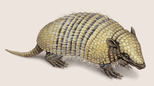
On average, an adult measures 406mm from head to body and has a tail 2/3 as long. These armadillos are distinguished by their pointed and flattened heads, which are covered by large plates arranged in a distinctive pattern. Their body consists of 6-8 moveable bands, which are covered with thin grey-brown hair. They have 5 toes, and their claws are well developed for digging and constructing burrows.
- Other Physical Features
- endothermic
- bilateral symmetry
Reproduction
The female usually gives birth to a litter of 1-3 (both male and female) baby armadillos in a nest that she has built herself. These babies may be born anytime during the year after a gestation period of 60-64 days. There is a possibility of a time delay between fertilization and the implantation of the egg in the wall of the female's uterus. Babies weigh about 95-115 grams at birth and their eyes open after 22-25 days. During the first month of their lives, the babies quadruple their weight and by the end of the month are able to consume solid foods. Within nine months the baby armadillo matures into an adult.
- Key Reproductive Features
- gonochoric/gonochoristic/dioecious (sexes separate)
- sexual
Lifespan/Longevity
-
- Average lifespan
Status: captivity - 18.8 years
- Max Planck Institute for Demographic Research
- Average lifespan
Behavior
Euphractus sexcinctus live in self-dug burrows in the savannahs of South America. Their burrows are characterized by a single, inverted, u-shaped entrance. This particular species gives off a characteristic odor from scent glands located at the base of their tails. These scents are used to mark their territories. Euphractus are largely diurnal but occasionally come out at night. If threatened by conspecifics, they fight amongst themselves with their teeth and claws. If a mother's young are disturbed she will act aggressively and try to hide or move them to a safer location. However, these armadillos are mainly timid animals generally run to escape predators rather than stay and fight. They are good swimmers and stay afloat by swallowing air. Bouyancy in the water is also aided by the armadillos good fat storing ability, which is believed to be related to seasonal scarcity of food.
- Key Behaviors
- motile
Communication and Perception
Food Habits
Euphractus sexcinctus is omnivorous. Plant material(including bromeliad fruit, tubers, palm nuts) composes 90% of the diet. Insects such as ants and termites, carrion, and small vertebrates such as frogs are also consumed. These armadillos have been observed to feed on dead carcasses by standing on them and ripping off pieces held in their jaws.
Economic Importance for Humans: Positive
A small number of E. sexcinctus are hunted and killed for thier meat in northeastern Brazil. In addition to being used in a small scale meat market. the armadillos are killed for their tails, which are used by Argentinian Indians for carrying their firemaking tools.
Economic Importance for Humans: Negative
Euphractus sexcinctus may damage sprouting corn.
Conservation Status
Although E. sexcinctus is not given any special status as an endangered or threatened species, it is important to note that they are often trapped and killed by farmers because of the armadillo's love for sprouting corn shoots.
-
- IUCN Red List
-
Least Concern
More information
Other Comments
Euphractus sexcinctus can live up to 15 1/2 years.
Contributors
Brittany Bird (author), University of Michigan-Ann Arbor.
Glossary
- Neotropical
-
living in the southern part of the New World. In other words, Central and South America.

- bilateral symmetry
-
having body symmetry such that the animal can be divided in one plane into two mirror-image halves. Animals with bilateral symmetry have dorsal and ventral sides, as well as anterior and posterior ends. Synapomorphy of the Bilateria.
- chemical
-
uses smells or other chemicals to communicate
- endothermic
-
animals that use metabolically generated heat to regulate body temperature independently of ambient temperature. Endothermy is a synapomorphy of the Mammalia, although it may have arisen in a (now extinct) synapsid ancestor; the fossil record does not distinguish these possibilities. Convergent in birds.
- motile
-
having the capacity to move from one place to another.
- native range
-
the area in which the animal is naturally found, the region in which it is endemic.
- sexual
-
reproduction that includes combining the genetic contribution of two individuals, a male and a female
- tactile
-
uses touch to communicate
- tropical savanna and grassland
-
A terrestrial biome. Savannas are grasslands with scattered individual trees that do not form a closed canopy. Extensive savannas are found in parts of subtropical and tropical Africa and South America, and in Australia.
- savanna
-
A grassland with scattered trees or scattered clumps of trees, a type of community intermediate between grassland and forest. See also Tropical savanna and grassland biome.
- temperate grassland
-
A terrestrial biome found in temperate latitudes (>23.5° N or S latitude). Vegetation is made up mostly of grasses, the height and species diversity of which depend largely on the amount of moisture available. Fire and grazing are important in the long-term maintenance of grasslands.
References
Encyclopedia Britannica. Volume 1. Encyclopaedia Britannica Inc. 1989.
Journal of Zoology. Vol. 222(1) 1990: 27-47. "The anatomy abd functioning of the feeding apparatus in two armadillos".
Mammalian Species. Vol. 252 1985: 1-4. "Euphractus sexcinctus".