Eudorcas thomsoniiThomson's gazelle




Geographic Range
Thomson's gazelles are found in eastern Africa, in Kenya, Tanzania, and southern Sudan. ("ARKive: Images of Life on Earth", 2009; African Wildlife Foundation, 1997; Feldhamer, et al., 2007)
Habitat
Thomson's gazelles live in dry, short grasslands and shrubby savannas. They are an arid-adapted species and are able to stay in dry grasslands for longer than other plains ungulates in the same region, which migrate towards more moist habitats. They follow a similar sort of seasonal migratory pattern as other ungulates in their range, but they stay for longer on the wet season range and don't migrate as far north in the dry season. ("ARKive: Images of Life on Earth", 2009; "IUCN 20008 Red List of Threatened Species:Eudorcas thomsonii", 2008; Kingdon, 1997)
- Habitat Regions
- tropical
- terrestrial
- Terrestrial Biomes
- savanna or grassland
- Other Habitat Features
- agricultural
Physical Description
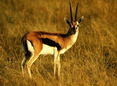
Thomson's gazelles are small gazelles, the typical weight range is 15 to 35 kg. Males are larger overall, ranging in weight from 20 to 35 kg, females are from 15 to 25 kg. They have white bellies and reddish-brown backs, divided by a bold, black stripe laterally. Their rumps are white and their tails are black. Thomson's gazelles have reddish-brown fur on their faces, with a broad white stripe that extends from the eye to the nose and is bordered below by a black stripe. Males and some females have horns that curve backwards and are curved forwards distally in males. Females have smaller horns, if any, both lengthwise and in circumference. The horns are arrayed with a series of marked annulations. Thomson's gazelles resemble Grant's gazelles (Nanger granti) somewhat, although Grant's gazelles are larger overall, have horns that curve outwards, and the white of their rump extends to above the tail. Thomson's gazelles have a head and body length of 80 to 120 cm, a tail length of 15 to 27 cm, and height at the shoulder of 55 to 82 cm. They have prominent pre-orbital glands. ("ARKive: Images of Life on Earth", 2009; African Wildlife Foundation, 1997; Dorst, 1969; Kingdon, 1997)
Thomson's gazelles are exceptionally fast runners, able to run at speeds up to 70 km/hour. They can outrun cheetahs if they can evade them for long enough because cheetahs can maintain high speeds for shorter times. (Kingdon, 1997)
- Other Physical Features
- endothermic
- homoiothermic
- bilateral symmetry
- Sexual Dimorphism
- male larger
- ornamentation
-
- Range mass
- 15 to 35 kg
- 33.04 to 77.09 lb
Reproduction
Thomson's gazelle males defend small territories and attempt to mate with females in that area. Females prefer rich foraging grounds, so preferred territories are those in areas with good grazing. Males use markings from preorbital glands and dung to advertise their territories and actively defend them against other males. They sometimes attempt to "herd" females in order to keep them in their territory for longer. (African Wildlife Foundation, 1997; Dorst, 1969; Estes, 1967; Kingdon, 1997)
- Mating System
- polygynous
There is little available information on breeding in Thomson's gazelles. Thomson's gazelles mate twice yearly. Gestation is for 6 months and the majority of births occur right after the rainy season, with a single calf being born at 2 to 3 kg. ("ARKive: Images of Life on Earth", 2009; African Wildlife Foundation, 1997; Dorst, 1969)
- Key Reproductive Features
- iteroparous
- year-round breeding
- gonochoric/gonochoristic/dioecious (sexes separate)
- sexual
- viviparous
-
- Breeding interval
- Thomson's gazelles can breed twice a year.
-
- Breeding season
- Most breeding is timed so that most births occur right after the rainy season, although births can occur throughout the year.
-
- Range number of offspring
- 1 (low)
-
- Average number of offspring
- 1
-
- Average gestation period
- 6 months
Thomson's gazelle calves are precocial at birth, able to stand and walk soon after, although they spend their first days hidden and motionless in the grass. The mother will leave the young in high grass and frequently come back a few times during the day to nurse. After this hiding period, the young follow and accompany their mother with the herd. (African Wildlife Foundation, 1997)
- Parental Investment
- altricial
-
pre-fertilization
- provisioning
-
protecting
- female
-
pre-hatching/birth
-
provisioning
- female
-
protecting
- female
-
provisioning
-
pre-weaning/fledging
-
provisioning
- female
-
protecting
- female
-
provisioning
Lifespan/Longevity
Thomson's gazelles typically have a lifespan of 10.5 years in the wild. Approximately half of calves will die within their first year. (African Wildlife Foundation, 1997)
-
- Average lifespan
Status: wild - 10.5 years
- Average lifespan
Behavior
Thomson's gazelles are social animals that are nomadic or migratory and specialized for cursorial locomotion. Thomson's gazelles usually form groups with a fluid association of 5 to 60 individuals, although temporary associations can number in the hundreds. Groups split and join readily and do not seem to have any permanent or exclusive membership or social hierarchy. They are also found in mixed-species herds with impalas (Aepyceros melampus) and Grant’s gazelles (Nanger granti). Males defend small territories during breeding seasons that they hope will attract females for mating opportunities. Outside of the breeding season, males form small bachelor herds or associate with females in loose groups. (African Wildlife Foundation, 1997; Dorst, 1969; Feldhamer, et al., 2007)
Home Range
Home range size of Eudorcas thomsonii is not reported.
Communication and Perception
Thomson’s gazelles are fairly silent animals that communicate more visually. When alarmed they will communicate to conspecifics by stotting, which is a stereotyped series of high jumps with the head held high and the legs stiff. Males communicate to other males and females by marking territories with their scent glands, including preorbital glands that they use to mark grasses and stems. Males also drop dung at spots in their territory to advertise ownership. (Dorst, 1969; Estes, 1967; Kingdon, 1997)
Food Habits
Thomson’s gazelles graze mainly on short grasses. They eat twigs, seeds, and leaves from trees as well, especially during the dry season. Their smaller body size and drought tolerance make it possible for them to persist on arid grasslands that cannot support larger ungulates. Preferred grasses include Themeda, Cynodon, and Harpachne species. Foliage and seeds taken are from Acacia, Balanites, Boscia, Sida, and Solanum species. ("IUCN 20008 Red List of Threatened Species:Eudorcas thomsonii", 2008; African Wildlife Foundation, 1997; Dorst, 1969; Kingdon, 1997)
- Plant Foods
- leaves
- wood, bark, or stems
- seeds, grains, and nuts
Predation
Predators of Thomson's gazelles include lions, spotted hyenas, wild dogs, cheetahs, leopards, and jackals. During the calving season, the young are easy prey for all of these predators, as well as yellow baboons and pythons. Thomson's gazelles travel in small herds, which helps to protect individuals from predation. They are alert and can run quickly. ("ARKive: Images of Life on Earth", 2009; African Wildlife Foundation, 1997; "ARKive: Images of Life on Earth", 2009; African Wildlife Foundation, 1997)
-
- Known Predators
-
- lions (Panthera leo)
- spotted hyenas (Crocuta crocuta)
- cheetahs (Acinonyx jubatus)
- leopards (Panthera pardus)
- African wild dogs (Lycaon pictus)
- black backed jackals (Canis mesomelas)
- golden jackals (Canis aureus)
- yellow baboons (Papio cynocephalus)
- pythons (Python)
Ecosystem Roles
Thomson's gazelles are eaten by large predators such as lions, hyenas, and jackals. They modify plant communities through their grazing. ("ARKive: Images of Life on Earth", 2009; African Wildlife Foundation, 1997)
- impalas (Aepyceros melampus)
- Grant's gazelles (Nanger granti)
Economic Importance for Humans: Positive
Thomson's gazelles may be hunted for skin and meat. They are also part of the charismatic African ungulate fauna that supports a huge ecotourism industry in eastern Africa. (Feldhamer, et al., 2007; Kingdon, 1997)
- Positive Impacts
- food
- body parts are source of valuable material
- ecotourism
Economic Importance for Humans: Negative
Thomson's gazelles may be killed by farmers who think that they compete with domestic livestock. However, their impact is likely to be negligible. ("ARKive: Images of Life on Earth", 2009; African Wildlife Foundation, 1997; Dorst, 1969)
Conservation Status
According to the IUCN Red List, Thomson's gazelles are listed as near threatened. Although populations are stable in some areas and widespread, some populations have experienced severe declines since the 1970's. If E. thomsonii and E. mongalla (southern Sudan populations) are considered separate species, then E. thomsonii has a small and restricted distribution, which further threatens this species. In Kenya, the largest populations are found in the lands of the Masai Mara, the Masai Mara National Reserve, and the Laikipia and Kajiado rangelands. They occupy about half of their former range in Tanzania. In some areas population declines can be partially attributed to human impacts such as roads, habitat changes, and the impacts of tourism. Large parts of their range are already in protected areas, including the Serengeti National Park and Masai Mara National Reserve. ("IUCN 20008 Red List of Threatened Species:Eudorcas thomsonii", 2008)
-
- IUCN Red List
-
Near Threatened
More information
-
- IUCN Red List
-
Near Threatened
More information
-
- US Federal List
- No special status
-
- CITES
- No special status
Other Comments
Thomson's gazelles were previously recognized as Gazella thomsonii and were also lumped with all red gazelles under Gazella rufifrons. Eudorcas rufina, previously also placed within Gazella rufifrons was known only from Algeria and is presumed extinct. Eudorcas rufifrons, also previously known as Gazella rufifrons, was more widespread, occurring throughout the savannas of central Africa, from Senegal and Mauritania in the west to the western side of the Nile in Sudan and portions of Sudan, Ethiopia, and Eritrea east of the Nile. Populations throughout that range are now highly fragmented and have declined dramatically because of hunting, competition with livestock, and habitat degradation. Some authorities recognize Eudorcas albonotata as a separate species (Sudan populations), here it is recognized as conspecific with Eudorcas thomsonii. ("IUCN 20008 Red List of Threatened Species:Eudorcas thomsonii", 2008; Kingdon, 1997)
Contributors
Amy Auman (author), Penn State University Park, Rachael Fye (author), Penn State University Park, Jacqualine Grant (editor, instructor), Penn State University Park, Tanya Dewey (author, editor), Animal Diversity Web.
Glossary
- Ethiopian
-
living in sub-Saharan Africa (south of 30 degrees north) and Madagascar.

- acoustic
-
uses sound to communicate
- agricultural
-
living in landscapes dominated by human agriculture.
- altricial
-
young are born in a relatively underdeveloped state; they are unable to feed or care for themselves or locomote independently for a period of time after birth/hatching. In birds, naked and helpless after hatching.
- bilateral symmetry
-
having body symmetry such that the animal can be divided in one plane into two mirror-image halves. Animals with bilateral symmetry have dorsal and ventral sides, as well as anterior and posterior ends. Synapomorphy of the Bilateria.
- chemical
-
uses smells or other chemicals to communicate
- diurnal
-
- active during the day, 2. lasting for one day.
- ecotourism
-
humans benefit economically by promoting tourism that focuses on the appreciation of natural areas or animals. Ecotourism implies that there are existing programs that profit from the appreciation of natural areas or animals.
- endothermic
-
animals that use metabolically generated heat to regulate body temperature independently of ambient temperature. Endothermy is a synapomorphy of the Mammalia, although it may have arisen in a (now extinct) synapsid ancestor; the fossil record does not distinguish these possibilities. Convergent in birds.
- folivore
-
an animal that mainly eats leaves.
- food
-
A substance that provides both nutrients and energy to a living thing.
- herbivore
-
An animal that eats mainly plants or parts of plants.
- iteroparous
-
offspring are produced in more than one group (litters, clutches, etc.) and across multiple seasons (or other periods hospitable to reproduction). Iteroparous animals must, by definition, survive over multiple seasons (or periodic condition changes).
- migratory
-
makes seasonal movements between breeding and wintering grounds
- motile
-
having the capacity to move from one place to another.
- native range
-
the area in which the animal is naturally found, the region in which it is endemic.
- nomadic
-
generally wanders from place to place, usually within a well-defined range.
- polygynous
-
having more than one female as a mate at one time
- sexual
-
reproduction that includes combining the genetic contribution of two individuals, a male and a female
- sexual ornamentation
-
one of the sexes (usually males) has special physical structures used in courting the other sex or fighting the same sex. For example: antlers, elongated tails, special spurs.
- social
-
associates with others of its species; forms social groups.
- tactile
-
uses touch to communicate
- terrestrial
-
Living on the ground.
- tropical
-
the region of the earth that surrounds the equator, from 23.5 degrees north to 23.5 degrees south.
- tropical savanna and grassland
-
A terrestrial biome. Savannas are grasslands with scattered individual trees that do not form a closed canopy. Extensive savannas are found in parts of subtropical and tropical Africa and South America, and in Australia.
- savanna
-
A grassland with scattered trees or scattered clumps of trees, a type of community intermediate between grassland and forest. See also Tropical savanna and grassland biome.
- temperate grassland
-
A terrestrial biome found in temperate latitudes (>23.5° N or S latitude). Vegetation is made up mostly of grasses, the height and species diversity of which depend largely on the amount of moisture available. Fire and grazing are important in the long-term maintenance of grasslands.
- visual
-
uses sight to communicate
- viviparous
-
reproduction in which fertilization and development take place within the female body and the developing embryo derives nourishment from the female.
- year-round breeding
-
breeding takes place throughout the year
References
2009. "ARKive: Images of Life on Earth" (On-line). Accessed February 23, 2009 at http://www.arkive.org/.
2008. "IUCN 20008 Red List of Threatened Species:Eudorcas thomsonii" (On-line). Accessed April 24, 2009 at http://www.iucnredlist.org/details/8982.
African Wildlife Foundation, 1997. Wild Lives Guidebook: Profiles of East African Mammals. Washington, DC: African Wildlife Foundation.
Dorst, J. 1969. A Field Guide to The Larger Mammals of Africa. Great Britain: Houghton Mifflin Company Boston.
Estes, R. 1967. The Comparative Behavior of Grant's and Thomson's Gazelles. Journal of Mammalogy, Volume 48, Number 2: 189-209.
Feldhamer, G., L. Drickamer, S. Vessey, J. Merritt, C. Krajewski. 2007. Mammalogy: Adaptation, Diversity, Ecology 3rd edition. Baltimore: The John Hopkins University Press.
Kingdon, J. 1997. The Kingdon Field Guide to African Mammals. San Diego, CA: Academic Press.