Esox luciusAmerican pike(Also: Common pike; Great Lakes pike; Great northern pickerel; Jackfish)


Geographic Range
Esox lucius is native to North America and Eurasia. They are found from Labrador west to Alaska, south to Pennsylvannia, Missouri and Nebraska. In Europe they are found throughout northern and western Europe, south throughout Spain and east to Siberia.
- Biogeographic Regions
- nearctic
- palearctic
- Other Geographic Terms
- holarctic
Habitat
Esox lucius are found in almost every type of freshwater, from cold deep lakes, to warm shallow ponds, to muddy rivers. Having a broad range of tolerances for water temperature, clarity and oxygen content allows Esox lucius to be extremely adaptable to different conditions.
- Habitat Regions
- temperate
- freshwater
- Aquatic Biomes
- lakes and ponds
- rivers and streams
Physical Description
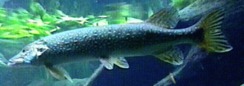
Northern pike average 46 to 51 cm (18-20 inches) in length. They can be identified by their single dorsal fin and light-colored spots along their dark body. They are also recognized by scales that cover their entire cheek and the upper half of their gill covers. Their close relative, the muskellunge (Esox masquinongy), have scales covering only the upper half of their cheek and gill covers. The sides of E. lucius vary from dark shades of green to olive green to brown, with 7 to 9 rows of yellowish, bean-shaped spots. The underside is white to cream-colored.
- Other Physical Features
- ectothermic
- heterothermic
- bilateral symmetry
- Sexual Dimorphism
- sexes alike
-
- Range mass
- 0.5 to 1.4 kg
- 1.10 to 3.08 lb
-
- Range length
- 46 to 51 cm
- 18.11 to 20.08 in
Reproduction
Northern pike are considered random spawners not nest builders.
- Mating System
- polygynandrous (promiscuous)
Spawning occurs in the shallows when the water temperature reaches 4 to 7 degress Celsius (40-45 degrees Fahrenheit). When they are laid, the eggs are vulnerable to predators. The eggs that survive hatch in about 2 weeks. With their insatiable eating habits young E. lucius grow rapidly in both length and weight. Males become sexually mature at 2 to 3 years-old and females at 3 to 4 years-old.
- Key Reproductive Features
- iteroparous
- seasonal breeding
- gonochoric/gonochoristic/dioecious (sexes separate)
- sexual
- fertilization
- oviparous
-
- Breeding season
- Spawning occurs in the spring.
-
- Average time to hatching
- 2 weeks
-
- Range age at sexual or reproductive maturity (female)
- 3 to 4 years
-
- Range age at sexual or reproductive maturity (male)
- 2 to 3 years
Spawning lasts for 5 to 10 days after which the female leaves. Males remain in the spawning area for several weeks, but do not protect the eggs.
- Parental Investment
- no parental involvement
-
pre-fertilization
- provisioning
Lifespan/Longevity
Northern pike can live up to 12 years.
-
- Typical lifespan
Status: wild - 12 (high) years
- Typical lifespan
-
- Average lifespan
Status: captivity - 10.0 years
- Max Planck Institute for Demographic Research
- Average lifespan
-
- Average lifespan
Status: captivity - 6.8 years
- Max Planck Institute for Demographic Research
- Average lifespan
Behavior
Esox lucius are aggressive, solitary fish. They are typically lurkers, but are able to attack quickly. Their eyes are highly movable and are able to see in practically any direction. This is extremely important in tracking their prey. Considerd "sprint predators", E. lucius hide in some type of cover, cocked in an "S" position, ready to strike.
- Key Behaviors
- natatorial
- diurnal
- motile
- sedentary
- solitary
Communication and Perception
Food Habits
Esox lucius are a carnivorous fish. Equipped with sharp teeth and very complex skull and jaw structures they are predators of smaller fish, frogs, crayfish, small mammals and birds.
- Animal Foods
- birds
- mammals
- amphibians
- fish
- aquatic crustaceans
Predation
Northern pike are top predators in the systems they inhabit. However, the eggs, fry, and young of northern pike may be eaten by other predatory fish, aquatic birds, otters, or by the larvae of aquatic insects.
Ecosystem Roles
Northern pike are important as top predators in the aquatic systems where they live.
Economic Importance for Humans: Positive
Esox lucius is a prized game fish throughout its range and is a commercial food fish in eastern Europe.
- Positive Impacts
- food
Economic Importance for Humans: Negative
There are no negative effects of northern pike on humans.
Conservation Status
Esox lucius is not currently threatened by extinction. The Departments of Natural Resources in states where they occur keep a close watch on population levels and can augment populations by stocking streams with Esox lucius raised in hatcheries.
-
- IUCN Red List
-
Least Concern
More information
-
- IUCN Red List
-
Least Concern
More information
-
- US Federal List
- No special status
-
- CITES
- No special status
-
- State of Michigan List
- No special status
Contributors
Courtney Egan (editor).
Ryan Lefevre (author), University of Michigan-Ann Arbor.
Glossary
- Nearctic
-
living in the Nearctic biogeographic province, the northern part of the New World. This includes Greenland, the Canadian Arctic islands, and all of the North American as far south as the highlands of central Mexico.

- Palearctic
-
living in the northern part of the Old World. In otherwords, Europe and Asia and northern Africa.
- bilateral symmetry
-
having body symmetry such that the animal can be divided in one plane into two mirror-image halves. Animals with bilateral symmetry have dorsal and ventral sides, as well as anterior and posterior ends. Synapomorphy of the Bilateria.
- carnivore
-
an animal that mainly eats meat
- chemical
-
uses smells or other chemicals to communicate
- diurnal
-
- active during the day, 2. lasting for one day.
- ectothermic
-
animals which must use heat acquired from the environment and behavioral adaptations to regulate body temperature
- external fertilization
-
fertilization takes place outside the female's body
- fertilization
-
union of egg and spermatozoan
- food
-
A substance that provides both nutrients and energy to a living thing.
- freshwater
-
mainly lives in water that is not salty.
- heterothermic
-
having a body temperature that fluctuates with that of the immediate environment; having no mechanism or a poorly developed mechanism for regulating internal body temperature.
- holarctic
-
a distribution that more or less circles the Arctic, so occurring in both the Nearctic and Palearctic biogeographic regions.
Found in northern North America and northern Europe or Asia.
- iteroparous
-
offspring are produced in more than one group (litters, clutches, etc.) and across multiple seasons (or other periods hospitable to reproduction). Iteroparous animals must, by definition, survive over multiple seasons (or periodic condition changes).
- motile
-
having the capacity to move from one place to another.
- natatorial
-
specialized for swimming
- native range
-
the area in which the animal is naturally found, the region in which it is endemic.
- oviparous
-
reproduction in which eggs are released by the female; development of offspring occurs outside the mother's body.
- piscivore
-
an animal that mainly eats fish
- polygynandrous
-
the kind of polygamy in which a female pairs with several males, each of which also pairs with several different females.
- seasonal breeding
-
breeding is confined to a particular season
- sedentary
-
remains in the same area
- sexual
-
reproduction that includes combining the genetic contribution of two individuals, a male and a female
- solitary
-
lives alone
- tactile
-
uses touch to communicate
- temperate
-
that region of the Earth between 23.5 degrees North and 60 degrees North (between the Tropic of Cancer and the Arctic Circle) and between 23.5 degrees South and 60 degrees South (between the Tropic of Capricorn and the Antarctic Circle).
References
Encyclopedia of Fishing 1994. Dorling Kindersley. New York.
Evawoff, Vlad 1980. The Freshwater Fisherman's Bible. Doubleday and Co.
Klein, Stanley 1983. Encylopedia of North American Wildlife. Facts on File Inc.
Sternberg, Dick 1992. Northern Pike and Muskie. CY DeCrosse Inc.
www.seagrant.wisc.edu/Communications/Publications/Fish/northernpike.html.