Equus hemionuskulan



Geographic Range
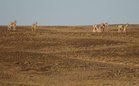
In the late Pleistocene, Equus hemionus flourished as far east as West Germany. Currently, at least one subspecies has been found in Russia, China, Iran, and India. However, the major population (over half the total number) of E. hemionus is found in southern Mongolia. (Feh et al, 2001)
- Biogeographic Regions
- palearctic
- oriental
Habitat
E. hemionus prefers flat country. It primarily grazes and rests on highland or lowland desert, semidesert or steppe. They are never found more than 30 km from a permanent oasis or spring. (Glenn, 1999)
- Habitat Regions
- temperate
- Terrestrial Biomes
- desert or dune
Physical Description
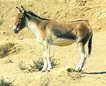
The color of the Asian wild ass varies depending on distribution and season. As a rule, they are reddish brown in the summer and lighten to yellowish brown in the winter. The underneath part of the animals is white or buff. These asses are characterized by a thick black stripe with white edges that runs down the middle of their backs. They also have small feet and short legs. Individuals may be 1-1.4 m tall at the shoulders. (Glenn, 1999)
- Other Physical Features
- endothermic
- bilateral symmetry
-
- Range mass
- 200 to 260 kg
- 440.53 to 572.69 lb
-
- Range length
- 1.98 to 2.44 m
- 6.50 to 8.01 ft
Reproduction
Equus hemionus are monogamous. Stallions tend to stay with the mare and foal year-round. (Feh et al, 2001)
- Mating System
- monogamous
Less than half of the foals born survive through the first year. (Feh et al, 2001)
- Key Reproductive Features
- seasonal breeding
- gonochoric/gonochoristic/dioecious (sexes separate)
- sexual
- fertilization
- viviparous
-
- Breeding season
- April to October
-
- Range number of offspring
- 1 (high)
-
- Average number of offspring
- 0.5
-
- Average number of offspring
- 1
- AnAge
-
- Average gestation period
- 11-12 months
-
- Average gestation period
- 339 days
- AnAge
-
- Average weaning age
- 12-24 months
-
- Average age at sexual or reproductive maturity (female)
- 3-4 years
-
- Average age at sexual or reproductive maturity (female)
Sex: female - 1157 days
- AnAge
- Average age at sexual or reproductive maturity (female)
-
- Average age at sexual or reproductive maturity (male)
- 3-4 years
-
- Average age at sexual or reproductive maturity (male)
Sex: male - 1187 days
- AnAge
- Average age at sexual or reproductive maturity (male)
Other than predator defense by the male, the mare mostly raises the foal. (Feh et al, 2001)
- Parental Investment
- male parental care
- female parental care
Lifespan/Longevity
In captivity, Asian wild asses have lived for 26 years. The oldest found specimen in the wild was 12-14 years old. Most E. hemionus live between four and eight years. A majority of these die between four and six years old, not long after entering sexual maturity. (Feh et al, 2001)
-
- Range lifespan
Status: wild - 14 (high) years
- Range lifespan
-
- Range lifespan
Status: captivity - 26 (high) years
- Range lifespan
-
- Typical lifespan
Status: wild - 4 to 8 years
- Typical lifespan
-
- Average lifespan
Status: captivity - 38.8 years
- Max Planck Institute for Demographic Research
- Average lifespan
Behavior
E. hemionus has been clocked at speeds of up to 43 mph. (Glenn, 1999)
- Key Behaviors
- motile
- territorial
- social
Communication and Perception
Food Habits
The Asian wild ass is strictly herbivorous. They tend to eat perennial grasses (noncotyledons) that are of species of Stipa or Agropyron. They also eat herbs and bark. (Glenn, 1999)
- Plant Foods
- leaves
- wood, bark, or stems
Predation
E. hemionus has a well-developed strategy for anti-predator defense. Stallions from more than one family group cooperate to chase off predators. The frequent occurrence of large groups aids this ability. Wolves are the only known predator of the Asian wild ass other than humans. (Feh et al, 2001)
-
- Known Predators
-
- gray wolves (Canis lupus)
- humans (Homo sapiens)
Economic Importance for Humans: Positive
During the first half of the 1900s, Asian wild asses were hunted for meat and for their coats. (Glenn, 1999)
- Positive Impacts
- food
Economic Importance for Humans: Negative
The protected status of the Asian wild ass has been challenged recently by nomadic herders and other farmers in Mongolia. They believe populations in southern Mongolia are becoming too large. The Asian wild ass competes with domestic grazers for water and food resources. (Reading et al., 2001)
- Negative Impacts
- crop pest
Conservation Status
The Syrian wild ass (E. hemionus hemippus) went extinct in 1927. The subspecies found in southern Mongolia (E. hemionus hemionus) contains several thousand individuals. All of the other subspecies exist in the hundreds. Conservation status varies from subspecies to subspecies. (Reading et al, 2001)
The largest threat to all of the six subspecies is competition with livestock. The species is desired by nomadic livestock herders for harvesting.
-
- IUCN Red List
-
Critically Endangered
More information
-
- IUCN Red List
-
Critically Endangered
More information
-
- US Federal List
- Endangered
-
- CITES
- Appendix I
Other Comments
Substantial competition occurs between wild asses and domestic herds. The habitat of E. hemionus is often restricted from the optimal to the most arid parts of an area by this competition. (Glenn, 1999)
Contributors
Bradley Reuter (author), University of Michigan-Ann Arbor, Bret Weinstein (editor), University of Michigan-Ann Arbor.
Glossary
- Palearctic
-
living in the northern part of the Old World. In otherwords, Europe and Asia and northern Africa.

- bilateral symmetry
-
having body symmetry such that the animal can be divided in one plane into two mirror-image halves. Animals with bilateral symmetry have dorsal and ventral sides, as well as anterior and posterior ends. Synapomorphy of the Bilateria.
- chemical
-
uses smells or other chemicals to communicate
- desert or dunes
-
in deserts low (less than 30 cm per year) and unpredictable rainfall results in landscapes dominated by plants and animals adapted to aridity. Vegetation is typically sparse, though spectacular blooms may occur following rain. Deserts can be cold or warm and daily temperates typically fluctuate. In dune areas vegetation is also sparse and conditions are dry. This is because sand does not hold water well so little is available to plants. In dunes near seas and oceans this is compounded by the influence of salt in the air and soil. Salt limits the ability of plants to take up water through their roots.
- endothermic
-
animals that use metabolically generated heat to regulate body temperature independently of ambient temperature. Endothermy is a synapomorphy of the Mammalia, although it may have arisen in a (now extinct) synapsid ancestor; the fossil record does not distinguish these possibilities. Convergent in birds.
- female parental care
-
parental care is carried out by females
- fertilization
-
union of egg and spermatozoan
- folivore
-
an animal that mainly eats leaves.
- food
-
A substance that provides both nutrients and energy to a living thing.
- herbivore
-
An animal that eats mainly plants or parts of plants.
- internal fertilization
-
fertilization takes place within the female's body
- male parental care
-
parental care is carried out by males
- monogamous
-
Having one mate at a time.
- motile
-
having the capacity to move from one place to another.
- native range
-
the area in which the animal is naturally found, the region in which it is endemic.
- oriental
-
found in the oriental region of the world. In other words, India and southeast Asia.
- seasonal breeding
-
breeding is confined to a particular season
- sexual
-
reproduction that includes combining the genetic contribution of two individuals, a male and a female
- social
-
associates with others of its species; forms social groups.
- tactile
-
uses touch to communicate
- temperate
-
that region of the Earth between 23.5 degrees North and 60 degrees North (between the Tropic of Cancer and the Arctic Circle) and between 23.5 degrees South and 60 degrees South (between the Tropic of Capricorn and the Antarctic Circle).
- territorial
-
defends an area within the home range, occupied by a single animals or group of animals of the same species and held through overt defense, display, or advertisement
- viviparous
-
reproduction in which fertilization and development take place within the female body and the developing embryo derives nourishment from the female.
References
Feh, C., S. Munkhtuya, S. Enkhbold, T. Sukhbaatar. September 2001. Ecology and social structure of the Gobi khulan, Equus hemionus, subsp. in the Gobi B National Park, Mongolia. Biological Conservation, 101 (1): 51-61.
Glenn, C. 7/99. "Earth's Endangered Creatures" (On-line). Accessed October 17, 2001 at http://www.geocities.com/endangeredsp2/MEastM6.html.
Reading, R., H. Mix, B. Lhagvasuren, C. Feh, D. Kane. July 2001. Status and distribution of khulan (Equus hemionus) in Mongolia. Journal of Zoology, 254 (3): 381-389.