Eptatretus stoutiiCalifornia hagfish(Also: Lamperina; Pacific hagfish)
Geographic Range
Eptatretus stoutii (Pacific hagfish) are found in cold marine waters of the antitropical north and south Pacific Ocean on muddy sea floors. (McCrae, 1997)
- Biogeographic Regions
- pacific ocean
Habitat
Pacific hagfish are found typically on muddy bottoms to depths of 633 meters, but can also be found occasionally on rocky bottoms. They are more common at shallower depths, from 40 to 100 meters. Pacific hagfish may make small migrations from shallow waters in the fall into deeper water. Although this is unconfirmed, it is consistent with seasonal migrations in other hagfish. (Fernholm, 1998; McCrae, 1997)
- Habitat Regions
- temperate
- saltwater or marine
- Aquatic Biomes
- benthic
-
- Range depth
- 16 to 633 m
- 52.49 to 2076.77 ft
Physical Description
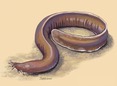
Pacific hagfish resemble lampreys, being long, tubular, and pinkish grey in color. They lack fins, except for a primitive tail fin that proves useless for propulsion. Their eyes are small and reduced, but Pacific hagfish have a good sense of smell and touch. Their mouth contains a ring of short and sensitive tentacles. Hagfish do not have true jaws, but instead have two pair of rasps on the tongue used for pulling and tearing. Large slime glands run the length of their body near the degenerate lateral line. Hagfish have a partial skull and cartilagenous skeleton. They are from 30 to 63.5 cm in length and from 0.8 to 1.4 kg. Females are typically larger than males. (Broadal and Fange, 1963; McCrae, 1997)
- Other Physical Features
- ectothermic
- bilateral symmetry
- Sexual Dimorphism
- female larger
-
- Range mass
- 0.8 to 1.4 kg
- 1.76 to 3.08 lb
-
- Range length
- 30.48 to 63.5 cm
- 12.00 to 25.00 in
Development
Pacific hagfish hatch from an egg in fully functional form without any intermediate larval stage. Determining the sex of Pacific hagfish below 35 cm in length is difficult as a copulatory organ is absent. Despite over a century of searching, only 200 fertilized eggs of Eptatretus stoutii have been found in Monterey Bay, California. (Broadal and Fange, 1963; Fernholm, 1998; Martini, 1998; Patzner, 1998)
Reproduction
Hagfish reproduction is poorly understood, but evidence has been found indicating sequential hermaphroditic periods thought to arise from population pressures. (McCrae, 1997)
Sexes are separate, but hermaphroditic adults can be found. No specific spawning season has been identified as males and females are found at various maturation stages throughout the year. Some females have been found with distinctly separate egg batches in them. Smaller sized egg batches do not develop further until the larger batch has completed development. From 20 to 30 eggs are usually deposited at a time. Eggs have been found at depths of 15 to 25 meters. Age is difficult to determine, as hagfish have a cartilagenous skeleton. (McCrae, 1997)
- Key Reproductive Features
- gonochoric/gonochoristic/dioecious (sexes separate)
- sequential hermaphrodite
- sexual
- oviparous
-
- Breeding interval
- Breeding intervals are unknown, but there is some evidence that individuals breed once yearly.
-
- Breeding season
- There is no evidence of a breeding season.
-
- Range number of offspring
- 20 to 30
Pacific hagfish hatch into fully functional, small hagfish. There is no parental involvement after egg-laying. (McCrae, 1997)
- Parental Investment
-
pre-fertilization
- provisioning
-
protecting
- female
Lifespan/Longevity
Estimated life span of Pacific hagfish in the wild is 40 years, and 17 years in captivity. (Finch, 1990; King and McFarlane, 2003)
-
- Typical lifespan
Status: wild - 40 (high) years
- Typical lifespan
-
- Typical lifespan
Status: captivity - 17 (high) years
- Typical lifespan
Behavior
One of the most distinguishing behaviors of hagfish is the ability to produce large amounts of mucilaginous slime almost instantaneously. The slime is secreted as a defense mechanism from pores that line the sides of the body. Upon contact with seawater, the slime rapidly expands into a sticky gel that can sometimes suffocate an attacker. Hagfish also have the ability to tie a knot in their body, and slide in and out of the knot. This can be used to elude predators, to bury into a carcass, to gain leverage to tear off pieces of flesh, or clean itself of slime. (Broadal and Fange, 1963; Schewe, et al., 2003)
- Key Behaviors
- natatorial
- motile
- colonial
Communication and Perception
A system of sensory organs resembling taste buds, called Schreiner organs, are found throughout the epidermis. The distribution of these organs is more extensive than taste buds in nearly any vertebrate, giving hagfish the ability to sense prey in dark and muddy habitats. This sensory system has no direct homologue in vertebrates and seems specific to hagfish. Hagfish also have well-developed nasal organs used in olfaction. (Braun, 1998; McCrae, 1997)
- Perception Channels
- chemical
Food Habits
Pacific hagfish have two pair of primitive, yet effective, rasps on the tongue used primarily for grasping. After establishing a firm hold on a food source, the hagfish ties and unties a knot within its own body to generate a ripping force. Pacific hagfish feed on a variety of dead or dying organisms, including fish and mammals, but also probably include marine invertebrates in their diet. Male hagfish may eat hagfish eggs. (Broadal and Fange, 1963; Fernholm, 1998; McCrae, 1997)
- Animal Foods
- mammals
- fish
- eggs
- carrion
- aquatic or marine worms
- other marine invertebrates
Predation
Pacific hagfish produce large amounts of mucilaginous slime, and can tie and untie knots in their body to evade predators. The primary predators of Pacific hagfish are harbor seals (Phoca vitulina) and humans. They have also been found in the stomachs of sablefish (Anoplopoma fimbria). (Fernholm, 1998)
-
- Known Predators
-
- harbor seals (Phoca vitulina)
- humans (Homo sapiens)
- sablefish (Anoplopoma fimbria)
Ecosystem Roles
Pacific hagfish are crucial for eliminating dead and dying organsims, and the effect of large-scale removal on the ecosystem could be significant as hagfish are important for recycling nutrients. (Broadal and Fange, 1963; McCrae, 1997)
- Ecosystem Impact
- biodegradation
- parasite
Economic Importance for Humans: Positive
In Korea, approximately 5 million pounds of Pacific hagfish meat is consumed yearly, and in many countries the skin is commonly processed into "eelskin" accessories such as purses, wallets, and boots. Hagfish are sometimes found in public aquariums, and their very low metabolic rate is of specific research interest. (Barnaby, et al., 1995; Fernholm, 1998)
- Positive Impacts
- food
- body parts are source of valuable material
- research and education
Economic Importance for Humans: Negative
There are no negative impacts of Pacific hagfish on humans.
Conservation Status
Pacific hagfish remain common throughout their range.
-
- IUCN Red List
-
No special status
More information
-
- IUCN Red List
-
No special status
More information
-
- US Federal List
- No special status
-
- CITES
- No special status
Other Comments
Pacific hagfish are a member of one of the most primitive craniate groups. Pacific hagfish have changed little over the past 330 million years, and closely resemble the first craniates. The evolutionary path leading to Homo sapiens probably diverged from hagfish approximately 530 million years ago. Hagfish can go several months without eating. One adult Pacific hagfish can fill a seven-liter bucket with slime in minutes. (Broadal and Fange, 1963; Fernholm, 1998; Martini, 1998; McCrae, 1997)
Contributors
Tanya Dewey (editor), Animal Diversity Web.
Brett Schroeder (author), University of Michigan-Ann Arbor, Kevin Wehrly (editor, instructor), University of Michigan-Ann Arbor.
Glossary
- Pacific Ocean
-
body of water between the southern ocean (above 60 degrees south latitude), Australia, Asia, and the western hemisphere. This is the world's largest ocean, covering about 28% of the world's surface.

- benthic
-
Referring to an animal that lives on or near the bottom of a body of water. Also an aquatic biome consisting of the ocean bottom below the pelagic and coastal zones. Bottom habitats in the very deepest oceans (below 9000 m) are sometimes referred to as the abyssal zone. see also oceanic vent.
- bilateral symmetry
-
having body symmetry such that the animal can be divided in one plane into two mirror-image halves. Animals with bilateral symmetry have dorsal and ventral sides, as well as anterior and posterior ends. Synapomorphy of the Bilateria.
- biodegradation
-
helps break down and decompose dead plants and/or animals
- carnivore
-
an animal that mainly eats meat
- carrion
-
flesh of dead animals.
- chemical
-
uses smells or other chemicals to communicate
- colonial
-
used loosely to describe any group of organisms living together or in close proximity to each other - for example nesting shorebirds that live in large colonies. More specifically refers to a group of organisms in which members act as specialized subunits (a continuous, modular society) - as in clonal organisms.
- ectothermic
-
animals which must use heat acquired from the environment and behavioral adaptations to regulate body temperature
- food
-
A substance that provides both nutrients and energy to a living thing.
- motile
-
having the capacity to move from one place to another.
- natatorial
-
specialized for swimming
- native range
-
the area in which the animal is naturally found, the region in which it is endemic.
- oviparous
-
reproduction in which eggs are released by the female; development of offspring occurs outside the mother's body.
- parasite
-
an organism that obtains nutrients from other organisms in a harmful way that doesn't cause immediate death
- saltwater or marine
-
mainly lives in oceans, seas, or other bodies of salt water.
- scavenger
-
an animal that mainly eats dead animals
- sexual
-
reproduction that includes combining the genetic contribution of two individuals, a male and a female
- temperate
-
that region of the Earth between 23.5 degrees North and 60 degrees North (between the Tropic of Cancer and the Arctic Circle) and between 23.5 degrees South and 60 degrees South (between the Tropic of Capricorn and the Antarctic Circle).
References
Barnaby, R., G. Nardi, K. Cho, J. Goldman. 1995. "Trade Barriers Lifted on Hagfish Exports to Korea Earnings of Developing New England Fishery Expected to Double" (On-line). Sea Grant News Media Center. Accessed October 15, 2005 at http://www.seagrantnews.org/news/hagfish.html.
Braun, C. 1998. Schreiner Organs: A new Craniate Chemosensory Modality in Hagfishes. J Comp Neurol., March 9;392(2): 135-163.
Broadal, A., R. Fange. 1963. The Biology of Myxine. Oslo: Grondahl & Son. Accessed October 15, 2005 at http://oceanlink.island.net/oinfo/hagfish/hagfish.html.
Fernholm, B. 1998. The Biology of Hagfishes. London: Chapman & Hall.
Finch, C. 1990. Longevity, Senescence, and the Genome. Chicago: University of Chicago Press.
King, J., G. McFarlane. 2003. Marine Fish Life History Strategies: Applications to Fishery Management. Fisheries Management & Ecology, 10: 249-264.
Martini, F. 1998. Secrets of the Slime Hag. Scientific American, October: 70-75.
McCrae, J. 1997. "Pacific Hagfish" (On-line). Oregon Developmental Species. Accessed October 15, 2005 at http://hmsc.oregonstate.edu/odfw/devfish/sp/hagfish.html.
Patzner, R. 1998. Gonads and Reproduction in Hagfishes. London: Chapman & Hall. Accessed October 15, 2005 at http://www.fishbase.org/References/FBRefSummary.cfm?ID=51361.
Schewe, P., B. Stein, J. Riordon. 2003. "A Close Look at Hagfish Slime" (On-line). Accessed October 17, 2005 at http://www.aip.org/pnu/2003/660.html.