Enoplosus armatusOld wife(Also: Zebra-tail)
Geographic Range
Enoplosus armatus is found from Indonesia to Southern Australia (Robins 1991).
- Biogeographic Regions
- australian
Habitat
Juvenile Enoplosus armatus live in sea grass beds. As they mature, they migrate to coastal waters. They are mainly found in rocky reefs and wharves (Marshall 1964).
Physical Description
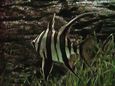
The body of Enoplosus armatus is deep and compressed, approximately 230 mm in length. The body is silver with black vertical lines of varying width. There are two separate dorsal fins. The middle spines and the anterior rays of the dorsal fins are much larger than the remaining spines and rays. In total, E. armatus has 9 dorsal spines and 14-15 dorsal rays (Fishbase 2000). The dorsal spines are poisonous to humans (Robins 1991). There are 2 sharp spines on the lower angle of the preoperculum. The iris of the eye is bright yellow (Scott 1962).
- Other Physical Features
- bilateral symmetry
Reproduction
The reproduction of Enoplosus armatus has not been well studied. They spawn in June, July, and August (Fishbase 2000). At this time they leave their schools and form closely associated pairs. They produce pelagic eggs. These are eggs that are lighter than water and therefore float and drift in the water column (Thresher 1984).
Behavior
Generally, Enoplosus armatus lives in large schools, but can also be found as solitary individuals (Fishbase 2000). They break off from these schools to mate in solitary pairs (Thresher 1984).
- Key Behaviors
- natatorial
- motile
Communication and Perception
Food Habits
Enoplosus armatus is a carnivorous species. Not much is known about their general feeding habits. They have been seen eating small crustaceans (Stead 1906).
Economic Importance for Humans: Positive
Enoplosus armatus has a small financial value as a food source. The value of E. armatus in the aquarium market is small but growing (Animal World 2000).
Economic Importance for Humans: Negative
Enoplosus armatus has no known negative financial effect on humans.
Conservation Status
Enoplosus armatus is not currently threatened by humans.
-
- IUCN Red List
- No special status
-
- US Federal List
- No special status
-
- CITES
- No special status
Other Comments
Not much is known about Enoplosus armatus. This is due to the fact that it is hard to catch and therefore hard to study. They rarely take bait and nets seldom catch them because the stay in the protection of rocky shores (Marshall 1964).
Enoplosus armatus was given its common name, Old Wife, by the sailors who were able to catch it. Enoplosus armatus grinds its teeth together when it is caught. The sailors said that it sounded like the grumbling of an "Old Wife" and so they named it accordingly (Animal World 2000).
Contributors
William Fink (editor), University of Michigan-Ann Arbor.
Allison Sapsford (author), University of Michigan-Ann Arbor.
Glossary
- Australian
-
Living in Australia, New Zealand, Tasmania, New Guinea and associated islands.

- bilateral symmetry
-
having body symmetry such that the animal can be divided in one plane into two mirror-image halves. Animals with bilateral symmetry have dorsal and ventral sides, as well as anterior and posterior ends. Synapomorphy of the Bilateria.
- chemical
-
uses smells or other chemicals to communicate
- coastal
-
the nearshore aquatic habitats near a coast, or shoreline.
- motile
-
having the capacity to move from one place to another.
- natatorial
-
specialized for swimming
- native range
-
the area in which the animal is naturally found, the region in which it is endemic.
- reef
-
structure produced by the calcium carbonate skeletons of coral polyps (Class Anthozoa). Coral reefs are found in warm, shallow oceans with low nutrient availability. They form the basis for rich communities of other invertebrates, plants, fish, and protists. The polyps live only on the reef surface. Because they depend on symbiotic photosynthetic algae, zooxanthellae, they cannot live where light does not penetrate.
- tactile
-
uses touch to communicate
References
Animal World, 2000. "Miscellaneous Marine Fish" (On-line). Accessed Oct. 29, 2000 at http://www.AnimalAtlas.com/encyclo/marine/misc/misc.htm.
Fishbase, 2000. "Species Summary for Enoplosus armatus" (On-line). Accessed Oct. 29, 2000 at http://www.fishbase.org/Summary/SpeciesSummary.cfm?genusname=Enoplosus&speciesname=armatus.
Marshall, T. 1964. Fishes of the Great Barrier Reef and Coastal Waters of Queensland. Sydney: Angus and Robertson.
Robins, C., R. Baily, C. Bond, J. Brooker, E. Lachner. 1991. World fishes important to North Americans. American Fisheries Society Special Publication, 21: 243.
Scott, T. 1962. The Marine and Freshwater Fishes of South Australia. Adelaide: W.L. Hawes, Government Printer.
Stead, D. 1906. Fishes of Australia. Sydney: William Brooks and Co. Limited.
Thresher, R. 1984. Reproduction in Reef Fishes. Neptune City, New Jersey: T.F.H. Publications, Inc. Ltd..