Emys orbicularisEuropean Pond turtle
Geographic Range
Emys orbicularis, commonly known as European pond turtles, is found in southern and central Europe, northwestern Africa (roughly Morocco through to Tunisia), and in humid areas of the Middle East and Central Asia as far east as the Aral Sea. Historically the species was more common and had a wider distribution than it does today. (Gadow, 1958; Harless and Morlock, 1979)
- Biogeographic Regions
- palearctic
Habitat
This species lives in freshwater areas, including ponds, lakes, slow-moving streams and other lentic regions. They select terrestrial locations with open, high, and sandy soil habitats for nesting. These turtles search for habitats in shallow, fertile areas with adequate food supplies and minimal predators. (Bodie, 2001; Gadow, 1958)
- Habitat Regions
- temperate
- terrestrial
- freshwater
- Aquatic Biomes
- lakes and ponds
- rivers and streams
- Wetlands
- swamp
- Other Habitat Features
- riparian
Physical Description
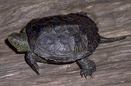
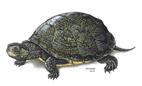
Extensively variable coloration is seen within this generally small species, however there is usually some light speckling on a dark (often black) background color. The shape and coloration of the shell changes with age. Young E. orbicularis have a rounded shell, and the shields are rough and slightly keeled, uniformly dark brown above and black below, with a yellow spot on each marginal and plastral shield along the rim of the carapace. As they age, the dorsal shields become smooth and are generally spotted or striated with yellow markings on a dark background. The head, limbs, and tail are dark with yellow or light brown spots and small dots. Shell size ranges from 12 to 38 cm (5 to 15 in.) and they have 12 pairs of marginal shields. The head is covered with smooth skin and the limbs are extensively webbed. Emys orbicularis has a flexible hinged plastron that is loosely united to the carapace by ligaments. Males of this species mature earlier and generally remain smaller than females, but they have similar growth rates. (Feldman and Parham, 2002; Gadow, 1958; Harless and Morlock, 1979)
- Other Physical Features
- ectothermic
- heterothermic
- bilateral symmetry
- Sexual Dimorphism
- female larger
-
- Range length
- 12 to 38 cm
- 4.72 to 14.96 in
Development
Embryos of E. orbicularis exhibit temperature-dependent sex determination, based on egg incubation temperature and hormonal factors that cause gonadal differentiation. During the thermosensitive period of incubation, eggs at temperatures below 25 degrees C will become male embryos, while eggs at temperatures above 30 degrees C will become female embryos. Posthatchling growth includes body elongation and development of a streamlined body structure. The tails of young are nearly as long as the shell, but become shorter with age. Specimens about 5 inches in length are considered fully developed adults. Males of this species mature earlier and generally remain smaller than females, but they have similar growth rates. Growth is responsive to and limited by ecological factors, including hatchling size, food availability, genetic factors, and quality of their habitats. Alterations of diet and prolonged activity affect growth rate. Growth rate decreases as size increases and slows considerably following sexual maturity. (Belaid, et al., 2001; Gans, 1985; Harless and Morlock, 1979)
- Development - Life Cycle
- temperature sex determination
Reproduction
Once a pair-bond is formed, courtship and copulation follow. Mating may occur in sandy areas if not hidden within foliage. Most males and females cohabitate peacefully, but some adults are more aggressive toward each other. (Gans, 1985)
After reaching sexual maturity at age 5 to 6 years, adult Emys orbicularis mate and the female produces approximately eight to ten white, hard-shelled, elongate eggs per clutch, averaging 15 to 25 mm in length, which are laid on land. The pregnant female selects a suitable spot of hard soil free from grass and other dense vegetation and prepares and moistens the ground. Then the female uses her stiff tail to bore a hole into the ground approximately five inches deep. The hind-limbs dig out the hole, and the eggs are laid at the bottom in one layer, and are divided and distributed by the feet. The female covers the hole with the removed soil, stamps the soil firm and flat, and abandons the nest. After approximately 90 to 100 days of incubation, the young hatch according to locality and seasonal conditions. Some embryos hibernate within the egg overwinter and do not hatch until the following spring when conditions are more favorable. These turtles mate repeatedly and may produce multiple clutches per year. (Gadow, 1958; Gans, 1985; Harless and Morlock, 1979)
- Key Reproductive Features
- iteroparous
- seasonal breeding
- gonochoric/gonochoristic/dioecious (sexes separate)
- sexual
- oviparous
-
- Breeding season
- spring to early summer
Males in this species make no parental investement, and female investment in her offspring ends when she lays her eggs and covers her nest.
- Parental Investment
-
pre-fertilization
- provisioning
-
protecting
- female
-
pre-hatching/birth
-
provisioning
- female
-
protecting
- female
-
provisioning
Lifespan/Longevity
Compared to many other reptiles and amphibians, this species has a relatively long lifespan. Individuals living in northern populations tend to exhibit longer lifespans than those in more southern locations. Records have shown average Emys orbicularis turtles living fifteen years or longer and adults may potentially live for decades. Mortality is very high for hatchlings due to abundant predators and lack of protection from the elements. Captive individuals may live several years longer than those living in natural populations. The age of turtles can be determined by counting the annuli growth rings on the scutes of the shell. It is assumed that only one growth ring forms annually.
-
- Average lifespan
Status: captivity - 27.9 years
- Max Planck Institute for Demographic Research
- Average lifespan
-
- Average lifespan
Sex: male
Status: captivity - 11.7 years
- Max Planck Institute for Demographic Research
- Average lifespan
Behavior
During the day, these turtles bask with their bodies stretched out for long periods of time upon stones or banks lying motionless. From underwater, they survey the area and prey with just the nose and eyes emerged above the surface, or conceal themselves behind or within floating vegetation. They hibernate during the cold season buried in the mud and do not reappear until late spring.
Studies have shown male dominance hierarchies, particularly during breeding seasons. They may also exhibit territoriality and agonistic behaviors during food competition. Their behavioral movements include head extension, bobbing, biting, and similar activities. They have been known to assume dominant and subordinate postures. In captivity they become very tame, but in their native habitats they are extremely shy and cautious.
Adults exhibit pair-bonding and live in small groups. Their activities and behaviors are altered by changes in season and environmental conditions. For example, feeding decreases with decreased temperatures. Generally, this species performs regional migration, emigration, and active foraging. They can remain below water for many hours before returning to the surface. (Gadow, 1958; Gans, 1985; Harless and Morlock, 1979)
- Key Behaviors
- terricolous
- natatorial
- diurnal
- motile
- migratory
- hibernation
- territorial
- social
- dominance hierarchies
Communication and Perception
During the mating season members of this species emit short piping sounds. Other possible vocalizations include whistles, chirps, and groans, which are often used in stressful situations. Head movements are also used to communicate. Auditory stimuli may be involved in mating rituals. (Gadow, 1958; Harless and Morlock, 1979)
Food Habits
Emys orbicularis is a generalsit carnivore diet. Most small aquatic animals are prey, and their diet may shift as they grow and can eat larger animals. Worms, insects, frogs, and fishes comprise their main sources of sustenance and they generally feed in water. These turtles attack and capture their prey, biting with a sideward turn of the head, then tearing the prey to pieces with sharp claws on the forelimbs. Generally, in the wild, their prey must be moving to be seized. In captivity, these turtles may resort to eating fruits and vegetables. (Gadow, 1958)
- Primary Diet
-
carnivore
- piscivore
- insectivore
- eats non-insect arthropods
- Animal Foods
- amphibians
- fish
- insects
- mollusks
- aquatic or marine worms
Predation
Hinges in the plastron allow these turtles to withdraw into the shell and close off shell openings as protection from predators. Hatchlings and eggs are preyed upon by various animals including: herons, raccoons, bears, king snakes, ghost crabs, hermit crabs, dogs, gulls, alligators, crocodiles, foxes, rats, cats, and cormorants. Young turtles are at risk of becoming prey to predacious fish species as well. Adult E. orbicularis are subject to attack by wild dogs, coyotes, carnivorous birds, and humans. (Gadow, 1958; Gans, 1985; Harless and Morlock, 1979)
-
- Known Predators
-
- herons (Ardeidae)
- raccoons (Procyon lotor)
- bears (Ursus)
- king snakes (Lampropeltis)
- domestic dogs (Canis lupus familiaris)
- gulls (Laridae)
- foxes (Canidae)
- rats (Rattus)
- cats (Felis)
- cormorants (Phalacrocoracidae)
- fish (Actinopterygii)
- coyotes (Canis latrans)
- birds (Aves)
- humans (Homo sapiens)
- alligators (Alligatorinae)
- crocodiles (Crocodylidae)
- crabs (Decapoda)
Ecosystem Roles
Emys orbicularis serves a significant role in the food web of freshwater habitats. They prey upon worms, insects, frogs, and fishes, and are in turn preyed upon by other reptiles, fish, predatory birds, and large mammals. (Gadow, 1958)
Economic Importance for Humans: Positive
Freshwater turtles, including Emys orbicularis, are hunted as sources of food, used for medicinal applications, and kept as pets. (Bodie, 2001)
- Positive Impacts
- pet trade
- food
- source of medicine or drug
- research and education
- controls pest population
Economic Importance for Humans: Negative
Emys orbicularis is generally harmless and does not normally have extensive contact with humans
(Gadow 1958).
Conservation Status
Populations of Emys orbicularis have been declining over the past century. Their geographic range has diminished and it will most likely continue to decrease duet to habitat destruction. Several solutions may be successful in replenishing these populations. Governmental and ecological organizations will need to regulate turtle hunters and egg collectors, protect habitats, and reduce destructive factors, including pollution and siltation. (Bodie, 2001; Harless and Morlock, 1979)
-
- IUCN Red List
-
Lower Risk - Near Threatened
More information
-
- IUCN Red List
-
Lower Risk - Near Threatened
More information
-
- US Federal List
- No special status
-
- CITES
- No special status
Other Comments
Emys orbicularis is the only species in this genus. E. orbicularis was previously named Testudo orbicularis and Testudo europaea. This is the only species in the Emydidae to reach geographic ranges above 45 degrees latitude. (Feldman and Parham, 2002; Harless and Morlock, 1979)
Contributors
Matthew Wund (editor), University of Michigan-Ann Arbor.
Aryn Bereznay (author), Western Maryland College, Randall L. Morrison (editor), Western Maryland College.
Glossary
- Palearctic
-
living in the northern part of the Old World. In otherwords, Europe and Asia and northern Africa.

- acoustic
-
uses sound to communicate
- bilateral symmetry
-
having body symmetry such that the animal can be divided in one plane into two mirror-image halves. Animals with bilateral symmetry have dorsal and ventral sides, as well as anterior and posterior ends. Synapomorphy of the Bilateria.
- carnivore
-
an animal that mainly eats meat
- chemical
-
uses smells or other chemicals to communicate
- diurnal
-
- active during the day, 2. lasting for one day.
- dominance hierarchies
-
ranking system or pecking order among members of a long-term social group, where dominance status affects access to resources or mates
- drug
-
a substance used for the diagnosis, cure, mitigation, treatment, or prevention of disease
- ectothermic
-
animals which must use heat acquired from the environment and behavioral adaptations to regulate body temperature
- food
-
A substance that provides both nutrients and energy to a living thing.
- freshwater
-
mainly lives in water that is not salty.
- heterothermic
-
having a body temperature that fluctuates with that of the immediate environment; having no mechanism or a poorly developed mechanism for regulating internal body temperature.
- hibernation
-
the state that some animals enter during winter in which normal physiological processes are significantly reduced, thus lowering the animal's energy requirements. The act or condition of passing winter in a torpid or resting state, typically involving the abandonment of homoiothermy in mammals.
- insectivore
-
An animal that eats mainly insects or spiders.
- iteroparous
-
offspring are produced in more than one group (litters, clutches, etc.) and across multiple seasons (or other periods hospitable to reproduction). Iteroparous animals must, by definition, survive over multiple seasons (or periodic condition changes).
- migratory
-
makes seasonal movements between breeding and wintering grounds
- motile
-
having the capacity to move from one place to another.
- natatorial
-
specialized for swimming
- native range
-
the area in which the animal is naturally found, the region in which it is endemic.
- oviparous
-
reproduction in which eggs are released by the female; development of offspring occurs outside the mother's body.
- pet trade
-
the business of buying and selling animals for people to keep in their homes as pets.
- piscivore
-
an animal that mainly eats fish
- riparian
-
Referring to something living or located adjacent to a waterbody (usually, but not always, a river or stream).
- seasonal breeding
-
breeding is confined to a particular season
- sexual
-
reproduction that includes combining the genetic contribution of two individuals, a male and a female
- social
-
associates with others of its species; forms social groups.
- swamp
-
a wetland area that may be permanently or intermittently covered in water, often dominated by woody vegetation.
- tactile
-
uses touch to communicate
- temperate
-
that region of the Earth between 23.5 degrees North and 60 degrees North (between the Tropic of Cancer and the Arctic Circle) and between 23.5 degrees South and 60 degrees South (between the Tropic of Capricorn and the Antarctic Circle).
- terrestrial
-
Living on the ground.
- territorial
-
defends an area within the home range, occupied by a single animals or group of animals of the same species and held through overt defense, display, or advertisement
- visual
-
uses sight to communicate
References
Belaid, B., N. Richard-Mercier, C. Pieau, M. Dorizzi. 2001. Sex reversal and aromatase in the European Pond Turtle: treatment with letrozole after the thermosensitive period for sex determination. J. Experimental Zoology,, 290: 490-7.
Bodie, J. 2001. Steam and riparian management for freshwater turtles. J. Env. Management, 62: 443-55.
Feldman, C., J. Parham. 2002. Molecular phylogenetics of emydine turtles: taxonomic revision and the evolution of shell kinesis. Molecular Phylogenetics and Evolution,, 22: 388-98.
Gadow, H. 1958. Amphibia and Reptiles. England: Wheldon & Wesley, Ltd..
Gans, C. 1985. Biology of the Reptilia: Vol. 14. New York: John Wiley & Sons.
Harless, M., H. Morlock. 1979. Turtles: Perspectives and Research. New York: John Wiley & Sons.