Emys marmorataWestern Pond Turtle, Pacific Pond Turtle

Geographic Range
Western pond turtles (also known as Pacific pond turtles and Pacific mud turtles) are native to the west coast and are found from Baja California, Mexico north through Klickitat County, Washington. Within this region, there are two subspecies: northwestern pond turtles (E. m. marmorata) are found in areas north of the American River in California; southwestern pond turtles (E. m. pallida) are found in areas south of San Francisco. There are isolated inland populations in Washington, Oregon, California, Nevada and Idaho. It has been suggested that some of these isolated populations represent introductions through human transport, although there is no clear evidence for this. ("WESTERN POND TURTLE (Clemmys marmorata). Natural History.", 1997; "Western Pond Turtle: Clemmys marmorata", 1999; Bettelheim, 2006; "Western Pond Turtle (Clemmys Marmorata)", 2004)
Habitat
Western pond turtles use both aquatic and terrestrial habitats. They are found in rivers, lakes, streams, ponds, wetlands, vernal pools, ephemeral creeks, reservoirs, agricultural ditches, estuaries, and brackish waters. Western pond turtles prefer areas that provide cover from predators, such as vegetation and algae, as well as basking sites for thermoregulation. Such cover also provides shelter when wintering. Western pond turtles are observed in aquatic habitats ranging from 1 to 40 degrees Celsius. Juveniles are found primarily in areas between 12 and 33 degrees Celsius, whereas adults are found between 10 and 17 degrees Celsius. Adults tend to favor deeper, slow moving water, whereas hatchlings search for slow and shallow water that is slightly warmer. Terrestrial habitats are used for wintering and consist usually of burrows in leaves and soil. Western pond turtles also lay their eggs in terrestrial habitats.They are rarely found at altitudes above 1500m. ("Western Pond Turtle (Clemmys Marmorata)", 2005; "WESTERN POND TURTLE (Clemmys marmorata). Natural History.", 1997; "Western Pond Turtle: Clemmys marmorata", 1999; Bettelheim, 2006; Gray, 1995; "Western Pond Turtle (Clemmys Marmorata)", 2004; Reese and Welsh, 1997; Reese and Welsh, 1998)
- Habitat Regions
- temperate
- terrestrial
- freshwater
- Aquatic Biomes
- lakes and ponds
- rivers and streams
- brackish water
- Other Habitat Features
- suburban
- agricultural
- riparian
- estuarine
-
- Range elevation
- 0 to 1980 m
- 0.00 to 6496.06 ft
-
- Range depth
- 1 to 5 m
- 3.28 to 16.40 ft
Physical Description
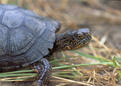
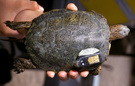
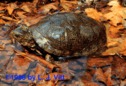
Western pond turtles are generally yellowish with dark blotches in the center of the plastron. There is marbled patterning throughout the body. The dorsal area is generally dark brown to olive. The shell tends to be low, wide, and smooth. Adult males have a larger head, pointier snout, thicker tail base, and a wider neck characterized by white and yellow on the chin and throat. Adult females tend to have a blunt snout, thinner tail base, and darker markings on the chin and throat. Western pond turtles have webbed feet. Hatchlings tend to have a longer tail, soft shell, and be a lighter brown; darkening as they age. They weigh approximately 5g at hatching and measure around 28 mm in shell length. The southern subspecies tends to grown only to 115 mm in shell length, northern subspecies reach 210 mm in shell length. ("Exposure Factors for Western Pond Turtle (Clemmys marmorata)", 1999; "WESTERN POND TURTLE (Clemmys marmorata). Natural History.", 1997; Bettelheim, 2006; Gray, 1995; "Western Pond Turtle (Clemmys Marmorata)", 2004)
- Other Physical Features
- ectothermic
- heterothermic
- bilateral symmetry
- Sexual Dimorphism
- female larger
- sexes colored or patterned differently
- sexes shaped differently
-
- Range mass
- 623.7 to 935.55 g
- 21.98 to 32.97 oz
-
- Range length
- 110 to 210 mm
- 4.33 to 8.27 in
-
- Average basal metabolic rate
- Unknown cm3.O2/g/hr
Development
Females deposit eggs in a nest they dig on land at night. After incubation, hatchlings leave the egg only if the temperature is below 81 degrees Fahrenheit. Hatchlings tends to be male if the incubation temperature was below 86 degrees Fahrenheit or female if the incubation temperature was above 86 degrees Fahrenheit). Hatchlings immediately return to the water and grow at a rate of 3.29 mm/month, .08 mm/month, .05 mm/month, and .04 mm/month during successive growth seasons. Growth is accompanied by darkening of the body and hardening of the shell. After about 8 years of growth, the rate slows as the turtles mature into adults. Growth rate depends on environmental factors such as water, temperature, and food abundance. Colder water and less food slows growth. ("WESTERN POND TURTLE (Clemmys marmorata). Natural History.", 1997; "Western Pond Turtle: Clemmys marmorata", 1999)
- Development - Life Cycle
- temperature sex determination
Reproduction
Western pond turtle males court females using their forelimbs to scratch the anterior edge the female’s carapace. This is followed by the female raising her posterior end, after which mating occurs. Due to the seclusive nature of these animals there is not much known about the mating process. ("WESTERN POND TURTLE (Clemmys marmorata). Natural History.", 1997; "Western Pond Turtle: Clemmys marmorata", 1999)
- Mating System
- polygynandrous (promiscuous)
Western pond turtles mate from May through August, with most females laying eggs in alternating years. Although the average age of maturity is between 8 and 14 years of age, females in the southern subspecies occasionally reach maturity at an earlier age. Nests are built up to 402 m from the water with an average distance of 28 m and require at least 10 cm of soil. Hatching success rates are approximately 70%, as there is a high rate of nest predation and complete nest failure. Nests are generally found in flat areas with low vegetation and dry, hard soil. Incubation takes approximately 3 months, with most hatchlings staying in the nest chamber until the following spring. Some hatchlings in southern and central California emerge in the fall. ("Exposure Factors for Western Pond Turtle (Clemmys marmorata)", 1999; "Western Pond Turtle (Clemmys Marmorata)", 2005; "WESTERN POND TURTLE (Clemmys marmorata). Natural History.", 1997; Gray, 1995; "Western Pond Turtle (Clemmys Marmorata)", 2004)
- Key Reproductive Features
- iteroparous
- seasonal breeding
- gonochoric/gonochoristic/dioecious (sexes separate)
- sexual
- oviparous
-
- Breeding interval
- Western pond turtle females breed in alternating years.
-
- Breeding season
- The breeding season takes place from May through August.
-
- Range number of offspring
- 1 to 13
-
- Average number of offspring
- 6
-
- Range gestation period
- 80 to 100 days
-
- Range age at sexual or reproductive maturity (female)
- 8 to 14 years
-
- Range age at sexual or reproductive maturity (male)
- 8 to 14 years
After the eggs are laid, there is no evidence of parental care. ("Western Pond Turtle (Clemmys Marmorata)", 2005; "WESTERN POND TURTLE (Clemmys marmorata). Natural History.", 1997; "Western Pond Turtle: Clemmys marmorata", 1999)
- Parental Investment
- no parental involvement
-
pre-fertilization
- provisioning
-
protecting
- female
-
pre-hatching/birth
-
provisioning
- female
-
provisioning
Lifespan/Longevity
As hatchlings, western pond turtles are easy prey and have a survival rate of 8 to 12%. Adults can live 40 to 70 years or even longer. As adults the average survival rate increases to around 45%. In adults there is a 4:1 male to female ratio, which is probably a reflection of the prolonged amount of time females are exposed to terrestrial predators while laying eggs. ("WESTERN POND TURTLE (Clemmys marmorata). Natural History.", 1997; "Western Pond Turtle: Clemmys marmorata", 1999; Gray, 1995)
-
- Range lifespan
Status: wild - 80 (high) years
- Range lifespan
-
- Typical lifespan
Status: wild - 40 to 70 years
- Typical lifespan
-
- Average lifespan
Status: wild - 50 years
- Average lifespan
Behavior
Western pond turtles are not generally territorial although aggressive encounters including ramming, biting, and threatening with open-mouth gestures are common over basking areas. They tend to hunt late in the day and bask intermittently in order to maintain an average body temperature of 28 degrees Celsius. The maximum body temperature is 40 degrees Celsius, although they usually avoid going over 34 degrees Celsius. This species is most active in water that reaches 15 degrees Celsius. Although primarily associated with an aquatic environment, these turtles also spend significant amounts of time in terrestrial habits, primarily during overwintering and moving between aquatic areas. They move between overwintering sites as well, usually 4 times. ("Western Pond Turtle (Clemmys Marmorata)", 2005; "WESTERN POND TURTLE (Clemmys marmorata). Natural History.", 1997; "Western Pond Turtle: Clemmys marmorata", 1999; Reese and Welsh, 1997)
- Key Behaviors
- terricolous
- natatorial
- diurnal
- motile
- sedentary
- hibernation
- solitary
-
- Range territory size
- 2833 to 10117 m^2
Home Range
Male western pond turtle home ranges average 1 hectare, or around 200 to 5623 square meters. Female home ranges average only 0.3 hectares or up to 2100 square meters. Juveniles have home ranges up to 3175 square meters or around 0.4 hectares. ("Exposure Factors for Western Pond Turtle (Clemmys marmorata)", 1999; "Western Pond Turtle (Clemmys Marmorata)", 2005; "Western Pond Turtle: Clemmys marmorata", 1999)
Communication and Perception
Western pond turtles find food using both sight and smell. Moreover, based on the mating ritual it is clear that touch is important in communication among sexes. ("WESTERN POND TURTLE (Clemmys marmorata). Natural History.", 1997; Bettelheim, 2006)
- Communication Channels
- tactile
Food Habits
Western pond turtles are omnivores. Animal prey includes crustaceans, midges, fish, dragonflies, beetles, stoneflies, grasshoppers, and caddisflies. They will eat carrion as well. The plant portion of their diet consists primarily of willow (Salix) and alder catkins (Alnus), tule grass (Scripus), ditch grasses (Ruppiaceae), pond lily inflorescences, and green filamentous algae. They have been observed using a "gape-and-suck" form of taking in small invertebrates in the water column. Males tend to eat more insects and vertebrates and females eat more algae and other plant material. ("Western Pond Turtle (Clemmys Marmorata)", 2005; "WESTERN POND TURTLE (Clemmys marmorata). Natural History.", 1997; "Western Pond Turtle: Clemmys marmorata", 1999; Bettelheim, 2006)
- Primary Diet
- omnivore
- Animal Foods
- amphibians
- fish
- carrion
- insects
- aquatic crustaceans
- other marine invertebrates
- Plant Foods
- flowers
- algae
Predation
Their primary anti-predator adaptation is their thick carapace and wariness. At hatching, young turtles are both small enough and soft enough to make easy prey, so achieving adult size best protects these turtles from predation. ("WESTERN POND TURTLE (Clemmys marmorata). Natural History.", 1997; Bettelheim, 2006)
-
- Known Predators
-
- raccoons (Procyon lotor)
- coyotes (Canis latrans)
- domestic dogs (Canis lupus familiaris)
- black bears (Ursus americanus)
- river otters (Lontra canadensis)
- mink (Neovison vison)
- bullfrog (Lithobates catesbeianus)
- California mountain kingsnakes (Lampropeltis zonata)
- common kingsnakes (Lampropeltis getula)
- gopher snakes (Pituophis melanoleucus)
- yellow-bellied racers (Coluber constrictor)
- largemouth bass (Micropterus salmoides)
- spotted skunks (Spilogale putorius)
- Virginia opossums (Didelphis virginiana)
- red foxes (Vulpes vulpes)
- grey fox (Urocyon cinereoargenteus)
- common ravens (Corvus corax)
- American crows (Corvus brachyrhynchos)
Ecosystem Roles
Western pond turtles are prey for numerous species and predators of other, smaller species. These turtles act as hosts for several parasitic organisms. ("WESTERN POND TURTLE (Clemmys marmorata). Natural History.", 1997; Ingles, 1930; Reese and Welsh, 1998)
Economic Importance for Humans: Positive
There is no current documented economic benefit of western pond turtles. From the 1800s to the 1930s these turtles were sold for human consumption and collected for pet trade. This kind of trade is largely illegal today, although poaching may still occur. ("WESTERN POND TURTLE (Clemmys marmorata). Natural History.", 1997)
Economic Importance for Humans: Negative
There are no adverse effects of western pond turtles on humans.
Conservation Status
Current threats to western pond turtles are numerous and include fire, flooding, drought, upper respiratory disease, habitat destruction, and lack of genetic variation. The lack of variation is due to the isolation of individual populations over ranges to large to be covered by migration. Habitat destruction is the result of intense urbanization. Additionally humans pose a great threat via off-road vehicles, chemical spills, and incidental catch by fishermen. Lack of research has prevented western pond turtles from being added to the federal endangered species list. ("Western Pond Turtle (Clemmys Marmorata)", 2005; "Western Pond Turtle: Clemmys marmorata", 1999; Bettelheim, 2006; "Western Pond Turtle (Clemmys Marmorata)", 2004)
Although recommended for the federal endangered species list, western pond turtles are currently only recognized as state species of special concern by the California Department of Fish and Game (CDFG). Western pond turtles have been extirpated for nearly 20 years in British Columbia, are listed as endangered in Washington, and as sensitive with critical standing in Oregon. ("WESTERN POND TURTLE (Clemmys marmorata). Natural History.", 1997; Gray, 1995)
-
- IUCN Red List
-
Vulnerable
More information
-
- IUCN Red List
-
Vulnerable
More information
-
- US Federal List
- No special status
-
- CITES
- No special status
-
- State of Michigan List
- No special status
Other Comments
Western pond turtles are currently recognized as Emys marmorata, previously they were recognized as Clemmys marmorata. ("Western Pond Turtle (Clemmys Marmorata)", 2005)
Contributors
Tanya Dewey (editor), Animal Diversity Web.
Joshua Nachman (author), University of Maryland, Baltimore County, Kevin Omland (editor, instructor), University of Maryland, Baltimore County.
Glossary
- Nearctic
-
living in the Nearctic biogeographic province, the northern part of the New World. This includes Greenland, the Canadian Arctic islands, and all of the North American as far south as the highlands of central Mexico.

- agricultural
-
living in landscapes dominated by human agriculture.
- bilateral symmetry
-
having body symmetry such that the animal can be divided in one plane into two mirror-image halves. Animals with bilateral symmetry have dorsal and ventral sides, as well as anterior and posterior ends. Synapomorphy of the Bilateria.
- brackish water
-
areas with salty water, usually in coastal marshes and estuaries.
- carrion
-
flesh of dead animals.
- chemical
-
uses smells or other chemicals to communicate
- diurnal
-
- active during the day, 2. lasting for one day.
- ectothermic
-
animals which must use heat acquired from the environment and behavioral adaptations to regulate body temperature
- estuarine
-
an area where a freshwater river meets the ocean and tidal influences result in fluctuations in salinity.
- food
-
A substance that provides both nutrients and energy to a living thing.
- freshwater
-
mainly lives in water that is not salty.
- heterothermic
-
having a body temperature that fluctuates with that of the immediate environment; having no mechanism or a poorly developed mechanism for regulating internal body temperature.
- hibernation
-
the state that some animals enter during winter in which normal physiological processes are significantly reduced, thus lowering the animal's energy requirements. The act or condition of passing winter in a torpid or resting state, typically involving the abandonment of homoiothermy in mammals.
- iteroparous
-
offspring are produced in more than one group (litters, clutches, etc.) and across multiple seasons (or other periods hospitable to reproduction). Iteroparous animals must, by definition, survive over multiple seasons (or periodic condition changes).
- marsh
-
marshes are wetland areas often dominated by grasses and reeds.
- motile
-
having the capacity to move from one place to another.
- natatorial
-
specialized for swimming
- native range
-
the area in which the animal is naturally found, the region in which it is endemic.
- omnivore
-
an animal that mainly eats all kinds of things, including plants and animals
- oviparous
-
reproduction in which eggs are released by the female; development of offspring occurs outside the mother's body.
- pet trade
-
the business of buying and selling animals for people to keep in their homes as pets.
- polygynandrous
-
the kind of polygamy in which a female pairs with several males, each of which also pairs with several different females.
- riparian
-
Referring to something living or located adjacent to a waterbody (usually, but not always, a river or stream).
- seasonal breeding
-
breeding is confined to a particular season
- sedentary
-
remains in the same area
- sexual
-
reproduction that includes combining the genetic contribution of two individuals, a male and a female
- solitary
-
lives alone
- suburban
-
living in residential areas on the outskirts of large cities or towns.
- swamp
-
a wetland area that may be permanently or intermittently covered in water, often dominated by woody vegetation.
- tactile
-
uses touch to communicate
- temperate
-
that region of the Earth between 23.5 degrees North and 60 degrees North (between the Tropic of Cancer and the Arctic Circle) and between 23.5 degrees South and 60 degrees South (between the Tropic of Capricorn and the Antarctic Circle).
- terrestrial
-
Living on the ground.
- visual
-
uses sight to communicate
References
Office of Environmental Health Hazard Assesment. Exposure Factors for Western Pond Turtle (Clemmys marmorata). California: The California Wildlife Biology, Exposure Factor, and Toxicity Database (Cal/Ecotox). 1999. Accessed April 22, 2008 at http://www.oehha.ca.gov/cal_ecotox/report/clemmef.pdf.
USDA Forest Service. WESTERN POND TURTLE (Clemmys marmorata). Natural History.. Redwood Sciences Laboratory: Pacific Southwest Research Station. 1997. Accessed April 20, 2008 at http://www.krisweb.com/biblio/gen_usfs_ashtonetal_1997_turtle.pdf.
East Contra Costa County HCP/NCCP. Western Pond Turtle (Clemmys Marmorata). California: 2005. Accessed April 20, 2008 at http://www.cocohcp.org/hcp_nccp_content/hcp_nccp/app_figs/App%20D%20components/APP_D-10a_Western_pond_turtle_1-18-05.pdf..
Herpetology Northwest. 2004. "Western Pond Turtle (Clemmys Marmorata)" (On-line). Herpetology Northwest. Accessed April 20, 2008 at http://www.herpetologynorthwest.org/nwherps/turtles/western-pond-turtle.html.
U.S. Department Of The Interior. Western Pond Turtle: Clemmys marmorata. California: Bureau Of Land Management. 1999. Accessed April 22, 2008 at http://www.blm.gov/ca/pdfs/cdd_pdfs/clemmys1.PDF.
Bettelheim, M. 2006. "Western Pond Turtle Natural History" (On-line). Atlantis Magazine: Rediscovering Our Lost World. Accessed April 20, 2008 at http://www.atlantismagazine.com/bettelheim/pondturtle.html.
Gray, E. 1995. DNA Fingerprinting Reveals a Lack of Genetic Variation in Northern Populations of the Western Pond Turtle (Clemmys marmorata). Conservation Biology, Vol. 9, No. 5: 1244-1254. Accessed April 20, 2008 at http://www.jstor.org/stable/view/2387062?seq=2.
Ingles, L. 1930. A New Species of Telorchis from the Intestine of Clemmys marmorata. The Journal of Parasitology, Vol. 17, No. 2: 101-103.
Reese, D., H. Welsh. 1998. Comparative Demography of Clemmys marmorata Populations in the Trinity River of California in the Context of Dam-induced Alterations. Journal Of Herpetology, Vol. 32, No. 4: 505-515. Accessed April 20, 2008 at http://www.fs.fed.us/psw/rsl/projects/wild/reese/reese1x.PDF.
Reese, D., H. Welsh. 1998. Habitat use by western pond turtles in the Trinity River, California. Journal of Wildlife Management, Vol. 62/3: 842-853. Accessed April 20, 2008 at http://www.treesearch.fs.fed.us/pubs/3654.
Reese, D., H. Welsh. 1997. Use of terrestrial habitat by western pond turtles (Clemmys marmorata): implications for management. Proceedings: Conservation, Restoration, and Management of Turtles and Tortoises. An International Conference. New York Turtle and Tortoise Society.: 352-357. Accessed April 20, 2008 at http://www.treesearch.fs.fed.us/pubs/3652.