Elephantulus brachyrhynchusshort-snouted elephant-shrew(Also: short-snouted sengi)
Geographic Range
Short-snouted elephant shrews are limited to Africa, occupying areas south of the Sahara from Kenya and southern Zaire to the Transvaal and northeastern Namibia (Nowak, 1991).
Habitat
Short-snouted elephant shrews are found in arid and semi-arid environments. They prefer wooded bushlands and densely covered areas such as dense grasslands and scrub (Smithers, 1983).
- Terrestrial Biomes
- savanna or grassland
Physical Description
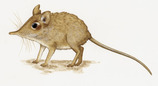
Short-snouted elephant shrews have the long, narrow snout, characteristic of all members of the family Macroscelididae, however the snout is shorter and it tapers slightly (Nowak, 1991). Average body length is 21 cm and tail length is approximately the same. Short-snouted elephant shrews vary in color depending on geographic location. They range from reddish-yellow to yellowish-brown or grey. All short-snouted elephant shrews have a faint white ring around the eyes. Short-snouted elephant shrews have soft fur and lack hair on the soles of their hind feet (Smithers, 1983).
- Other Physical Features
- endothermic
- bilateral symmetry
-
- Range mass
- 40 to 60 g
- 1.41 to 2.11 oz
-
- Average basal metabolic rate
- 0.244 W
- AnAge
Reproduction
The gestation period is between 57 and 65 days. Young weigh approximately 10g at birth and reach adult size by 50 days (Nowak, 1991). On average, two young are produced per litter and are precocial, which means they are fully haired and are born with their eyes open (Smithers, 1983). Short-snouted elephant shrews are monogamous. Reproduction occurs throughout the year although conceptions decrease during cool periods. Females are able to produce between 5 and 6 litters a year, resulting in an average of 8 young per year (Neal, 1995).
- Key Reproductive Features
- gonochoric/gonochoristic/dioecious (sexes separate)
- sexual
-
- Average number of offspring
- 1.8
- AnAge
Behavior
Short-snouted elephant shrews are diurnal and most active during the morning. They are primarily solitary but sometimes are observed in pairs. They are a fast-moving species, like most elephant shrews, and are observed scurrying from place to place, avoiding areas with no cover (Smithers, 1983). Short-snouted elephant shrews sometimes dig their own burrow but often they occupy rodent burrows (Nowak, 1991). Short-snouted elephant shrews are highly territorial. They spend less time on the ground surface than other macroscelid species (Neal, 1995).
- Key Behaviors
- motile
Communication and Perception
Food Habits
The short-snouted elephant shrew is primarily insectivorous, eating ants and termites (Smithers, 1983). They are, however, opportunistic feeders and eat small amounts of green plant material, fruits, and seeds (Leirs et al., 1995).
Conservation Status
-
- IUCN Red List
-
Least Concern
More information
-
- IUCN Red List
-
Least Concern
More information
-
- US Federal List
- No special status
-
- CITES
- No special status
Other Comments
Elephant shrews can produce an acoustic sound or signal by tapping their hind feet. This activity is called footdruming and is often a response to a stressful situation, such as encounters with a predator, or associated with mating. Each species has its own pattern or signal of footdrumming. Short-snouted elephant shrews have a regular and irregular "drum" pattern (Faurie et al.,1996).
Contributors
Elizabeth Gill (author), University of Michigan-Ann Arbor, Phil Myers (editor), Museum of Zoology, University of Michigan-Ann Arbor.
Glossary
- Ethiopian
-
living in sub-Saharan Africa (south of 30 degrees north) and Madagascar.

- bilateral symmetry
-
having body symmetry such that the animal can be divided in one plane into two mirror-image halves. Animals with bilateral symmetry have dorsal and ventral sides, as well as anterior and posterior ends. Synapomorphy of the Bilateria.
- chemical
-
uses smells or other chemicals to communicate
- endothermic
-
animals that use metabolically generated heat to regulate body temperature independently of ambient temperature. Endothermy is a synapomorphy of the Mammalia, although it may have arisen in a (now extinct) synapsid ancestor; the fossil record does not distinguish these possibilities. Convergent in birds.
- motile
-
having the capacity to move from one place to another.
- native range
-
the area in which the animal is naturally found, the region in which it is endemic.
- sexual
-
reproduction that includes combining the genetic contribution of two individuals, a male and a female
- tactile
-
uses touch to communicate
- tropical savanna and grassland
-
A terrestrial biome. Savannas are grasslands with scattered individual trees that do not form a closed canopy. Extensive savannas are found in parts of subtropical and tropical Africa and South America, and in Australia.
- savanna
-
A grassland with scattered trees or scattered clumps of trees, a type of community intermediate between grassland and forest. See also Tropical savanna and grassland biome.
- temperate grassland
-
A terrestrial biome found in temperate latitudes (>23.5° N or S latitude). Vegetation is made up mostly of grasses, the height and species diversity of which depend largely on the amount of moisture available. Fire and grazing are important in the long-term maintenance of grasslands.
References
Faurie, A., E. Dempster, M. Perrin. 1996. Footdrumming patterns of southern African elephant-shrews. Mammalia, volume 60, n4: 567-576.
Leirs, H., R. Verhagen, W. Verhagen, M. Perrin. 1995. The Biology of Elephantulus brachyrhynchus. Mammal Review, Volume 25, Nos 1 and 2: 45-49.
Neal, B. 1995. The ecology and reproduction of the Short-snouted Elephant-Shrew, Elephantulus brachyrhynchus, in Zimbabwe with a review of the reproductive ecology of the genus Elephantulus. Mammal Review, Volume 25, Nos 1 and 2: 51-60.
Nowak, R. 1991. Walker's Mammals of the World Fifth Edition Volume 1. Baltimore and London: John Hopkins University Press.
Smithers, R. 1983. The Mammals of the Southern African Subregion. University of Pretoria: Pretoria, Republic of South Africa.