Elanoides forficatusswallow-tailed kite

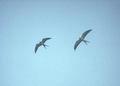
Geographic Range
Elanoides forficatus, otherwise known as the American swallow-tailed kite, is found primarily in the southeastern United States, from Louisiana to South Carolina. Most of the known population is centered in the southern tip of Florida. In the winter E. forficatus migrates to South America. (Dunne, 1995; Farrand, Jr., 1988)
- Biogeographic Regions
- nearctic
- neotropical
Habitat
Swallow-tailed kites occupy wooded swamps, open forests, lake shores, and freshwater marshes. They nest near sources of water in tall trees, anywhere from 18 to 40 meters above the ground. (Ehrlich, et al., 1988; National Geographic Society, 2002; Weidensaul, 2004; Wetmore, 1965)
- Habitat Regions
- temperate
- tropical
- terrestrial
- Terrestrial Biomes
- forest
- Aquatic Biomes
- coastal
- Other Habitat Features
- riparian
-
- Range elevation
- 0 (low) m
- 0.00 (low) ft
Physical Description
The most notable feature of E. forficatus is the deeply forked swallow-like tail, which distinguishes this kite species from its relatives, Mississippi kites and white-tailed kites. The structure of the tail enables this kite to fly well at low speeds. The wings are long and thin, enabling flight at high speeds as well. (Dunne, 1995; Farrand, Jr., 1988)
Swallow-tailed kites are monomorphic. Adults have black wings with white undersides, white heads, necks, and underparts. The tail and upperparts are iridescent black, with streaks of green, purple, and bronze. Juveniles look similar to adults but with slightly streaked heads and underparts, as well as shorter white-tipped tails. (Dunne, 1995; Farrand, Jr., 1988; Hausman, 1948)
Swallow-tailed kites have a body length ranging from 49 to 65 cm. Wingspan is from 114 to 127 cm. The average weight of maled is 441 g and the average weight of females is 423 g, although females may be slightly larger in size. (Hausman, 1948; National Geographic Society, 2002; Weidensaul, 2004; Hausman, 1948; National Geographic Society, 2002; Weidensaul, 2004)
- Other Physical Features
- endothermic
- homoiothermic
- bilateral symmetry
- Sexual Dimorphism
- sexes alike
- female larger
-
- Range mass
- 423 to 441 g
- 14.91 to 15.54 oz
-
- Range length
- 49 to 65 cm
- 19.29 to 25.59 in
-
- Average length
- 58 cm
- 22.83 in
-
- Range wingspan
- 114 to 127 cm
- 44.88 to 50.00 in
-
- Average wingspan
- 122 cm
- 48.03 in
Reproduction
Swallow-tailed kites are monogamous, although pair bonds are not necessarily maintained between breeding seasons. Females and males will approach each other on a horizontal tree limb. The female will quickly go under the limb or turn, bending forward with the wings extended. The male lands on her back and drapes his wings over the female, then mating occurs. There is also courtship feeding. (Ehrlich, et al., 1988; Johnsgard, 1990; National Audubon Society, 2001)
- Mating System
- monogamous
Swallow-tailed kites breed once per year, usually in April. They produce loud shrills, squealing calls, and whistles during the mating season. Females usually lay two eggs per clutch. The eggs are incubated for approximately 28 days, and the fledgling period lasts anywhere from 36 to 42 days. Fledglings can take an additional 2 weeks or more to become independent. (Johnsgard, 1990; National Audubon Society, 2001; Wetmore, 1965)
- Key Reproductive Features
- iteroparous
- seasonal breeding
- gonochoric/gonochoristic/dioecious (sexes separate)
- sexual
- oviparous
-
- Breeding interval
- Swallow-tailed kites breed once yearly.
-
- Breeding season
- The breeding season is short and usually occurs in the month of April.
-
- Range eggs per season
- 3 (high)
-
- Average eggs per season
- 2
-
- Average time to hatching
- 28 days
-
- Range fledging age
- 36 to 42 days
-
- Range time to independence
- 50 (low) days
Not much is known about the degree of parental investment in swallow-tailed kites. Both parents incubate the eggs. When one parent comes in to sit on the eggs, the other flies straight up from the nest. The incoming parent hovers over the nest, and then gently settles down. Young are altricial. In their close relatives males bring back food while females watch the young and protect the nest. Towards the end of the nesting period both parents will hunt. After fledging the adults continue to provide food for their young. (National Audubon Society, 2001; Wetmore, 1965)
- Parental Investment
- altricial
-
pre-fertilization
- provisioning
-
protecting
- female
-
pre-hatching/birth
-
provisioning
- female
-
protecting
- male
- female
-
provisioning
-
pre-weaning/fledging
-
provisioning
- male
- female
-
protecting
- male
- female
-
provisioning
-
pre-independence
-
provisioning
- male
- female
-
provisioning
Lifespan/Longevity
There is no specific information available on the lifespan of E. forficatus, but the lifespan of one white-tailed kite was recorded to be nearly 6 years. (Clapp, et al., 1982; National Audubon Society, 2001)
Behavior
Swallow-tailed kites can be solitary or social birds. Often they nest in close range to one another and large pre-migration gatherings have been noted in areas with abundant food sources. Swallow-tailed kites are also known to hunt in small groups. (DeWitt, 1989; Weidensaul, 2004; Wetmore, 1965)
Home Range
Although the home range size of E. forficatus is not known, the home range of a close relative, black-shouldered kites, is approximately 2 square kilometers. (Johnsgard, 1990; Johnsgard, 1990)
Communication and Perception
Swallow-tailed kites communicate primarily through cries, short, weak, high-pitched whistles, and twitters, usually while hunting or during mating season. They also use visual displays, including postures associated with courtship and mating. Like other raptors, swallow-tailed kites, primarily use vision to hunt for food. (Wetmore, 1965)
Food Habits
Swallow-tailed kites are primarily insectivorous, snatching and feeding on flying insects in mid-air, but they are also known to capture other prey, such as snakes, frogs, and nestlings and fledglings. They do not hover and usually eat prey in mid-flight. They also drink in flight in a fashion similar to swallows, by skimming the water. (Farrand, Jr., 1988; National Geographic Society, 2002)
- Primary Diet
-
carnivore
- eats terrestrial vertebrates
- insectivore
- Animal Foods
- birds
- amphibians
- reptiles
- insects
Predation
Little is known about predators of swallow-tailed kites, but fledglings are often preyed on by owls, especially great horned owls (Bubo virginianus). (Dunne, 1995)
-
- Known Predators
-
- great horned owls (Bubo virginianus)
Ecosystem Roles
There is little known about the role of wallow-tailed kites in their native ecosystem, although it can be surmised that they help control insect populations.
Economic Importance for Humans: Positive
Swallow-tailed kites contribute to control of insect populations in habitats they occupy. They are also lovely birds that attract ecotourism. (Hausman, 1948)
- Positive Impacts
- ecotourism
- controls pest population
Economic Importance for Humans: Negative
There are no known adverse effects of E. forficatus on humans.
Conservation Status
Elanoides forficatus has not been classified as a threatened species. Before 1980, these birds were found as far as the northern Midwest, but due to logging, draining of swamps, and shooting, populations dwindled and are now found only in the southern U.S., mainly in Florida and tropical habitats during the winter. They are protected by the U.S. Migratory Bird Act.
-
- IUCN Red List
-
Least Concern
More information
-
- IUCN Red List
-
Least Concern
More information
-
- US Migratory Bird Act
- Protected
-
- US Federal List
- No special status
-
- CITES
- No special status
-
- State of Michigan List
- No special status
Other Comments
Swallow-tailed kites are also known as forked-tailed kites, swallow hawks, wasp hawks, and snake hawks. (Hausman, 1948; Wetmore, 1965)
Contributors
Tanya Dewey (editor), Animal Diversity Web.
Jansi Maganti (author), Kalamazoo College, Ann Fraser (editor, instructor), Kalamazoo College.
Glossary
- Nearctic
-
living in the Nearctic biogeographic province, the northern part of the New World. This includes Greenland, the Canadian Arctic islands, and all of the North American as far south as the highlands of central Mexico.

- Neotropical
-
living in the southern part of the New World. In other words, Central and South America.
- acoustic
-
uses sound to communicate
- altricial
-
young are born in a relatively underdeveloped state; they are unable to feed or care for themselves or locomote independently for a period of time after birth/hatching. In birds, naked and helpless after hatching.
- arboreal
-
Referring to an animal that lives in trees; tree-climbing.
- bilateral symmetry
-
having body symmetry such that the animal can be divided in one plane into two mirror-image halves. Animals with bilateral symmetry have dorsal and ventral sides, as well as anterior and posterior ends. Synapomorphy of the Bilateria.
- carnivore
-
an animal that mainly eats meat
- chemical
-
uses smells or other chemicals to communicate
- coastal
-
the nearshore aquatic habitats near a coast, or shoreline.
- colonial
-
used loosely to describe any group of organisms living together or in close proximity to each other - for example nesting shorebirds that live in large colonies. More specifically refers to a group of organisms in which members act as specialized subunits (a continuous, modular society) - as in clonal organisms.
- diurnal
-
- active during the day, 2. lasting for one day.
- ecotourism
-
humans benefit economically by promoting tourism that focuses on the appreciation of natural areas or animals. Ecotourism implies that there are existing programs that profit from the appreciation of natural areas or animals.
- endothermic
-
animals that use metabolically generated heat to regulate body temperature independently of ambient temperature. Endothermy is a synapomorphy of the Mammalia, although it may have arisen in a (now extinct) synapsid ancestor; the fossil record does not distinguish these possibilities. Convergent in birds.
- forest
-
forest biomes are dominated by trees, otherwise forest biomes can vary widely in amount of precipitation and seasonality.
- insectivore
-
An animal that eats mainly insects or spiders.
- iteroparous
-
offspring are produced in more than one group (litters, clutches, etc.) and across multiple seasons (or other periods hospitable to reproduction). Iteroparous animals must, by definition, survive over multiple seasons (or periodic condition changes).
- marsh
-
marshes are wetland areas often dominated by grasses and reeds.
- migratory
-
makes seasonal movements between breeding and wintering grounds
- monogamous
-
Having one mate at a time.
- motile
-
having the capacity to move from one place to another.
- native range
-
the area in which the animal is naturally found, the region in which it is endemic.
- oviparous
-
reproduction in which eggs are released by the female; development of offspring occurs outside the mother's body.
- riparian
-
Referring to something living or located adjacent to a waterbody (usually, but not always, a river or stream).
- seasonal breeding
-
breeding is confined to a particular season
- sexual
-
reproduction that includes combining the genetic contribution of two individuals, a male and a female
- social
-
associates with others of its species; forms social groups.
- solitary
-
lives alone
- swamp
-
a wetland area that may be permanently or intermittently covered in water, often dominated by woody vegetation.
- tactile
-
uses touch to communicate
- temperate
-
that region of the Earth between 23.5 degrees North and 60 degrees North (between the Tropic of Cancer and the Arctic Circle) and between 23.5 degrees South and 60 degrees South (between the Tropic of Capricorn and the Antarctic Circle).
- terrestrial
-
Living on the ground.
- tropical
-
the region of the earth that surrounds the equator, from 23.5 degrees north to 23.5 degrees south.
- visual
-
uses sight to communicate
References
Clapp, R., M. Klimkiewicz, J. Kennard. 1982. Longevity records of North American birds: Gaviidae through Alcidae. J. Field Ornithol, 53(2): 81-208. Accessed January 15, 2007 at http://elibrary.unm.edu/sora/JFO/v053n02/index.php.
DeWitt, L. 1989. Eagles, Hawks, and Other Birds of Prey. New York: Franklin Watts.
Dunne, P. 1995. The Wind Masters: The Lives of North American Birds of Prey. Boston: Houghton Mifflin Co.
Ehrlich, P., D. Dobkin, D. Wheye. 1988. The Birder's Handbook: A Field Guide to the Natural History of North American Birds. New York: Simon and Schuster Inc..
Farrand, Jr., J. 1988. An Audubon Handbook: Eastern Birds. New York: Chanticleer Press, Inc.
Hausman, L. 1948. Birds of Prey of Northeastern America. New Brunswick, NJ: Rutgers University Press.
Johnsgard, P. 1990. Hawks, Eagles, and Falcons of North America. Washington, D.C.: Smithsonian Institution Press.
National Audubon Society, 2001. The Sibley Guide to Bird Life and Behavior. New York: Alfred A. Knopf, Inc.
National Geographic Society, 2002. Field Guide to the Birds of North America (4th ed.). Washington, DC: Library of Congress.
Weidensaul, S. 2004. The Raptor Almanac. Guilford, CT: The Lyons Press.
Wetmore, A. 1965. Water, Prey, and Game Birds of North America. Chicago: R.R. Donnelley and Sons Co.