Echimyidaespiny rats
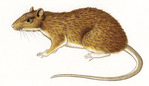

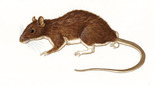


This family, with 78 species in around 20 genera (including a few probably-extinct West Indian species), is the most diverse of the South American hystricognath rodents. This is certainly true in terms of number of species, and may be true in terms of the ecological range of the family as well. Echimyids are found in tropical regions of Central and South America.
Spiny rats are medium sized rodents, but they are relatively small compared to most other South American hystricognaths. They range in head-body length from around 80 to almost 500 mm. Their bodies are mostly rat-like, usually with pointed noses (but blunt and squirrel-like in some genera), medium-sized eyes and ears, and a tail that varies from less than half the length of the body to considerably longer than the body. The tail, however, frequently breaks off and is lost, even in wild animals. The forefeet have 4 functional digits, and the hindfeet 5. The length of the toes and claws varies according to the animal's habits; Dactylomys, for example, which climbs by grasping bamboo stalks, has long digits and primate-like feet, while Clyomys, a burrower, has broader feet and better-developed claws.
Echimyids earn their common name because most species have spiny or bristly hairs at least on their backs and rumps. These vary from well-developed spines in some genera (e.g., Hoplomys) to broadened and stiffened guard hairs (e.g., Proechimys) to soft fur with no hint of spines at all (e.g., Thrichomys). The color of the fur also varies greatly among species; Thrichomys, for example is gray above and whitish below; Proechimys tend to be rufous brown above and white below; and members of some genera, such as Echimys and Isothrix, have white or white and black patterns on the head or body.
The crania of echimyids have moderately large auditory bullae and relatively small paroccipital process that are in most species in close contact with the bullae. The zygomatic arches are delicate in all but the fossorial Euryzygomatomys and the jugal does not reach the lacrimal . The arrangement of masseters and infraorbital is hystricomorphous, as it is in all South American hystricognaths. The mandible is lightly built with delicate coronoid and angular processes.


The dental formula of members of this family is 1/1, 0/0, 1/1, 3/3 = 20. The cheekteeth of echimyids are flatcrowned, rooted, and usually brachydont. Their occlusal surface has a pattern of re-entrant folds that range from 2-4 on the labial side of the tooth and 1 on the lingual side. In some species, for example Dactylomys, the teeth are highly prismatic, probably related to their habit of feeding on abrasive bamboo leaves.

Echimyids occupy an amazing variety of habitats. Some are fully arboreal, probably never descending from the treetops. Others spend their lives on the forest floor, nesting in shallow burrows and probably rarely or never climbing. Yet others are fossorial, building and occupying complex burrow systems. Their food habits are similarly varied, ranging from browsing on bamboo and other leaves to consuming fruit, hard nuts, and insects.
Most species are solitary, but at least Clyomys is colonial. Dactylomys produces loud calls often heard at night; Proechimys (probably the best-studied genus) also is known to be rather vocal.
Echimyids are divided into several subfamilies, including the Echimyinae, Dactylomyinae, Chaetomyinae, and Heteropsomyinae. Echimyines include the majority of species in the family. The dactylomyines are three genera that apparently specialize on living in and feeding on bamboo. Chaetomys was until recently thought to be a member of the porcupine family; it is densely covered with bristles, and it has a considerably larger body than other members of the family. The West Indian Heteropsomyinae are all extinct. They are known from Recent fossils and probably survived until the arrival of Europeans.
References and literature cited
Feldhamer, G. A., L. C. Drickamer, S. H. Vessey, and J. F. Merritt. 1999. Mammalogy. Adaptation, Diversity, and Ecology. WCB McGraw-Hill, Boston. xii+563pp.
Macdonald, David. 1984. The encyclopedia of mammals. Facts on File Publications, New York.
Nowak, Ronald M. and John L. Paradiso. 1983. Walker's mammals of the world. The Johns Hopkins University Press, Baltimore and London, pp 803-810.
Vaughan, T. A. 1986. Mammalogy. Third Edition. Saunders College Publishing, Fort Worth. vii+576 pp.
Vaughan, T. A., J. M. Ryan, N. J. Czaplewski. 2000. Mammalogy. Fourth Edition. Saunders College Publishing, Philadelphia. vii+565pp.
Wilson, Don E. and DeeAnn M. Reeder (eds.). 1993. Mammal species of the world: A taxonomic and geographic reference, 2nd ed.. Smithsonian Institution Press, Washington and London.
Woods, C. A. 1984. Hystricognath rodents. Pp. 389-446 in Anderson, Sydney and J. Know Jones, Jr. (eds.). Orders and familes of mammals of the world. John Wiley and Sons, New York.
Contributors
Phil Myers (author), Museum of Zoology, University of Michigan-Ann Arbor.
Glossary
- bilateral symmetry
-
having body symmetry such that the animal can be divided in one plane into two mirror-image halves. Animals with bilateral symmetry have dorsal and ventral sides, as well as anterior and posterior ends. Synapomorphy of the Bilateria.
- chemical
-
uses smells or other chemicals to communicate
- endothermic
-
animals that use metabolically generated heat to regulate body temperature independently of ambient temperature. Endothermy is a synapomorphy of the Mammalia, although it may have arisen in a (now extinct) synapsid ancestor; the fossil record does not distinguish these possibilities. Convergent in birds.
- motile
-
having the capacity to move from one place to another.
- sexual
-
reproduction that includes combining the genetic contribution of two individuals, a male and a female
- tactile
-
uses touch to communicate