Donax variabilis


Geographic Range
The coquina clam, Donax variabilis, ranges from the eastern coast of the United States, from New York to the Caribbean, and across the Gulf of Mexico and into Texas. (Ruppert and Fox, 1988)
- Biogeographic Regions
- nearctic
- atlantic ocean
Habitat
Coquina clams are commonly found at sandy beach fronts in the intertidal zone, where the tides ebb and flow. Some can also be found in knee-deep waters. (Delancey, 1999)
- Habitat Regions
- saltwater or marine
- Aquatic Biomes
- coastal
- Other Habitat Features
- intertidal or littoral
Physical Description
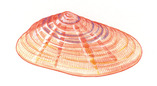
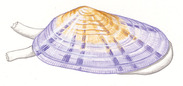
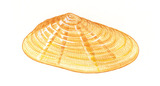
Coquinas have small, long, triangular-shaped shells, ranging from 15 to 25 mm in length. These shells contain very colorful bands, with a range of colors anywhere from red to violet. (Miner, 1950)
- Other Physical Features
- ectothermic
- heterothermic
- bilateral symmetry
- Sexual Dimorphism
- sexes alike
-
- Range length
- 15 to 25 mm
- 0.59 to 0.98 in
Development
Coquina clams undergo indirect development, first from a trochophore larva to a veliger larva. The veliger larva uses its ciliated velum for swimming and feeding on plankton. Eventually, the veliger will settle to the seafloor, where it undergoes metamorphosis to the adult stage. ("Bivalves", 2007)
- Development - Life Cycle
- metamorphosis
Reproduction
Coquinas typically live in close proximity of each other, sometimes in colonies. They release their gametes when gravid and their close proximity with each other heightens the chances of fertilization. ("Coquina Clam", 2009)
Coquina clams are dioecious (male and female) broadcast spawners. Eggs and sperm are released synchronously into the water for external fertilization. ("Coquina Clam", 2011)
- Key Reproductive Features
- gonochoric/gonochoristic/dioecious (sexes separate)
- sexual
- fertilization
- broadcast (group) spawning
- oviparous
-
- Breeding interval
- Gametes are released when gravid
There is no form of parental care. Fertilization occurs externally and larvae are left to feed and swim independently. ("Bivalves", 2007)
- Parental Investment
- no parental involvement
Lifespan/Longevity
Coquinas typically live between 1 to 2 years in the wild but can only live up to 3 days in the absence of moving water. Lack of water deprives the coquina of nutrients obtained through filter feeding. ("Coquina Clam", 2011)
-
- Typical lifespan
Status: wild - 2 (high) years
- Typical lifespan
Behavior
Coquinas are active animals, found migrating up and down beaches with the assistance of waves. They use their muscular foot to burrow into the sand as waves recede down the beach to prevent being swept away. They are also known to use the waves in order to move up the beach and are capable of moving horizontally along the beach. (Delancey, 1999; Ellers, 1995; Turner, Jr. and Belding, 1957)
Communication and Perception
There is no known social communication between coquinas. However, they have a tendency to live within close proximity of each other, most likely due to favorable environmental factors for the clams. ("Coquina Clam", 2009)
Food Habits
Coquinas are filter feeders, feeding primarily on phytoplankton, algae, detritus, bacteria, and other small particles suspended in the surf as the waves ebb and flow. Feeding is performed through the use of short siphons. (Delancey, 1999)
- Primary Diet
- planktivore
- detritivore
- Plant Foods
- algae
- phytoplankton
- Other Foods
- detritus
- microbes
- Foraging Behavior
- filter-feeding
Predation
Coquinas are consumed by various fish (such as Trachinotus carolinus and Menticirrhus spp.), shore birds, and humans (Homo sapiens). ("Coquina Clam", 2011; Delancey, 1999)
-
- Known Predators
-
- Pompanos (Trachinotus carolinus)
- whiting species (Menticirrhus)
- shorebirds (Charadriidae)
- humans (Homo sapiens)
Ecosystem Roles
Coquinas serve as food sources for shorebirds, fish, and humans. In addition, the abundance of coquinas on beaches is an indicator of the beach habitat’s ability to sustain life. A beach with a large number of coquinas indicates a healthy beach habitat due to the presence of naturally-formed sand and the absence of external factors such as human construction. ("Coquina Clam", 2011)
Economic Importance for Humans: Positive
Coquinas are eaten and used as decoration because of their colorful markings. The shells are also be used in ornamental landscaping. ("Coquina Clam", 2011)
- Positive Impacts
- food
- body parts are source of valuable material
Economic Importance for Humans: Negative
Through their filter-feeding, coquinas can concentrate toxins and harmful organisms (bacteria, viruses, etc) that may cause harm to humans when eaten. ("Bivalves", 2007)
- Negative Impacts
-
injures humans
- causes disease in humans
- carries human disease
- poisonous
Conservation Status
Coquinas are not listed in the IUCN, as they are very common along beaches in the eastern United States. However, coquinas face certain challenges, such as rising sea levels, global warming, and beach erosion. Laws and regulations that curtail erosion and maintain the natural flow of sand on beaches benefit populations of this clam. (Delancey, 1999)
-
- IUCN Red List
- Not Evaluated
-
- US Federal List
- No special status
-
- CITES
- No special status
-
- State of Michigan List
- No special status
Other Comments
Other common names for Donax variabilis include bean clam, butterfly clam, donax clam, and southern coquina. ("Coquina Clam", 2011)
Contributors
Mike Luna (author), Rutgers University, Jonathan To (author), Rutgers University, David V. Howe (editor), Rutgers University, Renee Mulcrone (editor), Special Projects.
Glossary
- Atlantic Ocean
-
the body of water between Africa, Europe, the southern ocean (above 60 degrees south latitude), and the western hemisphere. It is the second largest ocean in the world after the Pacific Ocean.

- Nearctic
-
living in the Nearctic biogeographic province, the northern part of the New World. This includes Greenland, the Canadian Arctic islands, and all of the North American as far south as the highlands of central Mexico.
- bilateral symmetry
-
having body symmetry such that the animal can be divided in one plane into two mirror-image halves. Animals with bilateral symmetry have dorsal and ventral sides, as well as anterior and posterior ends. Synapomorphy of the Bilateria.
- causes disease in humans
-
an animal which directly causes disease in humans. For example, diseases caused by infection of filarial nematodes (elephantiasis and river blindness).
- chemical
-
uses smells or other chemicals to communicate
- coastal
-
the nearshore aquatic habitats near a coast, or shoreline.
- detritivore
-
an animal that mainly eats decomposed plants and/or animals
- detritus
-
particles of organic material from dead and decomposing organisms. Detritus is the result of the activity of decomposers (organisms that decompose organic material).
- ectothermic
-
animals which must use heat acquired from the environment and behavioral adaptations to regulate body temperature
- external fertilization
-
fertilization takes place outside the female's body
- fertilization
-
union of egg and spermatozoan
- filter-feeding
-
a method of feeding where small food particles are filtered from the surrounding water by various mechanisms. Used mainly by aquatic invertebrates, especially plankton, but also by baleen whales.
- food
-
A substance that provides both nutrients and energy to a living thing.
- heterothermic
-
having a body temperature that fluctuates with that of the immediate environment; having no mechanism or a poorly developed mechanism for regulating internal body temperature.
- intertidal or littoral
-
the area of shoreline influenced mainly by the tides, between the highest and lowest reaches of the tide. An aquatic habitat.
- metamorphosis
-
A large change in the shape or structure of an animal that happens as the animal grows. In insects, "incomplete metamorphosis" is when young animals are similar to adults and change gradually into the adult form, and "complete metamorphosis" is when there is a profound change between larval and adult forms. Butterflies have complete metamorphosis, grasshoppers have incomplete metamorphosis.
- motile
-
having the capacity to move from one place to another.
- native range
-
the area in which the animal is naturally found, the region in which it is endemic.
- oviparous
-
reproduction in which eggs are released by the female; development of offspring occurs outside the mother's body.
- phytoplankton
-
photosynthetic or plant constituent of plankton; mainly unicellular algae. (Compare to zooplankton.)
- planktivore
-
an animal that mainly eats plankton
- poisonous
-
an animal which has a substance capable of killing, injuring, or impairing other animals through its chemical action (for example, the skin of poison dart frogs).
- saltwater or marine
-
mainly lives in oceans, seas, or other bodies of salt water.
- sedentary
-
remains in the same area
- sexual
-
reproduction that includes combining the genetic contribution of two individuals, a male and a female
- tactile
-
uses touch to communicate
References
2007. Bivalves. Pp. 311-20 in Encyclopedia Britannica, Vol. 24, 1 Edition. Chicago: Encyclopedia Britannica, Inc.
2011. "Coquina Clam" (On-line). Encyclopedia Britannica. Accessed March 03, 2011 at http://www.britannica.com/EBchecked/topic/136997/coquina-clam.
Scienceray. 2009. "Coquina Clam" (On-line). Scienceray. Accessed December 29, 2010 at http://scienceray.com/biology/marine-biology/coquina-clams.
Delancey, L. 1999. "Coquina Clam" (On-line). Accessed February 26, 2011 at http://www.dnr.sc.gov/cwcs/pdf/Coquinaclam.pdf.
Ellers, O. 1995. Behavioral control of swash-riding in the clam Donax variabilis. The Biological Bulletin, 189: 120-7.
Miner, R. 1950. Field Book of Seashore Life. New York: G.P. Putnam's Sons.
Ruppert, H., R. Fox. 1988. Seashore Animals of the Southeast. Columbia: University of South Carolina Press.
Turner, Jr., H., D. Belding. 1957. The tidal migrations of Donax variabilis Say. American Society of Limnology and Oceanography, 2: 120-4.