Didelphis albiventriswhite-eared opossum


Geographic Range
White-eared opossums (Didelphis albiventris) are found in northern and eastern South America, from Columbia to French Guiana, down to central Argentina. They can also be found in Brazil, Bolivia, Paraguay and Uruguay. However, within this range, they are excluded from the Amazon Basin. (Alessio, et al., 2005; Caceres, 2002; Cerqueira and Tribe, 2008; Costa, et al., 2008)
- Biogeographic Regions
- neotropical
Habitat
White-eared opossums may be found in a variety of habitats. At higher altitudes they are commonly found in plains, marshes, grasslands and rainforests. In Brazil and Argentina, they may also be found in open and deciduous forests, as well as Cerrado environments, which are characterized by savannahs. Their habitat preference also extends to dry areas, including scrubby Caatinga forests and the Monte Desert, although they typically prefer a convenient water source. White-eared opossums may also be found in areas of anthropogenic change, such as agricultural habitats, deforested areas and suburban environments. (Alessio, et al., 2005; Caceres, 2002; Cerqueira and Tribe, 2008; Costa, et al., 2008; Smith, 2007)
- Habitat Regions
- tropical
- Terrestrial Biomes
- desert or dune
- savanna or grassland
- forest
- rainforest
- scrub forest
- Wetlands
- marsh
- Other Habitat Features
- suburban
- agricultural
Physical Description
White-eared opossums are member of the genus Didelphis. Until very recently (2002), Didelphis albiventris included what is now 3 different species, including Didelphis pernigra, Didelphis imperfect and Didelphis albiventris. Due to this recent split, information regarding each of these new species is somewhat sparse. Compared to other species once included in Didelphis albiventris, white-eared opossums have thinner fur. (Lemos and Cerqueira, 2002)
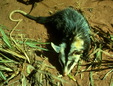
White-eared opossums are relatively robust in appearance and weigh between 500 to 2,750 grams. Most individuals have a coat primarily composed of gray fur, with sparse white guard hairs. However, a rare darker phase is also seen in about 12% of individuals. The fur of white-eared opossums has varying length; this can lead to a shaggy appearance. They have a triangular skull; the fur on their face has a dusty-whitish hue, with a dark gray medial stripe between the ears. The darkness of the facial stripe depends on the range of the population, for instance, populations limited to southern regions are more likely to have a lighter colored facial stripe; likewise, southern populations are more likely to have spots of black on their ears. This species typically has white ears, black fur surrounding their eyes and pointed muzzles tipped with a pink nose. Their prehensile tails are largely hairless and scaly, with the exception of fur at the base of the tail and a bit of sparse fur throughout. This species has a pronounced sagittal crest and the following dental formula: 5/4, 1/1, 3/3, 4/4. Females have a marsupium with 13 mammae. There has been some disagreement regarding sexual dimorphism in this species, generally however, it is accepted that males are somewhat larger than females and have larger canines. (Cerqueira and Tribe, 2008; Lemos and Cerqueira, 2002; Oliveira-Santos, et al., 2008; Smith, 2007; de Almeida, et al., 2008)
- Other Physical Features
- endothermic
- bilateral symmetry
- Sexual Dimorphism
- male larger
-
- Range mass
- 500 to 2,750 g
- 17.62 to oz
Reproduction
There is no specific information regarding the mating systems of white-eared opossums. However, members of family Didelphidae are generally considered polygynous. Males compete for reproductive females, communicating with a series of clicking noises. Didelphids exhibit neither courtship rituals nor pair bonding. (Fernandes, et al., 2010; O'Connell, 2006)
- Mating System
- polygynous
The breeding behavior of white-eared opossums is largely based on food availability. The increase in available food during the wet season facilitates their breeding season. This species typically has 2 breeding periods; specific breeding months are dependent on the latitude at which the population is found. Regardless, breeding typically begins at the end of the dry season and offspring are typically born during the wet season. After a short gestation period of 12 to 14 days, white-eared opossums have 4 to 23 young. These offspring are extremely altricial; they are often about 15 mm long and weigh about 0.13 grams. (Cerqueira and Tribe, 2008; O'Connell, 2006; Rademaker and Cerqueira, 2006; Smith, 2007; Talamondi and Dias, 1999; de Almeida, et al., 2008)
- Key Reproductive Features
- seasonal breeding
- gonochoric/gonochoristic/dioecious (sexes separate)
- sexual
- viviparous
-
- Breeding interval
- White-eared opossums typically have 2 breeding periods per year.
-
- Breeding season
- This species generally breeds at the end of the dry season.
-
- Range number of offspring
- 4 to 23
-
- Average number of offspring
- 5
- AnAge
-
- Range gestation period
- 12 to 14 days
-
- Range weaning age
- 3 to 4 months
-
- Average age at sexual or reproductive maturity (female)
- 9 months
-
- Average age at sexual or reproductive maturity (female)
Sex: female - 365 days
- AnAge
- Average age at sexual or reproductive maturity (female)
-
- Average age at sexual or reproductive maturity (male)
- 9 months
-
- Average age at sexual or reproductive maturity (male)
Sex: male - 365 days
- AnAge
- Average age at sexual or reproductive maturity (male)
Once the offspring are born, they must climb to the marsupium. Although a female many have many offspring within a litter, their marsupium only includes 13 mammae, as such, many of these altricial young will not survive. The young remain within the pouch attached to the mammae for the first two months of their life, after which, they cling to their mothers back. They will stay with their mother for several more weeks. White-eared opossums are typically weaned at 3 to 4 months of age. They are sexually mature at around 9 months. (Cerqueira and Tribe, 2008; Rademaker and Cerqueira, 2006; Smith, 2007)
- Parental Investment
- female parental care
-
pre-weaning/fledging
-
provisioning
- female
-
protecting
- female
-
provisioning
Lifespan/Longevity
Similar to other didelphids, white-eared opossums have a very short lifespan, most wild individuals do not survive beyond 20 months of age. (Smith, 2007)
-
- Average lifespan
Status: wild - 20 months
- Average lifespan
Behavior
White-eared opossums are solitary marsupials. They are primarily terrestrial, but they are also adept climbers. These animals are nocturnal and crepuscular; they become active directly after sunset and remain active throughout the night. During daylight hours white-eared opossums stay in shelter, often in holes, palm trees or underneath bromeliads. They may also stay in abandoned nests of other species or hallow tree trunks lined with grass, fur or feathers. (Cerqueira and Tribe, 2008; Oliveira-Santos, et al., 2008; Smith, 2007; de Almeida, et al., 2008)
- Key Behaviors
- cursorial
- terricolous
- nocturnal
- crepuscular
- motile
- solitary
Home Range
The home range size for this species may vary; however, in Argentina it averages about 0.57 hectares per individual. Although home range sizes may vary across populations it does not appear to vary based on gender. (Smith, 2007; de Almeida, et al., 2008)
Communication and Perception
White-eared opossums primarily detect food items by using their olfactory and auditory senses. In general, members of genus Didelphis also have very good eyesight. Likewise, members of this genus are equipped with long whiskers, which help them navigate at night. When these animals perceive a threat they typically bare their teeth, they can also run rather quickly when they are on the ground, their speed is impaired when they are climbing. Additionally, threatened white-eared opossums may produce an odor from their cloaca and in rare cases they may feign death, similar to Virginia opossums. (O'Connell, 2006; Oliveira and Santori, 1999; Smith, 2007)
Food Habits
White-eared opossums are omnivorous opportunistic feeders. They primarily feed on invertebrates, however, their diet changes based on food availability. During the wet season, white-eared opossums eat more fruit, reptiles and beetles. In the dry season, they consume a greater amount of birds and millipedes. Their diet components are generally as follows, 39% invertebrates, 28% vegetation including leaves, grasses and fibers, 17% birds, 12% fruits and seeds and 4% unknown. Among invertebrates, white-eared opossums typically feed on beetles, millipedes and dung beetles. The plant material most commonly consumed comes from pioneer plants as well as mulberries (Morus nigra), Vassobia breviflora, rose-leaf bramble (Rubus rosifolius), Solanum sanctaecatherinae and passion flower (Passiflora actinia). White-eared opossums are also known to eat snakes including Liotyphlops beui and captive individuals have eaten pit vipers (Bothrops jararaca). Feeding on snakes is facilitated by white-eared opossums’ immunity to snake venom. Although both adult and young white-eared opossums have similar diets, adults are more likely to capture and consume vertebrate prey. When feeding, white-eared opossums sit in a semi-erect position, when consuming invertebrates and vertebrates, these animals typically eat the head first. Other reports of this species opportunistic feeding habits extend to their sympatric relationship with common marmosets. In this relationship, marmosets scratch bark off of trees (Tapirira guianensis) and feed on the resulting tree gum. White-eared opossums also feed on this tree gum and in many circumstances may feed on the tree gum before the marmosets have an opportunity. (Alessio, et al., 2005; Caceres, 2002; Oliveira and Santori, 1999; Oliveira-Santos, et al., 2008; Smith, 2007; Talamondi and Dias, 1999)
- Primary Diet
- carnivore
- Animal Foods
- birds
- mammals
- reptiles
- insects
- Plant Foods
- leaves
- roots and tubers
- wood, bark, or stems
- seeds, grains, and nuts
- fruit
Predation
White-eared opossums are predated upon by a variety of animals including maned wolves, felines, foxes, roadside hawks, barn owls, yellow anacondas and boa constrictors. Likewise, juvenile white-eared opossums may be prey for various adult snakes and great horned owls. Contrary to popular perception, white-eared opossums can actually run rather rapidly when attempting to escape a predator. (Jacomo, et al., 2004; Oliveira and Santori, 1999; Smith, 2007; Talamondi and Dias, 1999)
-
- Known Predators
-
- maned wolves (Chrysocyon brachyurus)
- felines (Felidae)
- foxes (Canidae)
- roadside hawks (Rupornis magnirostris)
- barn owls (Tyto alba)
- yellow anacondas (Eunectes notaeus)
- boa constrictors (Boa constrictor)
- great horned owls (Bubo virginianus)
Ecosystem Roles
White-eared opossums are important seed dispersers for a variety of plants in South America (the families of these plants include: Solanacea, Passifloraceae, Moraceae, Rosaceae, Piperaceae, Cucubitaceae, Arecaceae, Poaceae, Myrtaceae, Rutaceae, Melastomataceae and Erythroxylaceae) most of these seeds pass through their digestive tract unharmed, especially small seeds. Due to their role as seed dispersers and their penchant for living in human altered environments, white-eared opossums may play a special role in forest regeneration. (Caceres, 2002; Smith, 2007)
White-eared opossums are hosts for a huge variety of endo- and ectoparasites. Among ectoparasites, these animals are hosts for 6 species of fleas, 3 species of ticks and 9 species of mites. Likewise, white-eared opossums are reservoirs for many endoparasites, including 10 species of nematodes and 4 trematodes. (Cerqueira and Tribe, 2008; Fornazari, et al., 2011; Quintal, et al., 2011; Smith, 2007)
- Ecosystem Impact
- disperses seeds
- Fleas: Craneopsylla minerva, Adoratopsylla ronnai, Ctenocephalides felis, Polygenis tripus, Polygenis rimatus and Rhopalosyllus lutzi
- Ticks: Ixodes loricatus, Amblyomma cajennense, Carios talaje
- Mites:Ornithonyssus wernecki, Androlaelaps fahrenholzi, Gigantolaelaps butantanensis, Gigantolaelaps goyanensis, Gigantolaelaps oudemansi, Gigantolaelaps vitzbumi, Laelaps mastacalis, Archemyobia latipilis and Didelphilichus serrifer
- Nematodes: Aspidodera raillieti, Aspidodera subulata, Cruzia tentaculata, Gnathostoma didelphis, Didelphostrongylus hayesi, Gnathostoma turgidum, Turgida turgida, Viannaia hamata, Travassostrongylus orloffi and Trichuris didelphis
- Trematodes: Duboisiella proloba, Zoonorchis goliath, Rhopalias coronatus and Brachylaema migrans
Economic Importance for Humans: Positive
The anatomy of white-eared opossums may be used in a variety of human medicines. For instance, their tails may be added to a stew to assist in painless childbirth, use of their fat as an ointment has been used in the treatment of hemorrhoids, boils, hernias, arthritis and osteoarthritis and their meat has been used for the treatment of kidney and back pain. The skin of white-eared opossums has also been used for coats. (Smith, 2007)
- Positive Impacts
- body parts are source of valuable material
- source of medicine or drug
Economic Importance for Humans: Negative
White-eared opossums can thrive in human-altered habitats; as a result, they can sometimes be pests. This species may be found in agricultural areas including orchards and gardens, however, there have been no reports of large-scale damage. They are also known to raid chicken coups, stealing eggs and often killing the birds. Likewise, they are carriers of a multitude of parasites and diseases that may be transmitted to humans, livestock and pets, including Salmonella. Their ability to live in such close proximity to human civilization makes transmission much more likely. (Cerqueira and Tribe, 2008; Fornazari, et al., 2011; Gomez-Villafane, et al., 2004; Quintal, et al., 2011; Smith, 2007)
- Negative Impacts
-
injures humans
- carries human disease
- crop pest
- causes or carries domestic animal disease
Conservation Status
White-eared opossums are currently listed as a species of least concern on the IUCN Red List of Threatened Species. Their ability to survive in human altered habitats, their sizable population and their large distribution makes the outlook for this species stable. (Costa, et al., 2008)
-
- IUCN Red List
-
Least Concern
More information
-
- IUCN Red List
-
Least Concern
More information
-
- US Federal List
- No special status
-
- CITES
- No special status
-
- State of Michigan List
- No special status
Contributors
Leila Siciliano Martina (author), Animal Diversity Web Staff.
Glossary
- Neotropical
-
living in the southern part of the New World. In other words, Central and South America.

- acoustic
-
uses sound to communicate
- agricultural
-
living in landscapes dominated by human agriculture.
- bilateral symmetry
-
having body symmetry such that the animal can be divided in one plane into two mirror-image halves. Animals with bilateral symmetry have dorsal and ventral sides, as well as anterior and posterior ends. Synapomorphy of the Bilateria.
- carnivore
-
an animal that mainly eats meat
- causes or carries domestic animal disease
-
either directly causes, or indirectly transmits, a disease to a domestic animal
- chemical
-
uses smells or other chemicals to communicate
- crepuscular
-
active at dawn and dusk
- desert or dunes
-
in deserts low (less than 30 cm per year) and unpredictable rainfall results in landscapes dominated by plants and animals adapted to aridity. Vegetation is typically sparse, though spectacular blooms may occur following rain. Deserts can be cold or warm and daily temperates typically fluctuate. In dune areas vegetation is also sparse and conditions are dry. This is because sand does not hold water well so little is available to plants. In dunes near seas and oceans this is compounded by the influence of salt in the air and soil. Salt limits the ability of plants to take up water through their roots.
- drug
-
a substance used for the diagnosis, cure, mitigation, treatment, or prevention of disease
- endothermic
-
animals that use metabolically generated heat to regulate body temperature independently of ambient temperature. Endothermy is a synapomorphy of the Mammalia, although it may have arisen in a (now extinct) synapsid ancestor; the fossil record does not distinguish these possibilities. Convergent in birds.
- female parental care
-
parental care is carried out by females
- forest
-
forest biomes are dominated by trees, otherwise forest biomes can vary widely in amount of precipitation and seasonality.
- insectivore
-
An animal that eats mainly insects or spiders.
- marsh
-
marshes are wetland areas often dominated by grasses and reeds.
- motile
-
having the capacity to move from one place to another.
- native range
-
the area in which the animal is naturally found, the region in which it is endemic.
- nocturnal
-
active during the night
- polygynous
-
having more than one female as a mate at one time
- rainforest
-
rainforests, both temperate and tropical, are dominated by trees often forming a closed canopy with little light reaching the ground. Epiphytes and climbing plants are also abundant. Precipitation is typically not limiting, but may be somewhat seasonal.
- scrub forest
-
scrub forests develop in areas that experience dry seasons.
- seasonal breeding
-
breeding is confined to a particular season
- sexual
-
reproduction that includes combining the genetic contribution of two individuals, a male and a female
- solitary
-
lives alone
- suburban
-
living in residential areas on the outskirts of large cities or towns.
- tactile
-
uses touch to communicate
- tropical
-
the region of the earth that surrounds the equator, from 23.5 degrees north to 23.5 degrees south.
- tropical savanna and grassland
-
A terrestrial biome. Savannas are grasslands with scattered individual trees that do not form a closed canopy. Extensive savannas are found in parts of subtropical and tropical Africa and South America, and in Australia.
- savanna
-
A grassland with scattered trees or scattered clumps of trees, a type of community intermediate between grassland and forest. See also Tropical savanna and grassland biome.
- temperate grassland
-
A terrestrial biome found in temperate latitudes (>23.5° N or S latitude). Vegetation is made up mostly of grasses, the height and species diversity of which depend largely on the amount of moisture available. Fire and grazing are important in the long-term maintenance of grasslands.
- visual
-
uses sight to communicate
- viviparous
-
reproduction in which fertilization and development take place within the female body and the developing embryo derives nourishment from the female.
References
Alessio, F., A. Pontes, V. da Silva. 2005. Feeding by Didelphis albiventris on tree gum in the northeastern Atlantic forest of Brazil. Mastozoologia Neotropical, 12:1: 53-56.
Caceres, N. 2002. Food habits and seed dispersal by the white-eared opossum Didelphis albiventris in southern Brazil. Studies on Neotropical Fauna and the Environment, 37: 1-8.
Cerqueira, R., C. Tribe. 2008. Genus Didelphis. Pp. 17-25 in A Gardner, ed. Mammals of South America: Marsupials, Xenarthrans, Shrews, and Bats, Vol. Volume 1. Chicago: University of Chicago Press.
Costa, L., D. Astua de Moraes, D. Brito, P. Soriano, D. Lew, C. Delgado. 2008. "Didelphis albiventris" (On-line). IUCN Red List of Threatened Species. Accessed May 02, 2013 at www.iucnredlist.org.
Fernandes, F., L. Cruz, E. Martins, S. dos Reis. 2010. Growth and home range size of the gracille mouse opossum Gracilinanus microtarsus (Marsupialia: Didelphidae) in Brazilian cerrado. Journal of Tropical Ecology, 26:2: 185-192.
Fornazari, F., C. Teixeira, R. da Silva, M. Leiva, C. de Almeido, H. Langoni. 2011. Prevalence of antibodies against Toxoplasma gondii among Brazilian white-eared opossums (Didelphis albiventris). Veterinary Parasitology, 179:1: 238-241.
Gomez-Villafane, I., F. Minarro, M. Ribicich, C. Rossetti, D. Rossotti, M. Busch. 2004. Assessment of the risks of rats (Rattus norvegicus) and opossums (Didelphis albiventris) in different poultry-rearing areas in Argentina. Brazilian Journal of Microbiology, 35: 359-363.
Jacomo, A., L. Silveira, J. Diniz-Filho. 2004. Niche separation between the maned wolf (Chrysocyon brachyurus), the crab-eating fox (Dusicyon thous) and the hoary fox (Dusicyon vetulus) in central Brazil. Journal of Zoology, 262: 99-106.
Lemos, B., R. Cerqueira. 2002. Morphological differentiation in the white-eared opossum group (Didelphidae:Didelphis). Journal of Mammalogy, 83:2: 354-369.
O'Connell, M. 2006. American Opossums. Pp. 808-813 in D MacDonald, S Norris, eds. The Encyclopedia of Mammals, Vol. 1. London: The Brown Reference Group.
Oliveira-Santos, L., M. Tortato, M. Graipel. 2008. Activity pattern of Atlantic forest small arboreal mammals as revealed by camera traps. Journal of Tropical Ecology, 24: 563-567.
Oliveira, M., R. Santori. 1999. Predatory behavior of the opossum Didelphis albiventris on the pitviper Bothrops jararaca. Studies on Neotropical Fauna and the Environment, 34:2: 72-75.
Quintal, A., E. Ribeiro, F. Rodrigues, F. Rocha, L. Floeter-Winter, C. Nunes. 2011. Leishmania spp. in Didelphis albiventris and Micoureus paraguayanus (Didelphimorphia:Didelphidae) of Brazil. Veterinary Parasitology, 176: 112-119.
Rademaker, V., R. Cerqueira. 2006. Variation in the latitudinal reproductive patterns of the genus Didelphis (Didelphimorphia:Didelphidae). Austral Ecology, 31:3: 337-342.
Smith, P. 2007. White-eared opossum Didelphis albiventris. Fauna Paraguay Handbook of the Mammals of Paraguay, 1: 1-19. Accessed May 07, 2013 at http://www.faunaparaguay.com/mam1Didelphisalbiventris.pdf.
Talamondi, S., M. Dias. 1999. Population and community ecology of small mammals in southeastern Brazil. Mammalia, 63:2: 167-181.
de Almeida, A., C. Torquetti, S. Talamoni. 2008. Use of space by the Neotropical marsupialDidelphis albiventris (Didelphimorphia: Didelphidae) in an urban forest fragment. Revista Brasileira de Zoologia, 25:2: 214-219.