Dermopteraflying lemurs

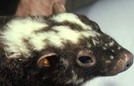

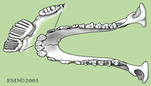

Colugos are strange, medium-sized animals (1-2 kg, approximately the size of a very large squirrel) with a large, well-furred membrane extending from the sides of the neck to the forepaws, and from the forepaws back to the hind feet and end of the tail. This membrane allows them to glide long distances (over 100 m) with considerable manueverability. The membrane is covered by brownish or gray pelage with irregular white spots. The fore and hind feet have long, needle-sharp claws, useful for holding onto bark and branches. The skull of a colugo is very distinctive, broad and flat in outline and with a nearly complete postorbital process that sets off the eye sockets. The tympanic bullae are flattened, and the palate is broad and flat. The teeth are relatively small and simple. The molars retain the basic tribosphenic pattern, with well developed lophs used in chewing abrasive plant matter. The first upper incisor is reduced, while the second (outer) upper incisor is caniniform. The lower incisors form a comb-like structure that is thought to be used both in grooming and in feeding.

Colugos are sometimes called "flying lemurs," because of their habit of gliding and the fact that their faces are lemur-like. They are not lemurs, however, and they have not achieved real flight (among mammals only bats have attained that distinction).
Colugos are herbivorous, feeding on fruit, young leaves, and flowers. They scrape green material from the surface of leaves with their lower incisors, using their tongue, which is very large, and incisors to pick the leaves. Like many other herbivores, they have a greatly elongated intestine and a very large cecum. The cecum, a sac located at the junction of large and small intestines, is divided into compartments, which harbor microorganisms that break down indigestible cellulose into components that the animal can assimilate. Colugos are nocturnal, passing the day in dens in hollow trees or suspended from branches. They hang upside down while feeding and travelling along branches.
The order Dermoptera contains a single family, the Cynocephalidae, which is made up of a single genus ( Cynocephalus) with two species. Colugos are found in southeastern Asia, including the southern Philippines.
Literature and references cited
Feldhamer, G. A., L. C. Drickamer, S. H. Vessey, and J. F. Merritt. 1999. Mammalogy. Adaptation, Diversity, and Ecology. WCB McGraw-Hill, Boston. xii+563pp.
Vaughan, T. A. 1986. Mammalogy. Third Edition. Saunders College Publishing, Fort Worth. vii+576 pp.
Vaughan, T. A., J. M. Ryan, N. J. Czaplewski. 2000. Mammalogy. Fourth Edition. Saunders College Publishing, Philadelphia. vii+565pp.
Yates, T. L. 1984. Insectivores, elephant shrews, tree shrews, and dermopterans. Pp. 117-144 in Anderson, S. and J. K. Jones, Jr. (eds). Orders and Families of Recent Mammals of the World. John Wiley and Sons, N.Y. xii+686 pp.
Contributors
Phil Myers (author), Museum of Zoology, University of Michigan-Ann Arbor.
Glossary
- bilateral symmetry
-
having body symmetry such that the animal can be divided in one plane into two mirror-image halves. Animals with bilateral symmetry have dorsal and ventral sides, as well as anterior and posterior ends. Synapomorphy of the Bilateria.
- chemical
-
uses smells or other chemicals to communicate
- endothermic
-
animals that use metabolically generated heat to regulate body temperature independently of ambient temperature. Endothermy is a synapomorphy of the Mammalia, although it may have arisen in a (now extinct) synapsid ancestor; the fossil record does not distinguish these possibilities. Convergent in birds.
- motile
-
having the capacity to move from one place to another.
- sexual
-
reproduction that includes combining the genetic contribution of two individuals, a male and a female
- tactile
-
uses touch to communicate