Dendroica virensblack-throated green warbler



Geographic Range
Black-throated green warblers are found through much of the Nearctic Region. In the summer they range from eastern British Columbia throughout southern Canada as far north as Alberta and as far east as Newfoundland. Their summer range includes much of the Appalachian mountains, as far south as South Carolina, Georgia, Alabama, and the Ozarks of northwest Arkansas. They are also found in the Great Lakes region and into Indiana and Illinois during the summer. An isolated subspecies, D. virens waynei, breeds in the cypress swamps of Virginia, North Carolina, and South Carolina. Black-throated green warblers migrate in the winter to southern Texas, southern Florida, and Central and South America. Some individuals have been known to migrate to the West Indies (Cuba), and some wind-blown individuals have recently been found in the British Isles. (Farrand, 1988; Farrand, 1988; Morse and Poole, 2005)
Habitat
Preferred breeding habitat of black-throated green warblers varies from the coastal plains to mountain ranges, but is mainly the coniferous and mixed forest regions of the northern United States and the Appalachian mountain range. In their winter range they also prefer woody habitats such as deciduous or coniferous forest edges. (Morse and Poole, 2005)
- Habitat Regions
- temperate
- tropical
- terrestrial
- Terrestrial Biomes
- savanna or grassland
- forest
- scrub forest
- mountains
-
- Range elevation
- 0 to 2450 m
- 0.00 to 8038.06 ft
-
- Average elevation
- 1500-2200 m
- ft
Physical Description
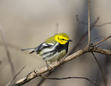
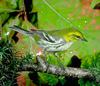
Black-throated green warblers range in size from 11.5 to 14 centimeters in length. A breeding adult male has a black chin, throat, and upper chest with a bright yellow face. The underside is mostly white with black lines running down the sides. A pale yellow color stretches across the lower chest and chin area. The wings are mostly gray with white streaks. Mature females are similar to males except not as bright and with less black on their chins. There is not much change in appearance during migration. A young female may have little or no black on its chin. Immature males and females have a yellowish belly rather than a white one. (Gough and Sauer, 1997; Morse and Poole, 2005; Peterson, 1983; Robbins, et al., 1983)
- Other Physical Features
- endothermic
- homoiothermic
- bilateral symmetry
- Sexual Dimorphism
- sexes colored or patterned differently
- male more colorful
-
- Range mass
- 9 (high) g
- 0.32 (high) oz
-
- Average mass
- 8.5 g
- 0.30 oz
-
- Range length
- 11.5 to 14 cm
- 4.53 to 5.51 in
-
- Average length
- 12 cm
- 4.72 in
-
- Range wingspan
- 17 to 20 cm
- 6.69 to 7.87 in
-
- Average basal metabolic rate
- 3.49 ± 0.15 cm3.O2/g/hr
Reproduction
Males reach the breeding ground first, with females following shortly after. This species is seasonally monogamous with males rarely taking a second mate. Mating begins with a male display to the female that includes fluffing, in which the male fluffs out his feathers. After mates are chosen, the male usually remains near the female to aid in nest building. After the young leave the nest, the male and female go their separate ways. Males are protective of the nesting area during mating season. (Morse and Poole, 2005)
- Mating System
- monogamous
All mating takes place in the spring. This occurs in mid April in the Appalachian mountains, early May in the northern United States, and as late as mid-May in Canada. One brood is produced per year with clutch sizes of 3 to 5 eggs. After 12 days of incubation, it takes about 8 to 10 days for the birds to leave the nest. (Ehrlich, et al., 1988; Gough and Sauer, 1997)
- Key Reproductive Features
- iteroparous
- seasonal breeding
- gonochoric/gonochoristic/dioecious (sexes separate)
- sexual
- oviparous
-
- Breeding interval
- Black-throated green warblers breed once yearly.
-
- Breeding season
- Breeding usually occurs in the spring (April to May) for black-throated green warblers.
-
- Range eggs per season
- 3 to 5
-
- Average eggs per season
- 4
- AnAge
-
- Average time to hatching
- 12 days
-
- Average time to hatching
- 12 days
- AnAge
-
- Range fledging age
- 8 to 10 days
-
- Range time to independence
- 6 to 8 days
A breeding female will spend 80% of her time with her eggs. Only the female broods while the male spends his time defending the nest. Time allotted to brooding decreases rapidly over the course of a few days. No brooding occurs within the last few days of the fledgling’s time in the nest. The female does all the feeding, although the male may contribute by bringing some food to the nest. The male may try to feed the young but this is very rare. The parents carry the food (mostly invertebrates such as spiders and insects) in their bill and place it in the beaks of their young. (Morse and Poole, 2005)
- Parental Investment
- precocial
-
pre-fertilization
- provisioning
-
protecting
- male
-
pre-hatching/birth
-
provisioning
- female
-
protecting
- male
-
provisioning
-
pre-weaning/fledging
-
provisioning
- female
-
protecting
- male
-
provisioning
-
pre-independence
-
provisioning
- female
-
protecting
- male
-
provisioning
Lifespan/Longevity
Adult survivorship amongst Dendroicia virens is high, with 67% yearly survival. The longest known lifespan of a black-throated green warbler is 71 months (5 years, 11 months). However, no information was found on the average lifespan of this species. (Morse and Poole, 2005)
-
- Range lifespan
Status: wild - 5.84 (high) years
- Range lifespan
-
- Average lifespan
Status: wild - 71 months
- Bird Banding Laboratory
- Average lifespan
Behavior
Black-throated green warblers hops around, usually on vegetation, but also on the ground. They tend to stay in wooded areas, but will fly across open spaces. (Morse and Poole, 2005)
Black-throated green warblers will bathe during the day in streams. This includes immersing themselves in the water and spreading the water over the rest of his body by shaking. Birds also spend time perched on branches in the sun. (Morse and Poole, 2005)
At dawn and dusk during the breeding season, males hunt for insects and sing to announce their territory. After the young have hatched, the female feeds periodically throughout the day. After hatching, females spend much of their time hunting for food to feed the young. (Morse and Poole, 2005)
Males tend to fight with conspecific males over territorial boundaries. This includes jabbing each other with their wings or pecking at the opponents head with their bill. They often will latch onto one another and fall to the ground with their wings open and continue fighting. Females have been known to enter into territorial conflicts with one another as well. (Morse and Poole, 2005)
- Key Behaviors
- arboreal
- flies
- diurnal
- crepuscular
- motile
- migratory
- solitary
- territorial
Home Range
Black-throated green warblers are territorial and protect the area around the nest site. No information on size of territory was found. (Morse and Poole, 2005)
Communication and Perception
Males sing at territorial boundaries. A different song is used in the presence of the female or near the nest. The typical song is slow with a clear whistle on the third and fourth notes, while other songs are wheezy. Another form of communication occurs before mating, fluffing is usually performed by the male and is a form of visual communication (see Reproduction: Mating Systems). (Ehrlich, et al., 1988; Robbins, et al., 1983)
Food Habits
Black-throated green warblers eat mostly insects, primarily caterpillars, such as spruce budworms. They have also been known to eat poison ivy berries during migration and the pollen of Cecropia trees in their winter range. During the breeding season, black-throated green warblers eat exclusively insects. (Morse and Poole, 2005)
- Primary Diet
- carnivore
- Animal Foods
- insects
- terrestrial non-insect arthropods
- Plant Foods
- fruit
- pollen
Predation
Predators include red squirrels and blue jays. These predators usually target eggs, hatchlings, or fledglings. The biggest threat to adults are hawks, mostly sharp-shinned hawks. (Morse and Poole, 2005)
-
- Known Predators
-
- blue jays (Cyanocitta cristata)
- red squirrels (Tamiasciurus hudsonicus)
- sharp-shinned hawks (Accipiter striatus)
Ecosystem Roles
Black-throated green warblers are insectivorous. They may help control insect populations in some areas. (Ehrlich, et al., 1988)
Economic Importance for Humans: Positive
There is no information to suggest that Dendroica virens has a positive economic impact on humans. Although, like most warblers, these are popular birds for birdwatching and may be indicators of ecosystem health.
- Positive Impacts
- ecotourism
Economic Importance for Humans: Negative
There is no information to suggest that Dendroica virens has a negative impact on humans.
Conservation Status
Dendroica virens is not currently considered threatened. However, destruction of forests in breeding and wintering ranges reduces their habitat and leads to the disappearance of the species in that area. Also, balsam woolly adelgids, small, sucking insects that prey on fir trees, are destroying forest habitats that black-throated green warblers rely on. (Morse and Poole, 2005)
-
- IUCN Red List
-
Least Concern
More information
-
- IUCN Red List
-
Least Concern
More information
-
- US Migratory Bird Act
- No special status
-
- US Federal List
- No special status
-
- CITES
- No special status
-
- State of Michigan List
- No special status
Contributors
Tanya Dewey (editor), Animal Diversity Web.
Marina Migliore (author), Kalamazoo College, Ann Fraser (editor, instructor), Kalamazoo College.
Glossary
- Nearctic
-
living in the Nearctic biogeographic province, the northern part of the New World. This includes Greenland, the Canadian Arctic islands, and all of the North American as far south as the highlands of central Mexico.

- acoustic
-
uses sound to communicate
- arboreal
-
Referring to an animal that lives in trees; tree-climbing.
- bilateral symmetry
-
having body symmetry such that the animal can be divided in one plane into two mirror-image halves. Animals with bilateral symmetry have dorsal and ventral sides, as well as anterior and posterior ends. Synapomorphy of the Bilateria.
- carnivore
-
an animal that mainly eats meat
- chemical
-
uses smells or other chemicals to communicate
- crepuscular
-
active at dawn and dusk
- diurnal
-
- active during the day, 2. lasting for one day.
- ecotourism
-
humans benefit economically by promoting tourism that focuses on the appreciation of natural areas or animals. Ecotourism implies that there are existing programs that profit from the appreciation of natural areas or animals.
- endothermic
-
animals that use metabolically generated heat to regulate body temperature independently of ambient temperature. Endothermy is a synapomorphy of the Mammalia, although it may have arisen in a (now extinct) synapsid ancestor; the fossil record does not distinguish these possibilities. Convergent in birds.
- forest
-
forest biomes are dominated by trees, otherwise forest biomes can vary widely in amount of precipitation and seasonality.
- insectivore
-
An animal that eats mainly insects or spiders.
- iteroparous
-
offspring are produced in more than one group (litters, clutches, etc.) and across multiple seasons (or other periods hospitable to reproduction). Iteroparous animals must, by definition, survive over multiple seasons (or periodic condition changes).
- migratory
-
makes seasonal movements between breeding and wintering grounds
- monogamous
-
Having one mate at a time.
- motile
-
having the capacity to move from one place to another.
- mountains
-
This terrestrial biome includes summits of high mountains, either without vegetation or covered by low, tundra-like vegetation.
- native range
-
the area in which the animal is naturally found, the region in which it is endemic.
- oviparous
-
reproduction in which eggs are released by the female; development of offspring occurs outside the mother's body.
- scrub forest
-
scrub forests develop in areas that experience dry seasons.
- seasonal breeding
-
breeding is confined to a particular season
- sexual
-
reproduction that includes combining the genetic contribution of two individuals, a male and a female
- solitary
-
lives alone
- tactile
-
uses touch to communicate
- temperate
-
that region of the Earth between 23.5 degrees North and 60 degrees North (between the Tropic of Cancer and the Arctic Circle) and between 23.5 degrees South and 60 degrees South (between the Tropic of Capricorn and the Antarctic Circle).
- terrestrial
-
Living on the ground.
- territorial
-
defends an area within the home range, occupied by a single animals or group of animals of the same species and held through overt defense, display, or advertisement
- tropical
-
the region of the earth that surrounds the equator, from 23.5 degrees north to 23.5 degrees south.
- tropical savanna and grassland
-
A terrestrial biome. Savannas are grasslands with scattered individual trees that do not form a closed canopy. Extensive savannas are found in parts of subtropical and tropical Africa and South America, and in Australia.
- savanna
-
A grassland with scattered trees or scattered clumps of trees, a type of community intermediate between grassland and forest. See also Tropical savanna and grassland biome.
- temperate grassland
-
A terrestrial biome found in temperate latitudes (>23.5° N or S latitude). Vegetation is made up mostly of grasses, the height and species diversity of which depend largely on the amount of moisture available. Fire and grazing are important in the long-term maintenance of grasslands.
- visual
-
uses sight to communicate
- young precocial
-
young are relatively well-developed when born
References
Ehrlich, P., D. Dobkin, D. Wheye. 1988. The Birder's Handbook, A Field Guide to the Natural History of North American Birds. New York: Simon & Schuster Inc.
Farrand, J. 1988. An Audubon Handbook, Eastern Birds. New York: McGraw-Hill Book Company.
Gough, G., J. Sauer. 1997. "Patuxent Bird Glossary" (On-line). Accessed November 14, 2006 at http://www.mbr-pwrc.usgs.gov/id/framlst/i6670id.html.
Morse, D., A. Poole. 2005. Black-throated Green Warbler (Dendroica virens). The Birds of North America Online, 2: 55. Accessed October 15, 2006 at http://bna.birds.cornell.edu/BNA/account/Black-throated_Green_Warbler/.
Peterson, W. 1983. Old World Warblers to Sparrows. Pp. 142-143 in J Farrand, Jr., ed. Black-throated Green Warblers, Vol. 3. New York: Alfred A. Knopf.
Robbins, C., B. Bruun, H. Zim. 1983. A Guide To Field Identification Birds Of North America. Racine, Wisconsin: Western Publishing Company, Inc.