Dendroica petechiayellow warbler


Geographic Range
Yellow warblers spend the majority of the year throughout much of North America, including Alaska, northern Canada, and the northern 2/3 of the United States. A highly migratory bird, Dendroica petechia winters in southern California, southern Florida, and south through the Brazilian Amazon, Bolivia, and Peru (Ehrlich 1992). (Ehrlich, et al., 1992)
- Biogeographic Regions
- nearctic
- neotropical
Habitat
Dendroica petechia prefers moist habitats with high insect abundance. The presence of willows is one common feature of yellow warbler habitat north of Mexico. South of Mexico mangroves are a dominant feature. Habitats include the edges of marshes and swamps, willow-lined streams, and leafy bogs. Dendroica petechia also inhabits dry areas such as thickets, orchards, farmlands, forest edges, and suburban yards and gardens. They seem to prefer areas of scattered trees, dense shrubbery, and any other moist, shady areas (Nuttall and Chamberlin, 1971; USGS, 2000). (Celada, et al., 1999; Nuttall and Chamberlin, ed., 1903; U.S. Department of the Interior, U.S. Geological Survey, 2000)
- Habitat Regions
- temperate
- tropical
- terrestrial
- Terrestrial Biomes
- savanna or grassland
- chaparral
- forest
- rainforest
- Other Habitat Features
- suburban
- agricultural
- riparian
Physical Description
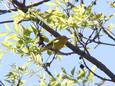
Yellow warblers are easily recognized. They are the most extensively yellow of warblers, with golden yellow plumage and rusty streaks on the breast. Yellow warbler males and females are similar with golden yellow upper parts tinged with olive, yellow under parts, and thin pointed beaks. Males are generally brighter, especially during the breeding season. Yellow warblers reach an average size of 10 to 18 cm in length (Perrins and Middleton 1985; The Otter Side 2000). (Perrins and Middleton, ed., 1985; The Otter Side, 2000)
- Other Physical Features
- endothermic
- homoiothermic
- bilateral symmetry
- Sexual Dimorphism
- male more colorful
-
- Range mass
- 7 to 25 g
- 0.25 to 0.88 oz
-
- Range length
- 10 to 18 cm
- 3.94 to 7.09 in
-
- Average wingspan
- 20 cm
- 7.87 in
Reproduction
From its wintering grounds, D. petechia arrive in the northern areas with little time between migrations for the reproduction process, which at a minimum takes 45 days. The process begins with a fairly elaborate courtship performed by the male who may sing up to 3,240 songs in a day to attract a mate. Yellow warblers are primarily monogamous, but there are occasional polygynous matings. Although yellow warblers are generally single-brooded, if their first nesting attempt fails they will breed again. (Perrins and Middleton et al. 1985; Rand et al. 1971) (Perrins and Middleton, ed., 1985; Rand, 1971)
- Mating System
- monogamous
- polygynous
Yellow warblers usually breed in late May and early June. Females lay 4 to 5 eggs, incubation lasts 10 to 14 days, nestling period lasts from 8 to 12 days, and parental feeding may extend to two weeks after the young leave the nest, sometimes longer. Females and males first attempt to breed in their first year after hatching. (Celada, et al., 1999)
- Key Reproductive Features
- iteroparous
- seasonal breeding
- gonochoric/gonochoristic/dioecious (sexes separate)
- sexual
- fertilization
- oviparous
-
- Breeding interval
- Normally yellow warblers breed once yearly; second broods are rarely attempted.
-
- Breeding season
- Mating occurs from May through June.
-
- Range eggs per season
- 1 to 6
-
- Average eggs per season
- 4.5
-
- Average eggs per season
- 3
- AnAge
-
- Range time to hatching
- 10 to 14 days
-
- Range fledging age
- 8 to 12 days
-
- Range time to independence
- 22 to 26 days
-
- Average age at sexual or reproductive maturity (female)
- 1 years
-
- Average age at sexual or reproductive maturity (male)
- 1 years
Both male and female parents participate in feeding the young, usually providing them with geometrid, chironomid and other lepidopteran larvae. The responsibility of incubation, construction of the nest, and most feeding of the young lies with the female, while the male contributes more as the young develop. After they mature, some of the fledglings may follow the mother while the rest remain with the father.
- Parental Investment
- altricial
- male parental care
- female parental care
Lifespan/Longevity
There is little information on causes of mortality. The longest known lifespan of a yellow warbler in the wild is 9 years, 11 months. (Celada, et al., 1999; Klimkiewicz, 2002)
-
- Range lifespan
Status: wild - 10 (high) years
- Range lifespan
-
- Average lifespan
Status: wild - 131 months
- Bird Banding Laboratory
- Average lifespan
Behavior
Yellow warblers are songbirds, both males and females engage in distinct musical songs. During the breeding season, yellow warblers are extremely territorial, but rejoin small flocks after breeding. Because of their well-built open-cup tree nests, parasitic cowbirds will often lay eggs in yellow warbler nests. However, D. petechia is not always fooled and will cover the intruder's eggs with an additional layer of nesting materials, sometimes burying its own. Yellow warblers are active during the day. (Perrins and Middleton et al. 1985; Rand 1971)
Yellow warblers are migratory birds that breed throughout much of North America and winter primarily from Mexico to northern South America. (Celada, et al., 1999)
- Key Behaviors
- flies
- diurnal
- motile
- migratory
- territorial
- social
Communication and Perception
Yellow warbler calls include notes given by young begging for food, by birds responding to the presence of predators, and in diverse social encounters. A "hiss" call has been described as being used in territorial defense. There are several calls used in the context of nest defense, including a "Seet" call that may be somewhat specialized for use in response to threats from parastic cowbids. Singing behavior is used for male-female communication, both for mate attraction and for interactions between mates. Songs are sung primarily by males. Females often give simple, high frequency "chip" calls at the end of a male song. No nonvocal sounds are thought to be used in communication. (Celada, et al., 1999)
Yellow warblers also communicate with postures and perhaps with touch. Yellow warblers perceive their environment with their keen vision, hearing, touch, and limited chemical sensation.
Food Habits
Dendroica petechia is first and foremost an insect feeder but occasionally supplements the diet with some berries. By gleaning and hawking D. petechia forages for insects and spiders on the limbs of trees and bushes. Small insect larvae and caterpillars are preferred foods. (Ehrlich 1992; Nuttall 1903; USGS 2000)
- Primary Diet
- carnivore
- Animal Foods
- insects
- terrestrial non-insect arthropods
- Plant Foods
- fruit
Predation
There is little information on the response of yellow warblers to predators. They have twice been observed to join other bird species in mobbing (attacking, as a group) great horned owls. Females will respond to snakes with distraction displays or give agitated vocalizations.
Yellow warblers are preyed on by a wide variety of small predators, which primarily prey on eggs and young in the nest. Adults and fledged juveniles may be taken by small birds of prey, such as American kestrels and Cooper's hawks. (Celada, et al., 1999)
-
- Known Predators
-
- red squirrels (Tamiasciurus hudsonicus)
- long-tailed weasels (Mustela frenata)
- raccoons (Procyon lotor)
- red foxes (Vulpes vulpes)
- American crows (Corvus brachyrhynchos)
- common garter snakes (Thamnophis sirtalis)
- blue jays (Cyanocitta cristata)
- blue racers (Coluber constrictor)
- striped skunks (Mephitis mephitis)
- domestic cats (Felis silvestris)
- American kestrels (Falco sparverius)
- Cooper's hawks (Accipiter cooperii)
Ecosystem Roles
Brown-headed Cowbirds and Shiny Cowbirds will lay their eggs in yellow warblers' nests. As a result the nest may be abandonned or covered over with a new lining, which can involve the loss of warbler eggs. Sometimes, however, warbler young do survive along with the cowbird young.
Yellow warblers are important predators of insects, especially potential pest species, in the ecosystems in which they live. They may help to disperse fruit seeds when they eat fruit.
Economic Importance for Humans: Positive
Primarily an insectivore, D. petechia forages for food in suburban areas, ridding farms and gardens of unwanted insect pests. Additionally, yellow warblers are popular with birders, they have lovely golden yellow plumage and musical songs (Ehrlich et.al., 1992). (Ehrlich, et al., 1992)
- Positive Impacts
- ecotourism
- controls pest population
Economic Importance for Humans: Negative
There are no known negative effects of yellow warblers on humans.
Conservation Status
Dendroica petechia is common, but due to loss of riparian woodland habitat and extensive paratism by cowbirds there has been a decline in yellow warbler populations. An increase in population occurs in areas where grazing and herbicide are restricted, permitting regrowth of riparian vegetation. One subspecies, the Barbados Yellow Warbler, D. petechia petechia, is on the U.S. endangered species list (Ehrlich et al. 1992; IUCN 2000; CITES 2000; USFW 2001).
-
- IUCN Red List
-
Least Concern
More information
-
- IUCN Red List
-
Least Concern
More information
-
- US Migratory Bird Act
- Protected
-
- US Federal List
- Endangered No special status
-
- CITES
- Appendix III
-
- State of Michigan List
- No special status
Contributors
Tanya Dewey (editor), Animal Diversity Web.
Kathleen Bachynski (author), University of Michigan-Ann Arbor.
Matt Kadlec (author), University of California, Irvine, Rudi Berkelhamer (editor), University of California, Irvine.
Glossary
- Nearctic
-
living in the Nearctic biogeographic province, the northern part of the New World. This includes Greenland, the Canadian Arctic islands, and all of the North American as far south as the highlands of central Mexico.

- Neotropical
-
living in the southern part of the New World. In other words, Central and South America.
- acoustic
-
uses sound to communicate
- agricultural
-
living in landscapes dominated by human agriculture.
- altricial
-
young are born in a relatively underdeveloped state; they are unable to feed or care for themselves or locomote independently for a period of time after birth/hatching. In birds, naked and helpless after hatching.
- bilateral symmetry
-
having body symmetry such that the animal can be divided in one plane into two mirror-image halves. Animals with bilateral symmetry have dorsal and ventral sides, as well as anterior and posterior ends. Synapomorphy of the Bilateria.
- carnivore
-
an animal that mainly eats meat
- chaparral
-
Found in coastal areas between 30 and 40 degrees latitude, in areas with a Mediterranean climate. Vegetation is dominated by stands of dense, spiny shrubs with tough (hard or waxy) evergreen leaves. May be maintained by periodic fire. In South America it includes the scrub ecotone between forest and paramo.
- chemical
-
uses smells or other chemicals to communicate
- diurnal
-
- active during the day, 2. lasting for one day.
- ecotourism
-
humans benefit economically by promoting tourism that focuses on the appreciation of natural areas or animals. Ecotourism implies that there are existing programs that profit from the appreciation of natural areas or animals.
- endothermic
-
animals that use metabolically generated heat to regulate body temperature independently of ambient temperature. Endothermy is a synapomorphy of the Mammalia, although it may have arisen in a (now extinct) synapsid ancestor; the fossil record does not distinguish these possibilities. Convergent in birds.
- female parental care
-
parental care is carried out by females
- fertilization
-
union of egg and spermatozoan
- forest
-
forest biomes are dominated by trees, otherwise forest biomes can vary widely in amount of precipitation and seasonality.
- insectivore
-
An animal that eats mainly insects or spiders.
- internal fertilization
-
fertilization takes place within the female's body
- iteroparous
-
offspring are produced in more than one group (litters, clutches, etc.) and across multiple seasons (or other periods hospitable to reproduction). Iteroparous animals must, by definition, survive over multiple seasons (or periodic condition changes).
- male parental care
-
parental care is carried out by males
- marsh
-
marshes are wetland areas often dominated by grasses and reeds.
- migratory
-
makes seasonal movements between breeding and wintering grounds
- monogamous
-
Having one mate at a time.
- motile
-
having the capacity to move from one place to another.
- native range
-
the area in which the animal is naturally found, the region in which it is endemic.
- oviparous
-
reproduction in which eggs are released by the female; development of offspring occurs outside the mother's body.
- polygynous
-
having more than one female as a mate at one time
- rainforest
-
rainforests, both temperate and tropical, are dominated by trees often forming a closed canopy with little light reaching the ground. Epiphytes and climbing plants are also abundant. Precipitation is typically not limiting, but may be somewhat seasonal.
- riparian
-
Referring to something living or located adjacent to a waterbody (usually, but not always, a river or stream).
- seasonal breeding
-
breeding is confined to a particular season
- sexual
-
reproduction that includes combining the genetic contribution of two individuals, a male and a female
- social
-
associates with others of its species; forms social groups.
- suburban
-
living in residential areas on the outskirts of large cities or towns.
- swamp
-
a wetland area that may be permanently or intermittently covered in water, often dominated by woody vegetation.
- tactile
-
uses touch to communicate
- temperate
-
that region of the Earth between 23.5 degrees North and 60 degrees North (between the Tropic of Cancer and the Arctic Circle) and between 23.5 degrees South and 60 degrees South (between the Tropic of Capricorn and the Antarctic Circle).
- terrestrial
-
Living on the ground.
- territorial
-
defends an area within the home range, occupied by a single animals or group of animals of the same species and held through overt defense, display, or advertisement
- tropical
-
the region of the earth that surrounds the equator, from 23.5 degrees north to 23.5 degrees south.
- tropical savanna and grassland
-
A terrestrial biome. Savannas are grasslands with scattered individual trees that do not form a closed canopy. Extensive savannas are found in parts of subtropical and tropical Africa and South America, and in Australia.
- savanna
-
A grassland with scattered trees or scattered clumps of trees, a type of community intermediate between grassland and forest. See also Tropical savanna and grassland biome.
- temperate grassland
-
A terrestrial biome found in temperate latitudes (>23.5° N or S latitude). Vegetation is made up mostly of grasses, the height and species diversity of which depend largely on the amount of moisture available. Fire and grazing are important in the long-term maintenance of grasslands.
- visual
-
uses sight to communicate
References
Celada, C., P. Lowther, N. Klein, C. Rimmer, D. Spector. 1999. Yellow Warber (Dedroica Petechia). The Birds of North America, No. 454.
Ehrlich, P., D. Dobkin, D. Wheye. 1992. Birds in Jeopardy: The Imperiled and Extinct Birds of the United States and Canada Including Hawaii and Puerto Rico. Stanford, California: Stanford University Press.
IUCN, 2000. "The 2000 IUCN Red List of Threatened Species. Database Search." (On-line). Accessed October 28, 2000 at http://redlist.cymbiont.ca/search.asp.
Klimkiewicz, M. 2002. "Longevity Records of North American Birds" (On-line). Patuxent Wildlife Resource Center. Accessed November 12, 2003 at http://www.pwrc.usgs.gov/bbl/homepage/longvrec.htm.
Nuttall, T., M. Chamberlin, ed.. 1903. A Popular Handbook of Birds of the United States and Canada. Boston: Little, Brown, and Company.
Perrins, C., L. Middleton, ed.. 1985. The Encyclopedia of Birds. London, Sydney: George Allen & Unwin.
Rand, A. 1971. Birds of North America. New York: Doubleday & Company, Inc..
The Otter Side, 2000. "Yellow Warbler (Dendroica petechia)" (On-line). Accessed October 24, 2000 at http://www.otterside.com/htmfiles/wrbye-h.htm.
U.S. Department of the Interior, U.S. Geological Survey, 2000. "Yellow Warbler Dendroica Petechia" (On-line). Accessed October 25, 2000 at http://www.mbr.nbs.gov/id/framlst/i6520id.html.
U.S. Fish and Wildlife Service, 2001. "Division of Endangered Species, Species Information" (On-line). Accessed 12 March 2001 at http://endangered.fws.gov/wildlife.html.
U.S. Fish and Wildlife Services, 2000. "U.S. Fish and Wildlilfe Services, International Affairs, CITES" (On-line). Accessed October 30, 2000 at http://international.fws.gov/pdf/citesoma.pdf.