Dendroica pensylvanicachestnut-sided warbler

Geographic Range
During the breeding season (spring-summer), the chestnut-sided warbled can be found in northern hardwood and mixed forests of southern Canada and north-eastern United States. It spends the winter in Central America.
- Biogeographic Regions
- nearctic
- neotropical
Habitat
Before the 1800s, the chestnut-sided warbler was not well known. Because of its highly specialized habitat and foraging techniques, it was believed to be limited to former natural disaster areas such as sites of forest fires. With the clearing of primeval forests and the subsequent growth of shrubby habitats, the chestnut-sided warbler is one of the most abundant breeding warblers in second growth deciduous woodlands.
- Terrestrial Biomes
- forest
Physical Description
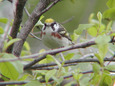
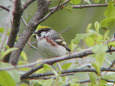
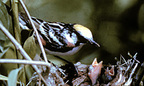
In non-breeding plumage, chestnut-sided warblers can be identified by their plain white underparts, greenish yellow upperparts, bold white wingbars, and white eye ring. In the summer, breeding plumage, chestnut-sided warblers have a yellowish forehead, black eye-stripe, plain white underparts, and a chestnut streak along its sides. The chestnut streak is longer and brighter in males and older birds. It may be missing completly in immature females and first year males.
- Other Physical Features
- endothermic
- homoiothermic
- bilateral symmetry
- Sexual Dimorphism
- sexes colored or patterned differently
- male more colorful
-
- Average mass
- 9 g
- 0.32 oz
- AnAge
Reproduction
The chestnut-sided warbler is believed to be monogamous. They can reproduce in their first year. After returning from winter migration and before the females arrive, males establish territory by continuous singing and aggression. Once females arrive, males act very aggressively at first. After copulation, the male follows the female, apparently guarding her. A female constructs a nest entirely on her own in deciduous trees or shrubs. She also incubates the eggs alone. Eggs are laid mid-May to mid-July. On average, there are about four eggs per brood and only one brood is reared per season. Both parents care for the young. At first they feed the young by regurgitation, then as the young become older they are fed small insects. Both parents help in removing waste from the nest.
When they first hatch, the young are altricial. They experience rapid growth in the first week and are capable of flight on the ninth day. They usually leave the nest on the tenth or eleventh day and move to low open thickets where they wait to be fed. They continue to beg for food until they are about one month old.
- Key Reproductive Features
- iteroparous
- gonochoric/gonochoristic/dioecious (sexes separate)
- sexual
- oviparous
Lifespan/Longevity
-
- Average lifespan
Status: wild - 83 months
- Bird Banding Laboratory
- Average lifespan
Behavior
The chestnut-sided warbler is believed to be monogamous. It is highly territorial during the breeding season. It is a nocturnal migrant. During migration, it may join other flocks and occasionally forage with them. Males produce two song classes. The first is used before the arrival of the females and in the early nesting cycle. The second is used while raising young. Young birds learn songs from adults.
- Key Behaviors
- flies
- motile
Communication and Perception
Food Habits
The chestnut-sided warbler is predominately insectivorous, but will eat some fruit. Each bird forages alone. It searches on the underside of leaves for insects. It hops from branch to branch with its tail cocked.
Economic Importance for Humans: Positive
The chestnut-sided warbler eats potentially harmful insects. This may benefit farmers as a natural way to control insect populations.
Conservation Status
Studies have been done on the effect of pesticides on the chestnut-sided warbler. They show that the birds still forage in treated areas, but return in fewer numbers in following years. It has been suggested that because the chestnut-sided warbler forages on the undersides of leaves, it may be less affected than other species in treated areas. It has been reported that a large number of chestnut-sided warblers are killed in collisions with stationary objects. Many are found dead at the base of TV towers, smokestacks, and large buildings during migration.
-
- IUCN Red List
-
Least Concern
More information
-
- US Migratory Bird Act
- Protected
-
- US Federal List
- No special status
-
- CITES
- No special status
-
- State of Michigan List
- No special status
Contributors
Sharon Swiderek (author), University of Michigan-Ann Arbor.
Glossary
- Nearctic
-
living in the Nearctic biogeographic province, the northern part of the New World. This includes Greenland, the Canadian Arctic islands, and all of the North American as far south as the highlands of central Mexico.

- Neotropical
-
living in the southern part of the New World. In other words, Central and South America.
- acoustic
-
uses sound to communicate
- bilateral symmetry
-
having body symmetry such that the animal can be divided in one plane into two mirror-image halves. Animals with bilateral symmetry have dorsal and ventral sides, as well as anterior and posterior ends. Synapomorphy of the Bilateria.
- chemical
-
uses smells or other chemicals to communicate
- endothermic
-
animals that use metabolically generated heat to regulate body temperature independently of ambient temperature. Endothermy is a synapomorphy of the Mammalia, although it may have arisen in a (now extinct) synapsid ancestor; the fossil record does not distinguish these possibilities. Convergent in birds.
- forest
-
forest biomes are dominated by trees, otherwise forest biomes can vary widely in amount of precipitation and seasonality.
- iteroparous
-
offspring are produced in more than one group (litters, clutches, etc.) and across multiple seasons (or other periods hospitable to reproduction). Iteroparous animals must, by definition, survive over multiple seasons (or periodic condition changes).
- motile
-
having the capacity to move from one place to another.
- native range
-
the area in which the animal is naturally found, the region in which it is endemic.
- oviparous
-
reproduction in which eggs are released by the female; development of offspring occurs outside the mother's body.
- sexual
-
reproduction that includes combining the genetic contribution of two individuals, a male and a female
- tactile
-
uses touch to communicate
- visual
-
uses sight to communicate
References
Richardson,M., and D.W. Brauning. 1995. Chestnut-sided Warbler(Dendroica pensylvania). In The Birds of North America, No. 190 (A. Poole and F. Gill, eds.). The Academy of Natural Sciences, Philadelphia, and The American Ornithologists' Union, Washington, D.C.