Dendroica caerulescensblack-throated blue warbler



Geographic Range
Black-throated blue warblers are found in northeastern North America in the summer, breeding season. They are found from the northern Great Lakes region east to the Canadian maritime provinces, throughout New England, and south through the Appalachian mountains. In winter they are found in southernmost Florida, the Antilles south to Trinidad, and the coastal Yucatan peninsula, from Mexico and Belize to Honduras. (Holmes, et al., 2005)
- Biogeographic Regions
- nearctic
- neotropical
Habitat
Black-throated blue warblers are found in tracts of undisturbed deciduous and mixed-deciduous forests in their breeding range. Forests they occur in include those with maples (Acer), birches (Betula), beeches (Fagus grandifolia), eastern hemlock (Tsuga canadensis), spruce (Picea), and fir (Abies). The elevational range of these forests varies throughout the region. They prefer forests with a dense, shrubby understory. They migrate along woodlands and woodland fragments, including riparian forests. In winter they are found in tropical forests, including secondary forest, plantations, and disturbed forest fragments. (Holmes, et al., 2005)
- Habitat Regions
- temperate
- tropical
- terrestrial
- Terrestrial Biomes
- forest
- rainforest
- Other Habitat Features
- suburban
- agricultural
- riparian
Physical Description
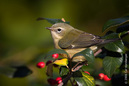
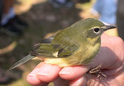
Black-throated blue warblers are about 13 cm long and from 9 to 10 g. Males and females have different plumages. Males have dark blue backs and black faces, throats, and sides. Their bellies and breasts are white. Females are olive green with buffy yellow throat, breast, and bellies. Females have a buffy eye stripe, a white semicircle below the eye, and a small white wing spot. Immature males have a greenish tinge to their dorsal feathers. They have black legs, feet, and bills, but they begin life with flesh-colored legs, feet, and bills. (Holmes, et al., 2005)
- Other Physical Features
- endothermic
- homoiothermic
- bilateral symmetry
- Sexual Dimorphism
- sexes colored or patterned differently
-
- Range mass
- 9 to 10 g
- 0.32 to 0.35 oz
-
- Average length
- 13 cm
- 5.12 in
Reproduction
Black-throated blue warblers are mainly monogamous, although rare males will maintain multiple female mates. Pairs are formed very soon after arrival at the breeding site. Mated pairs remain together for the breeding season through multiple broods or attempted broods. Males guard their mates closely and extra pair copulations are common in this warbler species. Approximately 34% of broods had nestlings that were not fathered by the territorial male. (Holmes, et al., 2005)
- Mating System
- monogamous
- polygynous
Black-throated blue warblers start breeding in late May or early June and may lay second clutches in late June or early July. Females determine nest sites and build them out of strips of bark, cobwebs, and saliva. They then line them with softer materials, like moss, hair, pine needles, or shredded bark. Males may help gather nest materials. Females may build up to 5 nests in a season if she has to re-nest several times. Females lay from 2 to 5, usually 4, white, speckled eggs in a clutch. Females usually lay 1 egg each day until done and begin incubating when the last egg is laid. Most females lay multiple clutches in a year either after losing a clutch or as a second nesting attempt after a first, successfully raised brood. They have been reported laying up to 5 clutches, but 2 is more typical. Incubation takes 12 to 13 days and young begin to fly between 8 and 10 days after hatching. They leave the nest at that point, but remain nearby and are fed and protected by their parents for another 2 to 3 weeks after they have fledged. Black-throated blue warblers can breed in their first year after hatching, although males may be unsuccessful at attracting mates until their second year. (Holmes, et al., 2005)
- Key Reproductive Features
- iteroparous
- seasonal breeding
- gonochoric/gonochoristic/dioecious (sexes separate)
- sexual
- oviparous
-
- Breeding interval
- Black-throated blue warblers breed seasonally and may attempt several clutches in a season, usually 2.
-
- Breeding season
- Black-throated blue warblers breed from late May through July or August.
-
- Range eggs per season
- 2 to 5
-
- Average eggs per season
- 4
-
- Range time to hatching
- 12 to 13 days
-
- Range fledging age
- 8 to 10 days
-
- Range time to independence
- 22 to 31 days
-
- Range age at sexual or reproductive maturity (female)
- 1 (low) years
-
- Average age at sexual or reproductive maturity (female)
- 1 years
-
- Range age at sexual or reproductive maturity (male)
- 1 to 2 years
Females incubate the eggs and brood hatchlings. Males may feed females while on the nest. Young hatch with their eyes closed and naked. Their eyes open at about 4 days old and they leave the nest at 8 to 10 days old, when they are just beginning to learn to fly. Males and females both feed nestlings and fledglings for up to 3 weeks after they fledge. Both parents protect their young from predators with alarm calls and distraction displays. (Holmes, et al., 2005)
- Parental Investment
- altricial
-
pre-fertilization
- provisioning
-
protecting
- female
-
pre-hatching/birth
-
provisioning
- female
-
protecting
- male
- female
-
provisioning
-
pre-weaning/fledging
-
provisioning
- male
- female
-
protecting
- male
- female
-
provisioning
-
pre-independence
-
provisioning
- male
- female
-
protecting
- male
- female
-
provisioning
Lifespan/Longevity
The oldest recorded black-throated blue warbler was at least 10 years old. There is some evidence that older individuals may have higher rates of survival, or higher site fidelity. Survival rates in the winter range were from 66 to 77% for females and males, respectively. Nestling mortality is largely from predation but nestlings also die from exposure during cold or rainy weather. (Holmes, et al., 2005)
-
- Range lifespan
Status: wild - 10 (high) years
- Range lifespan
Behavior
Black-throated blue warblers flit among vegetation and can hop on the ground. They are migratory and active during the day. They spend much of their time foraging, except when females are incubating eggs or brooding young, when they spend 75% of their time incubating or brooding. They are solitary throughout the year, except for mated pairs during breeding season. Males aggressively defend territories for feeding and nesting, excluding all conspecifics from the territory. (Holmes, et al., 2005)
Home Range
Foraging and nesting territories are from 1 to 4 hectares in size during the breeding season. In winter, foraging territories are from 0.2 to 0.3 hectares for males and slightly smaller for females. Although black-throated blue warblers don't seem to return to their natal site in their first year, adults seem to return to the same breeding and wintering sites each year. (Holmes, et al., 2005)
Communication and Perception
Black-throated blue warblers use a series of calls and songs to communicate. Females vocalize sometimes, but males perform the majority of songs. Male songs vary with individual, but there are two main song types: 1) a song of 3 to 7 buzzing notes that trills upward at the end, sounding like "zee-zee-zee-zreeee," and 2) a song of 2 to 5 notes that descends at the end, sounding like "zee-zee-zhurrr." The first song type is the most commonly heard and varies substantially among males. Males use other kinds of songs as well, although their purposes and contexts are not well understood. Most songs are used during the breeding season, but there is some singing during migration and in winter. Males sing from perches in their home range. (Holmes, et al., 2005)
Food Habits
Black-throated blue warblers are mainly insectivorous during the breeding season and supplement their insect diet with fruits during the winter. In the breeding range, these warblers eat mainly beetles, caterpillars, butterflies and moths, flies, bugs, and spiders. In the winter they eat as much as 95% insects, but supplement their diet with berries, other fruits, flower nectar, and honeydew excretions from scale insects. Black-throated blue warblers forage by themselves from 22 to 70% of daylight hours, depending on the season and their energy requirements. Females forage more during nest-building and the weeks leading up to egg laying, up to 70% of daylight hours. Males generally forage for 30-32% of daylight hours, but forage for an additional 20% when they are singing to defend nesting territories. They forage in undergrowth shrubs and forest canopy layers, taking most of their prey from leaves and bark. (Holmes, et al., 2005)
- Primary Diet
- carnivore
- Animal Foods
- body fluids
- insects
- terrestrial non-insect arthropods
- Plant Foods
- fruit
- nectar
Predation
Black-throated blue warbler adults are preyed on by birds of prey, such as Cooper's hawks (Accipiter cooperi). Eggs and nestlings are taken by a wide variety of nest predators, including sharp-shinned hawks (Accipiter striatus), blue jays (Cyanocitta cristata), red squirrels (Tamiasciurus hudsonicus), eastern chipmunks (Tamias striatus), martens (Martes americana), fishers (Martes pennanti), flying squirrels (Glaucomys), raccoons (Procyon lotor), black bears (Ursus americanus), and garter snakes (Thamnophis sirtalis). Black-throated blue warblers will mob predators and perform broken-wing displays to distract them. Parents give a high-pitched warning call when they see raptors and will respond to the warning calls of other birds. (Holmes, et al., 2005)
-
- Known Predators
-
- Cooper's hawks (Accipiter cooperi)
- sharp-shinned hawks (Accipiter striatus)
- blue jays (Cyanocitta cristata)
- red squirrels (Tamiasciurus hudsonicus)
- eastern chipmunks (Tamias striatus)
- martens (Martes americana)
- fishers (Martes pennanti)
- flying squirrels (Glaucomys)
- raccoons (Procyon lotor)
- black bears (Ursus americanus)
- garter snakes (Thamnophis sirtalis)
Ecosystem Roles
Black-throated blue warblers are important predators of insects in their forest habitats. They may also help to disperse seeds of the fruits they eat. There are few reported parasites in black-throated blue warblers. Only 2 nesting records indicate parasitism: bot flies (Oestridae) in one and parasitic fly larvae (Calliphoridae) in another. Brown-headed cowbirds will parasitize the nests of black-throated blue warblers, especially in areas of disturbed forest. If parasitized, they can successfully raise a cowbird young about 60% of the time. (Holmes, et al., 2005)
- bot flies (Oestridae)
- parasitic fly larvae (Calliphoridae)
- brown-headed cowbird (Molothrus ater)
Economic Importance for Humans: Positive
There is no direct positive impact of black-throated blue warblers on humans. However, they are lovely and interesting members of native faunas and may attract bird watching interest. (Holmes, et al., 2005)
Economic Importance for Humans: Negative
There are no known adverse effects of black-throated blue warblers on humans. However, along with many other bird species, they carry West Nile virus. (Holmes, et al., 2005)
- Negative Impacts
-
injures humans
- carries human disease
Conservation Status
Black-throated blue warblers have a large range and large populations without evidence of significant population declines. They are considered "least concern" by the IUCN. They are considered sensitive to forest fragmentation, preferring areas of forest over 100 hectares in size, but they are found in disturbed forests and secondary growth, provided there is a lush understory. Similarly, in their winter range, black-throated blue warblers are found in a variety of forests, including disturbed forests, orchards, and plantations, but populations may be negatively impacted by habitat destruction. They are also found dead as a result of collisions with man-made objects, such as television towers, during migration. (Holmes, et al., 2005)
-
- IUCN Red List
-
Least Concern
More information
-
- IUCN Red List
-
Least Concern
More information
-
- US Migratory Bird Act
- Protected
-
- US Federal List
- No special status
-
- CITES
- No special status
-
- State of Michigan List
- No special status
Contributors
Tanya Dewey (author), Animal Diversity Web.
Glossary
- Nearctic
-
living in the Nearctic biogeographic province, the northern part of the New World. This includes Greenland, the Canadian Arctic islands, and all of the North American as far south as the highlands of central Mexico.

- Neotropical
-
living in the southern part of the New World. In other words, Central and South America.
- acoustic
-
uses sound to communicate
- agricultural
-
living in landscapes dominated by human agriculture.
- altricial
-
young are born in a relatively underdeveloped state; they are unable to feed or care for themselves or locomote independently for a period of time after birth/hatching. In birds, naked and helpless after hatching.
- arboreal
-
Referring to an animal that lives in trees; tree-climbing.
- bilateral symmetry
-
having body symmetry such that the animal can be divided in one plane into two mirror-image halves. Animals with bilateral symmetry have dorsal and ventral sides, as well as anterior and posterior ends. Synapomorphy of the Bilateria.
- carnivore
-
an animal that mainly eats meat
- chemical
-
uses smells or other chemicals to communicate
- diurnal
-
- active during the day, 2. lasting for one day.
- endothermic
-
animals that use metabolically generated heat to regulate body temperature independently of ambient temperature. Endothermy is a synapomorphy of the Mammalia, although it may have arisen in a (now extinct) synapsid ancestor; the fossil record does not distinguish these possibilities. Convergent in birds.
- forest
-
forest biomes are dominated by trees, otherwise forest biomes can vary widely in amount of precipitation and seasonality.
- insectivore
-
An animal that eats mainly insects or spiders.
- iteroparous
-
offspring are produced in more than one group (litters, clutches, etc.) and across multiple seasons (or other periods hospitable to reproduction). Iteroparous animals must, by definition, survive over multiple seasons (or periodic condition changes).
- migratory
-
makes seasonal movements between breeding and wintering grounds
- monogamous
-
Having one mate at a time.
- motile
-
having the capacity to move from one place to another.
- native range
-
the area in which the animal is naturally found, the region in which it is endemic.
- oviparous
-
reproduction in which eggs are released by the female; development of offspring occurs outside the mother's body.
- polygynous
-
having more than one female as a mate at one time
- rainforest
-
rainforests, both temperate and tropical, are dominated by trees often forming a closed canopy with little light reaching the ground. Epiphytes and climbing plants are also abundant. Precipitation is typically not limiting, but may be somewhat seasonal.
- riparian
-
Referring to something living or located adjacent to a waterbody (usually, but not always, a river or stream).
- seasonal breeding
-
breeding is confined to a particular season
- sexual
-
reproduction that includes combining the genetic contribution of two individuals, a male and a female
- solitary
-
lives alone
- suburban
-
living in residential areas on the outskirts of large cities or towns.
- tactile
-
uses touch to communicate
- temperate
-
that region of the Earth between 23.5 degrees North and 60 degrees North (between the Tropic of Cancer and the Arctic Circle) and between 23.5 degrees South and 60 degrees South (between the Tropic of Capricorn and the Antarctic Circle).
- terrestrial
-
Living on the ground.
- territorial
-
defends an area within the home range, occupied by a single animals or group of animals of the same species and held through overt defense, display, or advertisement
- tropical
-
the region of the earth that surrounds the equator, from 23.5 degrees north to 23.5 degrees south.
- visual
-
uses sight to communicate
References
Holmes, R., N. Rodenhouse, T. Sillett. 2005. Black-throated Blue Warbler (Dendroica caerulescens). The Birds of North America Online, 87: 1-20. Accessed April 18, 2009 at http://bna.birds.cornell.edu.proxy.lib.umich.edu/bna/species/087.