Dendrobates tinctorius




Geographic Range
Dendrobates tinctorius is found only in the southernmost part of the South American country of Suriname in a region known as the Sipaliwini Savannah. (Silverstone, 1975; Durrell, 2001; )
- Biogeographic Regions
- neotropical
Habitat
Dendrobates tinctorius inhabits small isolated forest areas surrounded by the dry, prairie-like Sipaliwini Savannah at elevations from 315 to 430 m. However, the forest habitat of D. tinctorius is rather humid and warm with temperatures ranging from 22 to 27 degrees Celsius during the day to 20 degrees Celsius at night. Dendrobates tinctorius prefers a dark, moist environment, living only near small streams among moss-covered rocks. It typically remains on the ground, but has been found in trees at heights of up to 5 m. (Durrell, 2001; Hamlett, 2002; Silverstone, 1975)
- Habitat Regions
- tropical
- terrestrial
- Terrestrial Biomes
- rainforest
-
- Range elevation
- 315 to 430 m
- 1033.46 to 1410.76 ft
Physical Description
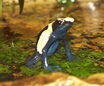
Dendrobates tinctorius is a mid-sized dendrobatid frog weighing about 3 grams and having a length ranging from 3 to 4.5 cm. Dendrobates tinctorius is brightly colored, and this coloration serves as a warning to would-be predators of its poisonous properties. In fact, its skin is covered with a myriad of glands that secrete alkaloid poisons capable of paralyzing, even killing predators. The coloration of D. tinctorius is an azure-blue hue on the limbs, a sky-blue on its dorsal surface, and a darker blue on its ventral surface. An irregular pattern of dark blue and black spots of various sizes cover this background coloration with the majority of the spotting located on its back as well as head. The pattern of spots is unique to each frog and thus serves as a "fingerprint" to differentiate between individuals. Sometimes, the ventral surface of the body has a dark blue or black midbelly stripe. Its skin is generally smooth, but often portions of the posterior ventral surface and thighs have a granular texture. Dendrobates tinctorius has four toes per foot; each of which has a wide, flattened tip and a suction cup pad used to help it grip in the slippery environment it inhabits. This species is also characterized by its hunch-backed posture. (Durrell, 2001; Goin, et al., 1978; Hamlett, 2002; "Blue Poison Dart Frog", 2002; Sandmeier, 2003; Silverstone, 1975)
Males and females are quite similar in appearance. However, the female is slightly larger and more plump than the male, with her average body length about 4.5 cm and his only 4 cm. Males have larger toe-tips, specifically those on the second, third, and fourth digits. In addition, these toe-tips are heart-shaped in males and round in females. On the other hand, the young of D. tinctorius are much different from the adults. The tadpole larvae are characterized by a long tail used for locomotion in their free-swimming existence. The tadpoles have a head-body and on average are approximately 10 mm in length, 6 mm of which is made up by the tail. The young also lack legs and breathe by means of gills instead of lungs. (Blake and Sherriff, 2003; Durrell, 2001; Silverstone, 1975)
- Other Physical Features
- ectothermic
- heterothermic
- bilateral symmetry
- poisonous
- Sexual Dimorphism
- female larger
-
- Average mass
- 3 g
- 0.11 oz
-
- Range length
- 3 to 4.5 cm
- 1.18 to 1.77 in
Development
Dendrobates tinctorius undergoes a metamorphosis in which it starts out as an egg, then hatches from the egg as a tadpole, and finally develops into an adult frog. The incubation period for the eggs is about 14-18 days. After hatching, the tadpole metamorphoses into an adult in 10 to 12 weeks. The process of sex ascription in D. tinctorius is still unknown. (Durrell, 2001; "Blue Poison Dart Frog", 2002)
- Development - Life Cycle
- metamorphosis
Reproduction
Dendrobates tinctorius breeds seasonally in the wild, usually during the rainy season (February and March). In captivity, it is known to breed year round. Males position themselves on a rock or a leaf and produce quiet calls in order to attract a female. Females then follow these calls to locate the male. Once found, females fight aggressively over the male. Afterwards, the victorious female begins the courtship ritual by gently stroking his snout and dorsal surface with her forelegs. Courtship may also involve chasing and wrestling between the male and female. Finally, the male leads the female to a secluded location of his choosing near a water source to mate and lay eggs. However, the mating process of D. tinctorius is still not entirely understood. Unlike most frog species, which practice the mating ritual of amplexus, males of D. tinctorius do not display this behavior. (Durrell, 2001; Hamlett, 2002; "Blue Poison Dart Frog", 2002)
The particular mating system of D. tinctorius is unknown, but many close relatives are polygynous (one male mates with several females). For instance, the green poison dart frog, Dendrobates auratus, is polygynous. (Summers, 1990)
Dendrobates tinctorius are solitary animals, interacting with others only during territorial fighting and breeding. Dendrobates tinctorius usually breed in the months of February and March producing 5-10 offspring per clutch. The eggs laid by the female hatch after about 14-18 days, and the juvenile tadpole matures into an adult in 10-12 weeks. The total time to independence for the frogs is about 84-102 days and both sexes reach sexual maturity at 2 years of age. Unlike most frogs which lay their eggs in water, the eggs of D. tinctorius are placed in consistently-moist, mossy areas underneath rocks or logs. (Durrell, 2001; "Poison-Arrow Frog", 2003)
- Key Reproductive Features
- seasonal breeding
- gonochoric/gonochoristic/dioecious (sexes separate)
- sexual
- fertilization
- oviparous
-
- Breeding interval
- This species breeds once yearly during the rainy season.
-
- Breeding season
- February-March
-
- Range number of offspring
- 5 to 10
-
- Range time to hatching
- 14 to 18 days
-
- Range time to independence
- 84 to 102 days
-
- Average age at sexual or reproductive maturity (female)
- 2 years
-
- Average age at sexual or reproductive maturity (male)
- 2 years
The female of D. tinctorius lays her eggs in the territory of the male which he aggressively defends. Both the female and male moisten and clean the place where the eggs will be laid. The male usually is the primary caretaker of the eggs, but it is not uncommon for the female to tend to them as well. As the primary caretaker, the male not only looks after the eggs, but he also makes sure to keep them moist by excreting water on them. After about 14-18 days, the eggs hatch and emerge as tadpoles. The male then carries the tadpoles on his back from the egg-laying land site to a relatively small pool of water such as that within the center of a bromeliad plant, a leaf axil, or a tiny tree hole. Sometimes the female also helps in this transportation of the tadpoles. Oftentimes, the tadpoles are placed in separate pools as they are cannibalistic. After this transport, the male's care of the young ends. The female, however, frequently visits the tadpoles to lay unfertilized eggs providing them with food. Once the tadpoles metamorphose into adults, the parental care of the female ends and the young frogs are on their own. Essentially, the total parental care provided for the young ranges from 12 to 14 weeks. (Durrell, 2001; Goin, et al., 1978; Hamlett, 2002; "Poison-Arrow Frog", 2003; Sandmeier, 2003)
- Parental Investment
- no parental involvement
- pre-fertilization
-
pre-hatching/birth
-
provisioning
- female
-
protecting
- male
- female
-
provisioning
-
pre-weaning/fledging
-
provisioning
- female
-
protecting
- male
-
provisioning
-
pre-independence
-
provisioning
- female
-
protecting
- male
-
provisioning
Lifespan/Longevity
The lifespan of D. tinctorius is about 4-6 years in the wild. In captivity it is known to live on average about 10 years, and can survive for up to 12 years. ("Blue Poison Arrow Frog", 2000; Durrell, 2001)
-
- Range lifespan
Status: captivity - 12 (high) years
- Range lifespan
-
- Typical lifespan
Status: wild - 4 to 6 years
- Typical lifespan
-
- Average lifespan
Status: captivity - 10 years
- Average lifespan
Behavior
Dendrobates tinctorius is terricolous and remains close to some type of water source such as a stream. It is very active during the daytime (diurnal) and moves constantly with short leaps. This species is also bold, aggressive, and very territorial, especially the males which are known to fight over territories (sizes unknown). However, both sexes are known to defend their territories from frogs of the same species as well as those of other species. Aggressive behavior in D. tinctorius usually consists of calling, chases, and wrestling. Wrestling usually occurs between those of the same sex, but can occur between males and females. (Cloudsley-Thompson, 1999; Durrell, 2001; "Poison-Arrow Frog", 2003; "Blue Poison Dart Frog", 2002)
- Key Behaviors
- terricolous
- diurnal
- motile
- territorial
Home Range
The size of the home range for D. tinctorius is unknown.
Communication and Perception
Little is known about the communication behaviors of D. tinctorius. However, during mating, males emit a series of soft calls to attract females. Dendrobates tinctorius is capable of communicating by means of producing quiet calls, but the extent to which these are used in intraspecies communication is unknown. In addition to sound perception, this species perceives the surrounding environment both visually and with its sense of smell. (Durrell, 2001)
Food Habits
Dendrobates tinctorius is an insectivore, but also eats non-insect arthropods as well. Its diet consists of ants, beetles, flies, mites, spiders, termites, maggots, and caterpillars. In captivity, its diet consists primarily of crickets and fruit flies. Interestingly, the toxic compounds (poisons) in the skin of D. tinctorius, known as lipophilic alkaloids, are found in high percentages within its prey, especially in ants. Thus, upon eating prey, the compounds are absorbed into the skin of the frog providing it with a defense mechanism. In captivity, this species loses its poisonous properties due to the lack of toxic compounds within the food it is fed. Tadpoles feed on unfertilized eggs provided by their mother. (Cloudsley-Thompson, 1999; "Blue Poison Arrow Frog", 2000; Durrell, 2001)
- Primary Diet
-
carnivore
- eats eggs
- insectivore
- eats non-insect arthropods
- Animal Foods
- eggs
- insects
- terrestrial non-insect arthropods
Predation
The predators of D. tinctorius are unknown, but it does have anti-predatory adaptations. One adaptation is its bright blue coloration that serves as a warning to predators not to eat it. Another important adaptation are its toxins within its skin that are capable of paralyzing or even killing potential predators. However, D. tinctorius is still preyed upon by snakes and large spiders. Tadpoles are also consumed by snakes and dragonfly larvae. ("Blue poison dart frog", 2003; Cloudsley-Thompson, 1999; Hamlett, 2002; "Blue poison dart frog", 2003)
- Anti-predator Adaptations
- aposematic
Ecosystem Roles
The role of D. tinctorius in the ecosystem in which it lives is as a predator of spiders, flies, ants, termites, caterpillars, mites, and beetles. (Durrell, 2001)
Economic Importance for Humans: Positive
Dendrobates tinctorius plays an important role in the rainforest ecosystem as a predator of small arthropods. Without this contribution, no matter how miniscule it may be, drastic changes in the food web could result. More recently, D. tinctorius has become quite a commodity worldwide in the pet trade. Their popularity is so great that many people are willing to pay around 75 dollars for one individual. In addition, the toxins of D. tinctorius are being studied by scientists for possible pharmaceutical uses (like the painkiller epibatidine, found in dart frogs of the genus Phyllobates). The species itself is being researched as well to give scientists a better understanding of its life habits, especially in the wild. ("Amphibians (Blue Dart Frogs)", 2003; Frazer, 1973; Hamlett, 2002; "Poison-Arrow Frog", 2003)
- Positive Impacts
- pet trade
- research and education
Economic Importance for Humans: Negative
Dendrobates tinctorius is poisonous, and its toxins could cause harm, and possibly prove fatal to a human. In fact, this frog contains on average about 200 micrograms of poison and only 2 of which is necessary to prove fatal to a human. (Hamlett, 2002)
- Negative Impacts
- injures humans
Conservation Status
The destruction of rainforest habitat by fires and by humans for farmland has contributed to the decreasing numbers of D. tinctorius in the wild. The illegal pet trade has also negatively impacted the existence of D. tinctorius by smuggling hundreds of these frogs out of Suriname into pet stores worldwide. With this pressure from illegal trade and shrinking habitat, D. tinctorius has become one of the most threatened of all the poison dart frogs in the neotropics. ("Suriname Conservation Projects", 2003; Durrell, 2001)
As a result of these pressures, much is currently being done to conserve the species. Captive breeding programs have sprung up in zoos and among private enthusiasts across the United States in attempts to conserve this rare species, while scientists, in hopes of obtaining a better understanding of these frogs, have conducted research expeditions in Suriname. For instance, the Atlanta Botanical Garden, in conjunction with the Suriname Forest Service, Conservation International Suriname, and the National Aquarium in Baltimore, has created a captive breeding program with the hopes of increasing D. tinctorius numbers. The National Aquarium in Baltimore was actually the first institution in the United States to breed D. tinctorius and has continued doing so ever since. In England, Durrell Wildlife has successfully bred this species since 1995 and has also distributed these frogs to other zoos around the world. Other efforts are being made to reintroduce these frogs into native areas where they have been completely decimated and to educate those individuals who collect the frogs to help ensure the survival of the species. Hopefully, through these efforts, D. tinctorius will be ensured preservation indefinitely. ("Suriname Conservation Projects", 2003; Durrell, 2001; "Blue poison dart frog", 2003)
-
- IUCN Red List
-
Least Concern
More information
-
- IUCN Red List
-
Least Concern
More information
-
- US Federal List
- No special status
-
- CITES
- Appendix II
Other Comments
Dendrobates tinctorius has skin that remains sticky from mucus secretions which not only helps to hold moisture in, but also enables tadpoles to take hold when they are carried from the egg-site to their new aquatic home. (Hamlett, 2002)
Contributors
David Armitage (editor), Animal Diversity Web.
James Brown (author), University of Michigan-Ann Arbor, Phil Myers (editor), Museum of Zoology, University of Michigan-Ann Arbor.
Glossary
- Neotropical
-
living in the southern part of the New World. In other words, Central and South America.

- acoustic
-
uses sound to communicate
- aposematic
-
having coloration that serves a protective function for the animal, usually used to refer to animals with colors that warn predators of their toxicity. For example: animals with bright red or yellow coloration are often toxic or distasteful.
- bilateral symmetry
-
having body symmetry such that the animal can be divided in one plane into two mirror-image halves. Animals with bilateral symmetry have dorsal and ventral sides, as well as anterior and posterior ends. Synapomorphy of the Bilateria.
- carnivore
-
an animal that mainly eats meat
- chemical
-
uses smells or other chemicals to communicate
- diurnal
-
- active during the day, 2. lasting for one day.
- ectothermic
-
animals which must use heat acquired from the environment and behavioral adaptations to regulate body temperature
- external fertilization
-
fertilization takes place outside the female's body
- fertilization
-
union of egg and spermatozoan
- heterothermic
-
having a body temperature that fluctuates with that of the immediate environment; having no mechanism or a poorly developed mechanism for regulating internal body temperature.
- insectivore
-
An animal that eats mainly insects or spiders.
- metamorphosis
-
A large change in the shape or structure of an animal that happens as the animal grows. In insects, "incomplete metamorphosis" is when young animals are similar to adults and change gradually into the adult form, and "complete metamorphosis" is when there is a profound change between larval and adult forms. Butterflies have complete metamorphosis, grasshoppers have incomplete metamorphosis.
- motile
-
having the capacity to move from one place to another.
- oviparous
-
reproduction in which eggs are released by the female; development of offspring occurs outside the mother's body.
- pet trade
-
the business of buying and selling animals for people to keep in their homes as pets.
- poisonous
-
an animal which has a substance capable of killing, injuring, or impairing other animals through its chemical action (for example, the skin of poison dart frogs).
- rainforest
-
rainforests, both temperate and tropical, are dominated by trees often forming a closed canopy with little light reaching the ground. Epiphytes and climbing plants are also abundant. Precipitation is typically not limiting, but may be somewhat seasonal.
- seasonal breeding
-
breeding is confined to a particular season
- sexual
-
reproduction that includes combining the genetic contribution of two individuals, a male and a female
- tactile
-
uses touch to communicate
- terrestrial
-
Living on the ground.
- territorial
-
defends an area within the home range, occupied by a single animals or group of animals of the same species and held through overt defense, display, or advertisement
- tropical
-
the region of the earth that surrounds the equator, from 23.5 degrees north to 23.5 degrees south.
- visual
-
uses sight to communicate
References
Amazon Reptile Center Inc. 2003. "Amphibians (Blue Dart Frogs)" (On-line ). Accessed 03/17/03 at http://www.amazonreptile.com/amphibians.html.
Denver Zoological Foundation. 2000. "Blue Poison Arrow Frog" (On-line). Accessed March 13, 2003 at http://www.denverzoo.org/animalsplants/amphibians01.htm#arrow.
Oregon Zoo. 2002. "Blue Poison Dart Frog" (On-line). Oregon Zoo Animal Fact Sheets. Accessed September 02, 2006 at http://www.oregonzoo.org/Cards/Amazon/blue.poison.dart.frog.htm.
National Aquarium In Baltimore. 2003. "Blue poison dart frog" (On-line). Accessed March 13, 2003 at http://www.aqua.org/animals_bluepoisondartfrog.html.
Honolulu Zoo. 2003. "Poison-Arrow Frog" (On-line ). Accessed 03/13/03 at http://www.honoluluzoo.org/poisonarrow_frog.htm.
Atlanta Botanical Garden. 2003. "Suriname Conservation Projects" (On-line). Accessed March 13, 2003 at http://www.atlantabotanicalgarden.org/conservation/poisonfrogs_conservation.htm.
Blake , E., D. Sherriff. 2003. "Maintenance of the Blue Poison Arrow frog" (On-line ). Accessed 03/19/03 at http://www.thebdg.org/library/frogspecies/d_azureus1.htm.
Cloudsley-Thompson, J. 1999. The Diversity of Amphibians and Reptiles. New York: Springer.
Durrell, G. 2001. "Blue Poison-Dart Frog" (On-line ). Accessed 03/13/03 at http://www.durrellwildlife.org/upload/MainSite/Documents/pdfs/blue%20poison%20dart%20frog.pdf.
Frazer, J. 1973. Amphibians. London, England: Wykeham Publications Ltd.
Goin, C., O. Goin, G. Zug. 1978. Introduction To Herpetology. San Francisco CA: W.H. Freeman and Company.
Hamlett, L. 2002. "Blue Poison Arrow Frog" (On-line). Accessed March 13, 2003 at http://www.nashvillezoo.org/blfrog.htm.
Sandmeier, F. 2003. "Dendrobates azureus" (On-line). AmphibiaWeb. Accessed March 13, 2003 at http://amphibiaweb.org/cgi-bin/amphib_query?where-genus=Dendrobates&where-species=azureus.
Silverstone, P. 1975. Dendrobates azureus. Science Bulletin of the Los Angeles Museum of Natural History, 21: 43-44.
Summers, K. 1990. Paternal care and the cost of polygyny in the green dart-poison frog Dendrobates auratus. Behavioral Ecology and Sociobiology, 27: 307-313.