Deirochelys reticulariaChicken Turtle
Geographic Range
Chicken turtles, made up of three subspecies, are found in suitable habitat throughout the southeastern United States. Deirochelys reticularia is found in coastal areas from Virginia to Texas and northward into Oklahoma and Arkansas. The Florida subspecies, D. r. chrysea, is limited to peninsular Florida. The eastern, D. r. reticularia, and western, D. r. miaria, subspecies of chicken turtles are separated by the Mississippi River. (; Ernst, et al., 1994)
Habitat
Chicken turtles are semi-aquatic basking turtles, found on both water and land. They prefer quiet bodies of water: ponds, lakes, ditches, marshes, cypress swamps and Carolina bays. They bask on logs, rocks, and other emergent structures. They prefer water with plenty of aquatic vegetation and a soft substrate. Chicken turtles are tolerant of ephemeral aquatic habitats and readily travel onto land to burrow into the soil and escape dry conditions. They have been found at water depths of a few centimeters to more than 2 m. (Ernst, et al., 1994; Gibbons and Greene, 1978)
- Habitat Regions
- temperate
- terrestrial
- freshwater
- Terrestrial Biomes
- forest
- Aquatic Biomes
- lakes and ponds
- rivers and streams
- temporary pools
- Other Habitat Features
- riparian
-
- Range depth
- .01 to > 2 m
- 0.03 to ft
Physical Description
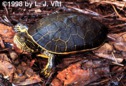
Chicken turtles are readily identified by their long, striped necks. Head and neck length is approximately equal to their plastron length, or up to 80% of the length of their carapace. They are sometimes called “American snake necks” because of this. They are small to medium-sized turtles with a pear-shaped, olive to dark brown carapace marked with a reticulate pattern of yellow to orange lines. They grow up to 25.4 cm long. The plastron is solid yellow and they have yellow stripes on their legs. Females are typically 1.5 times larger than males. Males have thicker tails, longer front claws, and more compressed shells than do females. ("Chicken Turtle", 2005; Ernst, et al., 1994; Gibbons and Greene, 1978)
Gibbons and Greene (1978) described patterns of growth in chicken turtles. Younger chicken turtles grow proportionally faster than adults but age at maximum size is not known. Young are 2.5 cm in diameter at hatching. Males mature at 10.2 cm, while females are mature at 17.8 cm. Chicken turtles may grow to a maximum size of 25.4 cm, though the typical adult ranges from 15.3 to 17.8 cm. (Ernst, et al., 1994; Gibbons and Greene, 1978)
- Other Physical Features
- ectothermic
- heterothermic
- bilateral symmetry
- Sexual Dimorphism
- female larger
- sexes shaped differently
-
- Range length
- 15.3 to 25.4 cm
- 6.02 to 10.00 in
Development
Chicken turtle embryos go through a period of diapause in the late gastrula stage. They must experience a period of cool temperatures before development proceeds. Eggs hatch in 152 days at 29 degrees Celsius in South Carolina and in 78 to 89 days at 25 to 29 degrees Celsius in Florida. Some eggs may overwinter in the nest before hatching. Incubation temperature influences the sex of the embryos, with a 25 degrees Celsius incubation temperature resulting in all males. Warmer temperatures result in an increase in female embryos, with only 11% becoming males at incubation temperatures of 30 degrees Celsius. (Ernst, et al., 1994)
Although size and age are directly related in chicken turtles, some individuals may experience several years of little or no growth, depending on environmental conditions. (Gibbons and Greene, 1978)
- Development - Life Cycle
- temperature sex determination
Reproduction
Males court female chicken turtles by vibrating their foreclaws against the female's face. Once the female is receptive, copulation occurs. (Ernst, et al., 1994)
- Mating System
- polygynandrous (promiscuous)
Chicken turtles are different from most other North American turtles because they nest in either the fall and winter. In South Carolina there are two egg-laying seasons; from winter to early spring (February to May) and fall to early winter (August to November). The highest percentages of nesting females in South Carolina were during the months of March and September. Florida chicken turtles nest nearly continuously from mid-September to early March. Females excavate cylindrical nests on land in a variety of soil types, from sandy to heavy soils. Females lay 2 clutches each year in South Carolina, with 5 to 15 elliptical eggs per clutch (average of 8); in Florida clutch size is 2 to 19 (average 9). The eggs are flexible and oblong, measuring 28 to 40 mm long and weighing 8.7 to 13.3 g. Eggs laid in the fall are usually larger than those laid in spring. (Buhlmann and Gibbons, 1995; Congdon, et al., 1983; Ernst, et al., 1994; Gibbons and Greene, 1978; Gibbons, 2004)
Male chicken turtles reach sexual maturity at 7.5 to 8.5 cm in carapace length, usually during their second or third year. Females mature at carapace lengths of 14.1 to 16 cm, after about 5 years of growth. (Buhlmann and Gibbons, 1995; Congdon, et al., 1983; Ernst, et al., 1994)
- Key Reproductive Features
- iteroparous
- seasonal breeding
- year-round breeding
- gonochoric/gonochoristic/dioecious (sexes separate)
- sexual
- oviparous
-
- Breeding interval
- Chicken turtles lay up to two clutches each year.
-
- Breeding season
- Breeding occurs two times a year in the northern part of their range and throughout the year in the southern part of their range.
-
- Range number of offspring
- 2 to 19
-
- Average number of offspring
- 8-9
-
- Range gestation period
- 78 to 152 days
-
- Average age at sexual or reproductive maturity (female)
- 5 years
-
- Average age at sexual or reproductive maturity (female)
Sex: female - 1825 days
- AnAge
- Average age at sexual or reproductive maturity (female)
-
- Range age at sexual or reproductive maturity (male)
- 2 to 3 years
Like most turtles, chicken turtles do not care for the hatchlings. Parents do not help the young once the eggs are laid. (Ernst, et al., 1994)
- Parental Investment
-
pre-fertilization
- provisioning
-
protecting
- female
Lifespan/Longevity
Wild chicken turtles in South Carolina have been recaptured up to 15 years after their first capture. Some reached maximum ages of 20 to 24 years. (Ernst, et al., 1994; Gibbons and Greene, 1978; Thomas, et al., 1997)
-
- Range lifespan
Status: wild - 24 (high) years
- Range lifespan
-
- Typical lifespan
Status: wild - 15 to 24 hours
- Typical lifespan
-
- Average lifespan
Sex: female
Status: captivity - 6.1 years
- Max Planck Institute for Demographic Research
- Average lifespan
Behavior
Chicken turtles are regularly encountered on land, either migrating between aquatic habitats or seeking areas to burrow into the soil and escape dry conditions. Males generally move farther than females. In South Carolina activity on land is highest in March and April. Chicken turtles spend much of their time basking and active turtles have been recorded with cloacal temperatures of 25.5 to 25.6 degrees Celsius. Chicken turtles hibernate in the soft mud and vegetation of bodies of water in the northern parts of their range. Florida chicken turtles remain active throughout the year. They are active during the day. (Ernst, et al., 1994)
- Key Behaviors
- natatorial
- diurnal
- motile
- sedentary
- hibernation
- aestivation
- solitary
Home Range
A single, marked chicken turtle moved 612 meters in a period of 8 months. Otherwise, there is little information on home ranges in chicken turtles, some researchers have suggested that movement is random or directional. (Ernst, et al., 1994)
Communication and Perception
Males use tactile communication to make females receptive to copulation. As in most turtles, chicken turtles use vision, touch, and chemical cues to perceive their environment. They are wary when basking.
- Communication Channels
- tactile
- Perception Channels
- visual
- tactile
- vibrations
- chemical
Food Habits
Chicken turtles are omnivorous, though they are somewhat more carnivorous than other turtle species. During their first year of life they may be almost completely carnivorous. Chicken turtles in South Carolina were found to be completely carnivorous during June and July (Buhlmann and Demuth, 1997). They eat primarily crustaceans, aquatic insects, tadpoles, fish, and plants. Chicken turtles use their well-developed hyoid apparatus to create suction that pulls food items into their throats. ("Chicken Turtle", 2005; ; Buhlmann and Demuth, 1997; )
- Primary Diet
- omnivore
- Animal Foods
- amphibians
- fish
- insects
- aquatic crustaceans
- Plant Foods
- leaves
Predation
Eastern moles (Scalopus aquaticus) are a significant predator of chicken turtle nests (Allen et al., 2005). Raccoons (Procyon lotor) and snapping turtles (Chelydra serpentina) are potential predators (Buhlmann, 1995). (Buhlmann and Mitchell, 2003; Buhlmann, 1995; Ernst, et al., 1994)
-
- Known Predators
-
- eastern moles (Scalopus aquaticus)
- raccoons (Procyon lotor)
- snapping turtles (Chelydra serpentina)
Ecosystem Roles
Chicken turtles are both predators and prey. They impact populations of aquatic insects, crustaceans, tadpoles, and aquatic vegetation. (; Buhlmann, 1995)
Economic Importance for Humans: Positive
Chicken turtles were once found in the food markets of the southern United States for their meat. Their common name, "chicken" turtle, refers to their taste. (Ernst, et al., 1994)
- Positive Impacts
- food
Economic Importance for Humans: Negative
There are no negative impacts of chicken turtles on humans. (Buhlmann and Mitchell, 2003; Peacock, 2000)
Conservation Status
Chicken turtle populations are currently considered stable throughout their range, although they do face potential threats. Habitat destruction reduces suitable habitat for foraging, migration, and hibernation. Chicken turtles are sometimes killed on roads as they migrate between habitats. Hunting for food also impacts populations of chicken turtles. (Buhlmann and Mitchell, 2003)
-
- IUCN Red List
- No special status
-
- US Federal List
- No special status
-
- CITES
- No special status
-
- State of Michigan List
- No special status
Other Comments
Chicken turtle fossils are known from the Pliocene, Pleistocene, and recent sites in Florida. (Ernst, et al., 1994)
Contributors
Tanya Dewey (author), Animal Diversity Web.
Glossary
- Nearctic
-
living in the Nearctic biogeographic province, the northern part of the New World. This includes Greenland, the Canadian Arctic islands, and all of the North American as far south as the highlands of central Mexico.

- bilateral symmetry
-
having body symmetry such that the animal can be divided in one plane into two mirror-image halves. Animals with bilateral symmetry have dorsal and ventral sides, as well as anterior and posterior ends. Synapomorphy of the Bilateria.
- bog
-
a wetland area rich in accumulated plant material and with acidic soils surrounding a body of open water. Bogs have a flora dominated by sedges, heaths, and sphagnum.
- chemical
-
uses smells or other chemicals to communicate
- diurnal
-
- active during the day, 2. lasting for one day.
- ectothermic
-
animals which must use heat acquired from the environment and behavioral adaptations to regulate body temperature
- food
-
A substance that provides both nutrients and energy to a living thing.
- forest
-
forest biomes are dominated by trees, otherwise forest biomes can vary widely in amount of precipitation and seasonality.
- freshwater
-
mainly lives in water that is not salty.
- heterothermic
-
having a body temperature that fluctuates with that of the immediate environment; having no mechanism or a poorly developed mechanism for regulating internal body temperature.
- hibernation
-
the state that some animals enter during winter in which normal physiological processes are significantly reduced, thus lowering the animal's energy requirements. The act or condition of passing winter in a torpid or resting state, typically involving the abandonment of homoiothermy in mammals.
- iteroparous
-
offspring are produced in more than one group (litters, clutches, etc.) and across multiple seasons (or other periods hospitable to reproduction). Iteroparous animals must, by definition, survive over multiple seasons (or periodic condition changes).
- marsh
-
marshes are wetland areas often dominated by grasses and reeds.
- motile
-
having the capacity to move from one place to another.
- natatorial
-
specialized for swimming
- native range
-
the area in which the animal is naturally found, the region in which it is endemic.
- omnivore
-
an animal that mainly eats all kinds of things, including plants and animals
- oviparous
-
reproduction in which eggs are released by the female; development of offspring occurs outside the mother's body.
- polygynandrous
-
the kind of polygamy in which a female pairs with several males, each of which also pairs with several different females.
- riparian
-
Referring to something living or located adjacent to a waterbody (usually, but not always, a river or stream).
- seasonal breeding
-
breeding is confined to a particular season
- sedentary
-
remains in the same area
- sexual
-
reproduction that includes combining the genetic contribution of two individuals, a male and a female
- solitary
-
lives alone
- swamp
-
a wetland area that may be permanently or intermittently covered in water, often dominated by woody vegetation.
- tactile
-
uses touch to communicate
- temperate
-
that region of the Earth between 23.5 degrees North and 60 degrees North (between the Tropic of Cancer and the Arctic Circle) and between 23.5 degrees South and 60 degrees South (between the Tropic of Capricorn and the Antarctic Circle).
- terrestrial
-
Living on the ground.
- vibrations
-
movements of a hard surface that are produced by animals as signals to others
- visual
-
uses sight to communicate
- year-round breeding
-
breeding takes place throughout the year
References
2005. Chicken Turtle. Pp. 199 in The New Encyclopedia Britannica, Vol. 3, 15th Edition. Chicago: Encyclopedia Britannica, Inc..
Buhlmann, K., J. Mitchell. 2003. "Virginia Cooperative Extension" (On-line). Sustaining America's Aquatic Biodiversity. Accessed March 05, 2006 at http://www.ext.vt.edu/pubs/fisheries/420-529/420-529.html#L5.
Buhlmann, K. 1995. Habitat Use, Terrestrial Movements, and Conservation of the Turtle, Deirochelys reticularia in Virginia. Journal of Herpetology, Volume 29 Number 2: 173-181.
Buhlmann, K., J. Demuth. 1997. Diet of the Turtle Deirochelys reticularia on the Savannah River Site, South Carolina. Journal of Herpetology, Volume 31 No. 3: 450-453.
Buhlmann, K., J. Gibbons. 1995. "University of Georgia Savannah River Ecology Laboratory News Release" (On-line). Unusual turtle species serving as a model in conservation of wetlands. Accessed March 15, 2006 at http://www.uga.edu/srel/chicken.htm.
Cervone, S., V. Ramey. 2004. "Plant Management in Florida Waters" (On-line). Florida's Freshwater Turtles. Accessed March 04, 2006 at http://aquat1.ifas.ufl.edu/guide/turtles.html.
Congdon, J., J. Gibbons, J. Greene. 1983. Parental Investment in the Chicken Turtle (Deirochelys reticularia). Ecology, Volume 64 No. 3: 419-425.
Ernst, C., J. Lovich, R. Barbour. 1994. Turtles of the United States and Canada. Washington, D.C.: Smithsonian Institution Press.
Gibbons, J. 1969. Ecology and Population Dynamics of the Chicken Turtle, Deirochelys reticularia. Copeia, Volume 1969 No. 4: 669-676.
Gibbons, J. 2004. "University of Georgia Savannah River Ecology Laboratory" (On-line). Why Did the Turtle Cross the Road?. Accessed March 15, 2006 at http://www.uga.edu/srelherp/ecoview/Eco12.htm.
Gibbons, J., J. Greene. 1978. Selected Aspects of the Ecology of Chicken Turtle, Deirochelys reticularia (Latreille) (Reptilia, Testudines, Emydidae). Journal of Herpetology, Volume 12 Number 2: pg. 237-241.
Peacock, T. 2000. Deirochelys reticularia (chicken turtle). Herpetological Review, 31/2: 110-111.
Thomas, R., D. Beckman, K. Thompson, K. Buhlmann, J. Gibbons, D. Moll. 1997. Estimation of Age for Trachemys scripta and Deirochelys reticularia by Counting Anuual Growth Layers in Claws. Copeia, Volume 1997 No. 4: pp. 842-845.