Damaliscus lunatustopi(Also: tsessebe)


Geographic Range
The range of the topis includes a series of segregated populations. These populations extend from the northern savanna to east and southern Africa (Estes, 1991).
Habitat
Topis prefer grassland habitats. These areas range from large treeless plains to areas with little bush and tree savannas. Topis are sometimes found in the uplands but are usually found in the lowlands. During the rains, topis avoid short or very mature grasses. In the dry season, they are abundant in any plant communities where there is a lot of grass (Estes, 1991).
- Terrestrial Biomes
- savanna or grassland
- forest
- scrub forest
Physical Description
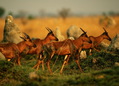
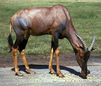
Topis are medium sized antelopes and range in height from 104 cm - 126 cm in males and 105 cm - 118 cm. The body of the topis is covered with a short, glossy coat that is tan in color with purple spots underneath. The markings of the topis are either white or dark in color. Adult males are darker than females and young calves have light markings. Topis have a long and narrow muzzle. Their horns oare S-shaped and are ringed, and range in length from 30 cm - 40 cm (Estes, 1991).
- Other Physical Features
- endothermic
- bilateral symmetry
-
- Range mass
- 90 to 147 kg
- 198.24 to 323.79 lb
Reproduction
Topis breed once a year. Most populations breed at the same time but a few populations have two calving peaks in a year. Unlike their close relatives, topis usually calve at the end of the dry season and have a good success rate. Gestation usually lasts around eight months. The calves are unusual because they can grow up as either a follower or a hider. If a calf is a follower, it is concealed within a large group of topis and is protected from predators by being in the herd. In small herds, babies may be "hiders"; that is, the mother may leave the herd for the birth of the calf and first few months afterward. Females only do this if there are places with considerable cover in which to hide from predators. Sometimes even in the large groups, the calves will leave the group at night to hide. The maternal bond lasts about a year or until the next calf is born. Males as young as eight months have been found in bachelor herds, but most males join these herds at the age of one year, at the end of the calving season or by the beginning of the rut. Females can breed at 16 - 18 months and reach their adult size in two years. Males are mature at three years of age, but it is unlikely that any will mate before four years of age (Estes, 1991).
- Key Reproductive Features
- gonochoric/gonochoristic/dioecious (sexes separate)
- sexual
-
- Range number of offspring
- 1 (low)
-
- Average number of offspring
- 1
-
- Average number of offspring
- 1
- AnAge
-
- Range gestation period
- 7.83 to 8.03 months
-
- Average gestation period
- 8 months
-
- Average age at sexual or reproductive maturity (female)
Sex: female - 639 days
- AnAge
- Average age at sexual or reproductive maturity (female)
- Parental Investment
- altricial
Lifespan/Longevity
-
- Range lifespan
Status: wild - 15 (high) years
- AnAge
- Range lifespan
Behavior
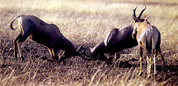
Habitat and ecological conditions determine the social structure of the topis. Territories may or may not have the same borders, depending on the size of the different territories. Most territories can support two to six females and their young under the age of one. Some females may occupy the same male's territory for up to three years. All territories have high vantage points that are used by both males and females. Males use these mounds to display where their territory is. Females use the mounds as a way to alert others of danger. Territorial males have exclusive rights to the females. Therefore, the herds are considered closed and both the males and females work to keep intruders out. When the bull is gone, the highest ranking female takes over the position of leader and is in charge. Traveling herd of topis travel through neutral territory and in dangerous areas - places where lions and other predators are - in order to avoid these territorial bulls and females. Males act differently depending on the social organization of the group. In a small herd, they are very protective of the females. They alert the females and young of approaching danger and defend them against predators. When there is a large group of topis, males are no longer protective and their only concern is meeting and securing females (Estes, 1991).
Every year, males go to traditional breeding areas, and the females arrive shortly afterwards in small groups or singly. Males approach a female in either a rocking canter or in a low stretch posture, searching for a female in heat. The female shows that she is ready by raising her head and standing tall. Before mounting, the male stands stationary behind the female. A cow will mate many times during her 1 - 1.5 days of heat with either the same male or many males (Estes, 1991).
- Key Behaviors
- motile
- migratory
- social
- dominance hierarchies
Communication and Perception
Food Habits
The diet of topis is composed almost entirely of grass. These animals have two feeding peaks, one in the morning and one in the late afternoon, but they can be found feeding at any time. Topis do not have to drink if the grass they are eating is water saturated. If they are eating dry grass, then they must drink water every day or two. During the rains, topis feed for longer periods of times and at shorter intervals (Estes, 1991).
Economic Importance for Humans: Positive
Topis, like other bovids, are fairly easy to maintain so they are an excellent animal to be displayed in zoos (Kingdon, 1989). They are hunted as trophies and for meat. Like other African bovids, they provide food for a large community of predators.
- Positive Impacts
- food
- body parts are source of valuable material
Conservation Status
The population of topis covers a large geographic area but has been broken up by hunting and habitat destruction by man (Estes, 1991).
-
- IUCN Red List
-
Least Concern
More information
-
- IUCN Red List
-
Least Concern
More information
-
- US Federal List
- No special status
-
- CITES
- No special status
Other Comments
A large populations of topis can live off the same land as cattle, even when the number of cattle is at the carrying capacity (Kingdon, 1989).
Contributors
Toni Lynn Newell (author), University of Michigan-Ann Arbor.
Glossary
- Ethiopian
-
living in sub-Saharan Africa (south of 30 degrees north) and Madagascar.

- altricial
-
young are born in a relatively underdeveloped state; they are unable to feed or care for themselves or locomote independently for a period of time after birth/hatching. In birds, naked and helpless after hatching.
- bilateral symmetry
-
having body symmetry such that the animal can be divided in one plane into two mirror-image halves. Animals with bilateral symmetry have dorsal and ventral sides, as well as anterior and posterior ends. Synapomorphy of the Bilateria.
- chemical
-
uses smells or other chemicals to communicate
- dominance hierarchies
-
ranking system or pecking order among members of a long-term social group, where dominance status affects access to resources or mates
- endothermic
-
animals that use metabolically generated heat to regulate body temperature independently of ambient temperature. Endothermy is a synapomorphy of the Mammalia, although it may have arisen in a (now extinct) synapsid ancestor; the fossil record does not distinguish these possibilities. Convergent in birds.
- food
-
A substance that provides both nutrients and energy to a living thing.
- forest
-
forest biomes are dominated by trees, otherwise forest biomes can vary widely in amount of precipitation and seasonality.
- migratory
-
makes seasonal movements between breeding and wintering grounds
- motile
-
having the capacity to move from one place to another.
- native range
-
the area in which the animal is naturally found, the region in which it is endemic.
- scrub forest
-
scrub forests develop in areas that experience dry seasons.
- sexual
-
reproduction that includes combining the genetic contribution of two individuals, a male and a female
- social
-
associates with others of its species; forms social groups.
- tactile
-
uses touch to communicate
- tropical savanna and grassland
-
A terrestrial biome. Savannas are grasslands with scattered individual trees that do not form a closed canopy. Extensive savannas are found in parts of subtropical and tropical Africa and South America, and in Australia.
- savanna
-
A grassland with scattered trees or scattered clumps of trees, a type of community intermediate between grassland and forest. See also Tropical savanna and grassland biome.
- temperate grassland
-
A terrestrial biome found in temperate latitudes (>23.5° N or S latitude). Vegetation is made up mostly of grasses, the height and species diversity of which depend largely on the amount of moisture available. Fire and grazing are important in the long-term maintenance of grasslands.
References
Estes, R.D. (1991). The Behavior Guide to African Mammals. The University of Califorinia Press: Berkeley, Los Angles, and London.
Kingdon, J. (1989). East African Mammals: An Atlas of Evolution in Africa, Volume III, Part D (Bovids). The University of Chicago Press: Chicago.