Cynocephalus volansPhilippine flying lemur

Geographic Range
Cynocephalus volans occurs on the Philippine islands of Mindanao, Basilan, Samar, Leyte, Bohol.
- Biogeographic Regions
- oriental
- oceanic islands
Habitat
Philippine colugos are entirely arboreal. They live in the multilayered rain forest. They are also often found near coconut and rubber plantations.
- Terrestrial Biomes
- rainforest
Physical Description
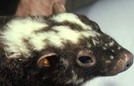
Colugos or "flying lemurs" neither resemble lemurs nor do they fly. They are cat-sized and a little smaller than the Malaysian flying lemurs. Fur coloration is usually darker and less spotted than in the Malaysian species. They have huge eyes and faces that resemble those of Old World fruit bats. The head is broad, somewhat like a greyhound's in appearance, with rounded short ears and a blunt muzzle. The limbs are of equal length, with strong sharp claws for climbing, and the toes are connected by webs of skin. This web of skin extends into a distinct structure called a patagium, which stretches from the side of the animal's neck to the tips of the fingers and toes and continues to the very tip of the tail. No other gliding mammal has such an extensive membrane. The arrangement of the unusual and distinctive incisor teeth is similar to that of herbivorous mammals such as cattle or deer. The upper incisors are located on the sides of the jaw and are caniniform, leaving a gap at the front so they do not oppose the forwardly protruded lower incisors. The lower incisors are comb-like with as many as 20 comb tines arising from one root, which may allow scraping and straining food, and also grooming and cleaning the fur. The molars retain a three-cusped insectivore pattern and have a shearing action that includes a large transverse component. This action, and the crenulated enamel of the molars, provide for efficient mastication of plant material. The dental formula is 2/3, 1/1, 2/2, 3/3 = 34.
- Other Physical Features
- endothermic
- homoiothermic
- bilateral symmetry
- Sexual Dimorphism
- sexes alike
-
- Range mass
- 1 to 1.75 kg
- 2.20 to 3.85 lb
Reproduction
Gestation takes 105 days. Usually a single young is produced, but occasionally twins are born. The infant is born in an underdeveloped state (altricial). The infant is carried on the belly of the mother.
- Key Reproductive Features
- iteroparous
- gonochoric/gonochoristic/dioecious (sexes separate)
- sexual
- viviparous
Behavior
Philippine colugos are crepuscular and seek refuge during the day in holes in trees. Their foraging activities are highest before sunset and a few hours prior to sunrise. They glide from tree to tree by climbing to the top of a tree and then launching themselves into the air. They are in control of their glides, usually landing on the lower trunk of another tree and then climbing up to start another gliding cycle. To move up a tree, they grasp the trunk with their outspread limbs and move both front feet together, then both hind feet. The glide distances can easily reach over 100 meters.
- Key Behaviors
- motile
Communication and Perception
Food Habits
The diet of Cynocephalus volans consists mainly of leaves, buds, and flowers from a variety of tree species. Most of the time, they prefer young leaves because young leaves contain higher nutritional value than old leaves. They also might eat fruits and sap. In general,they prefer larger trees for foraging because larger trees produce more young leaves and other food sources. They use their enlarged tongue and specialized lower incisors to pick leaves in a cow-like fashion. The stomach is specialized for ingesting large quantities of leafy vegetation. The intestines are long and convoluted. Their intestine can approach 4 meters in length. The pyloric digestive region, the part near the exit to the intestines, is enlarged and divided into compartments. These chambers harbors microorganisms that help break down cellulose and other relatively indigestible carbohydrates.
Economic Importance for Humans: Positive
Philippine colugos are hunted for their meat.
Economic Importance for Humans: Negative
Philippine colugos are considered by plantation owners as pests since their diet contain fruits, leaves, and flowers.
Conservation Status
Although Philippine Colugos are not endangered, they are threatened by deforestation and loss of habitat.
-
- IUCN Red List
-
Least Concern
More information
-
- IUCN Red List
-
Least Concern
More information
Contributors
Michael Kuo (author), University of Michigan-Ann Arbor, Phil Myers (editor), Museum of Zoology, University of Michigan-Ann Arbor.
Glossary
- bilateral symmetry
-
having body symmetry such that the animal can be divided in one plane into two mirror-image halves. Animals with bilateral symmetry have dorsal and ventral sides, as well as anterior and posterior ends. Synapomorphy of the Bilateria.
- chemical
-
uses smells or other chemicals to communicate
- endothermic
-
animals that use metabolically generated heat to regulate body temperature independently of ambient temperature. Endothermy is a synapomorphy of the Mammalia, although it may have arisen in a (now extinct) synapsid ancestor; the fossil record does not distinguish these possibilities. Convergent in birds.
- iteroparous
-
offspring are produced in more than one group (litters, clutches, etc.) and across multiple seasons (or other periods hospitable to reproduction). Iteroparous animals must, by definition, survive over multiple seasons (or periodic condition changes).
- motile
-
having the capacity to move from one place to another.
- native range
-
the area in which the animal is naturally found, the region in which it is endemic.
- oceanic islands
-
islands that are not part of continental shelf areas, they are not, and have never been, connected to a continental land mass, most typically these are volcanic islands.
- oriental
-
found in the oriental region of the world. In other words, India and southeast Asia.

- rainforest
-
rainforests, both temperate and tropical, are dominated by trees often forming a closed canopy with little light reaching the ground. Epiphytes and climbing plants are also abundant. Precipitation is typically not limiting, but may be somewhat seasonal.
- sexual
-
reproduction that includes combining the genetic contribution of two individuals, a male and a female
- tactile
-
uses touch to communicate
- threatened
-
The term is used in the 1994 IUCN Red List of Threatened Animals to refer collectively to species categorized as Endangered (E), Vulnerable (V), Rare (R), Indeterminate (I), or Insufficiently Known (K) and in the 1996 IUCN Red List of Threatened Animals to refer collectively to species categorized as Critically Endangered (CR), Endangered (EN), or Vulnerable (VU).
- viviparous
-
reproduction in which fertilization and development take place within the female body and the developing embryo derives nourishment from the female.
References
Cogger, H., J. Forshaw, E. Gould, G. McKay, R. Zweifel. 1993. Encyclopedia of Animals. 43 Victoria Street, McMahons Point, Sydney NSW 2060, Australia: The Reader's Digest Association Inc.
Macdonald, D., D. Bell, N. Bonner, T. Clutton, G. Corbert. 1984. The Encyclopedia of Mammals. 460 Park Ave South New York NY 10016: Facts on File Inc.
Vaughan, T., J. Ryan, N. Czaplewski. 2000. Mammalogy. Orlando, Florida: Emily Barrosse.
Wichusen, W., M. Richmond. November, 1998. Foraging Ecology of the Philippine Flying Lemur. Journal of Mammology, 79: 1288-1295.