Cygnus melancoryphusblack-necked swan


Geographic Range
Black-necked swans are native to south coastal South America and inland lakes in the Neotropical region. Black-necked swans breed in Patagonia, Tierra del Fuego, and the Falkland Islands. In winter they migrate northward to Paraguay and southern Brazil. (Dunning, 1987; Fjeldsa and Krabbe, 1990)
- Biogeographic Regions
- neotropical
Habitat
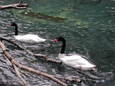
Habitats preferred by black-necked swans are shallow coastal areas along the Pacific Ocean, inland lakes, lagoons, estuaries and marshes. Especially important are areas rich with submergent vegetation. They are recorded from sea level to 1200 m elevation. (Fjeldsa and Krabbe, 1990; Jimenez II and Jiménez, 2000)
- Habitat Regions
- temperate
- saltwater or marine
- freshwater
- Aquatic Biomes
- lakes and ponds
- coastal
- brackish water
- Wetlands
- marsh
- Other Habitat Features
- estuarine
-
- Range elevation
- 0 to 1200 m
- 0.00 to 3937.01 ft
Physical Description
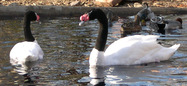
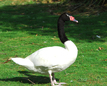
Black-necked swans are the smallest members of the genus Cygnus, ranging in length from 102 cm to 124 cm. Males range in mass from 4.5 kg to 6.7 kg, and females from 3.5 to 4.4 kg. Wingspan also differs between the sexes, where male wingspan range is 435 to 450 mm, in females it is 400 to 415 mm. Black-necked swans have a relatively high basal metabolism of 3680.56 cm^3 oxygen/hour. Cygnus melanocoryphus has a white body with a distinct long, velvet black neck and head, which distinguishes it from other swans. The neck and head also may have white speckles. The bluish-gray bill has a scarlet base with a large, double-lobed, red caruncle that rests on the base under the eyes. They have a white stripe behind the eyes that extends towards the back of the neck and the windpipe is unconvoluted (has only a slight bend). Black-necked swans have an elevated hind toe, a thin coat of feathers, and pointed wings. The legs are pink, very short, and have unusual positioning, making it hard for these swans to walk on land. The wings are covered in white feathers. Males are usually one-third larger than females, but are monomorphic in shape and color except for their considerably shorter necks. Cygnets (the young) are dull, light brownish-gray in color and have black bills and feet; they obtain their black neck and white body coat in their second year of life. ("ANIMAL BYTES - Black-necked Swan", 1994; "Common Name", 2006; Beeson, 2005; Fjeldsa and Krabbe, 1990; Miller and Eadie, 2006; Montgomery, 2006; Scott and Wildfowl Trust, 1972; Soothill and Whitehead, 1978; Wilmore, 1974)
- Other Physical Features
- endothermic
- homoiothermic
- bilateral symmetry
- Sexual Dimorphism
- sexes alike
- male larger
-
- Range mass
- 3500 to 6700 g
- 123.35 to 236.12 oz
-
- Range length
- 102 to 124 cm
- 40.16 to 48.82 in
-
- Range wingspan
- 400 to 450 mm
- 15.75 to 17.72 in
-
- Average basal metabolic rate
- 3680.56 cm3.O2/g/hr
Reproduction
Black-necked swans are monogamous and males and females mate for life. If one of them should die, the surviving mate will find a new mate. Breeding season begins in July and extends to September and November. Swans are known to have triumph ceremonies, which occur when a male attacks a rival suitor, then returns to his potential mate to perform an elaborate courtship ceremony while posturing and calling. Both males and females rhythmically dip their heads into the water and then stretch their necks upwards while swimming around each other. The triumph ceremony has no wing-raising and consists predominantly of calling and lifting of the chin. After copulation, there is no display of mating behavior except for habitual bathing. A nest is built in thick reed beds around the edges of bodies of water. The swan brings material to the site, such as rushes (vegetation) and aquatic plants, in order to build the large structure that partially floats. The cob is quite protective of his pen and her eggs and guards the nest for long periods of time. The monogamous behavior affects the care of cygnets such that the young have been known to ride on their parent's back. ("ANIMAL BYTES - Black-necked Swan", 1994; "Anseriformes; Ducks, Geese, Swans and Screamers", 2005; Fjeldsa and Krabbe, 1990; Montgomery, 2006; Scott and Wildfowl Trust, 1972; "Black-Necked Swan", 2003; Wilmore, 1974)
- Mating System
- monogamous
Black-necked swans breed between July and the autumn months. They can breed as many as three times during the mating season. Clutch sizes range from 3 to 7 eggs, with the mean being 4.6 eggs. It takes between 34 and 37 days for an egg to hatch, with the average being 35 days. Typically, eggs are between 101 x 66 mm in size and weigh approximately 238 gm. Fledging takes place within 10 weeks of hatching and each cygnet stays with its parents for 8 to 14 months before it is independent. Once a cygnet has reached the age of two (average), it is sexually mature and is able to mate. Even though the swans are mature at this age, they do not form pair bonds until they are three years old. Offspring stay with parents until the following summer, and may stay as long as the next winter season. ("ANIMAL BYTES - Black-necked Swan", 1994; Fjeldsa and Krabbe, 1990; Montgomery, 2006; Scott and Wildfowl Trust, 1972; United States Department of the Interior, 1964; Wilmore, 1974)
- Key Reproductive Features
- iteroparous
- seasonal breeding
- gonochoric/gonochoristic/dioecious (sexes separate)
- sexual
- oviparous
-
- Breeding interval
- There is one mating season per year but black-necked swans can lay up to three times each breeding season.
-
- Breeding season
- The breeding season for C. melancoryphus is between July and September to November at the latest.
-
- Range eggs per season
- 3 to 7
-
- Average eggs per season
- 4.6
-
- Range time to hatching
- 34 to 37 days
-
- Average time to hatching
- 35 days
-
- Average fledging age
- 70 days
-
- Range time to independence
- 8 to 14 months
-
- Average age at sexual or reproductive maturity (female)
- 2 years
-
- Average age at sexual or reproductive maturity (male)
- 2 years
During the incubation period, males are very protective of the nest and defend the territory surrounding the eggs. Although both parents are known to carry the young on their backs, the male usually takes over this responsibility after hatching so the female can concentrate on feeding; she must regain the weight she lost during incubation. Both parents provide the hatchlings with food and protection from predators. Females remain very close to cygnets during their foraging. Although vigorous in their use of wings and beak against attack from other animals, black-necked swans panic at the sight of humans and frequently leave their nests without covering their eggs. (Montgomery, 2006; Scott and Wildfowl Trust, 1972; "Black-Necked Swan", 2003; Wilmore, 1974)
- Parental Investment
- precocial
-
pre-fertilization
- provisioning
-
protecting
- female
-
pre-hatching/birth
-
provisioning
- female
-
protecting
- male
- female
-
provisioning
-
pre-weaning/fledging
-
provisioning
- male
- female
-
protecting
- male
- female
-
provisioning
-
pre-independence
-
provisioning
- male
-
protecting
- male
- female
-
provisioning
- post-independence association with parents
Lifespan/Longevity
In the wild, C. melancoryphus is expected to live between 10 and 20 years, which a record age of 30 years. In captivity, the average age for a black-necked swan is 6.8 years, but they can live up to 20 years. Typical causes of mortality include disease, predation on cygnets, and lack of food. Black-necked swans also suffer from lead poisoning from incidental ingestion of lead shot from guns used for hunting in the wetlands they inhabit. ("ANIMAL BYTES - Black-necked Swan", 1994; "Common Name", 2006; Scott and Wildfowl Trust, 1972; Wilmore, 1974)
-
- Range lifespan
Status: wild - 30 (high) years
- Range lifespan
-
- Typical lifespan
Status: wild - 121.67 to 243.33 months
- Typical lifespan
-
- Typical lifespan
Status: captivity - 20 (high) years
- Typical lifespan
-
- Average lifespan
Status: captivity - 6.8 years
- Average lifespan
Behavior
Black-necked swans are highly social. They are gregarious outside of the breeding season. During the breeding season they become territorial and separate into mated pairs. Despite its gregarious behavior with its own species, the black-necked swan is wary in proximity to humans, where it hides among the reeds and other vegetation. During breeding, they nest in small colonies or in solitaries, but regroup again once their young have hatched, reaching thousands of members to each flock. The flock may move around depending on resources and climate, but generally stay in the southern countries of South America until migration north. Cygnus melancoryphus spends most of its time in the water because walking on land is difficult due to the posterior placement of legs that aid in swimming. While they have difficulty taking flight, they are strong fliers once in the air and can cover long distances; they are one of the fastest fliers of the swan species, and can reach speeds of 50 miles per hour. In a flock, the birds circle each other and call repeatedly while moving the head up and down. If the male needs to defend his territory from another swan or a predator, his aggressive behavior is signaled by lowering the neck and thrusting the head forward. After fighting with a beating of its wings, the black-necked cob triumphantly returned to the female, continuously calling and lifting its chin. (Jimenez II and Jiménez, 2000; Soothill and Whitehead, 1978; "Black-Necked Swan", 2003; Wilmore, 1974)
- Key Behaviors
- flies
- natatorial
- diurnal
- motile
- migratory
- sedentary
- territorial
- social
-
- Average territory size
- 324 m^2
Home Range
Cygnus melancoryphus occupies mainly wet areas due to the difficulty it has with walking. Since it lives in relatively large flocks, the flock's range can span many kilometers either over land when flying, or on water when swimming. Although the flock range is large, each pair of swans claims a territory of 324 m^2 separating the various pairs of mating swans, a considerably smaller area than northern swan species. (Jimenez II and Jiménez, 2000; Wilmore, 1974)
Communication and Perception
Courting rituals, flight arrangement, and parental care all use visual communication. Swans signal to other members of the flock or a family unit by dipping the head or flapping the wings to suggest direction or the beginning of a triumph ceremony for mating. This species also uses tactile stimulation to communicate, such as grooming and bathing processes. Females groom young cygnets to teach them how to clean themselves and a bathing ritual is used after copulation to cement the pair-bond. Unlike most other swans, C. melancoryphus does not squawk or honk. Instead they use weak whistles to communicate. Black-necked swans are usually silent, but males give repeated hollow whining sounds, females are more melodious. The typical call for communication is a weak, wheezy whistle uttered both on water and in flight, but does not carry far. ("Swan, Birds, Swan, Bird Pictures, Catalog, Encyclopedia", 2003; Fjeldsa and Krabbe, 1990; Montgomery, 2006)
Food Habits
Black-necked swans feed mainly on aquatic vegetation, most often from the bottom of ponds. They have strong bills with serrated edges and a nail at the tip. The surface of the tongue is spinous, which aids in grasping and tearing plants. Also, horny serrations in the bill help to filter small food items from the water surface. This species is mainly vegetarian, feeding mostly on stonewarts (Characeae), pondweeds (Potamogeton), milfoil (Myriophyllum), wild celery (Vallisneria), and other waterweeds. They will also eat some invertebrates, like insects and rarely fish or frog spawn. ("Swan, Birds, Swan, Bird Pictures, Catalog, Encyclopedia", 2003; Fjeldsa and Krabbe, 1990; Scott and Wildfowl Trust, 1972)
- Animal Foods
- amphibians
- fish
- insects
- other marine invertebrates
- zooplankton
- Plant Foods
- leaves
- bryophytes
- algae
- macroalgae
- phytoplankton
- Foraging Behavior
- filter-feeding
Predation
Adults have few natural predators, but gulls are a threat to eggs and chicks. Minks and foxes also prey on small cygnets. Humans are considered predators when swans are hunted for food, game, and feathers or quills. ("Black-Necked Swan", 2003; Wilmore, 1974)
-
- Known Predators
-
- gulls (Larus)
- minks (Martes)
- foxes (Vulpes)
- humans (Homo sapiens)
Ecosystem Roles
Two Trichobilharzia species have been found in the nasal cavities of swans, which cause neuromotor problems. Schistosomula of both nasal and visceral Trichobilharzia species are able to develop and migrate for several days in a non-specific mammalian host, so humans are warned not to expose themselves to waters with dense swan populations and probably Trichobilharzia cercaria populations. Other species that use C. melancoryphus as a host are a gape-worm (Cyathostoma bronchialis), feather lice (Mallaphaga) and roundworm larvae (Echinuria uncinata). Gape-worms may cause pneumonia in young birds, often leading to death. Feeding on aquatic vegetation, C. melancoryphus controls algal populations in lakes such that they don't become invasive species in the environment. Black-necked swans may act as a keystone species for the management of these aquatic plants. (Skirnisson and Kolarova, 2002; Wilmore, 1974)
- Ecosystem Impact
- keystone species
- Trichobilharzia cercariae
- Cyathostoma bronchialis
- Mallaphaga
- Echinuria uncinata
Economic Importance for Humans: Positive
Swans were a source of food for native peoples of the world, but are seldom hunted currently. Due to the relatively calm nature of C. melancoryphus, they are a valuable breeding bird. There is a large pet trade in this species. Since they have a healthy population in South America and are not endangered, humans have been able to export C. melancoryphus to North America. Also, tourism is highly encouraged to the Falkland Islands just to witness the sight of this species, promoting the tourist industry. Swans control algal populations, improving water quality. (Montgomery, 2006; United States Department of the Interior, 1964; Van Wormer, 1972)
- Positive Impacts
- pet trade
- food
- ecotourism
Economic Importance for Humans: Negative
Human microsporidiosis, a serious disease of immunocompetent and immunosuppressed people, can be due to zoonotic and environmental transmission of microsporidian spores. The prevalence of microsporidian infections in waterfowl is significantly higher than in other birds. Waterborne microsporidian spores of species that infect people can originate from common waterfowl, like C. melancoryphus, which have unlimited access to surface waters, including waters used for production of drinking water. (Slodkowicz-Kowalska, et al., 2006)
- Negative Impacts
- injures humans
Conservation Status
Cygnus melancoryphus populations seem to be stable currently.
-
- IUCN Red List
-
Least Concern
More information
-
- IUCN Red List
-
Least Concern
More information
-
- US Migratory Bird Act
- No special status
-
- US Federal List
- No special status
-
- CITES
- No special status
-
- State of Michigan List
- No special status
Other Comments
Morphological, phylogenetic and molecular data suggests that the Cygnus evolved in Europe or western Eurasia during the Miocene, spreading all over the Northern Hemisphere until the Pliocene. When the southern species (C. melancoryphus) branched off is not known. (Scott and Wildfowl Trust, 1972)
Contributors
Tanya Dewey (editor), Animal Diversity Web.
Dragana Urdarevik (author), Kalamazoo College, Ann Fraser (editor, instructor), Kalamazoo College.
Glossary
- Neotropical
-
living in the southern part of the New World. In other words, Central and South America.

- acoustic
-
uses sound to communicate
- bilateral symmetry
-
having body symmetry such that the animal can be divided in one plane into two mirror-image halves. Animals with bilateral symmetry have dorsal and ventral sides, as well as anterior and posterior ends. Synapomorphy of the Bilateria.
- brackish water
-
areas with salty water, usually in coastal marshes and estuaries.
- causes disease in humans
-
an animal which directly causes disease in humans. For example, diseases caused by infection of filarial nematodes (elephantiasis and river blindness).
- chemical
-
uses smells or other chemicals to communicate
- choruses
-
to jointly display, usually with sounds, at the same time as two or more other individuals of the same or different species
- coastal
-
the nearshore aquatic habitats near a coast, or shoreline.
- diurnal
-
- active during the day, 2. lasting for one day.
- duets
-
to jointly display, usually with sounds in a highly coordinated fashion, at the same time as one other individual of the same species, often a mate
- ecotourism
-
humans benefit economically by promoting tourism that focuses on the appreciation of natural areas or animals. Ecotourism implies that there are existing programs that profit from the appreciation of natural areas or animals.
- endothermic
-
animals that use metabolically generated heat to regulate body temperature independently of ambient temperature. Endothermy is a synapomorphy of the Mammalia, although it may have arisen in a (now extinct) synapsid ancestor; the fossil record does not distinguish these possibilities. Convergent in birds.
- estuarine
-
an area where a freshwater river meets the ocean and tidal influences result in fluctuations in salinity.
- filter-feeding
-
a method of feeding where small food particles are filtered from the surrounding water by various mechanisms. Used mainly by aquatic invertebrates, especially plankton, but also by baleen whales.
- folivore
-
an animal that mainly eats leaves.
- food
-
A substance that provides both nutrients and energy to a living thing.
- freshwater
-
mainly lives in water that is not salty.
- herbivore
-
An animal that eats mainly plants or parts of plants.
- iteroparous
-
offspring are produced in more than one group (litters, clutches, etc.) and across multiple seasons (or other periods hospitable to reproduction). Iteroparous animals must, by definition, survive over multiple seasons (or periodic condition changes).
- keystone species
-
a species whose presence or absence strongly affects populations of other species in that area such that the extirpation of the keystone species in an area will result in the ultimate extirpation of many more species in that area (Example: sea otter).
- macroalgae
-
seaweed. Algae that are large and photosynthetic.
- marsh
-
marshes are wetland areas often dominated by grasses and reeds.
- migratory
-
makes seasonal movements between breeding and wintering grounds
- monogamous
-
Having one mate at a time.
- motile
-
having the capacity to move from one place to another.
- natatorial
-
specialized for swimming
- native range
-
the area in which the animal is naturally found, the region in which it is endemic.
- oviparous
-
reproduction in which eggs are released by the female; development of offspring occurs outside the mother's body.
- pet trade
-
the business of buying and selling animals for people to keep in their homes as pets.
- phytoplankton
-
photosynthetic or plant constituent of plankton; mainly unicellular algae. (Compare to zooplankton.)
- saltwater or marine
-
mainly lives in oceans, seas, or other bodies of salt water.
- seasonal breeding
-
breeding is confined to a particular season
- sedentary
-
remains in the same area
- sexual
-
reproduction that includes combining the genetic contribution of two individuals, a male and a female
- social
-
associates with others of its species; forms social groups.
- tactile
-
uses touch to communicate
- temperate
-
that region of the Earth between 23.5 degrees North and 60 degrees North (between the Tropic of Cancer and the Arctic Circle) and between 23.5 degrees South and 60 degrees South (between the Tropic of Capricorn and the Antarctic Circle).
- territorial
-
defends an area within the home range, occupied by a single animals or group of animals of the same species and held through overt defense, display, or advertisement
- visual
-
uses sight to communicate
- young precocial
-
young are relatively well-developed when born
- zooplankton
-
animal constituent of plankton; mainly small crustaceans and fish larvae. (Compare to phytoplankton.)
References
1994. "ANIMAL BYTES - Black-necked Swan" (On-line). Accessed October 10, 2006 at http://www.seaworld.org/animal-info/Animal-Bytes/animalia/eumetazoa/coelomates/deuterostomes/chordata/craniata/aves/anseriformes/black-necked-swan.htm.
Earth-Life Web Productions. 2005. "Anseriformes; Ducks, Geese, Swans and Screamers" (On-line). Accessed October 12, 2006 at http://www.earthlife.net/birds/anseriformes.html.
The Sacramento Zoological Society. 2003. "Black-Necked Swan" (On-line). Accessed October 12, 2006 at http://www.saczoo.com/1_about/_animals/fact_sheets/black_neck_swan2.pdf.
2006. "Common Name" (On-line). Accessed October 12, 2006 at http://www.ci.manhattan.ks.us/common/modules/documentcenter2/documentview.asp?DID=1382.
2003. "Swan, Birds, Swan, Bird Pictures, Catalog, Encyclopedia" (On-line). Accessed October 08, 2006 at http://www.4to40.com/earth/geography/htm/birdsindex.asp?counter=93.
Beeson, D. 2005. "The Swan Sanctuary, Shepperton (formerly Egham), England, UK - Rescuers of Swans, Cygnets, Geese, Goslings, Ducks, Ducklings, Waterfowl, Birds & Fledglings / Fledgelings" (On-line). Accessed October 12, 2006 at http://www.swanuk.org.uk/index%20frame.htm.
Dunning, J. 1987. South American Birds-A Photographic Aid to Identification. Newton Square, Pennsylvania: Harrowood Books.
Fjeldsa, J., N. Krabbe. 1990. Birds of the High Andes. Copenhagen, Denmark: Zoological Museum, University of Copenhagen.
Jimenez II, M., M. Jiménez. 2000. "Cygnus melancoryphus" (On-line). Accessed October 08, 2006 at http://www.damisela.com/zoo/ave/otros/anser/anatidos/cisne/blackneck/taxa.htm.
Jonas, M. 2006. "Black necked Swan - Cygnus melanocorypha Photo | TrekNature" (On-line). Accessed October 14, 2006 at http://www.treknature.com/gallery/Asia/China/photo15414.htm.
Meyer de Schauensee, R. 1966. Birds of South America and their Distribution. Philadelphia, Pennsylvania: Academy of Natural Sciences and Livingston Publishing Co..
Miller, M., J. Eadie. 2006. The Allometric Relationship between Resting Metabolic Rate and Body Mass in Wild Waterfowl (Anatidae) and an Application to Estimation of Winter Habitat Requirements. The Condor, 108/1: 166–177. Accessed November 11, 2006 at http://www.bioone.org/perlserv/?request=get-document&doi=10.1650%2F0010-5422(2006)108%5B0166%3ATARBRM%5D2.0.CO%3B2.
Montgomery, M. 2006. "Blacknecked Swan: WhoZoo" (On-line). Accessed October 14, 2006 at http://whozoo.org/Anlife99/marlamon/blnkswanindex.html.
Ogilvie, M., B. Pearson. 1994. Wildfowl. London: Hamlyn Limited.
Price, L. 1994. Swans of the World - In Nature, History, Myth & Art. Tulsa, Oklahoma: Council Oak Publishing Company.
Scott, P., Wildfowl Trust. 1972. The Swans. Boston: Houghton Mifflin Company.
Skirnisson, K., L. Kolarova. 2002. Are nasal Trichobilharzia cercariae potential threath to human health?. Laeknabladid, 88/10: 739-744.
Slodkowicz-Kowalska, A., T. Graczyk, L. Tamang, S. Jedrzejewski, A. Nowosad, P. Zduniak, P. Solarczyk, A. Girouard, A. Majewska. 2006. Microsporidian Species Known To Infect Humans Are Present in Aquatic Birds: Implications for Transmission Via Water?. Applied and Environmental Biology, 72/7: 4540–4544.
Soothill, E., P. Whitehead. 1978. Wildfowl of the World. Dorset, Great Britain: Blandford Press Ltd.
United States Department of the Interior, 1964. Waterfowl Tomorrow. Washington: Government Printing Office.
Van Wormer, J. 1972. The World of the Swan. Philadelphia and New York: J.B. Lippincott Company.
Wilmore, S. 1974. Swans of the World. London: David and Charles Limited.