Cuniculus pacalowland paca(Also: paca)

Geographic Range
Pacas are found in the neotropical regions of the Americas. They range from northeastern Mexico to Paraguay, Northern Argentina, and all the way down to southeastern Brazil. They likely do not inhabit any further north than the tropical subdeciduous forest of the Sierra Madre Oriental in northern Mexico. They have also been introduced in Algeria and Cuba. Paca are common and widely populated in the northern extent of their range, but are sparsely dispersed in the southern areas. There are 5 subspecies of pacas: the main subspecies present throughout this range is the Cuniculus paca paca. (Huanca-Hurachi, et al., 2011; Ojasti, 1996; Queirolo, et al., 2008; Rodriguez-Ruiz, et al., 2011)
- Biogeographic Regions
- nearctic
- palearctic
- neotropical
Habitat
Pacas like a variety of habitats, typically being found in tropical evergreen and tropical subdeciduous forests. They have also apparently been found in pine-oak, cloud forests, and mangroves. Different studies have found a wide range of population density estimates, ranging all the way from over 90 individuals per sq km to as low as 6 individuals per sq km in areas with hunting pressures. These rodents can be found around disturbed habitats, and often construct burrows around riparian zones near water, however these sites can be prone to flooding. In patchy habitat areas, pacas use undisturbed zones of forest as dispersal corridors. Agricultural plantations of fruit-bearing crops often produce a simulated agroforest environment, which is often adjacent to natural forest. Pacas and other forest-dwelling species will use this corridor to disperse across their range. Their population density and range is typically determined by the presence of fruit-bearing trees, and the abundance of fruit on the forest floor. Other factors influencing their population density include abundance of predators, type of forest, presence of water, and availability of denning locations. (Asquith, et al., 1999; Huanca-Hurachi, et al., 2011; Rodriguez-Ruiz, et al., 2011; Sa Petit Labao and Nogueira-Fiho, 2011)
- Habitat Regions
- tropical
- terrestrial
- Terrestrial Biomes
- forest
- rainforest
-
- Range elevation
- Sea Level to 2,300 m
- to ft
-
- Average elevation
- Below 1,600 m
- ft
Physical Description
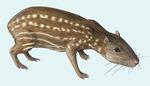
There are two species of pacas under the genus. There is the lowland or spotted paca and the mountain paca. Healthy adult lowland pacas, whether male or female, weigh in at about 6 to 12 kg, with males typically being slightly larger. Average adult length ranges from between 65 to 82 cm in males and 60 to 70 cm in females. They are a reddish-brown to darker brown color dorsally and have several rows of whitish spots down each side. Their underside is a lighter brown. Pacas are practically tailless, with short legs and a large, blunt head which make them slow and cumbersome on land, however they are quite good swimmers. They have four digits on their forefeet and 5 on their hindfeet. Cheek teeth are high-crowned (hypsodont), with a dental formula of incisors 1/1, canines 0/0, premolars 1/1, and molars 3/3 equaling 20, for a total of 40 teeth. They have a very broad zygomatic arch, which is coupled with concavities in the maxillary bones to form a reasonating chamber. The lowland paca is closely related to the mountain paca. Mountain pacas are typically smaller and have a thicker coat. There are also a number of differences in the morphology of the skull between the two species. Mountain pacas when compared with lowland pacas, have a less convex surface on the jugal bone. The infraorbital canal is also wider on the mountain pacas, and the suborbital process is more noticeable. Also, the nasal is more robust and longer, and the foramen is wider and deeper. Studies show that basal metabolic rates of lowland pacas average 0.44 with a standard deviation of 0.006 cubic cm of oxygen per g h (n=10, N=1) in subadult pacas averaging 4.5 kg, and about 0.30 with a standard deviation of 0.010 cubic cm of oxygen per g h (n=14, N=1) in adult pacas averaging 9 kg. This difference in metabolic rate is likely caused by higher activity levels while in captivity of the younger pacas. Body temperature typically remains around 37.0 with a standard deviation of 0.10°C (n=46, N=2) while at temperatures under 30°C. Pacas also have a high thermo conductance, reflective of their relatively thin coat. Subadults have a thermo conductance of around 0.037 with a standard deviation of 0.0005 cubic cm of oxygen per g h °C (n=24, N=1), while adults had a value of around 0.031±0.0012 cubic cm of oxygen per g h °C (n=8, N=1). (Arends and McNab, 2001; Ojasti, 1996; Rios-Uzeda, et al., 2004; Smythe, 1987; Vaughan, 1986)
- Other Physical Features
- endothermic
- bilateral symmetry
- Sexual Dimorphism
- male larger
-
- Range mass
- 7 to 12 kg
- 15.42 to 26.43 lb
-
- Range length
- 60 to 82 cm
- 23.62 to 32.28 in
-
- Average basal metabolic rate
- 0.30 ± 0.010 cm3.O2/g/hr
Reproduction
Lowland pacas are monogamous, with a pair of adult pacas mating for life, and usually inhabiting a home range of around 3 hectares. Males need to establish dominance over the females. The male establishes dominance and reinforces the pair bond by urinating on the female (enurination), who may become very aggressive if she is not receptive to this behavior. They may form a loose family group consisting of the male, female, and their offspring. (Smythe, 1987)
- Mating System
- monogamous
Pacas typically only have one or two offspring per year, and breed year round uniformly. It is believed this is largely due to the availability of fruit year round. There have been a number of studies conducted on the reproduction specifics of pacas, and the data are very similar. Generally, the estrous cycle of females averages around 32.5 days. Gestation length is typically somewhere around 148.6 days in captivity, while in the wild it is shorter, at around 97 to 118 days. Time between birth events averages about 224.5 days in captivity, and between 172 and 191 in the wild. In captivity 55.5% of females studied had two birthing events per year with one young per event. Of these births 44.7% were female and 55.3% were male. Newborn females weighed in around 605.9 g, while males averaged about 736.7 g, with an average length of around 23 cm. Females and males typically reach sexual maturity between 8 and 12 months, with most animals being sexually mature by a year. Structure of paca populations are estimated at around 74% adults, 3% subadults 19% juveniles, 4% infants. Males and females are thought to exist in an equal ratio. (Dubost, et al., 2005; Guimares, et al., 2008; Ojasti, 1996; Vaughan, 1986)
- Key Reproductive Features
- iteroparous
- year-round breeding
- gonochoric/gonochoristic/dioecious (sexes separate)
- sexual
- viviparous
-
- Breeding interval
- Pacas breed once or twice per year.
-
- Breeding season
- Pacas breed year round uniformly.
-
- Range number of offspring
- 1 to 2
-
- Range gestation period
- 97 to 118 days
-
- Average weaning age
- 3 months
-
- Range time to independence
- 2 to 6 months
-
- Range age at sexual or reproductive maturity (female)
- 8 to 12 months
-
- Range age at sexual or reproductive maturity (male)
- 8 to 12 months
Female pacas care for young for as little as 8 weeks, all the way up to over 6 months with lactation occurring for approximately 3 months. This lactation period can also overlap with a new female pregnancies. They are highly precocial at birth, as young are born fully developed, with open eyes and the ability to run and eat solid food within a day. Young follow their mothers and learn or “imprint” on her behaviors. Newborn pacas grow quite rapidly, reaching 4 kg by about three months and 6 kg in six months. (Ojasti, 1996; Smythe, 1987)
- Parental Investment
- precocial
- female parental care
-
pre-weaning/fledging
-
provisioning
- female
-
protecting
- female
-
provisioning
-
pre-independence
-
provisioning
- female
-
protecting
- female
-
provisioning
Lifespan/Longevity
The maximum lifespan for pacas in the wild is thought to be about 12.5 years, and the survival rate is estimated to be 80 percent. During the months between November and March there is often a shortage of food for the pacas. This time period is thought to be the limiting factor affecting population sizes of pacas. More often than not, the cause of death is being consumed by a predator, but pacas may be in a weakened state due to lack of food availability. (Ojasti, 1996; Smythe, 1987)
-
- Typical lifespan
Status: wild - 12.5 (high) years
- Typical lifespan
-
- Typical lifespan
Status: captivity - 12.5 (high) years
- Typical lifespan
Behavior
Pacas tend to sleep during the daytime in a sheltered spot: either a burrow or hollow log. They may build their own burrows, usually near to a water way, or occupy burrows constructed by other animals. These burrows typically have a couple entrances for general use, a couple more for emergency situations, and an internal cavity for sleeping during the day. Emergency escape exits will be covered with dry leaves and debris, while other exits are left open. Pacas are mainly nocturnal, and live in mostly permanent pairs. They do not alter the amount of nocturnal activity depending on the amount of lunar illumination, as many species do. However, they will often avoid open areas during periods of high lunar illumination and will stay in primary forest, likely due to predation pressure. Within their home range they will be quite aggressive towards members of the same sex or other species such as agoutis. They cooperate to defend their territory, with males and females residing in separate burrows in different parts of their range. Pacas are known to be frightened by unfamiliar stimuli. (Aquino, et al., 2009; Gallina, et al., 1992; Michalski and Norris, 2011; Ojasti, 1996; Queirolo, et al., 2008; Smythe, 1987)
- Key Behaviors
- terricolous
- fossorial
- natatorial
- nocturnal
- motile
- sedentary
- daily torpor
- territorial
- social
-
- Range territory size
- 0.03 to 0.04 km^2
Home Range
A pair of adults occupies a home range of about 3 or 4 hectares. The male and female will not use the same burrows, and will often burrow in different parts of the range in order to defend their territory against either intra or interspecific competition. This allows the pair to keep a better watch on different areas of their home range, and protect it from potential intruders. Some studies suggest that intraspecific competition is not strong between female pacas, as there will often be numerous females with home ranges overlapping. (Beck-King, et al., 1999; Gallina, et al., 1992; Smythe, 1987)
Communication and Perception
Lowland pacas, like most mammals, perceive their environment mainly through auditory and olfactory. However, they also have very advanced visual systems, due to their nocturnal lifestyle. These rodents have retinal ganglion cells and a tapetum lucidum that enhances their vision at night, allowing them to see well in darkness. This gives them an advantage over other similar diurnal species during times of low lunar illumination. Pacas have modified zygomatic arches and maxillary bones to produce a call unique to this species. The maxillaries have concavities that are coupled with the modified cheek structure to form a resonating chamber. When air is pushed through the chamber, a low rumbling sound is produced. (Michalski and Norris, 2011; Vaughan, 1986)
- Other Communication Modes
- mimicry
Food Habits
Pacas are frugivores, feeding mainly on fallen fruits, but will eat a wide variety of plant material including seeds, leaves, and tubers. Typically these rodents forage close to their denning grounds, and tend to limit their activity to a couple of small centers. Home range and activity will shift with fruit availability, often changing feeding locations around late August. Pacas will feed on native or foreign species of fruit. They prefer high energy foods such as mangos or avocados. They may eat the whole fruit, or may discard certain pieces of it. Pacas have been known to eat the seeds in addition to the fleshy part of the fruit. In a study done on captive pacas, spotted pacas were shown to have fruit preferences choosing with high energy contents, with mango (Mangifera indica), papaya (Carica papaya), and avocado (Persea americana) being some of the preferred foods. Introduced species such as jack-fruit (Artocarpus integrifolia) and buri (Polyandrococus caudensis) are also eaten. Some examples of vegetation the paca will not eat include flowering plants (Ocotea sps. and Terminalia sp), and palm trees (Irartea deltoidea). In the season between November and March, when there is a general shortage of fruit on the forest floor, pacas will browse on leaves and live off their fat reserves. (Asquith, et al., 1999; Beck-King, et al., 1999; Huanca-Hurachi, et al., 2011; Laska, et al., 2003; Michalski and Norris, 2011; Sa Petit Labao and Nogueira-Fiho, 2011; Smythe, 1987; Smythe, et al., 1982; Zucarotto, et al., 2010)
- Plant Foods
- leaves
- roots and tubers
- seeds, grains, and nuts
- fruit
Predation
Hunting pressure is estimated in certain areas to result in roughly 150 animals being harvested per year in a 500 sq km area. (0.4 pacas per sq km). Hunting by farmers has increased even more so due to their tendency to damage crops. Pacas use their ability to swim as an escape method from predators. Pacas are preyed on by a number of predators such as the jaguar and the cougar. Bush dogs are also predators of paca, and it is believed the presence of paca is influences the geographic distribution of these canids. (Aquino, et al., 2009; Gama Nogueira-Fiho and Sa Petit Labao, 2011; Gil and Lobo, 2012; Michalski and Norris, 2011; Rausch, et al., 1981; Vaughan, 1986)
- Anti-predator Adaptations
- cryptic
-
- Known Predators
-
- humans (Homo sapien)
- jaguars (Panthera onca)
- cougars (Puma concolor)
- bush dogs (Spethos venaticus)
Ecosystem Roles
Pacas and other herbivores (frugivores) have important influences on plant communities. Distribution and species richness of many plants are influenced by the actions of these mammals, meaning community composition and diversity are also affected. For some fruiting plant species (e.g. Attalea oleifera and Hymenaea courbaril) pacas are crucial in the regeneration of the species. The loss of pacas may result in loss of these tree species. Pacas are seed predators, they will eat the pods of many tree species (e.g. Hymenaea courbaril), and will effectively disperse the seeds throughout the forest. This action is important in the development of old-growth neotropical forests. Pacas could also be considered ecosystem engineers, because they dig burrows that other species use. (Asquith, et al., 1999; Darskaia and Malygin, 1996; Dubost, et al., 2005; Rausch, et al., 1981; Sa Petit Labao and Nogueira-Fiho, 2011; Silverman, et al., 2004)
Pacas serve as an intermediate host for parasites (Echinoccus vogeli). This parasite develops in the liver of pacas, and can also develop in humans. In pacas, these parasites are only harmful if the parasite causes infections and any harm in people is a result of parasite-host incompatibility. Men who regularly ingest paca meat can succumb to human leptospirosis, a result of the presence of disease causing microorganisms (Leptospira interrogans). Leptospirosis can result in rashes, fevers, muscle pain, and in some cases afflictions of the liver and kidney. Pacas also commonly serves as a host for a variety of flea species (e.g. Rhipsideigma lugubris). (Asquith, et al., 1999; Darskaia and Malygin, 1996; Dubost, et al., 2005; Rausch, et al., 1981; Sa Petit Labao and Nogueira-Fiho, 2011; Silverman, et al., 2004)
- Ecosystem Impact
- disperses seeds
- creates habitat
- parasites (Echinoccus vogeli)
- leptospirosis (Leptospira interrogans)
- fleas (Rhipsideigma lugubris)
Economic Importance for Humans: Positive
Pacas are an important game animal throughout their range and are used for food quite consistently by people living in these areas. Firearms, traps, and dogs are all used to hunt pacas. Paca meat is highly sought after throughout its native range, and is considered to be an important food source. Roughly 70% of the average 10 kg paca consists of usable meat. (Gallina, et al., 1992; Queirolo, et al., 2008; Smythe, 1987)
- Positive Impacts
- food
Economic Importance for Humans: Negative
Pacas are considered to be a pest on crops, gardens, and plantations. When asked about mammalian species doing damage to agricultural operations, most farmers and workers mentioned the paca as a problem, rating it second after the cacao rat. Crops affected by the paca include cocoa and fruit bearing crops (e.g. jack-fruit and buri). (Sa Petit Labao and Nogueira-Fiho, 2011; Vaughan, 1986)
- Negative Impacts
- crop pest
Conservation Status
Lowland pacas are listed as a species of Least Concern according to the IUCN redlist, although there have been pockets of extirpation in the southern areas of its range due to habitat loss. The spotted paca is not a conservation concern, due to its wide distribution and large population. Some surveys suggest that there have been disturbing signs of population decline due to extensive hunting and habitat loss. However, other studies have shown that pacas are widespread in many protected areas and apart from small pockets no signs of population decline have been seen. The mixing of agricultural systems, along with primary and secondary forest has created good habitat for pacas to survive and thrive in present day neotropics. Threats to the species include loss of habitat, forest fragmentation, hunting, and introduction of domestic species. (Huanca-Hurachi, et al., 2011; Queirolo, et al., 2008; Sa Petit Labao and Nogueira-Fiho, 2011)
-
- IUCN Red List
-
Least Concern
More information
-
- IUCN Red List
-
Least Concern
More information
Other Comments
Lowland pacas (Cuniculus paca) were formerly known by the scientific name Cuniculus paca until a ruling by the International Commission on Zoological Nomenclature permanently changed the taxonomy in 1998. Many papers still reference the mammal by its former name. Common names include both spotted pacas or the lowland pacas. (Wilson and Reeder, 2005)
Contributors
Gordon Macdonald (author), University of Manitoba, Jane Waterman (editor), University of Manitoba, Laura Podzikowski (editor), Special Projects.
Glossary
- Nearctic
-
living in the Nearctic biogeographic province, the northern part of the New World. This includes Greenland, the Canadian Arctic islands, and all of the North American as far south as the highlands of central Mexico.

- Neotropical
-
living in the southern part of the New World. In other words, Central and South America.
- Palearctic
-
living in the northern part of the Old World. In otherwords, Europe and Asia and northern Africa.
- acoustic
-
uses sound to communicate
- bilateral symmetry
-
having body symmetry such that the animal can be divided in one plane into two mirror-image halves. Animals with bilateral symmetry have dorsal and ventral sides, as well as anterior and posterior ends. Synapomorphy of the Bilateria.
- chemical
-
uses smells or other chemicals to communicate
- cryptic
-
having markings, coloration, shapes, or other features that cause an animal to be camouflaged in its natural environment; being difficult to see or otherwise detect.
- endothermic
-
animals that use metabolically generated heat to regulate body temperature independently of ambient temperature. Endothermy is a synapomorphy of the Mammalia, although it may have arisen in a (now extinct) synapsid ancestor; the fossil record does not distinguish these possibilities. Convergent in birds.
- female parental care
-
parental care is carried out by females
- folivore
-
an animal that mainly eats leaves.
- food
-
A substance that provides both nutrients and energy to a living thing.
- forest
-
forest biomes are dominated by trees, otherwise forest biomes can vary widely in amount of precipitation and seasonality.
- fossorial
-
Referring to a burrowing life-style or behavior, specialized for digging or burrowing.
- frugivore
-
an animal that mainly eats fruit
- granivore
-
an animal that mainly eats seeds
- herbivore
-
An animal that eats mainly plants or parts of plants.
- introduced
-
referring to animal species that have been transported to and established populations in regions outside of their natural range, usually through human action.
- iteroparous
-
offspring are produced in more than one group (litters, clutches, etc.) and across multiple seasons (or other periods hospitable to reproduction). Iteroparous animals must, by definition, survive over multiple seasons (or periodic condition changes).
- mimicry
-
imitates a communication signal or appearance of another kind of organism
- monogamous
-
Having one mate at a time.
- motile
-
having the capacity to move from one place to another.
- natatorial
-
specialized for swimming
- native range
-
the area in which the animal is naturally found, the region in which it is endemic.
- nocturnal
-
active during the night
- rainforest
-
rainforests, both temperate and tropical, are dominated by trees often forming a closed canopy with little light reaching the ground. Epiphytes and climbing plants are also abundant. Precipitation is typically not limiting, but may be somewhat seasonal.
- sedentary
-
remains in the same area
- sexual
-
reproduction that includes combining the genetic contribution of two individuals, a male and a female
- social
-
associates with others of its species; forms social groups.
- tactile
-
uses touch to communicate
- terrestrial
-
Living on the ground.
- territorial
-
defends an area within the home range, occupied by a single animals or group of animals of the same species and held through overt defense, display, or advertisement
- tropical
-
the region of the earth that surrounds the equator, from 23.5 degrees north to 23.5 degrees south.
- visual
-
uses sight to communicate
- viviparous
-
reproduction in which fertilization and development take place within the female body and the developing embryo derives nourishment from the female.
- year-round breeding
-
breeding takes place throughout the year
- young precocial
-
young are relatively well-developed when born
References
Aquino, R., D. Gil, E. Pezo. 2009. Ecological Aspects and hunting sustainability of paca (Cuniculus paca) in the italia river basin, Peruvian Amazonia. Revista Peruana de Biologia, 16/1: 67-72.
Arends, A., B. McNab. 2001. The Comparative Energetics of 'Caviomorph' Rodents. Comparative Biochemistry and Physiology, 130/1: 105-122.
Asquith, N., J. Terbogh, A. Arnold, C. Riveros. 1999. The fruits the agouti ate: Hymenaea courbaril seed fate when its disperser is absent.. Journal of Tropical Ecology, 15: 229-235.
Beck-King, H., O. von Helversen, R. Beck-King. 1999. Home Range, Population Density, and Food Resources of Agouti paca (Rodentia: Agoutidae) in Costa Rica: A Study Using Alternative Methods. Biotropica, 31/4: 675-685.
Darskaia, N., V. Malygin. 1996. The fleas of mammals from the Ucayali River basin (the Peruvian Amazonia). Parazitologiia, 2: 187-190.
Dubost, G., O. Henry, P. Comizzoli. 2005. Seasonality of reproduction in the three largest terrestrial rodents of French Guiana forest. Mammalian Biology, 70/2: 93-109.
Gallina, S., J. Perez-Torres, C. Guzman-Aguirre. 1992. Use of the paca, Cuniculus paca (Rodentia: Agoutidae) in the Sierra de Tabasco State Park, Mexico. Mammalian Species, 404: 1-7.
Gama Nogueira-Fiho, S., E. Sa Petit Labao. 2011. Human-wildlife Conflicts in the Brazilian Atlantic Forest.. Suiform Soundings, 10/2: 14-22.
Gil, G., J. Lobo. 2012. STATUS OF THE BUSH DOG (Speothos venaticus) IN THE EXTREME SOUTH OF ITS RANGE (ARGENTINA). Interciencia, 1: 21-28.
Guimares, D., A. Bastos, R. Luz-Rasmaros, O. Ohashi, H. Ribeiro. 2008. Reproductive [Reproductive] characteristics of the female paca (Agouti paca) raised in captivity.. Acta Amazonica, 38/3: 531-537.
Huanca-Hurachi, G., J. Herrera, A. Noss. 2011. Population density and habitat use of the paca (Cuniculus paca) in the north of the Amboro-Carrasco conservation complex.. Ecologia en Bolivia, 46/1: 4-13.
Laska, M., J. Luna Baltazar, E. Rodriguez Luna. 2003. Food preferences and nutrient composition in captive pacas, Agouti Paca (Rodentia, Dasyproctidae). Mammal Biology, 68: 31-41.
Michalski, F., D. Norris. 2011. Activity pattern of Cuniculus paca (Rodentia: Cuniculidae) in relation to lunar illumination and other abiotic variables in the southern Brazilian Amazon. Zoologia, 28: 701–708.
Ojasti, J. 1996. "Wildlife Utilization in Latin America: Current Situation and Prospects for Sustainable Management. (FAO Conservation Guide - 25)" (On-line). FAO Corporate Document History. Accessed November 29, 2012 at http://www.fao.org/docrep/t0750e/t0750e00.htm.
Queirolo, D., E. Vieira, L. Emmons, R. Samudio. 2008. "Cuniculus paca. In: IUCN 2012." (On-line). IUCN Red List of Threatened Species. Version 2012.2. Accessed October 29, 2012 at http://www.iucnredlist.org/details/699/0.
Rausch, R., A. D'Allessandro, V. Rausch. 1981. Characteristics of the Larval Echinococcus vogeli Rausch and Bernstein, 1972 in the Natural Intermediate host, the Paca, Cuniculus Paca L. (Rodentia: Dasyproctidae). The American Journal of Tropical Medicine and Hygiene, 30/5: 1043-1051.
Rios-Uzeda, B., R. Wallace, J. Vargas. 2004. The mountain paca (Cuniculus taczanowskii, Rodentia, Cuniculidae): a new mammal record for Bolivia.. Mastozoologica Neotropical, 11/1: 109-114.
Rodriguez-Ruiz, E., I. Casto-Areliano, J. Valencia-Harveth. 2011. New Records and Proposed Geographical Range of Pacas (Cuniculus paca) in Northeastern Mexico. The Southwestern Naturalist, 57/2: 219-221.
Sa Petit Labao, E., S. Nogueira-Fiho. 2011. Human-Wildlife Conflicts in the Brazilian Atlantic Forest. Suiform Soundings, 10/2: 14-22.
Silverman, M., L. Aronson, M. Eccles, J. Eisenstat, M. Gottesman, R. Rowsell, M. Ferron, D. Scolnik. 2004. Leptospirosis in febrile men ingesting Agouti paca in South America.. Annals of Tropical Medicine and Parasitology, 98/8: 851-859.
Smythe, N. 1987. The Paca (Cuniculus paca) as a Domestic Source of Protein for the Neotropical, Humid Lowlands. Applied Animal Behaviour Science, 17: 155-170.
Smythe, N., N. Glanz, E. Leigh. 1982. "Population regulation in some terrestrial frugivores" (On-line). CSA Illumina. Accessed October 28, 2012 at http://collections.si.edu/search/record/SILSRO_106631.
Vaughan, T. 1986. Mammalogy, 3rd Ed.. United States of America: Saunders College Publishing.
Wilson, D., D. Reeder. 2005. "Mammal Species of the World. A Taxonomic and Geographic Reference (3rd ed)" (On-line). Accessed February 23, 2013 at http://www.bucknell.edu/msw3/.
Zucarotto, R., R. Carrara, S. Franco, B. Karina. 2010. Diet of paca (Cuniculus paca) using indirect methods in an agricultural area in the Brazilian Atlantic Forest. Biotemas, 23/1: 235-239.