Ctenodactylidaegundis
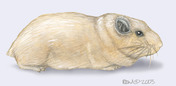
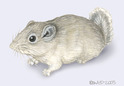
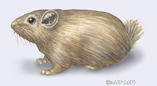
This family includes five species in four genera. Gundis are found in northern Africa.
Gundis are small, stocky rodents with short, furry tails and short legs. Adults weigh 170-200 gms. Their heads are large and blunt, their eyes are large, and superficially they resemble guinea pigs or pikas. Each foot has four digits, and on the hind feet, two of the digits have stiff bristles that form a comb. All digits have claws, which are not large but are very sharp. The soles of the feet have distinctive friction pads. The ears are short and rounded, and in some species, their openings are protected by a fringe of hairs around the inner margin of the ear. The pelage of these animals is soft, silky, and dense. The cuticular scales on individual hairs are unusual, narrow and petal-like. Most species are brown or gray in color.
Gundis have a flattened skull, with broad frontals and relatively well developed supraorbital ridges. They are sciurognathous and hystricomorphous, with a small and narrow zygomatic plate. The jugals have horizontal and vertical branches, and the vertical reaches the large lacrimal. The bullae are large, and the skull appears to broaden posteriorly. The dental formula is 1/1, 0/0, 1/1 or 2/2, 3/3 = 20 or 24, and the cheekteeth are flat-surfaced and evergrowing. Their occlusal surfaces are "8" or kidney-shaped.


Gundis are herbivorous. Their large eyes might suggest nocturnal habits; nevertheless, they are diurnal or crepuscular, moving rapidly from areas of sunlight to dark rock shelters. They sunbathe to help warm up in the morning, then alternate between sun and shade to maintain their body temperatures within tolerable limits. They tend to live in colonies, communicating with a variety of vocalizations.
References and literature cited:
Feldhamer, G. A., L. C. Drickamer, S. H. Vessey, and J. F. Merritt. 1999. Mammalogy. Adaptation, Diversity, and Ecology. WCB McGraw-Hill, Boston. xii+563pp.
McLaughlin, C. A. 1984. Protrogomorph, sciuromorph, castorimorph, myomorph (geomyoid, anomaluroid, pedetoid, and ctenodactyloid) rodents. Pp. 267-288 in Anderson, S. and J. K. Jones, Jr. (eds). Orders and Families of Recent Mammals of the World. John Wiley and Sons, N.Y. xii+686 pp.
Paradiso, J. L. 1975. Walker's Mammals of the World, Third Edition. Johns Hopkins University Press, Baltimore.
Savage, R. J. G. and M. R. Long. 1986. Mammal Evolution, an Illustrated Guide. Facts of File Publications, New York. 259 pp.
Vaughan, T. A. 1986. Mammalogy. Third Edition. Saunders College Publishing, Fort Worth. vii+576 pp.
Vaughan, T. A., J. M. Ryan, N. J. Czaplewski. 2000. Mammalogy. Fourth Edition. Saunders College Publishing, Philadelphia. vii+565pp.
Wilson, D. E., and D. M. Reeder. 1993. Mammal Species of the World, A Taxonomic and Geographic Reference. 2nd edition. Smithsonian Institution Press, Washington. xviii+1206 pp.
Contributors
Phil Myers (author), Museum of Zoology, University of Michigan-Ann Arbor.
Glossary
- bilateral symmetry
-
having body symmetry such that the animal can be divided in one plane into two mirror-image halves. Animals with bilateral symmetry have dorsal and ventral sides, as well as anterior and posterior ends. Synapomorphy of the Bilateria.
- chemical
-
uses smells or other chemicals to communicate
- endothermic
-
animals that use metabolically generated heat to regulate body temperature independently of ambient temperature. Endothermy is a synapomorphy of the Mammalia, although it may have arisen in a (now extinct) synapsid ancestor; the fossil record does not distinguish these possibilities. Convergent in birds.
- motile
-
having the capacity to move from one place to another.
- sexual
-
reproduction that includes combining the genetic contribution of two individuals, a male and a female
- tactile
-
uses touch to communicate