Cryptomys hottentotusAfrican mole rat
Geographic Range
Common mole rats are found in southwestern Cape Province, South Africa.
Habitat
Common mole rats live in the soil of grassy open plains.
- Terrestrial Biomes
- savanna or grassland
Physical Description
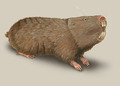
Body length of common mole rats ranges from 10.5 to 16.5 cm long and tail length from 1.2 to 3.8 cm. The fur is thick and is composed of many different colors, including a white spot on the head. Many of the physical features of mole rats are suited to an underground lifestyle. The body is cylindrical and the appendages are short. This shape allows the animal to burrow effectively. Long sensory hairs called vibrissae stand out from the pelage over the body. Mole rats have chisel-like incisors used for digging. The eyes are very reduced. In each colony, the reproductive male and female are the largest individuals. The rest of the colony members exhibit a sexually dimorphic pattern of size where the males are larger than the females.
- Other Physical Features
- endothermic
- bilateral symmetry
-
- Range mass
- 50 to 130 g
- 1.76 to 4.58 oz
-
- Average basal metabolic rate
- 0.35 W
- AnAge
Reproduction
C. hottentotus is a seasonal breeder with one or two litters per breeding season. Courtship, initiated by the male while the female is in estrous, consists of the female raising her tail and allowing the male to smell her genital region; this is followed by the male gently chewing on the female's hind region and stroking her sides with his head, finally the male mounts and mates. Each litter consists of 2-5 young, each weighing 8-9 grams. This small number of offspring may be due to the high survival rate of the young in the protective environment of the tunnels. The pups first leave the nest site 5 days after birth and begin to eat solids 10 days after birth.
- Key Reproductive Features
- gonochoric/gonochoristic/dioecious (sexes separate)
- sexual
Lifespan/Longevity
-
- Average lifespan
Status: captivity - 11 years
- AnAge
- Average lifespan
Behavior
Common mole rats live an entirely subterranean life. They dig extensive tunnel systems, one tunnel system, which contained 10 adult and 3 young, measured 1 km in length. The tunnels are dug mostly through compact soils but occasionally sandy soil is used. The tunnel systems are primarily a product of the search for food, but they also provide sites for food storage, nesting and waste disposal.
Common mole rats are social creatures, living in family units of up to 14 individuals. Each colony has one reproductive pair, which are usually the largest female and male in the group. The other individuals in the group are workers. The creation of a caste system of workers and reproducers is an example of eusocial animal behavior. The dominance hierarchy in a common mole rat colony is described as linear. The breeding male is at the top of the hierarchy, followed by the breeding female. For the rest of the colony males are dominant to females, and dominance is related to body mass.
The worker category is divided into two groups of animals, the "workers" and the "casual workers". The worker group usually consists of smaller sized mole rats that have been newly recruited to the colony. These mole rats do 15-20% more work than the second group, the casual workers. The casual worker group is comprised of larger, older mole rats.
It is very difficult for researchers to capture all of the members of a particular tunnel system. Because of this problem, little is known about how members of C. hottentotus get to be reproductive individuals in a given community.
- Key Behaviors
- motile
- social
- dominance hierarchies
Communication and Perception
Food Habits
Common mole rats are herbivorous, eating mainly geophytes, plants with underground storage organs, and grass rhizomes. They also consume large quantities of fiber, found in the roots of many plants.
Economic Importance for Humans: Positive
Due to the number of tunnels and amount of soil mole rats move, they help to improve soil drainage and soil turnover.
Economic Importance for Humans: Negative
Common mole rats can cause damage to human property. They can eat through most anything, including underground cables and roots of crops. The large mounds of dirt that they dig up can also cause damage to harvesting machines.
Conservation Status
Though common mole rats are found only in Southern Africa, the population there is quite dense. Mole rats have few predators due to their fossorial lifestyle and the lack of ground burrowing predators in Africa. The eastern beaked snake and some birds of prey may attack mole rats while digging out a burrow or venturing to the surface. Mole snakes (Pseudaspis cana) prey upon mole rats by penetrating the tunnel system.
-
- IUCN Red List
-
Least Concern
More information
-
- IUCN Red List
-
Least Concern
More information
-
- US Federal List
- No special status
-
- CITES
- No special status
Other Comments
Common mole rats coexist in the same geographical location with two other genera of mole rats, Bathyergus and Georychus. This is possible because members of each genus burrow at different depths and vary in diet. This is unusual for burrowing animals, typically one burrowing species occupies a geographic range almost exclusively.
Longevity in C. hottentosis is not well known, three specimens lived for five years after capture.
Contributors
Sandra Bruening (author), University of Michigan-Ann Arbor, Sandra Bruening (author), University of Michigan-Ann Arbor, Cynthia Sims Parr (editor), University of Michigan-Ann Arbor.
Glossary
- Ethiopian
-
living in sub-Saharan Africa (south of 30 degrees north) and Madagascar.

- bilateral symmetry
-
having body symmetry such that the animal can be divided in one plane into two mirror-image halves. Animals with bilateral symmetry have dorsal and ventral sides, as well as anterior and posterior ends. Synapomorphy of the Bilateria.
- chemical
-
uses smells or other chemicals to communicate
- dominance hierarchies
-
ranking system or pecking order among members of a long-term social group, where dominance status affects access to resources or mates
- endothermic
-
animals that use metabolically generated heat to regulate body temperature independently of ambient temperature. Endothermy is a synapomorphy of the Mammalia, although it may have arisen in a (now extinct) synapsid ancestor; the fossil record does not distinguish these possibilities. Convergent in birds.
- motile
-
having the capacity to move from one place to another.
- native range
-
the area in which the animal is naturally found, the region in which it is endemic.
- sexual
-
reproduction that includes combining the genetic contribution of two individuals, a male and a female
- social
-
associates with others of its species; forms social groups.
- tactile
-
uses touch to communicate
- tropical savanna and grassland
-
A terrestrial biome. Savannas are grasslands with scattered individual trees that do not form a closed canopy. Extensive savannas are found in parts of subtropical and tropical Africa and South America, and in Australia.
- savanna
-
A grassland with scattered trees or scattered clumps of trees, a type of community intermediate between grassland and forest. See also Tropical savanna and grassland biome.
- temperate grassland
-
A terrestrial biome found in temperate latitudes (>23.5° N or S latitude). Vegetation is made up mostly of grasses, the height and species diversity of which depend largely on the amount of moisture available. Fire and grazing are important in the long-term maintenance of grasslands.
References
Alados, C., R. Altevogt, R. Apfelbach, W. Arnold, A. Badrian. 1990. Grzimek's Encyclopedia of Mammals Vol. 3. New York: McGraw-Hill Publishing Company.
Bennett, N. 1989. The social structure and reproductive biology of the common mole-rat, Cryptomys h. hottentotus and remarks on the trends in reproduction and sociality in the family Bathyergidae. Journal of Zoology (London), 219: 45-59.
Bennett, N., J. Jarvis, D. Wallace. 1990. The relative age structure and body masses of complete wild-captured colonies of two social mole-rats, the common mole-rat, Cryptomys hottentotus hottentotus and the Damaraland mole-rat, Cryptomys damarensis. Journal of Zoology (London), 220: 469-485.
Walker, E. 1975. Mammals of the World Third Edition. Baltimore, Maryland: The John Hopkins University Press.