Cryptomys damarensisDamara mole rat
Geographic Range
Damaraland mole-rats, Crytomys damarensis, live in southwestern and central Africa, primarily in Botswana and West Zambia. (Nowak, 1999)
Habitat
Damaraland mole-rats are subterranean and inhabit semi-arid regions. This includes woodland, savannah, and secondary forest habitats. (Jarvis, et al., 2001; Nowak, 1999)
- Habitat Regions
- tropical
- terrestrial
- Terrestrial Biomes
- savanna or grassland
- scrub forest
- Other Habitat Features
- agricultural
Physical Description
Head and body length is 90 to 270 mm, and tail length is 10 to 30 mm. The breeding male and female within a colony are the largest individuals. The male is slightly larger than the female.
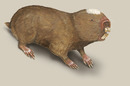
The body is slender with legs that are short, making this species well adapted for fossorial life. Also, the ears lack external pinnae. The pelage is thick, with sensitive guard hairs, sometimes referred to as vibrissae. Large, protuberant incisors are used extensively for borrowing. The lips close behind these digging tools to prevent dirt from entering the mouth. (Bennett, et al., 1990)
- Other Physical Features
- endothermic
- bilateral symmetry
- Sexual Dimorphism
- male larger
-
- Range mass
- 86 to 202 g
- 3.03 to 7.12 oz
-
- Range length
- 100 to 300 mm
- 3.94 to 11.81 in
-
- Average basal metabolic rate
- 0.418 W
- AnAge
Reproduction
Damaraland mole-rats have evolved a cooperative breeding system where within a colony, a high reproductive skew is maintained by only a single female and male breeding. The precise mechanism by which this operates is uncertain, although it is likely that both behavioral (i.e. aggression) and chemical suppression (i.e. pheromones) are used. (Bennet, 1994; Bennett, 1994; Nowak, 1999)
- Mating System
- monogamous
- eusocial
In wild populations, these animals are thought to breed once annually. Captive colonies of Damaraland mole-rats are capable of breeding year-round. In captivity, two litters per year are common. After a gestation of 78 to 112 days, a litter of one to three highly precocial young is born. Young nurse until about 82 days of age.
Females can reach reproductive maturity at 73 weeks of age. However, since reproduction is supressed in all but the breeding pair, it is difficult to estimate how early reproductive maturity might be reached. Age at dispersal and mechanism of dispersal of the young are not known. (Nowak, 1999)
- Key Reproductive Features
- iteroparous
- year-round breeding
- gonochoric/gonochoristic/dioecious (sexes separate)
- sexual
- fertilization
- viviparous
-
- Breeding interval
- In the wild, Damaraland mole-rats breed once each year.
-
- Breeding season
- Breeding season varies geographically.
-
- Range number of offspring
- 1 to 3
-
- Average number of offspring
- 2.5
- AnAge
-
- Range gestation period
- 78 to 112 days
-
- Average weaning age
- 82 days
-
- Average age at sexual or reproductive maturity (female)
- 73 weeks
-
- Average age at sexual or reproductive maturity (female)
Sex: female - 511 days
- AnAge
- Average age at sexual or reproductive maturity (female)
A pregant female spends most of her time within a chamber designated as the nesting area. The mother provides young with milk for about 82 days. Certain members of the colony help care for the juveniles through grooming, huddling together for warmth, feeding, and by preventing them from straying. (Bennet, 1994; Nowak, 1999)
- Parental Investment
- precocial
-
pre-fertilization
- provisioning
-
protecting
- female
-
pre-hatching/birth
-
provisioning
- female
-
protecting
- male
- female
-
provisioning
-
pre-weaning/fledging
-
provisioning
- male
- female
-
protecting
- male
- female
-
provisioning
-
pre-independence
-
protecting
- male
- female
-
protecting
- inherits maternal/paternal territory
Lifespan/Longevity
Lifespan and longevity is currently unknown for Damaraland mole-rats, although individuals of the closely related species, Cryptomys hottentotus, have lived nearly 10 years in captivity. Cryptomys damarensis probably has a similar lifespan. (Nowak, 1999)
-
- Average lifespan
Status: captivity - 11.9 years
- AnAge
- Average lifespan
Behavior
Damaraland mole-rats are eusocial and have evolved a caste system. This system is like that seen in bees and ants, where a single breeding queen is supported by many workers. These mole-rats spend nearly their entire lives underground in a network of tunnels that consist of a nesting area, toilet area, and food storage chamber. Colonies excavate large tunnel systems in search of food. (Bennet, 1994; Nowak, 1999)
A remarkable attribute of Damaraland mole-rats is their well established division of labor. The monogamously mated breeding pair does little or no work. However, there are individuals designated for the work of tunnel digging, caring for successive litters, and the foraging and storing of food. Although work is primarily done cooperatively, larger individuals physically "persuade" (often through tail pulling) smaller ones to doing a greater percentage of the work. (Bennett, 1994; Bennett, 2002; Bennett, et al., 1990; Nowak, 1999)
There is strong evidence that this eusocial type society evolved as a response to control colony growth during unfavorable conditions. When individuals do disperse, it occurs during times of high rainfall when it is favorable for digging and foraging. (Bennett, 2002)
As with other members of the genus Cryptomys, Damaraland mole-rats communicate and often act aggressively by means of squeaks, grunts, and growls when confronting members of another colony. Sparring between juveniles, such as tail pulling, is thought to aid in their physical and social development. (Bennett, 1994; Nowak, 1999)
- Key Behaviors
- fossorial
- motile
- social
- dominance hierarchies
Home Range
Although an average home range estimate for the Damaraland mole-rat isn't currently available, it is known that a close relative, C. hottentotus, has constructed tunnel networks that vary from 58 to 340 meters in length. It is likely that Damarland mole-rats are similar. (Nowak, 1999)
Communication and Perception
Like other members of the genus Cryptomys, Damaraland mole-rats often act aggressively. They use squeaks, grunts, and growls when confronting each other in order to create and maintain a dominance hierarchy.
Associated with these vocalizations, there are often aggressive physical encounters. Larger individuals often use tail-pulling as a means of forcing smaller individuals to perform more labor. Physcial contact may also be involved in reproductive supression of members of the colony.
It is believed that these animals lack the ability to see, although the surfaces of their eyes are used to detect air currents. Vibrissae located along the body are used for detecting their surroundings. This being the case, visual signals are highly unlikely to play any role in communication.
Chemical pheromones in the urine of the dominant female may be used to suppress sexual activity in subordinates. (Bennet, 1994; Bennett, 1994; Nowak, 1999)
- Other Communication Modes
- pheromones
- vibrations
- Perception Channels
- visual
- tactile
- acoustic
- vibrations
- chemical
Food Habits
Damaraland mole-rats are primarily herbivorous, eating mainly roots, bulbs, tubers, and aloe leaves. They also consume invertebrates, such as earthworms, cockchafer larvae, and white ants. (Nowak, 1999)
- Animal Foods
- insects
- terrestrial worms
- Plant Foods
- leaves
- roots and tubers
- Foraging Behavior
- stores or caches food
Predation
Specific predators of Damarland mole-rats have not yet been identified. Other species of subterranian mole-rats are thought to suffer from predation by snakes. Snakes are the most likely predator of these animals as well. (Nowak, 1999)
-
- Known Predators
-
- Unkown
Ecosystem Roles
Damaraland mole-rats are capable of tilling large quantities of soil which helps in its aeration. Their tunnels also aid in water infiltration, helping to supply water to deep-rooted trees. (Nowak, 1999)
- Ecosystem Impact
- soil aeration
Economic Importance for Humans: Positive
As with other fossorial mammals, Damaraland mole-rats contribute to soil tilling and water infiltration. They are also hunted for human consumption. For research and education, they present an interesting adaptation to life in arid environments. (Nowak, 1999; Nowak, 1999)
- Positive Impacts
- food
- research and education
Economic Importance for Humans: Negative
As with other members of the family Bathyergidae, mole-rats are often seen as pests in that they can consume large amounts of valuable agricultural products and private vegetable gardens. They have been known to chew through underground cables and cause damage to agricultural machinery. (Nowak, 1999)
- Negative Impacts
- crop pest
Conservation Status
Cryptomys damarensis is a common species and therefore has no special status. (Nowak, 1999)
-
- IUCN Red List
-
Least Concern
More information
-
- IUCN Red List
-
Least Concern
More information
-
- US Federal List
- No special status
-
- CITES
- No special status
Other Comments
There are a total of nine species of mole-rat in the genus Crypotmys, all of which are distributed across the semi-arid regions of Africa. Fossilized remains can be traced back to the Oligocene. Only one other species of mole-rat, from the genus Heterocephalus, is defined as being eusocial. (Nowak, 1999)
Contributors
Charles Goddard (author), Humboldt State University, Brian Arbogast (editor, instructor), Humboldt State University.
Nancy Shefferly (editor), Animal Diversity Web.
Glossary
- Ethiopian
-
living in sub-Saharan Africa (south of 30 degrees north) and Madagascar.

- acoustic
-
uses sound to communicate
- agricultural
-
living in landscapes dominated by human agriculture.
- bilateral symmetry
-
having body symmetry such that the animal can be divided in one plane into two mirror-image halves. Animals with bilateral symmetry have dorsal and ventral sides, as well as anterior and posterior ends. Synapomorphy of the Bilateria.
- chemical
-
uses smells or other chemicals to communicate
- dominance hierarchies
-
ranking system or pecking order among members of a long-term social group, where dominance status affects access to resources or mates
- endothermic
-
animals that use metabolically generated heat to regulate body temperature independently of ambient temperature. Endothermy is a synapomorphy of the Mammalia, although it may have arisen in a (now extinct) synapsid ancestor; the fossil record does not distinguish these possibilities. Convergent in birds.
- eusocial
-
the condition in which individuals in a group display each of the following three traits: cooperative care of young; some individuals in the group give up reproduction and specialize in care of young; overlap of at least two generations of life stages capable of contributing to colony labor
- fertilization
-
union of egg and spermatozoan
- folivore
-
an animal that mainly eats leaves.
- food
-
A substance that provides both nutrients and energy to a living thing.
- fossorial
-
Referring to a burrowing life-style or behavior, specialized for digging or burrowing.
- herbivore
-
An animal that eats mainly plants or parts of plants.
- iteroparous
-
offspring are produced in more than one group (litters, clutches, etc.) and across multiple seasons (or other periods hospitable to reproduction). Iteroparous animals must, by definition, survive over multiple seasons (or periodic condition changes).
- monogamous
-
Having one mate at a time.
- motile
-
having the capacity to move from one place to another.
- native range
-
the area in which the animal is naturally found, the region in which it is endemic.
- pheromones
-
chemicals released into air or water that are detected by and responded to by other animals of the same species
- scrub forest
-
scrub forests develop in areas that experience dry seasons.
- sexual
-
reproduction that includes combining the genetic contribution of two individuals, a male and a female
- social
-
associates with others of its species; forms social groups.
- soil aeration
-
digs and breaks up soil so air and water can get in
- stores or caches food
-
places a food item in a special place to be eaten later. Also called "hoarding"
- tactile
-
uses touch to communicate
- terrestrial
-
Living on the ground.
- tropical
-
the region of the earth that surrounds the equator, from 23.5 degrees north to 23.5 degrees south.
- tropical savanna and grassland
-
A terrestrial biome. Savannas are grasslands with scattered individual trees that do not form a closed canopy. Extensive savannas are found in parts of subtropical and tropical Africa and South America, and in Australia.
- savanna
-
A grassland with scattered trees or scattered clumps of trees, a type of community intermediate between grassland and forest. See also Tropical savanna and grassland biome.
- temperate grassland
-
A terrestrial biome found in temperate latitudes (>23.5° N or S latitude). Vegetation is made up mostly of grasses, the height and species diversity of which depend largely on the amount of moisture available. Fire and grazing are important in the long-term maintenance of grasslands.
- vibrations
-
movements of a hard surface that are produced by animals as signals to others
- visual
-
uses sight to communicate
- viviparous
-
reproduction in which fertilization and development take place within the female body and the developing embryo derives nourishment from the female.
- year-round breeding
-
breeding takes place throughout the year
- young precocial
-
young are relatively well-developed when born
References
Bennet, N. 1994. Reproductive suppresion in eusocial Crypotomys damarensis colonies: socially-induced infertility in females. Journal of Zoology, 233/4: 617-630.
Bennett, N. 1994. Behavioral and social organization in the colony of Damaraland mole-rat Cryptomys damaraland . Journal of Zoology, 220/2: 225-248.
Bennett, N. 2002. Rainfall, dispersal and reproductive inhibition in eusocial Damaraland mole-rats (Cryptomys damarensis). Journal of Zoology, 256: 445-448.
Bennett, N., J. Jarvis, D. Wallace. 1990. The relative age structure and body masses of complete wild-captured colonies of two social mole-rats, the common mole-rat, Cryptomys hottentotus hottentotus and the Damaraland mole-rat, Cryptomys damarensis . Journal of Zoology, 220/4: 469-485.
Jarvis, J., N. Bennett, A. Spinks. 2001. Environmental conditions in burrows of two species of African mole-rat, Georhychus capensis and Cryptomys damarensis . Oecologia, 113/2: 290-298.
Nowak, R. 1999. Common Mole-rats. Pp. 1637-1639 in Walker's Mammals of the World, Vol. 2, 6th Edition. Baltimore, Maryland: The Johns Hopkins University Press.