Crotaphytus collarisCollared Lizard



Geographic Range
Crotaphytus collaris, commonly known as the eastern collared lizard, is a species of lizard that is primarily found in North America and open areas of Mexico. Its range in Mexico includes parts of the states of Chihuahua, Coahuila, Durango, Nuevo Leon, San Luis Potosi, Tamaulipas, and Zacatecas. The geographic range of C. collaris is relatively large and encompasses several states and regions within the United States. The species is primarily distributed throughout the central and eastern regions of the United States, including parts of Texas, Oklahoma, Kansas, Nebraska, Missouri, Arkansas, Louisiana, Mississippi, Alabama, Tennessee, Kentucky, Indiana, Illinois, and Ohio. It is also found in isolated populations in southwestern Iowa, southeastern Colorado, and western Georgia. ("Eastern Collared Lizard", 2022; "Field Guide to North American reptiles and Amphibians", 1997; Glossip and Losos, 2002)
Habitat
Crotaphytus collaris inhabits arid and semi-arid regions of the southwestern United States and northern Mexico. This species is commonly found in rocky, sparsely vegetated habitats, particularly in areas with abundant boulders, rocks, and other rocky outcrops.
Crotaphytus collaris occupies a wide range of habitat types, including desert scrublands, grasslands, shrublands, and woodlands, often in close proximity to rocky areas. They occur at elevations ranging from 150 to 2400 meters above sea level, with its terrestrial level being predominantly found in the low to mid elevations. ("Eastern Collared Lizard", 2022; "Field Guide to North American reptiles and Amphibians", 1997; Glossip and Losos, 2002)
- Terrestrial Biomes
- desert or dune
- savanna or grassland
- forest
- scrub forest
-
- Range elevation
- 150 to 2400 m
- 492.13 to 7874.02 ft
Physical Description
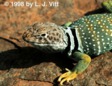
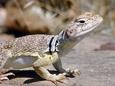
Adults are ectothermic and typically range from 20 to 38 centimeters, with males being slightly larger than females. Adult weight ranges from 45 to 120 grams, with males being higher in the weight range. Their appearance is distinctive, with a flattened body, large head, and long, powerful legs. They have a prominent, banded collar around their necks, which is black in males and brown in females. Their backs are covered in small, keeled scales that give them a rough texture, while their bellies are smooth and light-colored. The color of their skin varies depending on the region they are found in, but they typically have a brownish-gray color with darker brown or black markings.
Geographic variation has been reported in Crotaphytus collaris, with individuals from different regions having slightly different coloration and patterning. Seasonal variation has also been observed, with individuals in breeding season displaying brighter colors and more pronounced collar markings. Several subspecies of Crotaphytus collaris have been described, including C. c. baileyi, C. c. flavoviridis, and C. c. melanomaculatus. These subspecies differ in their geographic distribution, coloration, and pattern of markings.
Polymorphisms, or the existence of multiple forms within a species, have not been reported in Crotaphytus collaris. However, young animals differ from adults in their coloration and markings. Juveniles have a brighter coloration, with more vibrant red and orange markings on their backs and tails. As they mature, these colors become muted and blend in with their overall coloration.
Crotaphytus collaris can be distinguished from other closely related species, such as the western collared lizard Crotaphytus insularis bicinctores, by their distinct collar markings and the shape of their heads. The eastern collared lizard has a wider head with a more pronounced jawline, while the western collared lizard has a more elongated head with a narrower jawline. Additionally, the collar markings of the eastern collared lizard are thicker and more prominent than those of the western collared lizard. ("COLLARED LIZARD", 2023; "Field Guide to North American reptiles and Amphibians", 1997; J. E, 1992)
- Other Physical Features
- ectothermic
- bilateral symmetry
- Sexual Dimorphism
- male larger
- sexes colored or patterned differently
-
- Range mass
- 45 to 120 g
- 1.59 to 4.23 oz
-
- Range length
- 20 to 38 cm
- 7.87 to 14.96 in
Development
After mating, the females lay a clutch of 1 to 8 eggs in a burrow or crevice, which she then covers with soil. The eggs incubate for around 55 to 65 days, depending on the temperature and humidity of the nest environment. During this period, the embryos develop and grow inside the egg.
Once the eggs hatch, the hatchlings emerge from the nest and begin their journey towards adulthood. Juveniles resemble adult lizards in their appearance and behavior but are smaller in size. They grow rapidly and shed their skin frequently to accommodate their expanding bodies.
Collared lizards do not undergo metamorphosis. They mature directly from the hatchling stage to the adult form. The rate of maturation and growth of collared lizards depends on various factors such as temperature, diet, and habitat conditions.
The sex of collared lizards is determined by the temperature at which the eggs are incubated. The eggs incubated at a temperature range of 28-30°C produce males, while eggs incubated at temperatures between 30-32°C produce females.
Crotaphytus collaris exhibits indeterminate growth, meaning they continue to grow throughout their lifespan. The rate of growth, however, decreases with age, and they eventually reach a maximum size. (Clark, 2002; "Field Guide to North American reptiles and Amphibians", 1997; J. E, 1992; Sloan, 1996; Timanus, 2001)
- Development - Life Cycle
- temperature sex determination
Reproduction
Crotaphytus collaris is a polygynous species, where one male mates with multiple females. The mating season of C. collaris generally occurs during the spring and summer months, but can vary depending on the geographical location and environmental conditions.
Mating behavior in collared lizards begins with males establishing territories and actively searching for receptive females. Males engage in visual displays to attract females, including head-bobbing, push-ups, and displaying their brightly colored throat (dewlap) to signal their availability and fitness.
Once a male encounters a female, he may court her with further visual displays and physical contact, such as nuzzling or biting the female's neck or tail. Females may reject or accept mating attempts from males, and multiple males may compete for a single receptive female.
Male C. collaris defend their territories and mate-guard receptive females to prevent other males from mating with them. These territorial behaviors can result in social structures where dominant males control larger territories and have access to more females. ("Adult male collared lizards, Crotaphytus collaris, increase aggression towards displaced neighbours", 2003; Clark, 2002; "Field Guide to North American reptiles and Amphibians", 1997; Sloan, 1996)
- Mating System
- polygynous
Crotaphytus collaris breeds once a year, generally occurs during the spring and summer months, with females laying 1 to 8 eggs per breeding season. The eggs are incubated for approximately 55 to 65 days, and the hatchlings emerge fully formed and independent at birth. The species reaches sexual maturity at around 2 to 3 years of age and can breed annually. (Clark, 2002; Glossip and Losos, 2002; Sloan, 1996; Timanus, 2001)
- Key Reproductive Features
- seasonal breeding
- sexual
- fertilization
- oviparous
-
- Breeding interval
- Crotaphytus collaris breeds once a year
-
- Breeding season
- Crotaphytus collaris breed during the spring and summer months
-
- Range number of offspring
- 1 to 8
-
- Average time to independence
- 0 days
-
- Average age at sexual or reproductive maturity (female)
- 2-3 years
-
- Average age at sexual or reproductive maturity (male)
- 1-2 years
Crotaphytus collaris is an oviparous species and does not exhibit any parental care or investment beyond the initial production and deposition of eggs. Once the female has laid her eggs, she does not provide any further care or protection to them, and the hatchlings are fully independent and self-sufficient upon hatching.
There is no pre-fertilization, pre-hatching, or pre-independence parental investment exhibited by either parent in this species. There is also no post-hatching or post-fledging parental care, as the hatchlings are fully formed and independent at birth. ("Field Guide to North American reptiles and Amphibians", 1997; Glossip and Losos, 2002)
- Parental Investment
- no parental involvement
Lifespan/Longevity
The lifespan of eastern collared lizards varies depending on factors such as genetics, environment, and diet. In the wild, these lizards typically have a shorter lifespan due to various threats such as predation, disease, and habitat loss. In captivity, however, they can live longer due to the availability of a consistent food source, veterinary care, and protection from predators.
The typical lower lifespan of eastern collared lizards in the wild is around 2 to 3 years, while the typical highest lifespan is around 6 to 7 years. The average lifespan of this species in the wild is around 4to 5 years. In captivity, eastern collared lizards can live up to 10 years or more with proper care.
Factors that can limit the lifespan of eastern collared lizards include predation, disease, and environmental stressors such as temperature extremes and habitat loss. In captivity, a poor diet or improper husbandry practices can also lead to health issues and a shortened lifespan. ("COLLARED LIZARD", 2023; "Eastern Collared Lizard", 2022; "Field Guide to North American reptiles and Amphibians", 1997; J. E, 1992)
-
- Range lifespan
Status: wild - 6 to 7 years
- Range lifespan
-
- Range lifespan
Status: captivity - 10 to 15 years
- Range lifespan
-
- Typical lifespan
Status: wild - 4 to 5 years
- Typical lifespan
Behavior
Crotaphytus collaris is a solitary species that prefers to live alone. It is an active lizard and moves around frequently to find food and suitable habitat. They are diurnal while sleeping at night.
The eastern collared lizard is known for its interesting behavior of doing push-ups to communicate with other lizards and to attract mates. They also use their tails as a defensive mechanism and can detach them if attacked by predators.
Although they are solitary, eastern collared lizards establish and defend territories from other lizards of the same species. The social hierarchy is not well understood, but larger and more dominant individuals may have an advantage in acquiring the best territories and resources.
Overall, the eastern collared lizard are a fascinating species with interesting behaviors such as territoriality, push-up communication, and tail defense. ("Adult male collared lizards, Crotaphytus collaris, increase aggression towards displaced neighbours", 2003; "COLLARED LIZARD", 2023; "Eastern Collared Lizard", 2022; "Field Guide to North American reptiles and Amphibians", 1997; Glossip and Losos, 2002)
- Key Behaviors
- cursorial
- terricolous
- diurnal
- solitary
- territorial
-
- Range territory size
- 2000 to 250000 m^2
Home Range
The home range of Crotaphytus collaris can vary depending on factors such as sex, age, and habitat quality. Generally, male eastern collared lizards have larger home ranges than females.
The home range of male C.collaris can range from 1 to 25 hectares, while female home ranges are smaller, ranging from 0.2 to 2 hectares. The size of the home range may also be influenced by habitat quality and availability of resources, such as food and shelter.
Eastern collared Lizards defend their territories from other lizards of the same species and they may use certain landmarks, such as rocks or trees, to mark their boundaries.
Communication and Perception
One of the most notable behaviors is the use of push-ups to communicate with other lizards and to attract mates. Males perform push-ups to establish territories and to signal their dominance over other males. Females also use push-ups to signal their receptiveness to mating.
Eastern collared lizards have well-developed vision, which is important for locating prey, avoiding predators, and detecting potential mates. They are also able to perceive their environment through their sense of smell and can use scent marking to communicate with other lizards and to establish territories.
While individuals are solitary, they may communicate with others through visual displays such as head bobbing and tail waving. These behaviors can be used to establish dominance or to communicate aggression.
During courtship, potential mates may engage in visual displays and body movements to communicate their interest in mating. Once a male and female have paired up, they may engage in courtship rituals, which can involve visual displays and physical contact. ("Adult male collared lizards, Crotaphytus collaris, increase aggression towards displaced neighbours", 2003; "Field Guide to North American reptiles and Amphibians", 1997; J. E, 1992; Sloan, 1996; Timanus, 2001)
- Other Communication Modes
- duets
- pheromones
- Perception Channels
- visual
Food Habits
Crotaphytus collaris is primarily insectivorous, with a diet consisting mainly of insects such as grasshoppers, crickets, and beetles. They may also consume small lizards, spiders, and occasionally plant material.
Eastern collared lizards have specialized teeth that are adapted for capturing and consuming insects. They have sharp, pointed teeth in the front of their mouths and flatter teeth in the back for crushing the exoskeletons of their prey. Their powerful jaws and neck muscles allow them to quickly capture and subdue their prey.
They may occasionally consume small vertebrates such as other lizards. However, this makes up only a small portion of their overall diet. ("COLLARED LIZARD", 2023; "Field Guide to North American reptiles and Amphibians", 1997; " Weapon Performance, Not Size, Determines Mating Success and Potential Reproductive Output in the Collared Lizard (Crotaphytus collaris)", 2005)
- Primary Diet
- carnivore
- Animal Foods
- reptiles
- insects
- terrestrial non-insect arthropods
Predation
One of the most notable adaptations of Crotaphytus collaris is their ability to change color. When threatened, they can darken or lighten their skin color to blend in with their surroundings, making it difficult for predators to spot them. They can also puff up their bodies to appear larger, which can intimidate predators.
Another anti-predator adaptation of this species is their tail, which are capable of tail autotomy. This allows the lizard to escape, as the predator will be left with just the tail, which will continue to move and distract the predator.
Eastern collared Lizards also exhibit certain behaviors to avoid predators. For example, they will run quickly to escape danger and will often climb trees or rocks to evade predators. They can also use their sharp claws to defend themselves if necessary.
Some of the known predators of eastern collared lizards include birds of prey, snakes, and mammals such as coyotes and foxes. Predators can vary depending on the lizard's life stage. Juvenile lizards are more vulnerable to predation than adults, and they often face different predators. For example, birds of prey and snakes are more likely to prey on juvenile lizards, while adult lizards are more likely to face mammalian predators. ("Adult male collared lizards, Crotaphytus collaris, increase aggression towards displaced neighbours", 2003; "COLLARED LIZARD", 2023; "Field Guide to North American reptiles and Amphibians", 1997; Sloan, 1996)
- Anti-predator Adaptations
- cryptic
-
- Known Predators
-
- Red-tailed Hawk (Buteo jamaicensis)
- Cooper's Hawk (Accipiter cooperii)
- American Kestrel (Falco sparverius)
- Coachwhip Snake (Masticophis flagellum)
- Eastern Racer (Coluber constrictor)
- Copperhead Snake (Agkistrodon contortrix)
- Coyotes (Canis latrans)
- Foxes (Vulpes spp)
- Bobcats ("Lynx rufus")
Ecosystem Roles
As a predator of small insects, eastern collared lizards (Crotaphytus collaris) play an important role in controlling insect populations within their ecosystem. By consuming a variety of insects such as crickets, grasshoppers, and beetles, they help to maintain the balance between predator and prey populations.
Eastern collared lizards may also have a role in seed dispersal through their diet. Some insects they consume, such as grasshoppers, can feed on plants and carry plant seeds in their digestive tracts. By consuming these insects, lizards can disperse plant seeds across their habitat, contributing to the plant community's diversity and distribution. (Clark, 2002; "Eastern Collared Lizard", 2022; "Field Guide to North American reptiles and Amphibians", 1997)
- Ecosystem Impact
- disperses seeds
Economic Importance for Humans: Positive
Eastern collared lizards do not provide any direct benefits to humans. However, as a predator of insects, they may help control insect populations in their ecosystem, which can indirectly benefit humans. Insects can be pests that damage crops or spread disease, and by controlling their populations, eastern collared lizards can help reduce these negative impacts. ("COLLARED LIZARD", 2023; "Eastern Collared Lizard", 2022)
- Positive Impacts
- controls pest population
Economic Importance for Humans: Negative
There are no known adverse effects of Crotaphytus collaris on humans
Conservation Status
Eastern collared lizards are currently classified as a species of Least Concern on the IUCN Red List, which indicates that it is not considered at significant risk of extinction. Conservation efforts for eastern collard lizards include habitat protection and restoration, as well as regulations on collecting and trade. ("Eastern Collared Lizard", 2022)
-
- IUCN Red List
-
Least Concern
More information
-
- IUCN Red List
-
Least Concern
More information
-
- US Federal List
- No special status
-
- CITES
- No special status
-
- State of Michigan List
- No special status
Contributors
Addison Vande Plasse (author), Colorado State University, Tanya Dewey (editor), University of Michigan-Ann Arbor.
Glossary
- Nearctic
-
living in the Nearctic biogeographic province, the northern part of the New World. This includes Greenland, the Canadian Arctic islands, and all of the North American as far south as the highlands of central Mexico.

- bilateral symmetry
-
having body symmetry such that the animal can be divided in one plane into two mirror-image halves. Animals with bilateral symmetry have dorsal and ventral sides, as well as anterior and posterior ends. Synapomorphy of the Bilateria.
- carnivore
-
an animal that mainly eats meat
- chemical
-
uses smells or other chemicals to communicate
- cryptic
-
having markings, coloration, shapes, or other features that cause an animal to be camouflaged in its natural environment; being difficult to see or otherwise detect.
- desert or dunes
-
in deserts low (less than 30 cm per year) and unpredictable rainfall results in landscapes dominated by plants and animals adapted to aridity. Vegetation is typically sparse, though spectacular blooms may occur following rain. Deserts can be cold or warm and daily temperates typically fluctuate. In dune areas vegetation is also sparse and conditions are dry. This is because sand does not hold water well so little is available to plants. In dunes near seas and oceans this is compounded by the influence of salt in the air and soil. Salt limits the ability of plants to take up water through their roots.
- diurnal
-
- active during the day, 2. lasting for one day.
- duets
-
to jointly display, usually with sounds in a highly coordinated fashion, at the same time as one other individual of the same species, often a mate
- ectothermic
-
animals which must use heat acquired from the environment and behavioral adaptations to regulate body temperature
- fertilization
-
union of egg and spermatozoan
- forest
-
forest biomes are dominated by trees, otherwise forest biomes can vary widely in amount of precipitation and seasonality.
- insectivore
-
An animal that eats mainly insects or spiders.
- native range
-
the area in which the animal is naturally found, the region in which it is endemic.
- oviparous
-
reproduction in which eggs are released by the female; development of offspring occurs outside the mother's body.
- pheromones
-
chemicals released into air or water that are detected by and responded to by other animals of the same species
- polygynous
-
having more than one female as a mate at one time
- scrub forest
-
scrub forests develop in areas that experience dry seasons.
- seasonal breeding
-
breeding is confined to a particular season
- sexual
-
reproduction that includes combining the genetic contribution of two individuals, a male and a female
- solitary
-
lives alone
- territorial
-
defends an area within the home range, occupied by a single animals or group of animals of the same species and held through overt defense, display, or advertisement
- tropical savanna and grassland
-
A terrestrial biome. Savannas are grasslands with scattered individual trees that do not form a closed canopy. Extensive savannas are found in parts of subtropical and tropical Africa and South America, and in Australia.
- savanna
-
A grassland with scattered trees or scattered clumps of trees, a type of community intermediate between grassland and forest. See also Tropical savanna and grassland biome.
- temperate grassland
-
A terrestrial biome found in temperate latitudes (>23.5° N or S latitude). Vegetation is made up mostly of grasses, the height and species diversity of which depend largely on the amount of moisture available. Fire and grazing are important in the long-term maintenance of grasslands.
- visual
-
uses sight to communicate
References
2005.
Weapon Performance, Not Size, Determines Mating Success and Potential Reproductive Output in the Collared Lizard (Crotaphytus collaris). The American Naturalist, 166: 426-436. Accessed February 10, 2023 at https://doi.org/10.1086/432564.
1997. Field Guide to North American reptiles and Amphibians. New York: Knopf.
2003. Adult male collared lizards, Crotaphytus collaris, increase aggression towards displaced neighbours. Animal Behaviour, 65: 391-396. Accessed February 10, 2023 at https://doi.org/10.1006/anbe.2003.2058.
2023. "COLLARED LIZARD" (On-line). INHS Herpetology Collection. Accessed February 10, 2023 at https://herpetology.inhs.illinois.edu/species-lists/ilspecies/collared-lizard/.
2022. "Eastern Collared Lizard" (On-line). Missouri Department of Conservation. Accessed February 10, 2023 at https://mdc.mo.gov/discover-nature/field-guide/eastern-collared-lizard.
Clark, D. 2002. Sexual dichromatism and differential conspicuousness in two populations of the common collared lizard (Crotaphytus collaris) from Utah and New Mexico, USA. Biological Journal of the Linnean Society, 77: 67–85. Accessed February 10, 2023 at https://doi.org/10.1046/j.1095-8312.2002.00092.x.
Glossip, D., J. Losos. 2002.
Microhabitat Use and Thermal Biology of the Collared Lizard (Crotaphytus collaris collaris) and the Fence Lizard (Sceloporus undulatus hyacinthinus) in Missouri Glades. Journal of Herpetology, 36: 23-29. Accessed February 10, 2023 at https://doi.org/10.2307/1565797.
J. E, B. 1992. Size and Growth Rate Characteristics of a Peripheral Population of Crotaphytus collaris (Sauria: Crotaphytidae). Copeia, 1997: 968-980. Accessed February 10, 2023 at https://doi.org/10.2307/1446626.
Sloan, C. 1996. Age and Gender-Related Differences in the Social Behavior and Mating Success of Free-Living Collared Lizards, Crotaphytus collaris. Copeia, 2: 336-337. Accessed February 10, 2023 at https://doi.org/10.2307/1446849.
Timanus, D. 2001. Intra- and Inter-seasonal Variation in the Socio-Spatial Behavior of Adult Male Collared Lizards, Crotaphytus collaris (Reptilia, Crotaphytidae). Ethology, 107: 15-32. Accessed February 10, 2023 at https://doi.org/10.1046/j.1439-0310.2001.00628.x.