Crotalus viridisviridis
Geographic Range
Prairie rattlesnakes, Crotalus viridis, are found throughout the midwestern United States and extend from southwest Canada to the northwest part of Mexico. In Canada, prairie rattlesnakes are native to the southern provinces of Alberta and Saskatchewan. They are also in the northern part of Chihuahua, Mexico. Their range covers much of New Mexico, Colorado, Wyoming, and Montana in the United States, as well as northeast Texas, and the eastern borders of Nebraska, Arizona, and the Dakotas. (Frost, et al., 2007; Sweet, 1985; Zug and Ernst, 2004)
Habitat
Prairie rattlesnakes are found in environments ranging from 100 to 2700 feet in elevation and in settings that are rocky or rugged, as well as open fields that are heavily populated with prey. Prairie rattlesnakes are also found in forests because of the forest debris on the ground that can be used for protection. Many of their prey can also be found in dry grasslands and chaparrals. The chaparrals have various amounts of shrubs and vegetation that can be used to help prairie rattlesnakes be camouflaged for hunting. The main characteristic of prairie rattlesnake habitat are environments that have burrows formed from rocks, under branches, and holes dug by other animals. (Campbell and Lamar, 2004; Shipley, et al., 2013; Stebbins, 2003; Sweet, 1985)
- Habitat Regions
- temperate
- terrestrial
- Terrestrial Biomes
- savanna or grassland
- chaparral
- forest
-
- Range elevation
- 100 to 2700 m
- 328.08 to 8858.27 ft
Physical Description
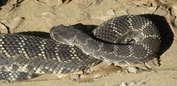
Prairie rattlesnake adults range between 45.3 and 165 cm in length and weigh 227 to 361 g. They possess a light brown to black tint on their dorsum and a yellow stripe located on their head. The prairie rattlesnakes' ventral side often blends with the ground to serve as camouflage. The most common colors found on their ventral sides are tan, a yellowish shade, or gray. The prairie rattlesnakes' surroundings are lighter blends of colors; to help complement this camouflage, there can also be patterned stripes or blotches on their body.
Male and female prairie rattlesnakes share the same physical characteristics. A characteristic to differentiate prairie rattlesnakes from other species of snakes is that prairie rattlesnakes have two or more nasal scales where other species of snakes only have one. Prairie rattlesnakes also have solenoglyphous teeth to transmit their venom. The teeth can range from 0.56 to 0.99 cm in length.
Male juveniles have an average size of 28.5cm in length, and females have an average size of 28.2cm.
There are seven subspecies of the prairie rattlesnakes, which differ in appearance. These include Grand Canyon rattlesnakes (Crotalus oreganus abyssus) which have a red color on the dorsum with darker ovals. Coronado Island rattlesnakes (Crotalus oreganus caliginis) stay a grayish color all over their body and are typically smaller in size, averaging 25cm long as adults. Arizona black rattlesnakes (Crotalus viridis ceberus) have darker shades on their body such as gray or black patches on the dorsum. Midget faded rattlesnakes (Crotalus oreganus concolor) have a pinkish tone to their scales. Southern Pacific rattlesnakes (Crotalus oreganus helleri) remain lighter in shades of colors such as tan and yellow as well as having dark brown patches on the body and a wide tail. Great Basin rattlesnakes (Crotalus oreganus lutosus) are thick-bodied and have tan coloring along with black patches on the dorsum. Hopi rattlesnakes (Crotalus oreganus) have pink and red shades on their scales, with brown patches all over the body. (Charland and Gregory, 1990; Klauber, 1939; Macartney, et al., 1990; Stebbins, 2003; William and William, 1974)
- Other Physical Features
- ectothermic
- heterothermic
- bilateral symmetry
- venomous
- Sexual Dimorphism
- sexes alike
-
- Range mass
- 227 to 361 g
- 8.00 to 12.72 oz
-
- Range length
- 25 to 165 cm
- 9.84 to 64.96 in
Development
Prairie rattlesnakes have offspring by laying amniotic eggs with linings of extra membranes for protection. Within the egg, the nutrients are supplied to the embryo by a yolk sac that is attached to the digestive tracts. Prairie rattlesnakes are viviparous, with females giving birth to up to 25 live young. Prairie rattlesnakes exhibit indeterminate growth. Male prairie rattlesnakes have a faster growth rate at a younger age compared to females. Males have a growth rate of 535 mm in 3 to 4 years while females grow 650 mm from 5 to 7 years. (Linzey, 2012; Macartney, et al., 1990; Shine and Charnov, 1992)
- Development - Life Cycle
- temperature sex determination
- indeterminate growth
Reproduction
Prairie rattlesnakes have a mating season of about 7 weeks between July-September. During this period, the males seek out the females to reproduce. The female snakes are scarce because only about 31% of female snakes are in heat during each mating period. Female snakes are considered monogamous during a single season but will seek out a different mate the following season. There are no relationships between mates and very little competition occurs between male snakes when a female is present. Because competition between males is at a minimum, females do not take physical characteristics into account when choosing a mate. ("COSEWIC assessment and status report on the Prairie Rattlesnake Crotalus viridis in Canada", 2015; Duvall and Shuett, 1997; Linzey, 2012; Zug and Ernst, 2004)
- Mating System
- monogamous
Prairie rattlesnakes are iteroparous and the mating season is about 7 weeks from July to September. Males have two sexual organs called hemipenes that are stored inside of the hemipenal sheath, and they are everted to mate. The hemipenes have a hooked shape to help attach to the female reproductive organs. The hemipenes are inserted into the female's cloaca and the sperm are released internally. Prairie rattlesnakes are oviparous and can lay 4 to 21 eggs with the gestation lasting from 3 to 4 months. Prairie rattlesnakes hare independent upon hatching and reach sexual maturity after 2 to 3 years. ("COSEWIC assessment and status report on the Prairie Rattlesnake Crotalus viridis in Canada", 2015; Aldridge and Sever, 2011; Linzey, 2012; Stebbins, 2003)
- Key Reproductive Features
- iteroparous
- seasonal breeding
- sexual
- oviparous
-
- Breeding interval
- They breed once a year
-
- Breeding season
- Approximately a 7-week season between July and September
-
- Range number of offspring
- 4 to 21
-
- Range gestation period
- 3 to 4 months
-
- Average time to independence
- 0 minutes
-
- Range age at sexual or reproductive maturity (female)
- 2 to 3 years
-
- Range age at sexual or reproductive maturity (male)
- 2 to 3 years
Once female prairie rattlesnakes lay the eggs, they guard the eggs by coiling up around them. By coiling around the eggs, the prairie rattlesnakes can increase the temperature of the body by contracting muscles. The temperature can increase up to 7.5° Celsius which helps with the incubation of the eggs. The incubation takes about 5 to 16 weeks. Once the eggs are hatched, the female ends up leaving and the newly-hatched prairie rattlesnakes have no parental care. ("COSEWIC assessment and status report on the Prairie Rattlesnake Crotalus viridis in Canada", 2015; Linzey, 2012; Stebbins, 2003; Zug and Ernst, 2004)
- Parental Investment
- female parental care
-
pre-fertilization
-
protecting
- female
-
protecting
-
pre-hatching/birth
-
protecting
- female
-
protecting
Lifespan/Longevity
The average expected lifespan for prairie rattlesnakes ranges between 16 and 20 years in the wild. The maximum known lifespan in captivity was 24.1 years. The main factor that limits the lifespan is being hunted by predators such as red-shouldered hawks (Buteo lineatus) and greater roadrunners (Geococcyx californianus). (Bowler and Snider, 1992)
-
- Range lifespan
Status: captivity - 24.1 (high) years
- Range lifespan
-
- Typical lifespan
Status: wild - 16 to 20 years
- Typical lifespan
-
- Average lifespan
Status: captivity - 24.1 years
- AnAge
- Average lifespan
Behavior
Prairie rattlesnakes only show aggression when they are threatened. To detect if there are prey or predators in the area, prairie rattlesnakes use tongue flicking to pick up on chemical cues left behind. They also perceive in infrared spectrum and can see the heat that radiates from their surroundings. There is no social hierarchy within this species, as these snakes remain solitary throughout their lives.
Prairie rattlesnakes most commonly hunt during the colder parts of the summer days such as dusk and dawn. These snakes are nocturnal when daytime ambient temperatures are extremely hot. In winter months prairie rattlesnakes hibernate. Prairie rattlesnakes are not migratory but travel as far as 10 kilometers for a den in which to hibernate. The length of hibernation is dependent on location. Prairie rattlesnakes that live in South Dakota endure a longer and more extreme winter compared to snakes living in Texas. Prairie rattlesnake hibernation can nearly double in time in the northern regions because of this climate factor. ("COSEWIC assessment and status report on the Prairie Rattlesnake Crotalus viridis in Canada", 2015; Charland, 1989; Chiszar, et al., 1978; Duvall, et al., 1990; Golan, et al., 1982; Zug and Ernst, 2004)
- Key Behaviors
- nocturnal
- crepuscular
- sedentary
- hibernation
- solitary
Home Range
Prairie rattlesnakes, on average, stay within a 0.04 to 0.21 square kilometer range. Many of the prairie rattlesnakes can be found within 1 meter of a burrow of some sort used for nesting and will get aggressive if they are threatened or if another species enters their home range. These burrows were made by a mammal or animal that has abandoned it. ("COSEWIC assessment and status report on the Prairie Rattlesnake Crotalus viridis in Canada", 2015)
Communication and Perception
Prairie rattlesnakes have a weak sense of sight. They are able to detect any object that emits heat. Prairie rattlesnakes rely heavily on their smell and tactile senses. Prairie rattlesnakes have a strong sense of chemical detection that helps them hunt prey. In order to detect the different chemical cues emitted by prey and other snakes, the use of the tongue acts a sense of smell so they know what is in their surroundings. They are able to detect potential prey and other snakes for possible reproduction. Potential prey also leave specific hormones and chemicals behind that can be easily detected as a scent to prairie rattlesnakes. These scents are transferred from the tongue to the vomeronasal organ in the mouth. The vomeronasal organ contains receptors that take the scent and interprets it as a smell. Using their tongues, male prairie rattlesnakes can also detect a sex pheromone released by females during the mating season. (Chiszar, et al., 1978; Chiszar, et al., 1983; Cooper, 1993; Daghfous, et al., 2012; Gillingham and Clark, 1981; Newman and Hartline, 1982; Shine and Mason, 2012)
- Other Communication Modes
- pheromones
- Perception Channels
- visual
- infrared/heat
- tactile
- chemical
Food Habits
The prairie rattlesnake diet consists of rodents such as voles (Microtus species), deer mice (Peromyscus species), smooth-toothed pocket gophers (Thomomys species), chipmunks (Tamias species), woodrats (Neotoma species), and red squirrels (Tamiasciurus species). About 60% of the adult prairie rattlesnake diet is composed of voles and deer mice. Prairie rattlesnakes will also eat birds, any type of eggs found, and even other reptiles, but they will typically not eat anything larger than black-tailed prairie dogs (Cynomys ludovicianus). In subduing prey, these rattlesnakes use a potent venom. The strike is so quick and accurate that it stuns the prey. The coiling of the body is what makes prairie rattlesnakes so dangerous because it generates power and helps account for minimal striking error. The jaws are able to re-correct the fang position to account for any attempt of escape from the prey.
Juvenile prairie rattlesnakes do not have the same type of diverse diet as adult prairie rattlesnakes. About 92.5% of a juvenile's diet is composed of shrews (Sorex species), deer mice, and voles. (Cooper, 2017; Kardong and Bels, 1998; Kardong and Rochelle, 1996; MacArtney, 1989; Reimer and Petras, 1967; Stebbins, 2003)
- Primary Diet
-
carnivore
- eats terrestrial vertebrates
- Animal Foods
- birds
- mammals
- reptiles
- eggs
Predation
Many birds prey on prairie rattlesnakes, including raptors like red-shouldered hawks (Buteo lineatus). Greater roadrunners (Geococcyx californianus) are also common predators. Greater roadrunners kill them by pecking them repeatedly in the head. They feed on snakes so often that they are given the name snake killers. Prairie rattlesnakes use their tail to rattle and warn the predator that they are venomous. The venom can cause hemorrhaging and necrotic damage. On top of rattling and being venomous, their cryptic coloration allows for prairie rattlesnakes to blend with the surroundings by using dark brown blotches with tan and yellowish shades on the dorsum. (Cameron and Tu, 1977; Campbell and Lamar, 2004; Fenton and Lawrence, 1990; Zug and Ernst, 2004)
- Anti-predator Adaptations
- cryptic
-
- Known Predators
-
- red-shouldered hawks (Buteo lineatus)
- greater roadrunners (Geococcyx californianus)
Ecosystem Roles
Prairie rattlesnakes, prey on rats and mice. Predators of these rattlesnakes include red-shouldered hawks (Buteo lineatus), and greater roadrunners (Geococcyx californianus). Prairie rattlesnakes serve as a host for parasitic worms called helminths. Species of helminths include: Rhabdias, Kalicephalus inermis coronelías, Physaloptera (3rd-stage larvae), and Oochoristica osheroffi. (Fenton and Lawrence, 1990; Meerburg, et al., 2009; Widmer, 1967; Zug and Ernst, 2004)
- helminths (Rhabdias)
- helminths (Kalicephalus inermis coronelías)
- helminths (Physaloptera)
- helminths (Oochoristica osheroffi)
Economic Importance for Humans: Positive
Prairie rattlesnake skin can be used for the manufacturing of clothing items such as boots, ties, and belts as well as bags. Prairie rattlesnake meat is expensive in the U.S. and can be used for trade. (Fitzgerald and Painter, 200)
- Positive Impacts
- food
- body parts are source of valuable material
Economic Importance for Humans: Negative
Prairie rattlesnakes will strike and bite when provoked. Prairie rattlesnakes release a polypeptide myotoxin and if bitten, hemorrhaging and necrotic damage to muscle tissues, myonecrosis, occurs. The antivenin is composed of anti-myotoxin serum and a polyvalent that can help neutralize the effects of hemorrhaging and myonecrosis caused by the venom. (Cameron and Tu, 1977; Campbell and Lamar, 2004; Ownby, et al., 1986)
- Negative Impacts
-
injures humans
- bites or stings
- venomous
Conservation Status
Prairie rattlesnakes are listed as a species of Least Concern and has no special status on the US Federal List, government lists in the United States or internationally (CITES). In the midwestern U.S., where there are residential and commercial expansions, populations have been extinguished when dens and habitats are eradicated. There are no known conservation measures in place. (Fitzgerald and Painter, 200; Frost, et al., 2007)
-
- IUCN Red List
-
Least Concern
More information
-
- IUCN Red List
-
Least Concern
More information
-
- US Federal List
- No special status
-
- CITES
- No special status
-
- State of Michigan List
- No special status
Contributors
Harry Russell (author), Radford University, Alex Atwood (editor), Radford University, Karen Powers (editor), Radford University, Joshua Turner (editor), Radford University, Tanya Dewey (editor), University of Michigan-Ann Arbor.
Glossary
- Nearctic
-
living in the Nearctic biogeographic province, the northern part of the New World. This includes Greenland, the Canadian Arctic islands, and all of the North American as far south as the highlands of central Mexico.

- bilateral symmetry
-
having body symmetry such that the animal can be divided in one plane into two mirror-image halves. Animals with bilateral symmetry have dorsal and ventral sides, as well as anterior and posterior ends. Synapomorphy of the Bilateria.
- carnivore
-
an animal that mainly eats meat
- chaparral
-
Found in coastal areas between 30 and 40 degrees latitude, in areas with a Mediterranean climate. Vegetation is dominated by stands of dense, spiny shrubs with tough (hard or waxy) evergreen leaves. May be maintained by periodic fire. In South America it includes the scrub ecotone between forest and paramo.
- chemical
-
uses smells or other chemicals to communicate
- crepuscular
-
active at dawn and dusk
- cryptic
-
having markings, coloration, shapes, or other features that cause an animal to be camouflaged in its natural environment; being difficult to see or otherwise detect.
- ectothermic
-
animals which must use heat acquired from the environment and behavioral adaptations to regulate body temperature
- female parental care
-
parental care is carried out by females
- food
-
A substance that provides both nutrients and energy to a living thing.
- forest
-
forest biomes are dominated by trees, otherwise forest biomes can vary widely in amount of precipitation and seasonality.
- heterothermic
-
having a body temperature that fluctuates with that of the immediate environment; having no mechanism or a poorly developed mechanism for regulating internal body temperature.
- hibernation
-
the state that some animals enter during winter in which normal physiological processes are significantly reduced, thus lowering the animal's energy requirements. The act or condition of passing winter in a torpid or resting state, typically involving the abandonment of homoiothermy in mammals.
- indeterminate growth
-
Animals with indeterminate growth continue to grow throughout their lives.
- infrared/heat
-
(as keyword in perception channel section) This animal has a special ability to detect heat from other organisms in its environment.
- iteroparous
-
offspring are produced in more than one group (litters, clutches, etc.) and across multiple seasons (or other periods hospitable to reproduction). Iteroparous animals must, by definition, survive over multiple seasons (or periodic condition changes).
- monogamous
-
Having one mate at a time.
- native range
-
the area in which the animal is naturally found, the region in which it is endemic.
- nocturnal
-
active during the night
- oviparous
-
reproduction in which eggs are released by the female; development of offspring occurs outside the mother's body.
- pheromones
-
chemicals released into air or water that are detected by and responded to by other animals of the same species
- seasonal breeding
-
breeding is confined to a particular season
- sedentary
-
remains in the same area
- sexual
-
reproduction that includes combining the genetic contribution of two individuals, a male and a female
- solitary
-
lives alone
- tactile
-
uses touch to communicate
- temperate
-
that region of the Earth between 23.5 degrees North and 60 degrees North (between the Tropic of Cancer and the Arctic Circle) and between 23.5 degrees South and 60 degrees South (between the Tropic of Capricorn and the Antarctic Circle).
- terrestrial
-
Living on the ground.
- tropical savanna and grassland
-
A terrestrial biome. Savannas are grasslands with scattered individual trees that do not form a closed canopy. Extensive savannas are found in parts of subtropical and tropical Africa and South America, and in Australia.
- savanna
-
A grassland with scattered trees or scattered clumps of trees, a type of community intermediate between grassland and forest. See also Tropical savanna and grassland biome.
- temperate grassland
-
A terrestrial biome found in temperate latitudes (>23.5° N or S latitude). Vegetation is made up mostly of grasses, the height and species diversity of which depend largely on the amount of moisture available. Fire and grazing are important in the long-term maintenance of grasslands.
- venomous
-
an animal which has an organ capable of injecting a poisonous substance into a wound (for example, scorpions, jellyfish, and rattlesnakes).
- visual
-
uses sight to communicate
References
COSEWIC. COSEWIC assessment and status report on the Prairie Rattlesnake Crotalus viridis in Canada. None. Ottawa, Canada: COSEWIC. 2015.
Aldridge, R. 1979. Female reproductive cycles of the snakes Arizona elegans and Crotalus viridis. Herpetologica, 33/5: 256-261.
Aldridge, R., D. Sever. 2011. Reproductive Biology and Phylogeny of Snakes. Boca Raton, FL: Taylor & Francis Group.
Bowler, K., A. Snider. 1992. Longevity of Reptiles and Amphibians in North American Collections. Oxford, OH: Society for the Study of Amphibians and Reptiles.
Cameron, D., A. Tu. 1977. Characterization of myotoxin a from the venom of prairie rattlesnake (Crotalus viridis viridis). Biochemistry, 16/11: 2546–2553.
Campbell, J., W. Lamar. 2004. The Venomous Reptiles of the Western Hemisphere, Volume 2. Ithaca, NY: Comstock Publishing Associates.
Charland, B. 1989. Size and winter survivorship in neonatal western rattlesnakes (Crotalus viridis). Canadian Journal of Zoology, 67/7: 1620-1625.
Charland, B., P. Gregory. 1990. The Influence of female reproductive status on thermoregulation in a viviparous snake, Crotalus viridis. Copeia, 1990/4: 1089-1098.
Chiszar, D., K. Scudder, L. Knight, H. Smith. 1978. Exploratory behavior in prairie rattlesnakes (Crotalus viridis) and water moccasins (Agkistrodon piscivorus). The Psychological Record, 28/3: 363-368.
Chiszar, D., K. Stimac, T. Boyer. 1983. Effect of mouse odors on visually-induced and strike-induced chemosensory searching in prairie rattlesnakes (Crotalus viridis). Chemical Senses, 7/3-4: 301-308.
Cooper, T. 2017. Membranous ventricular septal aneurysm in a black-tailed prairie dog (Cynomys ludovicianus). Journal of Veterinary Diagnostic Investigation, 29/4: 583-585.
Cooper, W. 1993. Chemical discrimination by tongue-flicking in lizards: A review with hypotheses on its origin and its ecological and phylogenetic relationships. Journal of Chemical Ecology, 20/2: 439-487.
Daghfous, G., M. Smargiassi, P. Libourel, R. Wattiez, V. Bels. 2012. The Function of Oscillatory tongue-flicks in snakes: Insights from kinematics of tongue-flicking in the banded water snake (Nerodia fasciata). Chemical Senses, 37/9: 883-896.
Diller, L. 1990. A field observation on the feeding behavior of Crotalus viridis lutosus. Journal of Herpetology, 24/1: 95-97.
Duvall, D., D. Chiszar, W. Hayes, J. Leonhardt, M. Goode. 1990. Chemical and behavioral ecology of foraging in prairie rattlesnakes (Crotalus viridis viridis). Journal of Chemical Ecology, 16/1: 87-101.
Duvall, D., G. Shuett. 1997. Straight-line movement and competitive mate searching in prairie rattlesnakes, Crotalus viridis viridis. Animal Behaviour, 52/2: 329-334.
Fenton, B., L. Lawrence. 1990. Why rattle snake. Journal of Herpetology, 24/3: 274-279.
Fitzgerald, L., C. Painter. 200. Rattlesnake commercialization: Long-term trends, issues, and implications for conservation. Wildlife Society Bulletin, 28/1: 235-253.
Frost, D., G. Hammerson, G. Santos-Barrera. 2007. "Crotalus Viridis" (On-line). The IUCN Red List of Threatened Species 2007: e.T64339A12771847. Accessed September 10, 2017 at http://dx.doi.org/10.2305/IUCN.UK.2007.RLTS.T64339A12771847.en.
Gillingham, J., D. Clark. 1981. Snake tongue-flicking: transfer mechanics to Jacobson's organ. Canadian Journal of Zoology, 59/9: 1651-1657.
Golan, L., C. Radcliffe, T. Miller, B. O'Connell, D. Chiszar. 1982. Trailing behavior in prairie rattlesnakes (Crotalus viridis). Journal of Herpetology, 16/3: 287-293.
Graves, B. 1989. Defensive behavior of female prairie rattlesnakes (Crotalus viridis) changes after parturition. Copeia, 1989/3: 791-794.
Grismer, L. 2002. Amphibians and Reptiles of Baja California, Including Its Pacific Islands and the Islands in the Sea of Cortés (Organisms and Environments). Los Angeles, CA: University of California Press.
Hayes, W. 1992. Prey-handling and envenomation strategies of prairie rattlesnakes (Crotalus v. viridis) feeding on mice and sparrows. Journal of Herpetology, 24/6: 496-499.
Himsworth, C., K. Parsons, D. Patrick. 2013. Rats, cities, people, and pathogens: A systematic review and narrative synthesis of literature regarding the ecology of rat-associated zoonoses in urban centers. Vector-Borne and Zoonotic Diseases, 13/6: 349-359.
Kardong, K., V. Bels. 1998. Rattlesnake strike behavior: Kinematics. Journal of Experimental Biology, 201/6: 837-850.
Kardong, K., K. Rochelle. 1996. Mechanical damage inflicted by fangs on prey during predatory strikes by rattlesnakes, Crotalus viridis oreganus. Bulletin of the Maryland Herpetological Society, 329/4: 113-118.
Klauber, L. 1939. A Statistical Study of the Rattlesnakes VI. Fangs. San Diego, CA: Occasional Papers San Diego Society of Natural History.
Linzey, D. 2012. Vertebrate Biology 2nd Edition. Baltimore, MD: The Johns Hopkins Press.
MacArtney, M. 1989. Diet of the northern Pacific rattlesnake, Crotalus viridis oreganus, in British Columbia. Herpetologica, 45/3: 299-304.
Macartney, M., P. Gregory. 1988. Reproductive biology of female rattlesnakes (Crotalus viridis) in British Columbia. Copeia, 1988/1: 47-57.
Macartney, M., P. Gregory, B. Charland. 1990. Growth and sexual maturity of the western rattlesnake, Crotalus viridis, in British Columbia. Copeia, 1990/2: 528-542.
Macartney, M., P. Gregory, K. Larsen. 1988. A tabular survey of data on movements and home ranges of snakes. Journal of Herpetology, 22/1: 61-73.
Meerburg, B., G. Singleton, A. Kijlstra. 2009. Rodent-borne diseases and their risks for public health. Critical Reviews in Microbiology, 35: 221-270.
Newman, E., P. Hartline. 1982. The infrared "vision" of snakes. Scientific American, 246/3: 116-127.
Ownby, C., T. Colberg, G. Odell. 1986. In vivo ability of antimyotoxin a serum plus polyvalent (Crotalidae) antivenom to neutralize prairie rattlesnake (Crotalus viridis viridis) venom. Toxicon, 24/2: 197-200.
Reimer, J., M. Petras. 1967. Breeding structure of the house mouse, Mus musculus, in a population cage. Journal of Mammalogy, 48/1: 88/99.
Saviola, A., D. Pla, T. Castoe, J. Calvete, S. Mackessy. 2015. Comparative venomics of the prairie rattlesnake (Crotalus viridis viridis) from Colorado. Journal of Proteomics, 121: 28-43.
Shine, R., R. Mason. 2012. An airborne sex pheromone in snakes. Biology Letters, 8/2: 183-185.
Shine, R., E. Charnov. 1992. Patterns of survival, growth, and maturation in snakes and lizards. The American Naturalist, 139/6: 1257-1269.
Shipley, B., D. Chiszar, K. Fitzgerald, A. Saviola. 2013. Spatial ecology of prairie rattlesnakes (Crotalus viridis) associated with black-tailed prairie dog (Cynomys ludovicianus) colonies in Colorado. Herpetological Conservation and Biology, 8/1: 240-250.
Stebbins, R. 2003. A Peterson Field Guide to Western Reptiles and Amphibians (Peterson Field Guides) 3rd Edition. New York, NY: Houghton Mifflin Company.
Sweet, S. 1985. Geographic variation, convergent crypsis and mimicry in gopher snakes (Pituophis melanoleucus) and western rattlesnakes (Crotalus viridis). Journal of Herpetology, 19/1: 55-67.
Widmer, E. 1967. Helminth parasites of the prairie rattlesnake, Crotalus viridis Rafinesque, 1808, in Weld County, Colorado. Journal of Parasitology, 53/2: 362-363.
William, P., B. William. 1974. Mortality and weight changes of Great Basin rattlesnakes (Crotalus viridis) at a hibernaculum in Northern Utah. Herpetologica, 30/3: 234-249.
Zug, G., C. Ernst. 2004. Snakes: The Smithsonian Answer Book, Second Edition. Washington, D.C.: Smithsonian Institution.