Cricetus cricetusblack-bellied hamster

Geographic Range
European hamsters (Cricetus cricetus) have a wide geographic range throughout the Paleartic region, but are found mostly in central and eastern Europe. In Europe they span as far west as northern France, Belgium and the Netherlands. They span north through Germany and Belarus, all the way to Bulgaria and Ukraine in the south. Their range extends as far east as the Yenisey river (Asian Russia). The majority of their latitudinal expansion is in the east, from Russia in the north to China in the south. (Nowak, 1999; Panteleyev, 1998; Reznik, et al., 1978; Surov, et al., 2016)
Habitat
The natural habitat of European hamsters consists of steppe and grassland, but they have expanded their range and now inhabit agricultural lands and some green patches in urban areas. Their burrows are typically extensive and occur in dense loess or clay soils. They live in areas no more than 400 m above sea level. (Hedrzak, et al., 2018; Tissier, et al., 2017)
- Terrestrial Biomes
- savanna or grassland
- Other Habitat Features
- urban
- suburban
- agricultural
-
- Average elevation
- 400 m
- 1312.34 ft
Physical Description
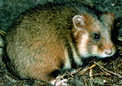
European hamsters have stocky bodies covered in reddish-brown to greyish-brown fur on their lateral and dorsal sides. Their snouts, lips, throats, cheeks and feet are white and their ventral surface is black, hence the name they are sometimes called: black-bellied hamsters. They have prominent, dark eyes and broad, oblique nostrils that run caudally. Their dentition consists of incisors and molars only, with a dental formula of 1/1, 0/0, 0/0, 3/3. Their facial whiskers are straight and stiff and occur in up to 30 brown or white hairs on each side. The soles of their forefeet have five pads, while their hindfeet are much longer and have six pads. Their ears are dorsomedially directed and average at a length of 2.3 to 3.2 cm. They have short tails measuring 3 to 6 cm in length, with hairs shorter than those on the rest of their bodies. Males have an average mass of 451 g while females average 359 g. Adult males have an average length of 24.1 cm while females average approximately 23.7 cm. (Nowak, 1999; Reznik, et al., 1978)
- Other Physical Features
- endothermic
- bilateral symmetry
- Sexual Dimorphism
- male larger
-
- Range mass
- 359 to 451 g
- 12.65 to 15.89 oz
-
- Range length
- 23.7 to 24.1 cm
- 9.33 to 9.49 in
-
- Average basal metabolic rate
- 1.251 W
- AnAge
Reproduction
Common hamsters have a promiscuous mating system with multiple matings per breeding season. To attract a mate, females will run in figure eights. Interested males run close behind and produce mating calls with increasing volume. European hamsters copulate multiple times before mating is finished. (Reznik, et al., 1978)
- Mating System
- polygynandrous (promiscuous)
Each litter consists of 3 to 7 altricial pups who are born with their eyes closed. Females can mate again shortly after giving birth to their first litter, which means it is possible for them to be pregnant while still providing milk for their first litter. Pregnancy lasts 18 to 21 days and babies are weaned for up to 30 days. (Gad, 2014; Reznik, et al., 1978)
- Key Reproductive Features
- gonochoric/gonochoristic/dioecious (sexes separate)
- sexual
- viviparous
-
- Breeding interval
- Females can have up to three litters in one breeding season, with the first arriving in mid-May.
-
- Breeding season
- The breeding season of European hamsters often begins in March to May and extends as long as August.
-
- Range number of offspring
- 3 to 7
-
- Average number of offspring
- 7
- AnAge
-
- Range gestation period
- 18 to 21 days
-
- Range weaning age
- 21 to 20 days
-
- Average weaning age
- 28 days
-
- Range age at sexual or reproductive maturity (female)
- 80 to 90 days
-
- Average age at sexual or reproductive maturity (male)
- 60 days
-
- Average age at sexual or reproductive maturity (male)
Sex: male - 56 days
- AnAge
- Average age at sexual or reproductive maturity (male)
There is little information about male parental care in European hamsters. However it is thought to be little to none, due to their promiscuous mating system. However, mothers will nurse their young for about 4 weeks and are extremely territorial, which is a form of offspring protection aggression. (Reznik, et al., 1978)
- Parental Investment
- altricial
- female parental care
-
pre-fertilization
-
protecting
- female
-
protecting
-
pre-hatching/birth
-
protecting
- female
-
protecting
-
pre-weaning/fledging
-
protecting
- female
-
protecting
-
pre-independence
-
protecting
- female
-
protecting
Lifespan/Longevity
Hamsters live significantly shorter lives in captivity because they do not hibernate. (Reznik, et al., 1978)
-
- Average lifespan
Status: wild - 8 years
- Average lifespan
-
- Average lifespan
Status: captivity - 5 years
- Average lifespan
-
- Average lifespan
Status: wild - 4 years
- Average lifespan
-
- Average lifespan
Status: captivity - 1-2 years
- Average lifespan
-
- Average lifespan
Status: captivity - 2.0 years
- Max Planck Institute for Demographic Research
- Average lifespan
-
- Average lifespan
Status: wild - 4.0 years
- Max Planck Institute for Demographic Research
- Average lifespan
Behavior
European hamsters are nocturnal, solitary burrowing rodents whose behavior is seasonally dependent. In late summer they start building up body fat reserves and their dorsal fur darkens for hibernation, which occurs from mid-October to mid-March. They hibernate in a curled position with outstretched forelegs and wake up every 5 to 7 days to feed. During hibernation, they can be found in their burrows as far as 2 m below ground as opposed to being found 30 to 60 cm deep in summer. They create extremely extensive tunnels consisting of dwelling, food storage, and latrine chambers. Their tunnels typically have a diameter of 8 to 9 cm with several exits. They are perceived to be highly adaptive, due to their dietary opportunism and ability to burrow in urban settings. They use their cheek pouches to transport food back to their burrows. They are very aggressive towards members of their own species except during breeding season. (Hedrzak, et al., 2018; Nowak, 1999; Reznik, et al., 1978; Tissier, et al., 2019)
- Key Behaviors
- cursorial
- fossorial
- crepuscular
- motile
- sedentary
- hibernation
- solitary
- territorial
-
- Range territory size
- 2,200 to 18,500 m^2
Home Range
Males on average occupy a larger territory (1.85 ha) than females (0.22 ha) (Reznik, et al., 1978; Tissier, et al., 2017; Ulbrich and Kayser, 2004)
Communication and Perception
They use visual communication, vocalizations, secretions, and touch to communicate with each other. For example, during breeding season, females run in figure eights while males make mating calls with increasing volume before mating.
European hamsters also produce secretions from their flank organs to mark their territories. Some of their aggressive communication consists of grunting, spitting and mobbing. When fighting, European hamsters will wrestle, stand on their hind legs, jump and bite. (Reznik, et al., 1978; Tissier, et al., 2019)
- Other Communication Modes
- scent marks
Food Habits
European hamsters are reported to be granivores/herbivores, because they eat grasses, seeds, grains, roots, fruits, and legumes. However, they opportunistically eat insects and insect larvae. (Reznik, et al., 1978; Tissier, et al., 2017; Tissier, et al., 2019)
- Animal Foods
- insects
- Plant Foods
- leaves
- roots and tubers
- seeds, grains, and nuts
- fruit
- Foraging Behavior
- stores or caches food
Predation
Predators of European hamsters in the wild include birds of prey, foxes, stoats, and badgers. In urban regions they are also preyed upon by feral cats and dogs. European hamsters are crepuscular and sedentary, so they are usually safe from predators until they leave their burrows. (Hedrzak, et al., 2018; Tissier, et al., 2019)
-
- Known Predators
-
- Red fox Vulpes vulpes
- Red kite Milvus milvus
- Stoat Mustela erminea
- Least weasel Mustela nivalis
- European badger Meles meles
- Common kestrel Falco tinnunculus
- Common buzzard Buteo buteo
- Lesser Spotted Eagle Clanga pomarina
- Western marsh harrier Circus aeruginosus
- Montagu’s harrier Circus pygargus
- Hen harrier Circus cyaneus
- Hooded crow Corvus cornix
- Common raven Corvus corax
- Rook Corvus frugilegus
- Grey heron Ardea cinerea
- White stork Ciconia ciconia
- Domestic dog Canis lupus familiaris
- Domestic cat Felis catus
Ecosystem Roles
European hamsters are primarily herbivores and consume producers. They serve as prey to many carnivores in their habitats and also serve as ecosystem engineers through their burrowing. They are also seed dispersers, since they store seeds in their burrows and occasionally lose them. (Hedrzak, et al., 2018; Tissier, et al., 2019)
- Ecosystem Impact
- disperses seeds
- creates habitat
- soil aeration
Economic Importance for Humans: Positive
European hamsters have been hunted or sold for their pelts. They also have been used for cancer research, due to their exposure to pesticides and air pollution in urban settings. (Gad, 2014; Reznik, et al., 1978)
- Positive Impacts
- body parts are source of valuable material
- research and education
Economic Importance for Humans: Negative
European hamsters are known to be agricultural pests. They can be territorial and attack humans when they feel threatened. (Surov, et al., 2016; Tissier, et al., 2019)
- Negative Impacts
-
injures humans
- bites or stings
- crop pest
Conservation Status
According to the IUCN Red list, European hamsters have a conservation status of least concern. However, they have a decreasing population trend due to habitat loss, fragmentation, predation, and pest control. (Hedrzak, et al., 2018; Tissier, et al., 2017; Tissier, et al., 2019; Ulbrich and Kayser, 2004)
-
- IUCN Red List
-
Least Concern
More information
-
- IUCN Red List
-
Least Concern
More information
Other Comments
European Hamsters (Cricetus cricetus) are also known as Eurasian hamsters, black-bellied hamsters or common hamsters. (Hedrzak, et al., 2018; Reznik, et al., 1978; Ulbrich and Kayser, 2004)
Contributors
Sierra Lippert (author), University of Washington, Laura Prugh (editor), University of Washington, Galen Burrell (editor), Special Projects.
Glossary
- Nearctic
-
living in the Nearctic biogeographic province, the northern part of the New World. This includes Greenland, the Canadian Arctic islands, and all of the North American as far south as the highlands of central Mexico.

- acoustic
-
uses sound to communicate
- agricultural
-
living in landscapes dominated by human agriculture.
- altricial
-
young are born in a relatively underdeveloped state; they are unable to feed or care for themselves or locomote independently for a period of time after birth/hatching. In birds, naked and helpless after hatching.
- bilateral symmetry
-
having body symmetry such that the animal can be divided in one plane into two mirror-image halves. Animals with bilateral symmetry have dorsal and ventral sides, as well as anterior and posterior ends. Synapomorphy of the Bilateria.
- chemical
-
uses smells or other chemicals to communicate
- crepuscular
-
active at dawn and dusk
- endothermic
-
animals that use metabolically generated heat to regulate body temperature independently of ambient temperature. Endothermy is a synapomorphy of the Mammalia, although it may have arisen in a (now extinct) synapsid ancestor; the fossil record does not distinguish these possibilities. Convergent in birds.
- female parental care
-
parental care is carried out by females
- fossorial
-
Referring to a burrowing life-style or behavior, specialized for digging or burrowing.
- granivore
-
an animal that mainly eats seeds
- herbivore
-
An animal that eats mainly plants or parts of plants.
- hibernation
-
the state that some animals enter during winter in which normal physiological processes are significantly reduced, thus lowering the animal's energy requirements. The act or condition of passing winter in a torpid or resting state, typically involving the abandonment of homoiothermy in mammals.
- motile
-
having the capacity to move from one place to another.
- native range
-
the area in which the animal is naturally found, the region in which it is endemic.
- polygynandrous
-
the kind of polygamy in which a female pairs with several males, each of which also pairs with several different females.
- scent marks
-
communicates by producing scents from special gland(s) and placing them on a surface whether others can smell or taste them
- sedentary
-
remains in the same area
- sexual
-
reproduction that includes combining the genetic contribution of two individuals, a male and a female
- soil aeration
-
digs and breaks up soil so air and water can get in
- solitary
-
lives alone
- stores or caches food
-
places a food item in a special place to be eaten later. Also called "hoarding"
- suburban
-
living in residential areas on the outskirts of large cities or towns.
- tactile
-
uses touch to communicate
- territorial
-
defends an area within the home range, occupied by a single animals or group of animals of the same species and held through overt defense, display, or advertisement
- tropical savanna and grassland
-
A terrestrial biome. Savannas are grasslands with scattered individual trees that do not form a closed canopy. Extensive savannas are found in parts of subtropical and tropical Africa and South America, and in Australia.
- savanna
-
A grassland with scattered trees or scattered clumps of trees, a type of community intermediate between grassland and forest. See also Tropical savanna and grassland biome.
- temperate grassland
-
A terrestrial biome found in temperate latitudes (>23.5° N or S latitude). Vegetation is made up mostly of grasses, the height and species diversity of which depend largely on the amount of moisture available. Fire and grazing are important in the long-term maintenance of grasslands.
- urban
-
living in cities and large towns, landscapes dominated by human structures and activity.
- visual
-
uses sight to communicate
- viviparous
-
reproduction in which fertilization and development take place within the female body and the developing embryo derives nourishment from the female.
References
Gad, S. 2014. Chapter 2 - Rodents model for toxicity testing and biomarkers. Biomarkers in Toxicology, 1: 7-69. Accessed June 07, 2019 at https://www.sciencedirect.com/science/article/pii/B9780124046306000026.
Hedrzak, M., D. Cywicka, I. Kaim. 2018. Comparison of Localities of European Hamster ( Cricetus Cricetus ) in the Areas of High and Low Level of Human Activity. Urban Ecosystems, 21, no.2: 323-338. Accessed May 13, 2019 at https://www.springerprofessional.de/en/comparison-of-localities-of-european-hamster-cricetus-cricetus-i/15263568.
Nowak, R. 1999. Cricetus Cricetus. Walker's Mammals of the World, Vol. 1, 6 Edition. Baltimore, MD: Johns Hopkins University Press.
Panteleyev, P. 1998. 1. Pensoft, Moscow, Russia, 1: 143.
Reznik, G., H. Schuller, U. Mohr. 1978. Clinical Anatomy of the European Hamster : Cricetus Cricetus. Philadelphia, PA: National Cancer Institute. Accessed May 11, 2019 at https://ia801305.us.archive.org/33/items/clinicalanatomyo00rezn/clinicalanatomyo00rezn.pdf.
Surov, A., A. Banaszek, P. Bogomolov, N. Feoktistova, S. Monecke. 2016. Dramatic Global Decrease in the Range and Reproduction Rate of the European Hamster Cricetus Cricetus. Endangered Species Research, 31, no. 1: 119-145. Accessed May 13, 2019 at https://www.int-res.com/articles/feature/n031p119.pdf.
Tissier, M., Y. Handrich, O. Dallongeville, J. Robin, C. Habold. 2017. Diets Derived from Maize Monoculture Cause Maternal Infanticides in the Endangered European Hamster Due to a Vitamin B3 Deficiency. Proceedings. Biological Sciences, 284, no.1847: MLT, 0000-0002-2107-8064. Accessed May 13, 2019 at https://royalsocietypublishing.org/doi/pdf/10.1098/rspb.2016.2168.
Tissier, M., C. Bousquet, J. Fleitz, C. Habold, O. Petit, Y. Handrich. 2019. Captive-reared European hamsters follow an offensive strategy during risk-assessment. PLoS ONE, 14, no.1: e0210158. Accessed June 07, 2019 at https://journals.plos.org/plosone/article/metrics?id=10.1371/journal.pone.0210158.
Ulbrich, K., A. Kayser. 2004. A risk analysis for the common hamster ( Cricetus cricetus). Biological Conservation, 117, no. 3: 263-270. Accessed May 13, 2019 at Ulbrich, & Kayser. (2004). A risk analysis for the common hamster ( Cricetus cricetus). Biological Conservation, 117(3), 263-270..