Cricetinaehamsters



Diversity
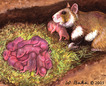
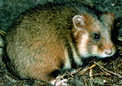
Cricetines, or hamsters, make up a small Old World subfamily of terrestrial cricetid rodents. There are 18 hamster species in 7 genera. (Musser and Carleton, 2005)
Geographic Range
Cricetine rodents have a Palearctic distribution. They are found in central and eastern Europe, in Asia Minor, Syria, and Iran, in Mongolia, Siberia, northern China, and Korea. (Carleton and Musser, 1984)
- Biogeographic Regions
- palearctic
Habitat
Cricetines are most common in dry, open habitats. They live in deserts, plains, sand dunes, steppes, shrublands, rocky foothills, river valleys, agricultural fields, gardens, and orchards. Hamsters may be found at elevations up to 3,600 meters. (Carleton and Musser, 1984; Nowak, 1999)
- Habitat Regions
- temperate
- terrestrial
- Terrestrial Biomes
- desert or dune
- savanna or grassland
- chaparral
- scrub forest
- Other Habitat Features
- agricultural
- riparian
Physical Description
Hamsters are small to large muroid rodents with compact bodies, small, furry ears, short legs, wide feet, and short stubby tails. Body lengths range from 50 mm to 340 mm, and tail lengths range from 7 to 106 mm. Females of some species are larger than males. Hamsters have long, thick fur. They are gray, pinkish buff, light brown, or reddish brown on the dorsal surface and white, gray, or black on the ventral surface. Their flanks are often white as well. Some have a middorsal stripe. Hamsters have large cheek pouches and sebaceous flank glands.
The dental formula of hamsters is 1/1, 0/0, 0/0, 3/3 = 16. The incisors are orthodont and ungrooved, and the molars are rooted and cuspidate. The upper molars have deep labial re-entrant angles, and most cricetines have molars with opposite cusps. The dentary has a pronounced sigmoid notch and coronoid process. The rostrum is long, wide, and robust. The area between the orbits is hourglass shaped, and the zygomatic plate usually lacks a spine or notch. The incisive foramena are usually short. The sphenopalatine vacuities are moderately large. There is a postglenoid foramen, and most have a sphenofrontal foramen and squamosoalisphenoid groove. The bony palate is wide and smooth, and there is usually a single pair of posterior palatine foramina. A strut of the alisphenoid bone separates the masticatory foramen and accessory foramen ovale. Cricentines have vertebral columns with 13 thoracic vertebrae and six lumbar vertebrae.


Hamsters have two-chambered stomachs, and most lack a gall bladder. Their large intestines and ceca are moderately complex. Hamsters have a diploid chromosome number between 20 and 44. (Carleton and Musser, 1984; Nowak, 1999)
- Other Physical Features
- endothermic
- homoiothermic
- bilateral symmetry
- Sexual Dimorphism
- sexes alike
- female larger
Reproduction
Cricetines are promiscuous, with males and females both having multiple mates. During the breeding season, male hamsters have been seen wandering down any burrows they find, looking for female hamsters. During mating, a copulatory plug forms and seals the female's reproductive tract, preventing subsequent males from successfully fertilizing the female's eggs. A female hamster often drives a male out of her territory soon after mating. (Carleton and Musser, 1984; Nowak, 1999)
- Mating System
- polygynandrous (promiscuous)
Cricetines are seasonal breeders that mate and raise their litters from February to November. Females bear between two and four litters per year. Gestation is short, lasting 15 to 22 days, and litter sizes average 5 to 7 but can be as small as one and as large as 13. Young hamsters nurse for about three weeks, and are sexually mature at six to eight weeks. (Carleton and Musser, 1984; Nowak, 1999)
- Key Reproductive Features
- iteroparous
- seasonal breeding
- gonochoric/gonochoristic/dioecious (sexes separate)
- sexual
- viviparous
Female hamsters nurse their altricial offspring for about three weeks. Some species are known to stuff their youngsters into their cheek pouches when danger threatens and move elsewhere. (Nowak, 1999)
- Parental Investment
- altricial
-
pre-fertilization
-
protecting
- female
-
protecting
-
pre-hatching/birth
-
provisioning
- female
-
protecting
- female
-
provisioning
-
pre-weaning/fledging
-
provisioning
- female
-
protecting
- female
-
provisioning
Lifespan/Longevity
The record longevity for a wild hamster is ten years. This is an unusual case, however, and most wild and captive hamsters live two to four years. Common causes of mortality in the wild are predation, harsh winters, disease, and, in agricultural areas, crushing by heavy machinery. (Carey and Judge, 2002; Kayser, et al., 2003; Nowak, 1999)
Behavior
Hamsters are terrestrial animals and their feet are modified for cursorial locomotion. Some hamsters can swim quite well by filling their cheek pouches with air, giving themselves buoyancy. They dig burrows with multiple entrances and many connected tunnels, with nest, latrine, and food storage chambers. Tunnels may be 50 cm deep, and even deeper during the winter--up to two meters below the soil surface. The size of a hamster's burrow often depends on the age of the animal. Hamsters are usually nocturnal or crepuscular, though some species are active both night and day, and they are solitary. Some species are highly aggressive toward conspecifics and strict dominance hierarchies help to assuage fighting. Often, females are the dominant animals. Hamsters are not true hibernators, but they do experience long bouts of torpor, lasting several weeks at a time, during the winter. (Carleton and Musser, 1984; Nowak, 1999)
- Key Behaviors
- cursorial
- terricolous
- fossorial
- diurnal
- nocturnal
- crepuscular
- motile
- sedentary
- daily torpor
- solitary
- territorial
- dominance hierarchies
Communication and Perception
Hamsters perceive visual, tactile, auditory, and chemical stimuli. They seem to rely most on vision when searching for live prey, but hearing and olfaction are also important (Langley 1985).
Hamsters use chemical cues to communicate. Males scent-mark their territories with their large sebaceous flank glands. In fact, the size of these glands is correlated with an individual's status in the dominance hierarchy: the larger the glands, the more dominant the animal. (Langley, 1985; Nowak, 1999)
- Communication Channels
- chemical
- Other Communication Modes
- scent marks
Food Habits
Cricetines are primarily granivorous, but they also consume leaves, shoots, roots, and fruit. In addition, some species are omnivorous and eat insects and even vertebrates such as frogs. They cram food into their large cheek pouches and take it back to store in their burrows. Hamster burrows have been found with as much as 90 kg of stored food. (Carleton and Musser, 1984; Nowak, 1999)
- Primary Diet
-
carnivore
- eats terrestrial vertebrates
- insectivore
- herbivore
- omnivore
- Foraging Behavior
- stores or caches food
Predation
Animals that prey on hamsters include diurnal raptors, snakes, and mammalian carnivores. Species that are known to eat hamsters are red kites, black kites, common buzzards, lesser spotted eagles, red foxes, domestic dogs, ermine, and Eurasian badgers. Predators such as common kestrels, grey herons, carrion crows, and rooks prey on juvenile hamsters.
Hamsters can be aggressive and do not hesitate to defend themselves from predators with their large incisors. Females sometimes protect their young from predators by carrying them in their cheek pouches. Finally, like the fur of most rodents, hamster fur comes in neutral colors, affording these animals some degree of camouflage. (Kayser, et al., 2003; Nowak, 1999)
- Anti-predator Adaptations
- cryptic
-
- Known Predators
-
- diurnal raptors Accipitridae
- mammalian carnivores Carnivora
- red kites Milvus milvus
- black kites Milvus migrans
- common buzzards Buteo buteo
- lesser spotted eagles Aquila pomarina
- red foxes Vulpes vulpes
- domestic dogs Canis lupus familiaris
- ermine Mustela erminea
- Eurasian badgers Meles meles
- common kestrels Falco tinnunculus
- grey herons Ardea cinerea
- carrion crows Corvus corone
- rooks Corvus frugilegus
Ecosystem Roles
As herbivores and carnivores, cricetines are primary, secondary, and in some cases, tertiary consumers. They are, in turn, food for various higher-level consumers. Their habit of storing seeds may mean that they play a role in seed dispersal. (Nowak, 1999)
- Ecosystem Impact
- disperses seeds
Economic Importance for Humans: Positive
Some hamster species thrive in captivity and make good pets, and they are also used in laboratories for behavioral and physiological research. Others are trapped for their skins. (Nowak, 1999)
- Positive Impacts
- pet trade
- research and education
Economic Importance for Humans: Negative
Some hamster species feed on beans, corn, and lentils, and are thus considered crop pests. (Nowak, 1999)
- Negative Impacts
- crop pest
Conservation Status
The IUCN currently lists one species in this subfamily as endangered (the popular pet, golden or Syrian hamsters, Mesocricetus auratus), one as vulnerable (Romanian hamsters, Mesocricetus newtoni), and one as lower risk (gray dwarf hamsters, Cricetulus migratorius). Although hamsters breed readily and are abundant in captivity, wild populations of some species have restricted ranges and are vulnerable to habitat destruction. (IUCN, 2004; Nowak, 1999)
-
- IUCN Red List [Link]
- Not Evaluated
Other Comments
Cricetines first show up in the fossil record in the middle Miocene of Europe. The earliest fossils of living genera are Cricetus specimens from the late Miocene. (Carleton and Musser, 1984)
Contributors
Tanya Dewey (editor), Animal Diversity Web.
Allison Poor (author), University of Michigan-Ann Arbor.
Glossary
- Palearctic
-
living in the northern part of the Old World. In otherwords, Europe and Asia and northern Africa.

- acoustic
-
uses sound to communicate
- agricultural
-
living in landscapes dominated by human agriculture.
- altricial
-
young are born in a relatively underdeveloped state; they are unable to feed or care for themselves or locomote independently for a period of time after birth/hatching. In birds, naked and helpless after hatching.
- bilateral symmetry
-
having body symmetry such that the animal can be divided in one plane into two mirror-image halves. Animals with bilateral symmetry have dorsal and ventral sides, as well as anterior and posterior ends. Synapomorphy of the Bilateria.
- carnivore
-
an animal that mainly eats meat
- chaparral
-
Found in coastal areas between 30 and 40 degrees latitude, in areas with a Mediterranean climate. Vegetation is dominated by stands of dense, spiny shrubs with tough (hard or waxy) evergreen leaves. May be maintained by periodic fire. In South America it includes the scrub ecotone between forest and paramo.
- chemical
-
uses smells or other chemicals to communicate
- crepuscular
-
active at dawn and dusk
- cryptic
-
having markings, coloration, shapes, or other features that cause an animal to be camouflaged in its natural environment; being difficult to see or otherwise detect.
- desert or dunes
-
in deserts low (less than 30 cm per year) and unpredictable rainfall results in landscapes dominated by plants and animals adapted to aridity. Vegetation is typically sparse, though spectacular blooms may occur following rain. Deserts can be cold or warm and daily temperates typically fluctuate. In dune areas vegetation is also sparse and conditions are dry. This is because sand does not hold water well so little is available to plants. In dunes near seas and oceans this is compounded by the influence of salt in the air and soil. Salt limits the ability of plants to take up water through their roots.
- diurnal
-
- active during the day, 2. lasting for one day.
- dominance hierarchies
-
ranking system or pecking order among members of a long-term social group, where dominance status affects access to resources or mates
- endothermic
-
animals that use metabolically generated heat to regulate body temperature independently of ambient temperature. Endothermy is a synapomorphy of the Mammalia, although it may have arisen in a (now extinct) synapsid ancestor; the fossil record does not distinguish these possibilities. Convergent in birds.
- folivore
-
an animal that mainly eats leaves.
- fossorial
-
Referring to a burrowing life-style or behavior, specialized for digging or burrowing.
- frugivore
-
an animal that mainly eats fruit
- granivore
-
an animal that mainly eats seeds
- herbivore
-
An animal that eats mainly plants or parts of plants.
- insectivore
-
An animal that eats mainly insects or spiders.
- iteroparous
-
offspring are produced in more than one group (litters, clutches, etc.) and across multiple seasons (or other periods hospitable to reproduction). Iteroparous animals must, by definition, survive over multiple seasons (or periodic condition changes).
- motile
-
having the capacity to move from one place to another.
- native range
-
the area in which the animal is naturally found, the region in which it is endemic.
- nocturnal
-
active during the night
- omnivore
-
an animal that mainly eats all kinds of things, including plants and animals
- pet trade
-
the business of buying and selling animals for people to keep in their homes as pets.
- polygynandrous
-
the kind of polygamy in which a female pairs with several males, each of which also pairs with several different females.
- riparian
-
Referring to something living or located adjacent to a waterbody (usually, but not always, a river or stream).
- scent marks
-
communicates by producing scents from special gland(s) and placing them on a surface whether others can smell or taste them
- scrub forest
-
scrub forests develop in areas that experience dry seasons.
- seasonal breeding
-
breeding is confined to a particular season
- sedentary
-
remains in the same area
- sexual
-
reproduction that includes combining the genetic contribution of two individuals, a male and a female
- solitary
-
lives alone
- stores or caches food
-
places a food item in a special place to be eaten later. Also called "hoarding"
- tactile
-
uses touch to communicate
- temperate
-
that region of the Earth between 23.5 degrees North and 60 degrees North (between the Tropic of Cancer and the Arctic Circle) and between 23.5 degrees South and 60 degrees South (between the Tropic of Capricorn and the Antarctic Circle).
- terrestrial
-
Living on the ground.
- territorial
-
defends an area within the home range, occupied by a single animals or group of animals of the same species and held through overt defense, display, or advertisement
- tropical savanna and grassland
-
A terrestrial biome. Savannas are grasslands with scattered individual trees that do not form a closed canopy. Extensive savannas are found in parts of subtropical and tropical Africa and South America, and in Australia.
- savanna
-
A grassland with scattered trees or scattered clumps of trees, a type of community intermediate between grassland and forest. See also Tropical savanna and grassland biome.
- temperate grassland
-
A terrestrial biome found in temperate latitudes (>23.5° N or S latitude). Vegetation is made up mostly of grasses, the height and species diversity of which depend largely on the amount of moisture available. Fire and grazing are important in the long-term maintenance of grasslands.
- visual
-
uses sight to communicate
- viviparous
-
reproduction in which fertilization and development take place within the female body and the developing embryo derives nourishment from the female.
References
Carey, J., D. Judge. 2002. "Longevity Records: Life Spans of Mammals, Birds, Amphibians, Reptiles, and Fish" (On-line). Max Planck Institute for Demographic Research. Accessed June 10, 2005 at http://www.demogr.mpg.de/.
Carleton, M., G. Musser. 1984. Muroid rodents. Pp. 289-379 in S Anderson, J Jones Jr., eds. Orders and Families of Recent Mammals of the World. New York: John Wiley and Sons.
Ellerman, J. 1941. The Families and Genera of Living Rodents, vol. II. London: British Museum (Natural History).
IUCN, 2004. "2004 IUCN Red List of Threatened Species" (On-line). Accessed June 13, 2005 at www.redlist.org.
Jansa, S., M. Weksler. 2004. Phylogeny of muroid rodents: relationships within and among major lineages as determined by IRBP gene sequences. Molecular Phylogenetics and Evolution, 31: 256-276.
Kayser, A., U. Weinhold, M. Stubbe. 2003. Mortality factors of the common hamster Cricetus cricetus at two sites in Germany. Acta Theriologica, 48 (1): 47-57.
Langley, W. 1985. Relative importance of distance senses in hamster predatory behavior. Behavioural Processes, 10 (3): 229-240.
Michaux, J., A. Reyes, F. Catzeflis. 2001. Evolutionary history of the most speciose mammals: Molecular phylogeny of muroid rodents. Molecular Biology and Evolution, 18(11): 2017-2031.
Miller, G., J. Gidley. 1918. Synopsis of supergeneric groups of rodents. Journal of the Washington Academy of Science, 8: 431-448.
Musser, G., M. Carleton. 2005. Superfamily Muroidea. D Wilson, D Reeder, eds. Mammal Species of the World. Baltimore and London: The Johns Hopkins University Press.
Nowak, R. 1999. Walker's Mammals of the World, vol. II. Baltimore and London: The Johns Hopkins University Press.
Steppan, S., R. Adkins, J. Anderson. 2004. Phylogeny and divergence-date estimates of rapid radiations in Muroid rodents based on multiple nuclear genes. Systematic Biology, 53(4): 533-553.
Vorontsov, N. 1966. Taxonomic position and a survey of the hamsters of the genus Mystromys Wagn. (Mammalia, Glires). Zoologicheskii Zhurnal, 45: 436-446.