Cratogeomys neglectusQuerétaro pocket gopher
Geographic Range
Queretaro pocket gophers (Cratogeomys neglectus) are found only in the northeastern part of the state of Queretaro, Mexico. They are located in a small range of mountains known as the Sierra del Doctor, which is part of the city of Pinal de Amoles. (Leon, et al., 2001)
Habitat
Queretaro pocket gophers live in mountainous regions where the habitat is transitional between oak and pine forests. The majority of their activity occurs in agricultural areas that are next to pine forests with many trees and low vegetation. Dark mounds of soil, which indicate the presence of their tunnels, are often seen on hillsides and in agricultural fields. (Leon, et al., 2001)
- Habitat Regions
- tropical
- terrestrial
- Other Habitat Features
- agricultural
-
- Range elevation
- 2570 to 2896 m
- 8431.76 to 9501.31 ft
Physical Description
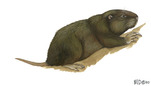
Queretaro pocket gophers are small animals with soft, shiny hair. They have a spindle-shaped body, strong forelimbs, reduced external ears, and a short, thin tail, as is typical of other members of the family Geomyidae. The hair on their backs is dense and gray to yellowish-brown, while the hair on their bellies is thinly scattered and gray to yellowish-red. They have whitish hairs on the throat and bottoms of the hind feet. Around their ears, the hair is dark brown, and their tails are sparsely covered with reddish hairs.
These animals have well-developed cheek pouches with openings outside the buccal cavity. Their procumbent incisors protrude from the mouth even when it is closed.
Males and females are sexually dimorphic in size. Males can weigh from 183 to 500 g and are 220 to 370 mm in length. Females can weigh from 290 to 360 g and are 260 to 304 mm in length. (Leon, et al., 2001; Merriam, 1902; Russell, 1968)
- Other Physical Features
- endothermic
- homoiothermic
- bilateral symmetry
- Sexual Dimorphism
- male larger
-
- Range mass
- 183 to 500 g
- 6.45 to 17.62 oz
-
- Average mass
- 395 g
- 13.92 oz
-
- Range length
- 260 to 370 mm
- 10.24 to 14.57 in
Reproduction
There is little information on the mating system and behavior of Queretaro pocket gophers, but in a close relative, Cratogeomys tylorhinus, the sexes meet only to breed.
Another species in the family Geomyidae, Buller's pocket gopher (Pappogeomys bulleri), is believed to be polygynous. These animals are also solitary except when breeding. (Kenny and Myers, 2006; Nowak, 1999)
The breeding season for Queretaro pocket gophers starts in early spring, when burrowing activity increases. Little information is available about the reproductive cycle of this species. However, a pregnant female was acquired by Leon et al. (1990); this female had two embryos.
Buller's pocket gophers, a related species, breed year-round, but most mating takes place in the spring. Males and females reach sexual maturity at an age of nine months to one year. After a gestation period of about 20 days, a female will give birth to a litter of two to eleven offspring. In two months the young are weaned and they leave their mother. (Kenny and Myers, 2006; Leon, et al., 1990; Leon, et al., 2001)
- Key Reproductive Features
- iteroparous
- seasonal breeding
- gonochoric/gonochoristic/dioecious (sexes separate)
- sexual
- viviparous
-
- Breeding interval
- Breeding intervals in Queretaro pocket gophers are unknown.
-
- Breeding season
- The breeding season starts in early spring, its duration is unknown.
There is little available information regarding parental investment and care in Queretaro pocket gophers. However, in Buller's pocket gophers, all parental care is performed by the female. She provides protection and nourishment to her offspring until they are weaned. Since Queretaro pocket gophers are solitary, it is likely that females of this species also fulfill all of the parental responsibilities. (Kenny and Myers, 2006)
- Parental Investment
- altricial
-
pre-fertilization
- provisioning
-
protecting
- female
-
pre-hatching/birth
-
provisioning
- female
-
protecting
- female
-
provisioning
-
pre-weaning/fledging
-
provisioning
- female
-
provisioning
Lifespan/Longevity
Data on the lifespan of Queretaro pocket gophers are not available. Buller's pocket gophers live to be about 5 years of age. (Kenny and Myers, 2006)
Behavior
Queretaro pocket gophers are solitary, fossorial mammals. They dig burrow systems that are separated from one another and are occupied by one individual. These systems are on average about one quarter meter below the surface, and there can be many secondary tunnels branching off of the main tunnel. Burrow systems are usually built during the early morning and late evening hours.
Captive Queretaro pocket gophers sleep most of the day, but in the early morning they are active and feed voraciously. After feeding, they clean their head, neck, and cheek pouches with their front feet. They sleep deeply and curl their heads under their bellies so only their backs are exposed. (Leon, et al., 2001)
- Key Behaviors
- fossorial
- nocturnal
- crepuscular
- motile
- sedentary
- solitary
- territorial
Home Range
The home range for this species has not been reported.
Communication and Perception
It has been noted that in captivity when one pocket gopher senses that another is near, it will rub its lower incisors against its upper incisors to make a clicking noise. It will also hiss. (Leon, et al., 2001)
Food Habits
Queretaro pocket gophers eat roots and stems from a variety of plant and tree species. Captive animals also eat corn, alfalfa, carrots, lettuce, and potatoes. They shake food items before ingesting them. (Leon, et al., 2001)
- Primary Diet
-
herbivore
- lignivore
- Plant Foods
- roots and tubers
- wood, bark, or stems
- Foraging Behavior
- stores or caches food
Predation
Several carnivores reportedly prey on Queretaro pocket gophers. These include tejons (Nasua nasua), long-tailed weasels (Mustela frenata), coyotes (Canis latrans), and gray foxes (Urocyon cinereoargenteus). Also, two species of snakes, Queretaran blotched rattlesnakes (Crotalus aquilus) and Mexican pine snakes (Pituophis deppei) are predators of Queretaro pocket gophers. Queretaro pocket gophers avoid most predation through their fossorial and nocturnal life style. (Dixon, et al., 1972; Leon, et al., 2001)
-
- Known Predators
-
- tejons (Nasua nasua)
- long-tailed weasels (Mustela frenata)
- coyotes (Canis latrans)
- gray foxes (Urocyon cinereoargenteus)
- Queretaran blotched rattlesnakes (Crotalus aquilus)
- Mexican pine snakes (Pituophis deppei)
Ecosystem Roles
Several types of animals use burrow systems made by Queretaro pocket gophers. These include spiders (Araeneidae), centipedes (Chilopoda), beetles (Coleoptera), springtails (Collembola), flies (Diptera), crickets (Orthoptera), mesquite lizards (Sceloporus grammicus), and Yarrow's spiny lizards (S. jarrovi). Their burrow digging helps to aerate and mix soil nutrients and their foraging impacts plant communities where they occur. (Leon, et al., 2001)
- Ecosystem Impact
- creates habitat
- centipedes (Chilopoda)
- spiders (Araeneidae)
- beetles (Coleoptera)
- springtails (Collembola)
- flies (Diptera)
- crickets (Orthoptera)
- mesquite lizards (Sceloporus grammicus)
- Yarrow's spiny lizards (Sceloporus jarrovi)
Economic Importance for Humans: Positive
Little information is available about any benefits Queretaro pocket gophers provide to humans. It has been suggested that Buller's pocket gophers have a positive effect on agriculture because their burrowing helps to aerate and fertilize the soil. It is possible that Queretaro pocket gophers have a similar impact. (Kenny and Myers, 2006)
Economic Importance for Humans: Negative
Queretaro pocket gophers are seen as pests by local people because their burrows and feeding habits harm trees and crops. Otherwise, there are no known adverse affects of these animals on humans. (Leon, et al., 2001)
- Negative Impacts
- crop pest
Conservation Status
Queretaro pocket gophers are considered a critically endangered species by the IUCN Red List of Threatened Species.
-
- IUCN Red List
- Critically Endangered
-
- US Federal List
- No special status
-
- CITES
- No special status
Other Comments
Queretaro pocket gophers were previously recognized as Pappogeomys neglectus.
Contributors
Tanya Dewey (editor), Animal Diversity Web.
Laura Mateskon (author), Michigan State University, Barbara Lundrigan (editor, instructor), Michigan State University.
Glossary
- Nearctic
-
living in the Nearctic biogeographic province, the northern part of the New World. This includes Greenland, the Canadian Arctic islands, and all of the North American as far south as the highlands of central Mexico.

- acoustic
-
uses sound to communicate
- agricultural
-
living in landscapes dominated by human agriculture.
- altricial
-
young are born in a relatively underdeveloped state; they are unable to feed or care for themselves or locomote independently for a period of time after birth/hatching. In birds, naked and helpless after hatching.
- bilateral symmetry
-
having body symmetry such that the animal can be divided in one plane into two mirror-image halves. Animals with bilateral symmetry have dorsal and ventral sides, as well as anterior and posterior ends. Synapomorphy of the Bilateria.
- chemical
-
uses smells or other chemicals to communicate
- crepuscular
-
active at dawn and dusk
- endothermic
-
animals that use metabolically generated heat to regulate body temperature independently of ambient temperature. Endothermy is a synapomorphy of the Mammalia, although it may have arisen in a (now extinct) synapsid ancestor; the fossil record does not distinguish these possibilities. Convergent in birds.
- forest
-
forest biomes are dominated by trees, otherwise forest biomes can vary widely in amount of precipitation and seasonality.
- fossorial
-
Referring to a burrowing life-style or behavior, specialized for digging or burrowing.
- herbivore
-
An animal that eats mainly plants or parts of plants.
- iteroparous
-
offspring are produced in more than one group (litters, clutches, etc.) and across multiple seasons (or other periods hospitable to reproduction). Iteroparous animals must, by definition, survive over multiple seasons (or periodic condition changes).
- motile
-
having the capacity to move from one place to another.
- mountains
-
This terrestrial biome includes summits of high mountains, either without vegetation or covered by low, tundra-like vegetation.
- native range
-
the area in which the animal is naturally found, the region in which it is endemic.
- nocturnal
-
active during the night
- seasonal breeding
-
breeding is confined to a particular season
- sedentary
-
remains in the same area
- sexual
-
reproduction that includes combining the genetic contribution of two individuals, a male and a female
- solitary
-
lives alone
- stores or caches food
-
places a food item in a special place to be eaten later. Also called "hoarding"
- tactile
-
uses touch to communicate
- terrestrial
-
Living on the ground.
- territorial
-
defends an area within the home range, occupied by a single animals or group of animals of the same species and held through overt defense, display, or advertisement
- tropical
-
the region of the earth that surrounds the equator, from 23.5 degrees north to 23.5 degrees south.
- viviparous
-
reproduction in which fertilization and development take place within the female body and the developing embryo derives nourishment from the female.
References
Dixon, J., A. Ketchersid, C. Lieb. 1972. The herpetofauna of Queretaro, Mexico, with remarks on taxonomic problems. Southwestern Naturalist, 16: 225-237.
Kenny, E., P. Myers. 2006. ""Pappogeomys bulleri"" (On-line). Animal Diversity Web. Accessed April 13, 2007 at http://animaldiversity.ummz.umich.edu/site/accounts/information/Pappogeomys_bulleri.html.
Leon, L., E. Romo, J. Morales, D. Navarro, D. Schmidly. 1990. Noteworthy records of mammals from the state of Queretaro, Mexico. Southwestern Naturalist, 35: 231-235.
Leon, L., T. Monterrubio, M. Hafner. 2001. Cratogeomys neglectus. Mammalian Species, No. 685: 1-4. Accessed February 03, 2007 at http://www.science.smith.edu/departments/Biology/VHAYSSEN/msi/pdf/685_Cratogeomys_neglectus.pdf.
Merriam, C. 1902. Five new mammals from Mexico. Proceedings of the Biological Society of Washington, 15: 67-69.
Nowak, R. 1999. Yellow-faced and Mexican Pocket Gophers. Pp. 1316-1318 in Walker's Mammals of the World, Vol. 11, 6th Edition. Baltimore: The Johns Hopkins University Press.
Russell, R. 1968. Revision of pocket gophers of the Genus Pappogeomys. University of Kansas Publications, Museum of Natural History, 16: 581-776.