Cracidaechachalacas, curassows, and guans



Diversity
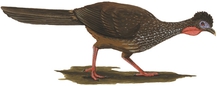
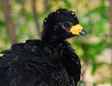
Cracidae comprises 11 genera and 50 species. Taxa within Cracidae are commonly referred to as curassows (Nothocrax, Mitu, Pauxi, Crax), guans (Penelope, Pipile, Aburria, Chamaepetes, Penelopina, Oreophasis) or chachalacas (Ortalis). Cracids are large, blunt-winged birds with long, broad tails. Many species have ornaments (crests or casques) on the head or bill. Cracids are mostly forest dwelling arboreal birds. Unlike many other taxa within Galliformes, many cracids provide parental care to young. Cracids may play an important role as seed dispersers and seed predators in Neotropical forests. (Campbell and Lack, 1985; Monroe and Sibley, 1993; Santamaria and Franco, 2000; Sibley and Ahlquist, 1990)
Geographic Range
Cracids are found in the Neotropics, ranging from southern North America through much of South America. (Campbell and Lack, 1985; Monroe and Sibley, 1993)
- Biogeographic Regions
- nearctic
- neotropical
Habitat
Cracids inhabit various forest types (humid, gallery, primary) located in lowland and mountainous regions (perhaps up to 4000 m). Some species inhabit secondary forests or scrub, or live in close proximity to human habitation. Cracids are arboreal birds, nesting, roosting and foraging in the trees. However, they can also be found foraging on the ground for fallen fruits and other food items. (Delacour and Amadon, 1973; Stiles and Skutch, 1991)
- Habitat Regions
- tropical
- terrestrial
- Terrestrial Biomes
- forest
- rainforest
- scrub forest
Physical Description
Cracids are medium to large chicken-like birds with blunt-wings and long, broad tails. Cracid body lengths range from 50 cm to 1 m and weights range from to 550 to 4800 g. Curassows are the largest in body size and chachalacas are the smallest. Cracids generally have dark plumage that is brown, black, or gray in color. Except for curassows, the sexes are similar in plumage coloration. Exposed skin of the ceres, dewlaps, horns, bills or legs may be brightly colored red or blue. In many cracids males are larger than females. Bills are strong and may be brightly colored. In some species the color of the iris is sexually dimorphic. Curassows are crested with curved feathers on top of the head. Cracids may have a casque, hard comb, wattle or fleshy knob at the base of the bill. Chicks are downy at hatching and may have light brown, black, or striped plumage. (Campbell and Lack, 1985; Delacour and Amadon, 1973; Stiles and Skutch, 1991)
- Other Physical Features
- endothermic
- bilateral symmetry
- polymorphic
- Sexual Dimorphism
- male larger
- sexes colored or patterned differently
- male more colorful
- ornamentation
Reproduction
The mating systems of cracids are variable. Guans appear to be monogamous and the pair bond lasts over many breeding seasons. It is thought that guans may use a flying wing rattling in relationship to courtship. In addition, piping calls of guans are heard in the early morning during the breeding season. Chachalacas may be polygamous and form nesting colonies. Male chachalacas help with nest construction. The head or neck skin of male chachalacas turns bright red during breeding season. Curassows are thought to be monogamous. Most curassows are sexually dimorphic with the sexes differing in plumage color or pattern, or cere color. In one curassow species the males develop an enlarged tracheal loop beneath the skin of the breast. Courtship feeding is part of the mating behavior of curassows. Male curassows in breeding season vocalize with a deep, resonant humming. The yellow knob at the base of the bill of great curassows (Crax rubra) increases in size during courtship. (Campbell and Lack, 1985; Delacour and Amadon, 1973; Stiles and Skutch, 1991)
- Mating System
- monogamous
- polygynandrous (promiscuous)
The breeding season for cracids is variable and for some species breeding starts in March and ends in July. Cracids generally nest in trees, the twig and leaf nest is usually well concealed by vegetation. Some species may nest on the ground. Cracids lay 2 to 4 white or creamy colored eggs with either smooth or rough eggshells. Usually the female alone incubates for 22 to 34 days. Chicks hatch with well-developed primary and secondary feathers. Unlike other Galliformes, cracid chicks roost on perches the first day of hatching. Cracid chicks leave the nest within a day and some species fly in as soon as 3 to 4 days. Large species of cracids may begin breeding at 2 years of age. (Campbell and Lack, 1985; Delacour and Amadon, 1973; Stiles and Skutch, 1991)
- Key Reproductive Features
- iteroparous
- seasonal breeding
- gonochoric/gonochoristic/dioecious (sexes separate)
- sexual
- fertilization
- oviparous
In most cracids it is the female that incubates the eggs for 22 to 34 days. Females also brood the chicks. Males guard incubating and brooding females, and both sexes defend the chicks. Usually the female feeds the chicks. In some species the males may also help to feed the chicks. Parents and offspring may stay together for some months and then may join flocks of 10 to 20 birds until the next breeding season. (Campbell and Lack, 1985; Delacour and Amadon, 1973; Stiles and Skutch, 1991)
- Parental Investment
- precocial
- male parental care
- female parental care
Lifespan/Longevity
One cracid, a great curassow (Crax rubra), reportedly lived for 24 years. (Delacour and Amadon, 1973)
Behavior
Cracids are largely arboreal birds that spend much of the time feeding, nesting and roosting in trees. Cracids also forage on the ground for fallen fruits and other food items. Guans and perhaps chachalacas may be more arboreal than curassows. Guans are most active at dawn and dusk, often seen in pairs walking and feeding amongst the tree branches. Some curassows are particularly active at night and are often seen in pairs, but after breeding season may forage in small family groups. Chachalacas are seen foraging, roosting and flying in noisy groups. Cracids generally glean fruits from the branches of fruiting trees or forage on the ground for fallen fruit. Some cracids have a crop or expandable esophagus for food storage while foraging. Small pebbles may be ingested ('grit') which is thought to help in the digestion of food. Many Cracids run easily along tree branches and jump from tree branch to tree branch when moving towards the treetops. From the treetops cracids may fly or glide or flutter to other locations. Cracids may jump straight up or head- flick when alarmed or nervous. (Campbell and Lack, 1985; Delacour and Amadon, 1973; Stiles and Skutch, 1991)
- Key Behaviors
- arboreal
- flies
- saltatorial
- crepuscular
- motile
- sedentary
- territorial
- social
Communication and Perception
Some cracids have brightly colored skin on the face or neck, or ornaments such as wattles, casques or combs. Coloration of these parts may vary with breeding and may play a role in mate choice.
Cracid vocalizations may be loud and raucous, whistling or booming. Presence of a long looped trachea or air chambers located in the neck may amplify the volume of vocalizations. Chachalaca vocalizations are described as raucous and choruses of chachalacas can be heard most often at dawn or dusk. Currasows may vocalize by cooing or long low booming. Guan vocalizations may be characterized as whistling.
During nesting season some cracids produce audible sounds by vibrating their wings. The sounds have been described as drumming, rattling or whirring. These sounds are produced while the birds fly from treetop to treetop and are heard most often at dawn or dusk. (Campbell and Lack, 1985; Delacour and Amadon, 1973; Stiles and Skutch, 1991)
- Other Communication Modes
- choruses
- vibrations
- Perception Channels
- visual
- tactile
- acoustic
- vibrations
- chemical
Food Habits
Cracids are characterized as frugivorous, but are known to eat other plant material and small animals. Other plant material includes: leaves, seeds and flowers. Invertebrates eaten by cracids include: worms, terrestrial snails and crabs, spiders, centipedes, millipedes, beetles, ants, termites, moths, dragonflies, grasshoppers and cockroaches. Cracids also forage for small vertebrates including: frogs, snakes, nestling birds and small rodents. Cracids have also been noted to consume eggs of pigeons, hummingbirds and tinamous. (Campbell and Lack, 1985; Delacour and Amadon, 1973; Santamaria and Franco, 2000; Stiles and Skutch, 1991)
Predation
Predators of cracids include snakes (suborder Serpentes), foxes (family Canidae), feral cats (Felis silvestris), feral dogs (Canis lupus familiaris) and raptors (order Falconiformes). (Delacour and Amadon, 1973)
-
- Known Predators
-
- snakes (Serpentes)
- foxes (Canidae)
- feral cats (Felis silvestris)
- feral dogs (Canis lupus familiaris)
- raptors (Falconiformes)
Ecosystem Roles
Cracids play important ecosystem roles as seed dispersers and seed predators. Cracids are also important indicators of habitat quality. (IUCN, 2003; Santamaria and Franco, 2000)
- Ecosystem Impact
- disperses seeds
Economic Importance for Humans: Positive
Humans hunt cracids for food or trade. Cracids are becoming an important species for the ecotourism industry. (Delacour and Amadon, 1973; IUCN, 2003; Santamaria and Franco, 2000)
- Positive Impacts
- food
- ecotourism
Economic Importance for Humans: Negative
There are no known adverse affects of Cracids on humans.
Conservation Status
The IUCN Red List of Threatened Species includes a total of 23 cracid species. One species, Alagoas curassow (Mita mita), is extinct in the wild. Three species are listed as 'Critically Endangered' (blue-billed curassow (Crax alberti); white-winged guan (Penelope albipennis); Trinindad piping guan (Pipile pipile). Major threats include habitat loss and hunting. (2003 IUCN, 2003; Collar, et al., 1994)
-
- IUCN Red List [Link]
- Not Evaluated
Contributors
Laura Howard (author), Animal Diversity Web, Alaine Camfield (editor), Animal Diversity Web.
Glossary
- Nearctic
-
living in the Nearctic biogeographic province, the northern part of the New World. This includes Greenland, the Canadian Arctic islands, and all of the North American as far south as the highlands of central Mexico.

- Neotropical
-
living in the southern part of the New World. In other words, Central and South America.
- acoustic
-
uses sound to communicate
- arboreal
-
Referring to an animal that lives in trees; tree-climbing.
- bilateral symmetry
-
having body symmetry such that the animal can be divided in one plane into two mirror-image halves. Animals with bilateral symmetry have dorsal and ventral sides, as well as anterior and posterior ends. Synapomorphy of the Bilateria.
- chemical
-
uses smells or other chemicals to communicate
- choruses
-
to jointly display, usually with sounds, at the same time as two or more other individuals of the same or different species
- crepuscular
-
active at dawn and dusk
- ecotourism
-
humans benefit economically by promoting tourism that focuses on the appreciation of natural areas or animals. Ecotourism implies that there are existing programs that profit from the appreciation of natural areas or animals.
- endothermic
-
animals that use metabolically generated heat to regulate body temperature independently of ambient temperature. Endothermy is a synapomorphy of the Mammalia, although it may have arisen in a (now extinct) synapsid ancestor; the fossil record does not distinguish these possibilities. Convergent in birds.
- female parental care
-
parental care is carried out by females
- fertilization
-
union of egg and spermatozoan
- food
-
A substance that provides both nutrients and energy to a living thing.
- forest
-
forest biomes are dominated by trees, otherwise forest biomes can vary widely in amount of precipitation and seasonality.
- frugivore
-
an animal that mainly eats fruit
- herbivore
-
An animal that eats mainly plants or parts of plants.
- internal fertilization
-
fertilization takes place within the female's body
- iteroparous
-
offspring are produced in more than one group (litters, clutches, etc.) and across multiple seasons (or other periods hospitable to reproduction). Iteroparous animals must, by definition, survive over multiple seasons (or periodic condition changes).
- male parental care
-
parental care is carried out by males
- monogamous
-
Having one mate at a time.
- motile
-
having the capacity to move from one place to another.
- native range
-
the area in which the animal is naturally found, the region in which it is endemic.
- oviparous
-
reproduction in which eggs are released by the female; development of offspring occurs outside the mother's body.
- polygynandrous
-
the kind of polygamy in which a female pairs with several males, each of which also pairs with several different females.
- polymorphic
-
"many forms." A species is polymorphic if its individuals can be divided into two or more easily recognized groups, based on structure, color, or other similar characteristics. The term only applies when the distinct groups can be found in the same area; graded or clinal variation throughout the range of a species (e.g. a north-to-south decrease in size) is not polymorphism. Polymorphic characteristics may be inherited because the differences have a genetic basis, or they may be the result of environmental influences. We do not consider sexual differences (i.e. sexual dimorphism), seasonal changes (e.g. change in fur color), or age-related changes to be polymorphic. Polymorphism in a local population can be an adaptation to prevent density-dependent predation, where predators preferentially prey on the most common morph.
- rainforest
-
rainforests, both temperate and tropical, are dominated by trees often forming a closed canopy with little light reaching the ground. Epiphytes and climbing plants are also abundant. Precipitation is typically not limiting, but may be somewhat seasonal.
- saltatorial
-
specialized for leaping or bounding locomotion; jumps or hops.
- scrub forest
-
scrub forests develop in areas that experience dry seasons.
- seasonal breeding
-
breeding is confined to a particular season
- sedentary
-
remains in the same area
- sexual
-
reproduction that includes combining the genetic contribution of two individuals, a male and a female
- sexual ornamentation
-
one of the sexes (usually males) has special physical structures used in courting the other sex or fighting the same sex. For example: antlers, elongated tails, special spurs.
- social
-
associates with others of its species; forms social groups.
- tactile
-
uses touch to communicate
- terrestrial
-
Living on the ground.
- territorial
-
defends an area within the home range, occupied by a single animals or group of animals of the same species and held through overt defense, display, or advertisement
- tropical
-
the region of the earth that surrounds the equator, from 23.5 degrees north to 23.5 degrees south.
- vibrations
-
movements of a hard surface that are produced by animals as signals to others
- visual
-
uses sight to communicate
- young precocial
-
young are relatively well-developed when born
References
2003 IUCN, 2003. "2003 IUCN Red List of Threatened Species" (On-line). Accessed March 09, 2004 at http://www.redlist.org.
Campbell, B., E. Lack. 1985. A Dictionary of Birds. Vermillion: Buteo Books.
Collar, N., M. Crosby, A. Stattersfield. 1994. Birds to Watch 2, The World List of Threatened Birds. D.C: Smithsonian Institution Press.
Delacour, J., D. Amadon. 1973. Curassows and Related Birds. New York: American Museum of Natural History.
Dyke, G., B. Gulas, T. Crowe. 2003. Suprageneric relationships of galliform birds (Aves, Galliformes): a cladistic analysis of morphological characters. Zoological Journal of the Linnean Society, 137: 227-244.
Haaramo, M. 2003. "Mikko's Phylogeny Archives, Field Museum of Natural History, Helsinki, Finland" (On-line). Accessed March 16, 2004 at http://www.fmnh.helsinki.fi/users/haaramo/Metazoa/Deuterostoma/Chordata/Archosauria/Aves/Galliformes/Galliformes.htm.
IUCN, 2003. "IUCN Executive Summary of Curassows, Guans and Chachalacas: Status survey and conservation action plan" (On-line). Accessed March 09, 2004 at http://www.iucn.org/themes/ssc/pubs/cracids.htm.
Ligon, J. 1999. The evolution of Avian Breeding Systems. New York: Oxford University Press.
Livezey, B., R. Zusi. 2001. Higher-order phylogenetics of modern Aves based on comparative anatomy. Netherlands Journal of Zoology, 51(2): 179-205.
Monroe, B., C. Sibley. 1993. A World Checklist of Birds. Ann Arbor: Edwards Brothers Inc.
Santamaria, M., A. Franco. 2000. Frugivory of Salvin's curassow in a rainforest of the Colombian Amazon. Wilson Bulletin, 112(4): 473-481.
Sibley, C., J. Ahlquist. 1990. Phylogeny and Classification of Birds, A Study in Molecular Evolution. New Haven: Yale University Press.
Sorenson, M., E. Oneal, J. Garcia-Moreno, D. Mindell. 2003. More taxa, more characters: the Hoatzin problem is still unresolved. Molecular Biology and Evolution, 20(9): 1484-1499.
Stiles, G., A. Skutch. 1991. A Guide to the Birds of Costa Rica. Ithaca: Cornell University Press.