Coturnix japonicaJapanese quail
Geographic Range
In general, this quail inhabits parts of Russia (Johnsgard 1988) and eastern Asia, including Japan, Korea and China (Hoffmann 1988) as well as India (Finn 1911). It winters in China, southeast Asia, the extreme northwestern coast of Africa, and a subsaharan band north of Congo and including the Nile River valley from Egypt to Kenya. A small population has been found in Angola. Races of this quail are found in Kenya, Tanzania, Malawi south to South Africa, Mozambique, and Namibia as well as parts of Madagascar. This quail may breed in parts of Europe, Turkey, and central Asia to parts of China (Alderton 1992).
Habitat
These quail are seen in grassy fields, on river banks, or in rice fields (Takatsukasa 1941).
- Terrestrial Biomes
- savanna or grassland
Physical Description
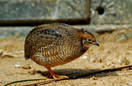
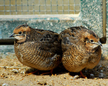
The Japanese Quail is similar in appearance to the European Common Quail, Coturnix coturnix. Overall, they are dark brown with buff mottling above and lighter brown underneath. They have a whitish stripe above the eye on the side of the head. Legs are orangish-gray to pinkish-gray as is the beak (Hoffmann 1988). In contrast to the males, females usually (but not always) lack the rufous coloring on the breast and black flecking or markings on the throat (Johnsgard 1988).
There are variations in plumage color. Some birds are whitish to buff with rufous to chestnut mottling above. Others have a very dark brown appearance with little to no mottling. In addition, there have been golden-brown varieties bred in captivity (Hoffmann 1988).
Wing sizes in males and females is similar ranging from 92 to 101 mm. Both male and female have similar sized tails ranging from 35-49 mm in length (Johnsgard 1988).
- Other Physical Features
- endothermic
- bilateral symmetry
-
- Average mass
- 90 g
- 3.17 oz
-
- Average mass
- 115 g
- 4.05 oz
- AnAge
Reproduction
As with other quail, eggs were laid at a rate of one per day (Lambert 1970), with 7-14 eggs per clutch (Hoffmann 1988). An egg averages 29.8 by 21.5 mm is size and weighs 7.6 g (Johnsgard 1988). Incubation time is 19-20 days (Lambert 1970), although clutch sizes have been associated with latitude and length of photoperiod. In Japan, clutch size is 5-8 eggs, while in Russia, clutch size is 5-9 eggs (Johnsgard 1988). The chicks are considered to be mature and able to mate after four weeks old (Hoffmann 1988).
The breeding season varies with location. In Russia, the season starts in late April and continues to early August. In Japan, nesting occurs from late in May and usually ends in August. On the rare occasion, eggs may be found in nests in September (Johnsgard 1988).
- Key Reproductive Features
- iteroparous
- gonochoric/gonochoristic/dioecious (sexes separate)
- sexual
- oviparous
Lifespan/Longevity
-
- Average lifespan
Status: captivity - 6 years
- AnAge
- Average lifespan
Behavior
From studies of captive-bred Japanese quail, seven distinct displays and calls have been recognized in males. Three of the calls were also observed to be uttered by females (Johnsgard 1988). The call of this quail consists of "deep hollow sounds, several times repeated in quick succession" (Finn 1911). The male's call is typically three notes. The female will utter a "long" call which allerts the male to her receptivity to copulate (Johnsgard 1988). In addition, these quail engage in courtship-feeding. The male will hold a small worm in his beak, uttering a soft croaking call. The female approaches the male and takes the small worm to eat. The male then attempts to copulate with the female (Lambert 1970).
This quail and its European counterpart are migratory. Coturnix japonica will migrate to India (Finn 1911), northern Japan and Korea for the summer (Hoffmann 1988). They winter in southeast China, Hainan, Taiwan, and southern Japan. Their migration covers 400-1000 km, which is remarkable for a bird not known for its flying capability (Hoffmann 1988). Overall, their migration route follows a north-south pattern (Johnsgard 1988).
- Key Behaviors
- flies
- motile
Communication and Perception
Food Habits
These quail eat many kinds of grass seeds, including pannicum and white millet. Their diet consists of a higher degree of protein than Painted Quail as these quail will eat more small worms and insect larvae. In the summer, they will especially seek and eat a variety of insects and small invertebrates (Johnsgard 1988). In addition, they eat grit, especially egg-laying females (Lambert 1970).
Economic Importance for Humans: Positive
These quail and their eggs provide food for humans (Hoffmann 1988). Japanese Quail are also frequently seen in aviaries.
Economic Importance for Humans: Negative
There are no known adverse effects on humans by this bird.
Conservation Status
With its broad breeding range, this quail is considered to be relatively secure in maintaining its populations in natural habitats (Johnsgard 1988).
-
- IUCN Red List
-
Near Threatened
More information
-
- IUCN Red List
-
Near Threatened
More information
Other Comments
This quail is closely related to the European Common Quail, Coturnix coturnix. In captivity, these quail will interbreed (Harper 1986) and produce fertile hybrids (Johnsgard 1988). Coturnix japonica has been domesticated since circa the 13th century (Hoffmann 1988). In their natural habitat, Coturnix japonica and C. coturnix have not been found to interbreed in areas where they are sympatric. Although these two forms are considered to be in an intermediate stage of speciation, they still warrant designation as two separate species (Johnsgard 1988).
Contributors
Janice Pappas (author), University of Michigan-Ann Arbor.
Glossary
- acoustic
-
uses sound to communicate
- bilateral symmetry
-
having body symmetry such that the animal can be divided in one plane into two mirror-image halves. Animals with bilateral symmetry have dorsal and ventral sides, as well as anterior and posterior ends. Synapomorphy of the Bilateria.
- chemical
-
uses smells or other chemicals to communicate
- endothermic
-
animals that use metabolically generated heat to regulate body temperature independently of ambient temperature. Endothermy is a synapomorphy of the Mammalia, although it may have arisen in a (now extinct) synapsid ancestor; the fossil record does not distinguish these possibilities. Convergent in birds.
- iteroparous
-
offspring are produced in more than one group (litters, clutches, etc.) and across multiple seasons (or other periods hospitable to reproduction). Iteroparous animals must, by definition, survive over multiple seasons (or periodic condition changes).
- motile
-
having the capacity to move from one place to another.
- native range
-
the area in which the animal is naturally found, the region in which it is endemic.
- oriental
-
found in the oriental region of the world. In other words, India and southeast Asia.

- oviparous
-
reproduction in which eggs are released by the female; development of offspring occurs outside the mother's body.
- sexual
-
reproduction that includes combining the genetic contribution of two individuals, a male and a female
- tactile
-
uses touch to communicate
- tropical savanna and grassland
-
A terrestrial biome. Savannas are grasslands with scattered individual trees that do not form a closed canopy. Extensive savannas are found in parts of subtropical and tropical Africa and South America, and in Australia.
- savanna
-
A grassland with scattered trees or scattered clumps of trees, a type of community intermediate between grassland and forest. See also Tropical savanna and grassland biome.
- temperate grassland
-
A terrestrial biome found in temperate latitudes (>23.5° N or S latitude). Vegetation is made up mostly of grasses, the height and species diversity of which depend largely on the amount of moisture available. Fire and grazing are important in the long-term maintenance of grasslands.
- visual
-
uses sight to communicate
References
Alderton, D. 1992. The Atlas of Quails. Neptune City, NJ: T.F.H. Publications.
Finn, F. 1911. Game Birds of India and Asia. Calcutta: Thacker, Spink & Co..
Harper, D. 1986. Pet Birds for Home and Garden. London: Salamander Books Ltd..
Hoffmann, E. 1988. Coturnix Quail. Taipei: Yi Hisien Publishing Co..
Johnsgard, P. 1988. The Quails, Partridges, and Francolins of the World. Oxford: Oxford University Press.
Lambert, R. 1970. Notes on the breeding and behaviour of Japanese Quails. Avicultural Magazine, 76(5): 177-179.
Takatsukasa, N. 1941. Japanese Birds. Tokyo: Board of Tourist Industry, Japanese Government Railways.