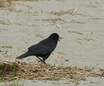
Corvus caurinusnorth-western crow(Also: northwestern crow)
Geographic Range
Corvus caurinus lives only along the coast of the northeastern Pacific Ocean between southern Alaska and the northern tip of Washington. (Verbeek and Butler, 1999)
Habitat
Corvus caurinus lives mainly in coastal regions near intertidal zones, but can be found along large rivers as far as 120 km inland. They are typically near, but not necessarily in, forested regions and will pull back into the forest edge during harsh weather conditions in winter. Northwestern crows are also likely to live near seabird colonies and refuse dumps. They have also been found living in river deltas, coastal bays, coastal villages, towns and cities, as well as on farmland. They can be found at elevations up to 1700 m. (Verbeek and Butler, 1999)
- Habitat Regions
- temperate
- terrestrial
- Terrestrial Biomes
- forest
- Aquatic Biomes
- coastal
- Other Habitat Features
- urban
- suburban
- agricultural
- riparian
-
- Range elevation
- 0 to 1700 m
- 0.00 to 5577.43 ft
Physical Description
Northwestern crows are mid-sized birds, 41.9 to 44.5 cm long and weighing 340 to 440 g. They have a wingspan of about 99 cm and their feathers are iridescent black with bluish-violet on their head, neck, back, wings, and tail. Their eyes are a smokey brownish-grey color, and their bills are glossy and stout though smaller and less powerful than those of common ravens (Corvus corax). They also have bristlelike feathers covering the nares. Corvus caurinus has thick, black legs with large scales on the front side only. When at rest, the tips of their folded wings do not reach the tip of the tail, which has slightly rounded ends. The sexes look alike, though the male is slightly larger than the female. ("Bird Identification Page", 2001; Verbeek and Butler, 1999)
Immature C. caurinus between 3 to 15 months are also black, but have less iridescence than adults. Their back, wing and tail feathers fade gradually from black to brown. Juveniles from 1 to 3 months have looser, fluffier feathers than adult or immature C. caurinus and their feathers are a dull black. They have blue eyes. (Verbeek and Butler, 1999)
Corvus caurinus can be distinguished from American crows (Corvus brachyrhynchos) because it is about 10% smaller, with smaller feet. It is also smaller than common ravens (C. corax), and while C. corax has a wedge-shaped tail, the tail of C. caurinus is squarish. Corvus corax also has shaggy throat-feathers which C. caurinus lacks. (Verbeek and Butler, 1999)
- Other Physical Features
- endothermic
- bilateral symmetry
- Sexual Dimorphism
- male larger
-
- Range mass
- 440 to 340 g
- 15.51 to 11.98 oz
-
- Range length
- 44.5 to 41.9 cm
- 17.52 to 16.50 in
-
- Average wingspan
- 99 cm
- 38.98 in
Reproduction
It is not known when northwestern crows (Corvus caurinus) form breeding pairs, but it is most likely sometime in their second year, prior to the breeding season. If a courtship display exists, it is very subtle and has not been observed. However, prior to copulation, the male droops, spreads his wings and tail, points his bill down and quivers his wings and tail while exposing nictitating membranes (a transparent inner eyelid in birds). The female has a similar display, but she crouches and quivers her tail rapidly. (Verbeek and Butler, 1999)
Corvus caurinus has been known to participate in cooperative breeding. A mated pair will sometimes keep one of their offspring from the previous season (who has not yet reached sexual maturity) with them on their breeding territory. The juvenile bird helps the male protect the territory, hide food, and, very infrequently, gather food for the nestlings. A breeding pair does not always have a helper; when they do they only have one and it is always one of their offspring. (James and Verbeek, 1983; Verbeek and Butler, 1999)
- Mating System
- monogamous
- cooperative breeder
Young Corvus caurinus probably reach sexual maturity between 15 and 20 months. They copulate and begin building nests from early February through late March. Northwestern crows breed once yearly, but they will renest if disturbed early in the season. The female selects a place to build the nest, normally in or under trees, shrubs, blackberry tangles, or tall grass. Nest-building occurs only during daylight hours and in good weather. Nests are built with branches broken off of trees, grass and moss as well as other objects and soil. Corvus caurinus line their nests with moss, gull and crow feathers and sheep's wool, among other things. (Verbeek and Butler, 1999)
A female C. caurinus typically lays 3 to 6 eggs per breeding season, laying one egg a day, almost always before 8:00 AM. Eggs are pale bluish with darker brown spots and are subelliptical to oval. They have a smooth, slightly glossy surface and are about 40 mm long and 28 mm wide. (Verbeek and Butler, 1999)
Incubation most likely begins on the second day, and is performed by the female only. The incubation period is about 18 days; during this time the male feeds the female, most often at a small distance from the nest. After the eggs have hatched, female C. caurinus begin feeding the hatchlings. (Verbeek and Butler, 1999)
Corvus caurinus typically leave the nest permanently at about 31 days. All of the chicks leave the nest on the same day and stay in nearby trees and shrubs, making short flights when their parents are away. They begin exploring nearby territories between 10 and 14 days and begin feeding themselves as early as 55 days after hatching. Parent C. caurinus will feed fledglings until they are 77 days old. (Verbeek and Butler, 1999)
- Key Reproductive Features
- iteroparous
- seasonal breeding
- gonochoric/gonochoristic/dioecious (sexes separate)
- sexual
- fertilization
- oviparous
-
- Breeding interval
- Northwestern crows breed once yearly, but they will renest if disturbed early in the season.
-
- Breeding season
- Corvus caurinus copulate and begin building nests from early February through late March.
-
- Range eggs per season
- 6 to 3
-
- Average eggs per season
- 4
- AnAge
-
- Range time to hatching
- 20 to 17 days
-
- Range fledging age
- 35 to 29 days
-
- Average time to independence
- 77 days
-
- Range age at sexual or reproductive maturity (female)
- 15 to 20 months
-
- Range age at sexual or reproductive maturity (male)
- 15 to 20 months
Adult C. caurinus build nests for their young, then lay eggs. The female broods the altricial young for about 18 days before devoting all of her time to gathering food and feeding them. The male, and sometimes a helper, will bring food from the time they hatch, until about 77 days after hatching. Young leave the nest at about 31 days but still rely on their parents for food as they can only make short flights. They begin to feed on their own starting around 55 days and parents generally stop feeding them at 77 days. Parent birds protect their offspring throughout this time. Immature C. caurinus associate with roosting groups of adults and feed near them for the first year or two, probably to pick up their leftovers and learn the intricacies of feeding. (Verbeek and Butler, 1999)
- Parental Investment
- no parental involvement
- altricial
-
pre-hatching/birth
-
protecting
- female
-
protecting
-
pre-weaning/fledging
-
provisioning
- male
- female
-
protecting
- male
- female
-
provisioning
-
pre-independence
-
provisioning
- male
- female
-
protecting
- male
- female
-
provisioning
- post-independence association with parents
Lifespan/Longevity
Corvus caurinus typically lives about 12 years in the wild, if it fledges. The longest known lifespan is 17 years. About 10% of eggs fail to hatch and many hatchlings either starve or are killed before they leave the nest. Some fledglings in coastal territories fall into the ocean and drown or are killed by neighboring colonies of gulls. Disease accounts for few deaths in C. caurinus populations. The main known cause of death is recreational shooting in British Columbia, but food availability is probably a large factor in determining population sizes. Corvus caurinus are not kept in captivity. (Verbeek and Butler, 1999)
-
- Range lifespan
Status: wild - 17 (high) years
- Range lifespan
-
- Average lifespan
Status: wild - 12 years
- Average lifespan
-
- Average lifespan
Status: wild - 200 months
- Bird Banding Laboratory
- Average lifespan
Behavior
Corvus caurinus spends the breeding season in territorial pairs. After the fledgling period they gradually decrease territorial behavior and eventually the entire family goes to live in a large roosting community. Yearlings and non-mating adults remain in the roosting community year-round. Within a roosting community, certain birds will act as sentries, keeping an eye out for available food, possible thieves and predators. They communicate with the rest of the flock through calls. Immature birds and fledglings have been known to play with one another while in flight. Corvus caurinus does not have a set hierarchy within roosting groups, but males are generally dominant over females, and females are dominant over yearlings and fledglings. When there is a breeding helper, the helper is subordinate to both adults, but dominant over any other adults trespassing on their territory. (Robinette and James, 2001; Verbeek and Butler, 1999)
Northwestern crows walk, hop and fly. They fly with a steady, regular wing-beat and make use of strong winds to glide along cliffs. They fly at about 30 km/h and have a wing-beat that is faster than that of American crows (C. brachyrhynchos). They are very maneuverable in flight. They have also been seen playing games, flying high into the air in order to drop a stick or stone from their claws or beak then rush back down to grasp it again. (Verbeek and Butler, 1999)
- Key Behaviors
- flies
- glides
- saltatorial
- diurnal
- motile
- sedentary
- territorial
- social
- dominance hierarchies
Home Range
During the mating season, C. caurinus pairs defend a territory of about 0.48 ha against all other adults, all unrelated fledglings and most or all related fledglings by calling, chasing, flying and displaying. At times they will share a larger range with a loose group of other nesting pairs. Breeding pairs tend to return to the same territory each breeding season and use the same roosting sites for the rest of the year. The size of home ranges is largely unknown and varies based on availability of food. (Verbeek and Butler, 1999)
Communication and Perception
Northwestern crows C. caurinus communicate mainly with calls. They have a variety of calls with meanings that range from threatening territorial defense calls to begging or feeding calls. Males have a specific call that they use to signal to brooding females that they are bringing food and she should come get some. They are very vocal in roosting groups and use warning calls and mob calls that will quickly bring the whole community together in order to scare off a would-be predator. They also engage in some visual displays, mostly to declare dominance, territory rights and to signal willingness to mate. (Verbeek and Butler, 1999)
Food Habits
Northwestern crows are omnivorous scavengers. They can and will eat almost anything they can find. Their diet ranges from small invertebrates, to human garbage, to fruit, depending on what is available. Along coasts they feed mainly on clams (Venerupis philippinarum and Protothaca staminea) crustaceans and sand dollars (Dendraster excentricus). The crows pick these animals up, fly high into the air and drop them on rocks in order to break them open. They have also been known to eat sea urchins (Strongylocentrotus purpuratus) off of rocks and to steal eggs and nestlings from peregrine falcons (Falco peregrinus) and cormorants (family Phalacrocoracidae), among others. Blackberries are an important part of their diet, as are many forms of carrion such as fish, dead seals, dead birds, roadkill and dead insects from the grills of cars. (Verbeek and Butler, 1999)
They can be seen walking along the shore, digging through the sand for clams, stabbing the ground in search of insects and wading in shallow tide pools. They have also been known to root through garbage cans and landfills. (Verbeek and Butler, 1999)
Corvus caurinus will also cache food in the morning and evenings. Saved items include clams, cormorant eggs, crabs and fish. Cached food is typically retrieved within 24 hours. They also transport cached food for young and incubating females. Food caching seems to take place mainly at the beginning of the breeding season during high tide. It is believed that one main function of caching food is that it guarantees food for the female and nestlings at a time when food could become scarce. Corvus caurinus caches food in vegetation and along rocks. They most often attempt to bury the food and seem to memorize its location in order to find it again. (James and Verbeek, 1983; Verbeek and Butler, 1999)
- Primary Diet
- omnivore
- Animal Foods
- birds
- mammals
- amphibians
- reptiles
- fish
- eggs
- carrion
- insects
- terrestrial non-insect arthropods
- mollusks
- aquatic crustaceans
- echinoderms
- Plant Foods
- seeds, grains, and nuts
- fruit
- Foraging Behavior
- stores or caches food
Predation
As a social animal, C. caurinus relies greatly on roosting partners for protection. They alert one another to predators with calls and then mob the potential predator and create a deafening noise by calling together. They tend to perch above predators and call down at them. They have been seen mobbing northern harriers (Circus cyaneus), hawks (Accipiter striatus and Buteo jamaicensis) , owls (Tyto alba, Asio flammeus and Asio otus), gray squirrels (Sciurus carolinensis), domestic cats (Felis silvestris), dogs (Canis lupus familiaris) and people. They also chase young birds, juvenile squirrels and raccoons (Procyon lotor). Many predators, such as garter snakes (genus Thamnophis), other birds, and possibly gray squirrels, are primarily a threat to nestlings and fledglings, these animals are attacked, chased or mobbed by the parents.
Predators of C. caurinus include: northern harriers (Circus cyaneus), sharp-shinned hawks (Accipiter striatus), red-tailed hawks (Buteo jamaicensis), owls (Tyto alba, Asio flammeus and Asio otus), gray squirrels (Sciurus carolinensis), domestic cats (Felis silvestris), dogs (Canis lupus familiaris), raccoons (Procyon lotor), northern goshawks (Accipiter gentilis), garter snakes (genus Thamnophis), Cooper's hawks (Accipiter cooperii) and bald eagles (Haliaeetus leucocephalus). (Robinette and James, 2001; Verbeek and Butler, 1999)
-
- Known Predators
-
- northern harriers (Circus cyaneus)
- sharp-shinned hawks (Accipiter striatus)
- red-tailed hawks (Buteo jamaicensis)
- long-eared owls (Asio otus)
- eastern gray squirrels (Sciurus carolinensis)
- domestic cats (Felis silvestris)
- domestic dogs (Canis lupus familiaris)
- raccoons (Procyon lotor)
- northern goshawks (Accipiter gentilis)
- Cooper's hawks (Accipiter cooperii)
- bald eagles (Haliaeetus leucocephalus)
- garter snakes (Thamnophis)
Ecosystem Roles
Corvus caurinus feeds on many different organisms, both living and dead. It eats many of the species that inhabit northern tide pools and cleans up carrion and refuse in all of its habitats. It is prey to some large sea birds and some smaller vertebrates feed on C. caurinus nestlings. Nestlings and adults serve as hosts to louse flies, bird blow fly larvae (Protocaliphora braueri), fleas Ceratophyllus niger, and feather louse Myrsidea interrupta. (Robinette and James, 2001; Verbeek and Butler, 1999)
Blackberries are also an important food for C. caurinus and it acts as a disperser of blackberry seeds. (Verbeek and Butler, 1999)
- Ecosystem Impact
- disperses seeds
- biodegradation
Economic Importance for Humans: Positive
Corvus caurinus provides an important cleaning service to humans. It keeps shorelines and riversides free of refuse and carrion. It also plays an important role in keeping tide pool ecosystems in check. Studies show that predatory sea birds, including C. caurinus are a significant factor in controlling sea urchin populations. Northwestern crows hold down populations of clams and crabs, preventing overpopulation and maintaining biodiversity in the ocean and intertidal zones. (Robinette and James, 1997; Verbeek and Butler, 1999)
- Positive Impacts
- controls pest population
Economic Importance for Humans: Negative
Northwestern crows have been known to feed on crops. (Verbeek and Butler, 1999)
- Negative Impacts
- crop pest
Conservation Status
This species is protected by the US Migratory Bird Treaty Act. Overall, (C. caurinus) has benefited from human contact because humans clear out deep forests creating more of the open, forest fringe which these crows thrive in. (Verbeek and Butler, 1999)
-
- IUCN Red List
-
Least Concern
More information
-
- IUCN Red List
-
Least Concern
More information
-
- US Migratory Bird Act
- Protected
-
- US Federal List
- No special status
-
- CITES
- No special status
Other Comments
Very little research has been done on C. caurinus, it is a relatively restricted species that occupies an unfriendly environment so it does not come into contact with humans very often. It also seems to have a fairly stable population. The number of individuals in a given area is based largely upon food availability and how many birds the area can support. (Verbeek and Butler, 1999)
Contributors
Alaine Camfield (editor), Animal Diversity Web.
Brynne McBryde (author), University of Michigan-Ann Arbor, Phil Myers (editor), Museum of Zoology, University of Michigan-Ann Arbor.
Glossary
- Nearctic
-
living in the Nearctic biogeographic province, the northern part of the New World. This includes Greenland, the Canadian Arctic islands, and all of the North American as far south as the highlands of central Mexico.

- acoustic
-
uses sound to communicate
- agricultural
-
living in landscapes dominated by human agriculture.
- altricial
-
young are born in a relatively underdeveloped state; they are unable to feed or care for themselves or locomote independently for a period of time after birth/hatching. In birds, naked and helpless after hatching.
- bilateral symmetry
-
having body symmetry such that the animal can be divided in one plane into two mirror-image halves. Animals with bilateral symmetry have dorsal and ventral sides, as well as anterior and posterior ends. Synapomorphy of the Bilateria.
- biodegradation
-
helps break down and decompose dead plants and/or animals
- carrion
-
flesh of dead animals.
- chemical
-
uses smells or other chemicals to communicate
- coastal
-
the nearshore aquatic habitats near a coast, or shoreline.
- cooperative breeder
-
helpers provide assistance in raising young that are not their own
- diurnal
-
- active during the day, 2. lasting for one day.
- dominance hierarchies
-
ranking system or pecking order among members of a long-term social group, where dominance status affects access to resources or mates
- endothermic
-
animals that use metabolically generated heat to regulate body temperature independently of ambient temperature. Endothermy is a synapomorphy of the Mammalia, although it may have arisen in a (now extinct) synapsid ancestor; the fossil record does not distinguish these possibilities. Convergent in birds.
- fertilization
-
union of egg and spermatozoan
- forest
-
forest biomes are dominated by trees, otherwise forest biomes can vary widely in amount of precipitation and seasonality.
- iteroparous
-
offspring are produced in more than one group (litters, clutches, etc.) and across multiple seasons (or other periods hospitable to reproduction). Iteroparous animals must, by definition, survive over multiple seasons (or periodic condition changes).
- monogamous
-
Having one mate at a time.
- motile
-
having the capacity to move from one place to another.
- native range
-
the area in which the animal is naturally found, the region in which it is endemic.
- omnivore
-
an animal that mainly eats all kinds of things, including plants and animals
- oviparous
-
reproduction in which eggs are released by the female; development of offspring occurs outside the mother's body.
- riparian
-
Referring to something living or located adjacent to a waterbody (usually, but not always, a river or stream).
- saltatorial
-
specialized for leaping or bounding locomotion; jumps or hops.
- seasonal breeding
-
breeding is confined to a particular season
- sedentary
-
remains in the same area
- sexual
-
reproduction that includes combining the genetic contribution of two individuals, a male and a female
- social
-
associates with others of its species; forms social groups.
- stores or caches food
-
places a food item in a special place to be eaten later. Also called "hoarding"
- suburban
-
living in residential areas on the outskirts of large cities or towns.
- tactile
-
uses touch to communicate
- temperate
-
that region of the Earth between 23.5 degrees North and 60 degrees North (between the Tropic of Cancer and the Arctic Circle) and between 23.5 degrees South and 60 degrees South (between the Tropic of Capricorn and the Antarctic Circle).
- terrestrial
-
Living on the ground.
- territorial
-
defends an area within the home range, occupied by a single animals or group of animals of the same species and held through overt defense, display, or advertisement
- urban
-
living in cities and large towns, landscapes dominated by human structures and activity.
- visual
-
uses sight to communicate
References
Canadian Cooperative Wildlife Health Center. 2001. "Bird Identification Page" (On-line). West Nile Maps. Accessed April 02, 2004 at http://wildlife.usask.ca/WestNileAlertHTML/WestNileAlertBirdPage.htm.
James, P., N. Verbeek. 1983. The food storage behavior of the northwestern crow Corvus caurinus. Behaviour, 85 (3-4): 276-291.
Robinette, R., C. James. 2001. Social and ecological factors influencing vigilance by northwestern crows, Corvus caurinus. Animal Behaviour, 62 (3): 447-452.
Robinette, R., C. James. 1997. The significance of fishing by Northwestern Crows. The Wilson Bulletin, 109(4): 748-749.
Verbeek, N., R. Butler. 1999. Northwestern Crow (Corvus caurinus). The Birds of North America, 407: 1-23.