Coregonus hoyiBloater
Geographic Range
Coregonus hoyi is endemic to the Great Lakes basin of North America where it inhabited all lakes except Lake Erie. This species was probably extirpated from Lakes Ontario and Nipigon and is threatened in Lake Michigan and declining in Lakes Superior and Huron. (Page and Burr, 1991)
Habitat
Bloaters exist in both pelagic and benthic regions of deep, freshwater lakes. During the day Coregonus hoyi is found on or near the bottom, but it moves upwards in the water column at night. Bloaters are most abundant between 40 and 110 m, but have rarely been reported as shallow as 10 m and as deep as 180 m. (TeWinkel and Fleischer, 1999)
- Habitat Regions
- freshwater
-
- Range depth
- 10 to 180 m
- 32.81 to 590.55 ft
-
- Average depth
- 40-110 m
- ft
Physical Description
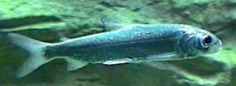
Coloration is silvery with some pink and purple iridescence, with a greenish tinge above lateral line and a silvery white ventral surface (Downs et al, 1998). These fish are distinctly laterally compressed with greatest body depth in front of dorsal fin. Coregonus hoyi has a long head and small eye, snout short or pointed with terminal mouth, lower jaw protruding past upper jaw with distinct tubercle, and a maxillary extending posteriorly to below the anterior portion of the eye. Gill raker number 37-50. A small dorsal adipose fin is present. The following is a characterizatin of the fins: dorsal 1, rays 9-11; caudal fin distinctly forked; anal rays 11-12; pelvic rays 11; pectoral rays 15-16. The scales are cycloid. It has 55-57 vertebrae. Females reach a slightly larger size than males (Crossman and Scott, 1973). (Crossman and Scott, 1973; Downs, et al., 1998)
- Other Physical Features
- ectothermic
- bilateral symmetry
- Sexual Dimorphism
- female larger
-
- Average mass
- 227 g
- 8.00 oz
-
- Average length
- 23 cm
- 9.06 in
Development
Coregonus hoyi remains in the larval state for aproximately 24 days with a length range of 8.6-14.9 mm. Larvae are most frequently located near the bottom at depths between 90 and 110 m in water with temperatures not exceeding 4.7 degrees C. Mature C. hoyi reach lengths of 200-250 cm, with size and growth rate variable between lakes.
- Development - Life Cycle
- metamorphosis
Reproduction
Spawning generally takes place in February and March, but some spawning occurs throughout the year as indicated by observations of ripe, nearly ripe, and spent male and females in almost all months. Spawning occurs over almost all bottom types at a depth between 36 and 90 m. Egg production ranges from 3000 to 12000 per female, with larger females producing more eggs than smaller individuals. The average number of eggs per ounce of fish is 1241 with little variation. The eggs are relatively large with an average diameter of 1.95 mm. (Crossman and Scott, 1973)
- Key Reproductive Features
- seasonal breeding
- sexual
- fertilization
-
- Breeding season
- February -March
-
- Range number of offspring
- 3000 to 12000 eggs
-
- Average number of offspring
- 7500.00
There is no parental care in this species.
- Parental Investment
- no parental involvement
Lifespan/Longevity
Females have a lifespan of 10 to 11 years, and reach a slightly larger size than males, which live to an age of 9 years. (Crossman and Scott, 1973)
-
- Range lifespan
Status: wild - 9 to 11 years
- Range lifespan
-
- Average lifespan
Status: captivity - 10 years
- AnAge
- Average lifespan
Behavior
Coregonus hoyi spends daylight hours on or near the bottom, and rise into the water column to feed at night. Nighttime densities in the water column have been observed at up to 6.61 fish/m^3. These nocturnal migrations are variable with water temperature, light levels, and individual size. Migration patterns allow C. hoyi to maximize growth through increased consumption of Mysis relicta, which also migrates. (TeWinkel and Fleischer, 1999)
- Key Behaviors
- natatorial
- motile
Communication and Perception
Food Habits
Coregonus hoyi is primarily a pelagic feeder, with occasional bottom feeding, but habits and diet appear to be variable between bodies of water. Analysis of stomach contents revealed primarily Mysis relicta and Pontoporeia affinis, both near bottom dwelling plankton. Copepods dominated some stomachs, indicating pelagic feeding. Fish eggs and fingernail clams were also found in some stomachs. Vertical migration on an individual basis is hypothesised to be driven by migration of invertebrates in the water column (TeWinkel and Fleischer, 1999). High potential feeding rates at cold temperatures allow bloaters to feed and grow during the winter when many competitors are inactive. Increased activity at cold temperatures also allows the bloater to take advantage of high early spring zooplankton abundance which its competitors cannot do.
Foods eaten: Mysis relicta, Pontoporeia affinis, Cyclops bicuspidatus, Diaptomu, copepods, fish eggs, fingernail clams (Rudstam, et al., 1994)
- Primary Diet
-
carnivore
- eats eggs
- eats non-insect arthropods
- planktivore
- Animal Foods
- eggs
- mollusks
- aquatic crustaceans
- zooplankton
Predation
Historically, the main predator of Coregonus hoyi has been the lake trout (Salvelinus namaycush). After parasitic sea lampreys decimated the lake trout populations in the Great Lakes, introduced Pacific salmonids have become the dominant predators of C. hoyi. Populations can also be limited by competition and predation from alewives.
Coregonus hoyi is heavily parasitized, with common parasites including: Botriochocephalidae, Nematoda, Trematoda, Cestoda, Acanthocephala (Crossman and Scott, 1973)
-
- Known Predators
-
- lake trout (Salvelinus namaycush)
- "salmons, salmonids, and trouts (Salmonidae)"
- alewives (Alosa pseudoharengus)
Ecosystem Roles
Coregonus hoyi is a deep water planktivore that provides an important trophic link between zooplankton and top predators. After initial population declines due to competition with and predation by introduced alewives and rainbow smelt, C. hoyi populations increased greatly in response to alewife and smelt predation by introduced Pacific salmonids. This change in fish community resulted in a shift in dominance from epi- and metalimnetic planktivores (alewife) to a hypolimnetic benthivore (bloater). This can affect the abundance of prey for pescivores, prey abundance for the forage fish, and possibly water clarity and primary production. (Rudstam, et al., 1994)
Economic Importance for Humans: Positive
Coregonus hoyi is an important component in the diet of larger salmonid species. Many of these salmonids are very valuable as gamefish, bringing economic benefit to the waters they inhabit. As the larger ciscoes have been depleted through overfishing, the smaller Coregonus hoyi has become an increasingly important component of commercial catches. Commercial catches of Coregonus hoyi, like other ciscoes are primarily smoked and distributed for human consumption. (Crossman and Scott, 1973)
- Positive Impacts
- food
Economic Importance for Humans: Negative
Bloaters have no known negative impact on people.
Conservation Status
Overfishing of other species of ciscoes has reduced populations, and shifted more pressure to Coregonus hoyi. Unchecked, this additional fishing effort could devastate Coregonus hoyi populations, as it has done to other ciscoe species. The bloater is not currently given special status under the Endangered Species Act. The IUCN classifies Coregonus hoyi as vulnerable. Fluctuations in the populations of bloaters have been inversely related to the introduced alewive, which competes for resources. Stocking of pacific salmonids in order to control alewive populations has allowed the Lake Michigan Coregonus hoyi population to rise from an estimated 4,000 metric tons in 1974 to 300,000 metric tons in 1987. (Rudstam, et al., 1994)
-
- IUCN Red List
-
Vulnerable
More information
-
- IUCN Red List
-
Vulnerable
More information
-
- US Migratory Bird Act
- No special status
-
- US Federal List
- No special status
-
- CITES
- No special status
-
- State of Michigan List
- No special status
Contributors
Courtney Egan (editor).
Matthew Wund (editor), University of Michigan-Ann Arbor.
Daniel Wyns (author), University of Michigan-Ann Arbor.
Glossary
- Nearctic
-
living in the Nearctic biogeographic province, the northern part of the New World. This includes Greenland, the Canadian Arctic islands, and all of the North American as far south as the highlands of central Mexico.

- benthic
-
Referring to an animal that lives on or near the bottom of a body of water. Also an aquatic biome consisting of the ocean bottom below the pelagic and coastal zones. Bottom habitats in the very deepest oceans (below 9000 m) are sometimes referred to as the abyssal zone. see also oceanic vent.
- bilateral symmetry
-
having body symmetry such that the animal can be divided in one plane into two mirror-image halves. Animals with bilateral symmetry have dorsal and ventral sides, as well as anterior and posterior ends. Synapomorphy of the Bilateria.
- carnivore
-
an animal that mainly eats meat
- chemical
-
uses smells or other chemicals to communicate
- ectothermic
-
animals which must use heat acquired from the environment and behavioral adaptations to regulate body temperature
- external fertilization
-
fertilization takes place outside the female's body
- fertilization
-
union of egg and spermatozoan
- food
-
A substance that provides both nutrients and energy to a living thing.
- freshwater
-
mainly lives in water that is not salty.
- metamorphosis
-
A large change in the shape or structure of an animal that happens as the animal grows. In insects, "incomplete metamorphosis" is when young animals are similar to adults and change gradually into the adult form, and "complete metamorphosis" is when there is a profound change between larval and adult forms. Butterflies have complete metamorphosis, grasshoppers have incomplete metamorphosis.
- motile
-
having the capacity to move from one place to another.
- natatorial
-
specialized for swimming
- native range
-
the area in which the animal is naturally found, the region in which it is endemic.
- pelagic
-
An aquatic biome consisting of the open ocean, far from land, does not include sea bottom (benthic zone).
- planktivore
-
an animal that mainly eats plankton
- seasonal breeding
-
breeding is confined to a particular season
- sexual
-
reproduction that includes combining the genetic contribution of two individuals, a male and a female
- tactile
-
uses touch to communicate
- zooplankton
-
animal constituent of plankton; mainly small crustaceans and fish larvae. (Compare to phytoplankton.)
References
Binkowski, F., L. Rudstam. 1994. Maximum daily ration of Great Lakes bloater. Transactions of the American Fisheries Society, 123: 335-343.
Crossman, W., E. Scott. 1973. Freshwater Fishes of Canada. Ottawa: Information Canada.
Downs, W., L. Wiland, E. White, S. Wittman. 1998. "Fish of the Great Lakes by Wisconsin Sea Grant" (On-line). Accessed October 28, 2002 at http://www.seagrant.wisc.edu/greatlakesfish/framefish.html.
Miller, T., L. Crowder. 1990. Effects of changes in the zooplankton assemblage on growth of bloater and implications for recruitment success. Transactions of the American Fisheries Society, 119: 483-491.
Page, L., B. Burr. 1991. A field guide to freshwater fishes of North America north of Mexico. Boston: Houghton Mifflin Company.
Rudstam, L., F. Binkowski, M. Miller. 1994. A Bioenergetics Model for Analysis of Food Consumption Patterns of Bloater in Lake Michigan. Transactions of the American Fisheries Society, 123: 344-357.
TeWinkel, L., G. Fleischer. 1999. Vertical Migration and Nighttime Distribution of Adult Bloaters in Lake Michigan. Transactions of Americans Fisheries Society, 128: 459-474.