Corallus caninusEmerald Tree Boa


Geographic Range
Emerald tree boas are found in lowland tropical rainforests in the Amazonian and Guianan regions of South America. They occur in northern Brazil, eastern Peru, southern Colombia, southern Venezuela, French Guiana, eastern Ecuador, Suriname, Guyana, and the exreme north of Bolivia. (Henderson, 2005; Kivit and Wiseman, 2000)
- Biogeographic Regions
- neotropical
Habitat
Emerald tree boas are found at elevations ranging from sea level to 1000 m above sea level (average = 200 m). They are aboreal species that spend most of their time in the rainforest canopy foliage. They have been found in both primary and secondary vegetation, and also in swamp forest. Although they are arboreal, they do occasionally descend to the ground to bask in the sun. They are found in the Amazon Basin and often found alongside rivers, but are not dependent on open water. They are found in areas that recieve an excess of 1500 mm of rain annually. (Henderson, 2005; Kivit and Wiseman, 2000; Stafford and Henderson, 1996; Vidal, et al., 2005)
- Habitat Regions
- tropical
- terrestrial
- Terrestrial Biomes
- rainforest
- Other Habitat Features
- riparian
-
- Range elevation
- 0 to 1000 m
- 0.00 to 3280.84 ft
-
- Average elevation
- 200 m
- 656.17 ft
Physical Description
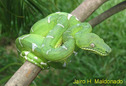
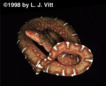
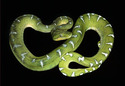
Emerald tree boas are called "emerald" because of the exquisite green coloration on their dorsal surfaces. Many populations have striking white markings occurring along the dorsal midline, although some individuals lack them. Other individuals have black coloration on the dorsum. Juveniles range from a brown to red color. Emerald tree boas can grow to be over 2 m in length. Male emerald tree boas are usually smaller in size, more "wiry" and have larger spurs. (Henderson, 2005; Vidal, et al., 2005)
- Other Physical Features
- heterothermic
- Sexual Dimorphism
- female larger
-
- Range length
- 2.2 (high) m
- 7.22 (high) ft
Development
At birth, emerald tree boas can be from 40 to 50cm long and can weigh 20 to 50 g. The young are a reddish-brown color. By 4 months, they begin to develop their adult, green coloration. (Groves, 1978; Kivit and Wiseman, 2000)
Reproduction
Little is known about Corallus caninus reproduction. One study observed mating behaviors between a male and female in a zoo. Courtship began in late January and continued irregularly until early March. The observed behavior was that the male was coiled near the female, attempting to wrap his tail around her tail. The only copulation observed was similar to this behavior. During this period, it was observed that the female fasted from May 8 to nearly 3 months later, without any significant weight loss. In August of that year, the female gave birth to 6 young. A second source stated that Corallus caninus typically give birth to an average of 10 young but can produce a litter size of 20. (Groves, 1978; Kivit and Wiseman, 2000)
Corallus caninus is a viviparous species with a gestation period of 6 to 7 months. Breeding does not typically begin until females are 4 to 5 years old and males are 3 to 4 years old. These snakes typically give birth to 5 to 12 young at a time, but offspring can number as many as 20. Emerald tree boas typically breed every other year. The typical breeding season is between April and July (late winter and early spring in the tropics). (Kivit and Wiseman, 2000)
- Key Reproductive Features
- iteroparous
- seasonal breeding
- year-round breeding
- sexual
- fertilization
- viviparous
-
- Breeding interval
- Breeding typically occurs every other year.
-
- Breeding season
- Emerald tree boas typically mate between April and July, although year-round mating is possible.
-
- Range number of offspring
- 5 to 20
-
- Average number of offspring
- 10
-
- Range gestation period
- 6 to 7 months
-
- Range time to independence
- 0 (low) minutes
-
- Range age at sexual or reproductive maturity (female)
- 4 to 5 years
-
- Range age at sexual or reproductive maturity (male)
- 3 to 4 years
Females invest heavily in young through gestation, but do not provide care after birth. (Kivit and Wiseman, 2000)
- Parental Investment
- no parental involvement
-
pre-fertilization
- provisioning
-
protecting
- female
-
pre-hatching/birth
-
provisioning
- female
-
protecting
- female
-
provisioning
Lifespan/Longevity
There are no data about the longevity of emerald tree boas in the wild. In captivity, one was kept over 15 years. This snake was received at a zoo when it was already an adult. It is believed that they can live well over 20 years. (Kivit and Wiseman, 2000)
-
- Range lifespan
Status: captivity - 15 (high) years
- Range lifespan
Behavior
Emerald tree boas spend most of their time in wet, lowland rainforests, living in the canopy foliage of trees and in shrubs. During the day they remain inactive, looped over a horizontal branch. They form an ellipsoidal coil with their bodies, with the head in the center. As ambush predators, they catch most prey by snatching them off the ground as they hang from these branches.
Agnostic behavior has been observed between males housed together in captivity with a female. Observed aggression between males consists of chasing, mounting, and writhing body movements until one male finally becomes dominant. Then the dominant snake continues to pursue the other male to overpower it, using the posterior part of the body to constrict the neck area. This behavior was observed when two males were located on the same, or nearby horizontal branches. No biting was observed. Also, on occasion, the dominant male was observed to attack and constrict the female. (Kivit and Wiseman, 2000; Stafford and Henderson, 1996)
-
- Average territory size
- 2.7 km^2
Home Range
Population densities have been estimated at one snake per 2.7 square kilometers. (Kivit and Wiseman, 2000)
Communication and Perception
Emerald tree boas perceive prey primarily through sight and infrared heat receptors located in the labial scales. These heat-sensitive pits are critical for locating prey at night. Like other snakes, they also use their tongues and vomeronasal organs to sense chemical cues and they can detect vibrations. Corallus caninus is a solitary species that interacts primarily with a mate and also with prey. Occasionally, aggressive behavior occurs when males get extremely close to one another. (Kivit and Wiseman, 2000)
- Perception Channels
- visual
- infrared/heat
- tactile
- vibrations
- chemical
Food Habits
Emerald tree boas are nocturnal predators of rodents, lizards, and marsupials. Some researchers suggest that they also prey on birds, but stomach content analyses have failed to support this. Observations strongly suggest that emerald tree boas are ambush predators that hang near the ground and angle their heads downward to ambush passing rodents. (Henderson, 2005; Vidal, et al., 2005)
- Primary Diet
-
carnivore
- eats terrestrial vertebrates
- Animal Foods
- birds
- mammals
- reptiles
Predation
The only known predators of Corallus caninus are Guianan crested eagles (Morphnus guianensis). Emerald tree boas are cryptically colored and generally remain hidden in the foliage of trees. (Kivit and Wiseman, 2000)
- Anti-predator Adaptations
- cryptic
-
- Known Predators
-
- Guianan crested eagles (Morphnus guianansis)
Ecosystem Roles
Corallus caninus may help control small mammal populations, especially rodents. It is also a food source for Guianan crested eagles (Morphnus guianensis).
Few studies have examined parasites of emerald tree boas. However, one article found a blood parasite (Hematozoon species) in 3 of 4 tested individuals in French Guiana. Captive emerald tree boas have also been infected by the parasite that causes cryptosporidiosis (Cryptosporidium serpentis). (de Thoisy, et al., 2000; Funk, 1987; Kivit and Wiseman, 2000)
- Hematozoon species
- Cryptosporidium serpentis
Economic Importance for Humans: Positive
Emerald tree boas have become increasingly desirable in captivity in recent years. Their beauty provides aesthetic benefits for humans. They also help to control rodent populations, which can be pests near human habitation. (Kivit and Wiseman, 2000)
- Positive Impacts
- pet trade
Economic Importance for Humans: Negative
No available literature discussed negative economic impacts.
Conservation Status
The conservation status of this species is unknown, as it is not in the IUCN database, and CITES does not list it as a species of concern.
-
- IUCN Red List
- Not Evaluated
-
- US Federal List
- No special status
-
- CITES
- No special status
-
- State of Michigan List
- No special status
Other Comments
In captivity, although emerald tree boas are slow-moving snak, they are generally regarded as aggressive. Specimens collected in the wild have been described as making no effort to escape until seized, whereupon they strike viciously and apply constriction at full force. After the initial struggle, they will relax and seem to "accept" captivity.
Contributors
Tanya Dewey (editor), Animal Diversity Web.
Drew Paulette (author), Radford University, Karen Powers (editor, instructor), Radford University.
Glossary
- Neotropical
-
living in the southern part of the New World. In other words, Central and South America.

- arboreal
-
Referring to an animal that lives in trees; tree-climbing.
- carnivore
-
an animal that mainly eats meat
- chemical
-
uses smells or other chemicals to communicate
- cryptic
-
having markings, coloration, shapes, or other features that cause an animal to be camouflaged in its natural environment; being difficult to see or otherwise detect.
- fertilization
-
union of egg and spermatozoan
- heterothermic
-
having a body temperature that fluctuates with that of the immediate environment; having no mechanism or a poorly developed mechanism for regulating internal body temperature.
- infrared/heat
-
(as keyword in perception channel section) This animal has a special ability to detect heat from other organisms in its environment.
- iteroparous
-
offspring are produced in more than one group (litters, clutches, etc.) and across multiple seasons (or other periods hospitable to reproduction). Iteroparous animals must, by definition, survive over multiple seasons (or periodic condition changes).
- native range
-
the area in which the animal is naturally found, the region in which it is endemic.
- nocturnal
-
active during the night
- pet trade
-
the business of buying and selling animals for people to keep in their homes as pets.
- rainforest
-
rainforests, both temperate and tropical, are dominated by trees often forming a closed canopy with little light reaching the ground. Epiphytes and climbing plants are also abundant. Precipitation is typically not limiting, but may be somewhat seasonal.
- riparian
-
Referring to something living or located adjacent to a waterbody (usually, but not always, a river or stream).
- seasonal breeding
-
breeding is confined to a particular season
- sexual
-
reproduction that includes combining the genetic contribution of two individuals, a male and a female
- solitary
-
lives alone
- tactile
-
uses touch to communicate
- terrestrial
-
Living on the ground.
- tropical
-
the region of the earth that surrounds the equator, from 23.5 degrees north to 23.5 degrees south.
- vibrations
-
movements of a hard surface that are produced by animals as signals to others
- visual
-
uses sight to communicate
- viviparous
-
reproduction in which fertilization and development take place within the female body and the developing embryo derives nourishment from the female.
- year-round breeding
-
breeding takes place throughout the year
References
Austin, C. 2000. Molecular Phylogeny and Historical Biogeography of Pacific Island Boas (Candoia). BioOne, 2000/2: 341-352.
Funk, R. 1987. Implications of cryptosporidiosis in Emerald tree boas (Corallus caninus). Pp. 139-143 in M Rosenberg, ed. 11th International Herpetological Symposium on Captive Propagation and Husbandry. Thurmont, Maryland: Zoological Consortium, Inc..
Greene, H., G. Burghadt. 1978. Behavior and Phylogeny: Constriction in Ancient and Modern Snakes. Science, New Series, 200/4337: 74-77.
Greene, H., J. Losos. 1988. Systematics, Natural History, and Conservation: Field Biologists Must Fight a Public-Image Problem. BioScience, 38/7: 458-462.
Groves, J. 1978. Observation on the reproduction of the emerald tree boa, Corallus caninus. Herpetological Review, 9/3: 100-102.
Henderson, R. 2005. The Emerald Puzzle: Geographic Variation in Corralus caninus. Iguana, 12/1: 2-7.
Kivit, R., S. Wiseman. 2000. The Green Tree Python & Emerald Tree Boa, Their Captive Husbandry and Reproduction. 3, 75210 Keltern-Weiler, Germany: Kirschner & Seufer Verlag, Kruezstr.
McDiarmid, R., T. Toure, J. Savage. 1996. The Proper Name of the Neotropical Tree Boa Often Referred to as Corallus enydris (Serpentes: Boidae). Journal of Herpetology, Vol. 30, No. 3: 320-326.
McDowell, S. 1979. A Catalogue of the Snakes of New Guinea and the Solomons, with Special Reference to Those in the Bernice P. Bishop Museum. Part III. Boinae and Acrochordoidea (Reptilia, Serpentes). A Catalogue of the Snakes of New Guinea and the Solomons, with Special Reference to Those in the Bernice P. Bishop Museum. Part III. Boinae and Acrochordoidea (Reptilia, Serpentes), 13/1: 1-92.
Pizzatto, L., O. Marques. 2007. REPRODUCTIVE ECOLOGY OF BOINE SNAKES WITH EMPHASIS ON BRAZILIAN SPECIES AND A COMPARISON TO PYTHONS. BioOne, 2/2: 107-122.
Stafford, P., R. Henderson. 1996. Kaleidoscopic Tree Boas, The Genus Corallus of Tropical America. Malaber, Florida: Krieger Publishing Company.
Vidal, N., R. Henderson, A. Delmas, S. Hedges. 2005. A Phylogenetic Study of the Emerald Tree Boa (Corralus caninus). Journal of Herpetology, 39/3: 500-503.
Vidal, N., R. Henderson, A. Delmas, S. Hedges. 2005. A Phylogenetic Study of the Emerald Treeboa (Corallus caninus). BioOne, 39/3: 500-503.
de Thoisy, B., J. Michel, I. Vogel, J. Vié. 2000. A Survey of Hemoparasite Infections in Free-Ranging Mammals and Reptiles in French Guiana. The Journal of Parasitology, 86/5: 1035-1040.