Cophosaurus texanusGreater Earless Lizard


Geographic Range
The greater earless lizard (Cophosaurus texanus) can be found in the southwestern United States including New Mexico, Arizona, and Texas, and has been found throughout many deserts of central and northern Mexico. An area in which the greater earless lizard can be found in high concentrations is the Big Bend National Park, located in the western Texas Chihuahuan Desert, as well as the northeastern extent of the Sonoran Desert. (Bashey and Dunham, 1997; Howland, 1992; Osmanski, 2014; Smith, et al., 1987)
Habitat
Known for their high tolerance of heat, greater earless lizards are found throughout the arid desert regions of the southwestern United States. They are often seen on steep slopes, rocky soils, and near desert plants. These lizards are found in dry, rocky soils containing scarce amounts of vegetation. Their known elevation ranges from 270-2100 meters. (Bashey and Dunham, 1997; Hardy, et al., 1997; Howland, 1992)
- Habitat Regions
- terrestrial
- Terrestrial Biomes
- desert or dune
-
- Range elevation
- 270 to 2100 m
- 885.83 to 6889.76 ft
Physical Description
The greater earless lizard ranges in total body length from 60-130 mm. Males are typically larger, with snout-vent lengths (SVL) ranging from 75-88 mm. Females' SVL are 50-67 mm. The lizards' adult body masses range from 4-8 g, though females reach maturity at just 3 g. Males reach maturity at 5 g.
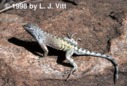
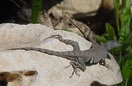
The lizards' dorsal side is light brown with orange, yellow, and white specks, which play a major role in camouflage. The ventral side displays two parallel black stripes projecting from in front of the hind limbs and slightly into the dorsal area. The males' stripes are known to be darker and more distinct, while the females' stripes appear faint. Surrounding the dark stripes, the lizard has blue- and green-colored scales. The males display bright and vibrant scale colors as the females show drabber colors. Juveniles have brown- or tan-colored scales and start to show more colors after a few months of life.
True to their name, greater earless lizards contain no external ear openings. Their scales are coarse, rough, and small with ventral scales being larger than the dorsal and anterior scales.
Through basking, the ectothermic lizards reach ideal internal body temperatures of 35-40 degrees Celsius. (Ballinger, et al., 1972; Hardy, et al., 1997; Howland, 1992; Punzo, 1982)
- Other Physical Features
- ectothermic
- bilateral symmetry
- Sexual Dimorphism
- male larger
- sexes colored or patterned differently
- male more colorful
-
- Range mass
- 4 to 8 g
- 0.14 to 0.28 oz
-
- Range length
- 60 to 130 mm
- 2.36 to 5.12 in
Development
Greater earless lizards live a maximum of 3 years. With determinate growth patterns, females stop growing after 5 months, before their first hibernation cycle. Males cease growth at one year after birth.
Once the offspring reach the mature size of 50 mm and specific weight limits (3 g for females, 5 g for males), they can begin reproducing. Growth rates vary from 0.1-0.4 mm per month until they reach their determinate lengths.
Although their body temperatures are affected by ambient temperatures, their ideal internal temperature for the highest reproductive fitness and growth is 38-40 degrees Celsius. (Ballinger, et al., 1972; Hardy, et al., 1997; Sugg, et al., 1995)
Reproduction
Greater earless lizards are a polygynandrous species that mate sexually from April to August, with their peak season in June. The males use body language such as lateral body compressions, push-ups, and the bobbing of the head in order to claim their territory and attract females. The males will defend a specific territory in order to mate with many different female lizards. Females are attracted to larger males with brighter colors and produce hormones to communicate their interest to the male species. Males continue growth and development for up to a year, while females stop growth at an earlier age, focusing on reaching sexual maturity faster. (Ballinger, et al., 1972; Schrank and Ballinger, 1973; Sugg, et al., 1995)
- Mating System
- polygynandrous (promiscuous)
Reproduction within this species occurs during the first and second years of life. The male lizard’s testis will enlarge and start producing sperm 70 days (range 50-180 days) after hatching and females will start producing eggs after 50 days (range 30-160 days). Females have an average gestation period of 25-35 days. They then lay their eggs underground to be incubated for 50 days until hatching. The lizards can reproduce with up to five mates each breeding season.
Greater earless lizards breed April to August. Females can bear up to 5 clutches with an average of 5 eggs each (range 2-9 eggs). The average egg in each clutch weighs 0.321 grams. Upon hatching, the lizards measure an average of 6 cm and weigh 0.4-0.9 grams. The young are independent upon hatching. (Ballinger, et al., 1972; Johnson, 1960; Sugg, et al., 1995)
- Key Reproductive Features
- iteroparous
- seasonal breeding
- sexual
- oviparous
-
- Breeding interval
- Greater earless lizards breed up to 5 times in a breeding season
-
- Breeding season
- The greater earless lizards breed from April to August with a peak in June.
-
- Range number of offspring
- 2 to 9
-
- Average number of offspring
- 5
-
- Range gestation period
- 25 to 35 days
-
- Range time to independence
- 0 to 0 minutes
-
- Range age at sexual or reproductive maturity (female)
- 30 to 160 days
-
- Average age at sexual or reproductive maturity (female)
- 50 days
-
- Range age at sexual or reproductive maturity (male)
- 50 to 180 days
-
- Average age at sexual or reproductive maturity (male)
- 70 days
Once male and female lizards mate, the male will leave her and go attract another female to continue reproducing. After a gestation period of 30 days (range 25-35 days), the females will bury their eggs in a matrix of heated sand where they leave them to be incubated for about 50 days until hatching. Females abandon their eggs immediately after they are laid in search for another partner for reproduction. (Ballinger, et al., 1972; Schrank and Ballinger, 1973; Smith, et al., 1987)
- Parental Investment
- no parental involvement
-
pre-fertilization
- provisioning
-
protecting
- female
Lifespan/Longevity
The lifespan for wild greater earless lizards ranges from one to three years. In captivity, their typical lifespan is two to three years. The primary reason for this short lifespan in the wild is the failure to keep warm or hidden throughout the months of hibernation. (Sugg, et al., 1995)
-
- Typical lifespan
Status: wild - 1 to 2 years
- Typical lifespan
-
- Typical lifespan
Status: captivity - 2 to 3 years
- Typical lifespan
Behavior
Greater earless lizards are known for their high heat tolerance. They will lie in the sun until they reach an internal temperature of approximately 43 degrees Celsius and then will cool down under the shade of a nearby rock or cactus. Once their body’s internal temperature has lowered back to approximately 38 degrees Celsius, they will again seek out another heated, rock-strewn destination for further basking. This process will continue throughout the day because the of the lizard's ectothermic nature. (Ballinger, et al., 1972; Bulova, 1994; Johnson, 1960; Maury, 1995)
Greater earless lizards are a cursorial species known for their increased running speed and coordination when chasing prey or escaping danger. They are diurnal. At dusk or on cloudy days, they will burrow into the sand to stay warm.
The males are territorial and become defensive of a chosen area to attract females for mating. They communicate through head-bobbing, push-ups, and pheromones. (Ballinger, et al., 1972; Bulova, 1994; Johnson, 1960; Maury, 1995)
- Key Behaviors
- cursorial
- terricolous
- fossorial
- diurnal
- motile
- sedentary
- hibernation
- daily torpor
- territorial
-
- Range territory size
- 5 to 15 m^2
Home Range
Their personal home range covers 150-400 m^2. Larger, more aggressive lizards are known to cover more area because of their ability to fight off neighboring lizards and take over additional areas. The territory they defend is about 5-15 m^2. This space acquired is later used for hibernation and must contain protection including sand that is easy for burial and shrubs to support hiding and warmth throughout the winter months. (Ballinger, et al., 1972; Schrank and Ballinger, 1973; Sugg, et al., 1995)
Communication and Perception
Although the greater earless lizards have no external ear openings, they are capable of detecting sound through deep vibrations.
Their sharp vision allows them to detect quick movement up to 400 meters away. During mating season, the females change color from brown to pale pink as a way to signal reproductive receptivity. Pheromone signals also are used during the mating season.
Their highly developed tongue with attached nerve receptors is connected to the vomeronasal organ, which helps them detect prey and avoid predation. (Bulova, 1994; Cooper, 1989; Punzo, 2008; Sugg, et al., 1995)
- Other Communication Modes
- pheromones
- scent marks
- vibrations
- Perception Channels
- visual
- infrared/heat
- tactile
- vibrations
- chemical
Food Habits
Greater earless lizards are insectivores and feast primarily on adult and larval arthropods ranging in size from 6-28 millimeters. Their opportunistic eating patterns increase survival when food is limited. Their elevated body temperature at an average of 38 degrees Celsius allows for the digestive system to break down large animal parts. (Maury, 1995; Punzo, 2008; Smith, et al., 1987)
- Primary Diet
-
carnivore
- insectivore
- eats non-insect arthropods
- Animal Foods
- insects
- terrestrial non-insect arthropods
Predation
The greater earless lizard’s habitat does not provide many hiding places from predators. They have acquired high running speeds and agility to escape predation when necessary. When fleeing from predators, they will curl their tail back to display black bands. This action will guide predators to attack the tail before attacking the body of the lizard. When the lizards are captured by their tail, they can easily detach it and escape without being harmed. The dorsal brown and gray color of their scales is another adaption which allows them to blend in with the color of the sand and gravel of desert environments and be overlooked by predators. Predators to this species include snakes and large birds. Common known predators include horned rattlesnakes Crotalus cerastes, greater roadrunners Geococcyx californianus, and the common nighthawk Chordeiles minor. (Bulova, 1994; Cooper, 1989; Cooper, et al., 1994)
- Anti-predator Adaptations
- cryptic
-
- Known Predators
-
- horned rattlesnakes (Crotalus cerastes)
- greater roadrunner (Geococcyx californianus)
- common nighthawk (Chordeiles minor)
Ecosystem Roles
Due to the greater earless lizards’ burying techniques, they are able to aerate the sand within their environments. They typically dig new holes in the desert grounds each night. This activity helps to loosen the sandy earth, allowing nearby plants (mostly cacti) easier access to nutrients for growth.
Known parasitic species that use these lizards as hosts are roundworms such as Parathelandros texanus, Crytosomum heyenemani, Atractis penneri, and Thubunaea iguana. Tapeworms include Mesocestoides tetrathyridia, Oochoristica, Oochoristica mesillensis, and Oochoristica neo-mexicana. All attack the digestive tract. (Ballinger, et al., 1972; Goldberg and Bursey, 1992; Mayberry, et al., 2000; Schrank and Ballinger, 1973)
- Ecosystem Impact
- soil aeration
- roundworms (Parathelandros texanus)
- roundworms (Crytosomum heyenemani)
- roundworms (Atractis penneri)
- roundworms (Thubunaea iguana)
- tapeworms (Mesocestoides tetrathyridia)
- tapeworms (Oochoristica mesillensis)
- tapeworms (Oochoristica neomexicana)
Economic Importance for Humans: Positive
There are greater earless lizards that are kept illegally as pets, but this is rare. (Meyne, et al., 1989; Punzo, 1982)
- Positive Impacts
- pet trade
Economic Importance for Humans: Negative
There are no known adverse economic effects of Cophosaurus texanus on humans.
Conservation Status
Greater earless lizards are a species of "least Concern on the IUCN Red List, and have no special status on CITES or the US federal lists.
Trapping of this species and keeping it in captivity requires a permit. This species thrives in desert environments and when held captive the overall fitness declines dramatically.
Most lizards found in the national parks of the United States are protected through federal wilderness areas. Others living outside of these areas may experience degradation of their territory from agricultural, residential, or commercial development.
Conservation methods such as restricting commercial building and the use of vehicles around the lizards' habitats have been suggested to protect theselizards and their natural environment. (Goldberg and Bursey, 1992; Osmanski, 2014)
-
- IUCN Red List
-
Least Concern
More information
-
- IUCN Red List
-
Least Concern
More information
-
- US Federal List
- No special status
-
- CITES
- No special status
-
- State of Michigan List
- No special status
Contributors
Libby Thomason (author), Radford University, Cari Mcgregor (editor), Radford University, Zeb Pike (editor), Radford University, Karen Powers (editor), Radford University, April Tingle (editor), Radford University, Jacob Vaught (editor), Radford University, Tanya Dewey (editor), University of Michigan-Ann Arbor.
Glossary
- Nearctic
-
living in the Nearctic biogeographic province, the northern part of the New World. This includes Greenland, the Canadian Arctic islands, and all of the North American as far south as the highlands of central Mexico.

- bilateral symmetry
-
having body symmetry such that the animal can be divided in one plane into two mirror-image halves. Animals with bilateral symmetry have dorsal and ventral sides, as well as anterior and posterior ends. Synapomorphy of the Bilateria.
- carnivore
-
an animal that mainly eats meat
- chemical
-
uses smells or other chemicals to communicate
- cryptic
-
having markings, coloration, shapes, or other features that cause an animal to be camouflaged in its natural environment; being difficult to see or otherwise detect.
- desert or dunes
-
in deserts low (less than 30 cm per year) and unpredictable rainfall results in landscapes dominated by plants and animals adapted to aridity. Vegetation is typically sparse, though spectacular blooms may occur following rain. Deserts can be cold or warm and daily temperates typically fluctuate. In dune areas vegetation is also sparse and conditions are dry. This is because sand does not hold water well so little is available to plants. In dunes near seas and oceans this is compounded by the influence of salt in the air and soil. Salt limits the ability of plants to take up water through their roots.
- diurnal
-
- active during the day, 2. lasting for one day.
- ectothermic
-
animals which must use heat acquired from the environment and behavioral adaptations to regulate body temperature
- fossorial
-
Referring to a burrowing life-style or behavior, specialized for digging or burrowing.
- hibernation
-
the state that some animals enter during winter in which normal physiological processes are significantly reduced, thus lowering the animal's energy requirements. The act or condition of passing winter in a torpid or resting state, typically involving the abandonment of homoiothermy in mammals.
- infrared/heat
-
(as keyword in perception channel section) This animal has a special ability to detect heat from other organisms in its environment.
- insectivore
-
An animal that eats mainly insects or spiders.
- iteroparous
-
offspring are produced in more than one group (litters, clutches, etc.) and across multiple seasons (or other periods hospitable to reproduction). Iteroparous animals must, by definition, survive over multiple seasons (or periodic condition changes).
- motile
-
having the capacity to move from one place to another.
- native range
-
the area in which the animal is naturally found, the region in which it is endemic.
- oviparous
-
reproduction in which eggs are released by the female; development of offspring occurs outside the mother's body.
- pet trade
-
the business of buying and selling animals for people to keep in their homes as pets.
- pheromones
-
chemicals released into air or water that are detected by and responded to by other animals of the same species
- polygynandrous
-
the kind of polygamy in which a female pairs with several males, each of which also pairs with several different females.
- scent marks
-
communicates by producing scents from special gland(s) and placing them on a surface whether others can smell or taste them
- seasonal breeding
-
breeding is confined to a particular season
- sedentary
-
remains in the same area
- sexual
-
reproduction that includes combining the genetic contribution of two individuals, a male and a female
- soil aeration
-
digs and breaks up soil so air and water can get in
- tactile
-
uses touch to communicate
- terrestrial
-
Living on the ground.
- territorial
-
defends an area within the home range, occupied by a single animals or group of animals of the same species and held through overt defense, display, or advertisement
- vibrations
-
movements of a hard surface that are produced by animals as signals to others
- visual
-
uses sight to communicate
References
Ballinger, R., E. Tyler, D. Tinkle. 1972. Reproductive ecology of a west Texas population of the greater earless lizard, Cophosaurus texanus. The American Midland Naturalist, 88/2: 419-428.
Bashey, F., A. Dunham. 1997. Elevational variation in the thermal constraints on and microhabitat preferences of the greater earless lizard, Cophosaurus texanus. Copeia, 1997/4: 725-737.
Bulova, S. 1994. Ecological correlates of population and individual variation in antipredator behavior of two species of desert lizards. Copeia, 1994/4: 980-992.
Cooper, W. 1989. Absence of prey odor discrimination by iguanid and agamid lizards in applicator tests. Copeia, 1989/2: 472-478.
Cooper, W., L. Vitt, J. Caldwell. 1994. Movement and substrate tongue flicks in phrynosomatid lizards. Copeia, 1994/1: 234-237.
Goldberg, S., C. Bursey. 1992. Gastrointestinal helminths of the southwestern earless Lizard, Cophosaums texanus scitulus, and the speckled earless lizard, Holbrookia maculata approximans (Phrynosomatidae). The Helminthological Society of Washington, 59/2: 230-231.
Hardy, S., W. Lutterschmidt, M. Fuller, P. Gier, R. Durtsche, R. Bradley, K. Meier. 1997. Ontogenetic variation in the autecology of the greater earless lizard, Cophosaurus texanus. Ecography, 20/4: 336-346.
Howland, J. 1992. Life history of Cophosaurus texanus (Sauria: Iguanidae): Environmental correlates and interpopulational variation. Copeia, 1992/1: 82-93.
Johnson, C. 1960. Reproductive cycle in females of the greater earless lizard, Holbrookia texana. Copeia, 1960/4: 297-300.
Maury, E. 1995. Diet composition of the greater earless lizard (Cophosaurus texanus) in central Chihuahuan desert. Journal of Herpetology, 29/2: 266-272.
Mayberry, L., A. Canaris, J. Bristol, S. Gardner. 2000. Bibliography of parasites and vertebrate hosts in Arizona, New Mexico and Texas (1893–1984). Faculty Publications from the Harold W. Manter Laboratory of Parasitology, Paper 2.: 1-101.
Meyne, J., R. Ratliff, R. Moyzis. 1989. Conservation of the human telomere sequence (TTAGGG) among vertebrates. Proceedings of the National Academy of Sciences of the United States of America, 86: 7049-7053.
Osmanski, A. 2014. On the Use of Unmanned Aerial Vehicles to Rapidly Assess Microhabitats of Texas Lizard Species, Cophosaurus texanus and Aspidoscelis gularis (Master's Thesis). Angelo, TX: Angelo State University.
Punzo, F. 2008. Chemosensory recognition of the marbled whiptail lizard, Aspidoscelis marmorata (Squamata: Teiidae) to odors of sympatric lizards (Crotophytus collaris, Coleonyx brevis, Eumeces obsoletus and Uta stansburiana) that represent different predation risks. Journal of Environmental Biology, 29/1: 57-61.
Punzo, F. 1982. Tail autonomy and running speed in the lizards Cophosaurus texanus and Uma notata. Journal of Herpetology, 16/3: 329-331.
Schrank, G., R. Ballinger. 1973. Male reproductive cycles in two species of lizards (Cophosaurus texanus and Cnemidophorus gularis). Herpetologica, 29/3: 289-293.
Smith, D., P. Medica, S. Sanborn. 1987. Ecological comparison of sympatric populations of sand lizards (Cophosarus texanus and Callisaurus draconoides). The Great Basin Naturalist, 47/2: 175-185.
Sugg, D., L. Fitzgerald, H. Snell. 1995. Growth rate, timing of reproduction, and size dimorphism in the southwestern earless lizard (Cophosaurus texanus scitulus). The Southwestern Naturalist, 40/2: 193-202.