Connochaetes taurinusblue wildebeest


Geographic Range
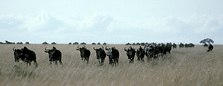
Blue wildebeest are common in eastern and southern Africa, from Kenya to eastern Namibia. Their southern range is bordered by the Orange River in South Africa. (Estes, 1991)
Habitat
Blue wildebeest can be found in a wide variety of habitats, from dense bush to open woodland floodplains, however, they appear to prefer acacia savannahs and plains with rapidly regrowing grasses and moderate soil moisture levels. (Estes, 1991; Kingdon, 1989)
- Habitat Regions
- terrestrial
- Terrestrial Biomes
- savanna or grassland
-
- Range elevation
- 600 (low) m
- 1968.50 (low) ft
-
- Average elevation
- 1000 m
- 3280.84 ft
Physical Description
Wildebeest are African bovids with broad shoulders, cow like horns, and a broad muzzle. The horns are unridged, have a parenthetical shape, and are thicker in males than in females. Of the two species in the genus Connochaetes, blue wildebeest are smaller and lighter in weight and are slate gray with tan forelegs. They range in mass from 118 kg to 270 kg. Adult males are generally darker than females. Blue wildebeest are uniquely marked by dark vertical stripes on the shoulders and back. In general, wildebeest have a mane and a beard, which is usually white to tan colored. (Estes, 1991)
- Other Physical Features
- endothermic
- homoiothermic
- bilateral symmetry
- Sexual Dimorphism
- male larger
- sexes colored or patterned differently
- male more colorful
- ornamentation
-
- Range mass
- 118 to 270 kg
- 259.91 to 594.71 lb
-
- Average length
- 123 cm
- 48.43 in
-
- Average basal metabolic rate
- 230.073 W
- AnAge
Reproduction
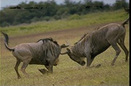
Mating season, also known as rut, lasts three weeks and coincides with favorable climatic conditions, yielding a high conception rate. Optimal reproductive conditions occur immediately after the rainy season, when wildebeest can feed on lush healthy grasses. Although blue wildebeest can reproduce at 16 months, average age of first reproduction is 28 months. Rut typically begins during a full moon, when bellowing males form leks. Leading up to the rut, increased testosterone production stimulates sperm production, resulting in increased calling, herding, and fighting amongst males. Males do not sleep or eat while there are sexually active females in the vicinity, and are constantly mating with or herding together as many females together as possible. When in close proximity of mature females, bachelors and territorial males serenade them by humming, bellowing, and croaking. Males compete for access to mates via direct physical contact, which includes sparring. Once a particular male gains access to mate, the female remains near her mate, and as long as she and her herd are stationary, up to several dozen copulations may occur. During calving season, pregnant mothers, mothers with recently born young, groups of yearlings separated from their mothers, and bachelor males segregate into separate groups. Calving usually coincides with a migration to more fertile lands, which also them decrease risk of predation due to decreased predator abundance. Evidence suggests that blue wildebeest are both polygynous and polygynandrous. (Clay, et al., 2010; Estes, 1991)
- Mating System
- polygynous
- polygynandrous (promiscuous)
Blue wildebeest breed once yearly during a 3 week period that immediately follows the rainy season. After gestation, which lasts an average of 8 months, a single calf is born. Average birth weight of new born calves is approximately 19 kg. Approximately 6 minutes after birth, calves can stand on their own and begin to nurse. Imprinting is critical, and the mother must remain near the calf to ensure that the process is successful. Mother-offspring recognition is originally achieved by scent alone. At about 8 months old, young leave their mothers and form peer groups. Females become sexually mature by 16 months of age, and males become sexually mature by 24 months. (Clay, et al., 2010; Estes, 1991)
- Key Reproductive Features
- iteroparous
- seasonal breeding
- gonochoric/gonochoristic/dioecious (sexes separate)
- sexual
- viviparous
-
- Breeding interval
- Once yearly
-
- Breeding season
- 1 month
-
- Range number of offspring
- 1 to 2
-
- Average number of offspring
- 1
-
- Average number of offspring
- 1
- AnAge
-
- Range gestation period
- 7 to 9 months
-
- Average time to independence
- 8 months
-
- Average age at sexual or reproductive maturity (female)
- 16 months
-
- Average age at sexual or reproductive maturity (female)
Sex: female - 411 days
- AnAge
- Average age at sexual or reproductive maturity (female)
-
- Average age at sexual or reproductive maturity (male)
- 2 years
-
- Average age at sexual or reproductive maturity (male)
Sex: male - 912 days
- AnAge
- Average age at sexual or reproductive maturity (male)
Young calves stay very close to their mothers for the first few months of their lives. The synchronicity of births in the herd limit predation, as does the calves innate behavior of following their mothers. Mothers protect young from predation, and males aid in the protection of the herd. Once imprinting has occurred, mothers and their calves continue to recognize one another through scent, even when they become separated during large herd movements. (Clay, et al., 2010; Estes, 1991)
- Parental Investment
- female parental care
-
pre-hatching/birth
-
provisioning
- female
-
protecting
- female
-
provisioning
-
pre-weaning/fledging
-
provisioning
- female
-
protecting
- male
- female
-
provisioning
-
pre-independence
-
provisioning
- female
-
protecting
- male
- female
-
provisioning
- extended period of juvenile learning
Lifespan/Longevity
On average, blue wildebeest live for 20 years in the wild and 21 years in captivity, with the oldest known captive individual living to be 24.3 years old. (Estes, 1991)
-
- Average lifespan
Status: wild - 20 years
- Average lifespan
-
- Range lifespan
Status: captivity - 24.3 (high) years
- Range lifespan
-
- Average lifespan
Status: captivity - 21 years
- Average lifespan
-
- Average lifespan
Status: wild - 20 years
- Average lifespan
-
- Average lifespan
Status: captivity - 20 years
- Average lifespan
-
- Average lifespan
Status: captivity - 21.5 years
- Max Planck Institute for Demographic Research
- Average lifespan
-
- Average lifespan
Status: captivity - 20.0 years
- Max Planck Institute for Demographic Research
- Average lifespan
Behavior
Wildebeest are gregarious and territorial. When sedentary, herds are formed. When mobile, loose, gregarious aggregations form. The state of a herd, mobile versus sedentary, is determined by access to water and food. Since wildebeest are obligate drinkers, the area most commonly inhabited by a herd may be only a few hectares. However, as water and food sources dwindle, herd move up to 50 km to find better pasture. Herds are generally made up of about 8 females and their calves, while territorial bulls wander amongst their herd. Transient cows are driven to leave by the territorial bull. As the rainy season subsides and food sources dwindle, herd structure diminishes, and only mothers and the young calves remain while new food sources are sought. Males are relatively docile and are relegated to the marginal feeding areas by territorial bulls. Male wildebeest become territorial and compete for mate access around 4 to 5 years of age.
-
- Average territory size
- 1.5 km^2
Home Range
Wildebeest may have two or three ranges, each corresponding to a particular season. These always include wet and dry ranges, with a third transitional range that not all wildebeest use. The transitional range is usually geographically close to dry season range (less than 20 km), while the dry and wet ranges may be up to 120 km away. Of the three ranges, the wet season range is the smallest, which allows for more efficient mating due to higher population concentrations. Average territory size is 1.5 km^2. (Estes, 1991; Serneels and Lambin, 2001)
Communication and Perception
Wildebeest communicate visually, vocally, and through olfaction. A male's bellow can carry up to 2 km. Preorbital and pedal gland secretions are important in olfactory communications, along with urine and feces. Pedal glands allow herds to follow one another during migrations. Wildebeest rub their preorbital glands and faces on the behinds of others for social contact. Individuals may also sniff and rub their nose and neck on other individuals. (Estes, 1991)
- Other Communication Modes
- choruses
- scent marks
Food Habits
Wildebeest are grazers, and will eat during both the day and moonlit nights. Their primary food consists of rapidly growing colonial grasses found on the savannah and the plains. When grasses are sparse, they may eat leaves off of shrubs and trees. During times of decreased food abundance, migratory herds of several thousand wildebeest travel hundreds of kilometers to find food. (Codron, et al., 2007; Estes, 1991; Kingdon, 1989)
- Plant Foods
- leaves
Predation
The major predators of wildebeest are lions, cheetahs, spotted hyenas, and African wild dogs. Individuals in larger herds fall victim to predation more often than those in smaller herds. This is thought to be a side-effect of herd size, as individuals in large herds tend to be less vigilant. When a potential predator is identified, wildebeest bunch together, stamp, and utter loud, shrill alarm calls. They often trail or follow predators in an effort to ward them off. Wildebeest mothers often defend their calves successfully against individual hyenas or cheetahs. (Estes, 1991)
-
- Known Predators
-
- lions, (Panthera leo)
- cheetahs, (Acinonyx jubatus)
- spotted hyenas, (Crocuta crocuta)
- African wild dogs, (Lycaon pictus)
Ecosystem Roles
Blue wildebeest are grazers and fertilize the grasses they consume with urine and feces. Wildebeest are considered a nuisance by local farmers because they reduce forage abundance for cattle and can transmit a number of pathogens to livestock. (Kingdon, 1989)
Economic Importance for Humans: Positive
Large herds of blue wildebeest are often sought during safari excursions, which create jobs and bring in foreign investments.
- Positive Impacts
- ecotourism
Economic Importance for Humans: Negative
Blue wildebeest are often considered a nuisance by local farmers, as they compete with cattle for forage and can transmit a number of pathogens to livestock. (Estes, 1991)
- Negative Impacts
- causes or carries domestic animal disease
Conservation Status
Blue wildebeest are classified as a species of least concern on the IUCN's Red List of Threatened Species. They are widespread and abundant, and a significant portion of their large population inhabits protected areas. Potential threats to their longterm persistence include the spread of civilization and agriculture, the reduction of water resources, poaching, and diseases that can be transmitted by cattle into local wildebeest populations. (IUCN SSC Antelope Specialist Group 2008, 2010)
-
- IUCN Red List
-
Least Concern
More information
-
- IUCN Red List
-
Least Concern
More information
-
- US Federal List
- No special status
-
- CITES
- No special status
-
- State of Michigan List
- No special status
Contributors
Greg Geraci (author), Michigan State University, Barbara Lundrigan (editor), Michigan State University, John Berini (editor), Animal Diversity Web Staff.
Glossary
- Ethiopian
-
living in sub-Saharan Africa (south of 30 degrees north) and Madagascar.

- acoustic
-
uses sound to communicate
- bilateral symmetry
-
having body symmetry such that the animal can be divided in one plane into two mirror-image halves. Animals with bilateral symmetry have dorsal and ventral sides, as well as anterior and posterior ends. Synapomorphy of the Bilateria.
- causes or carries domestic animal disease
-
either directly causes, or indirectly transmits, a disease to a domestic animal
- chemical
-
uses smells or other chemicals to communicate
- choruses
-
to jointly display, usually with sounds, at the same time as two or more other individuals of the same or different species
- diurnal
-
- active during the day, 2. lasting for one day.
- ecotourism
-
humans benefit economically by promoting tourism that focuses on the appreciation of natural areas or animals. Ecotourism implies that there are existing programs that profit from the appreciation of natural areas or animals.
- endothermic
-
animals that use metabolically generated heat to regulate body temperature independently of ambient temperature. Endothermy is a synapomorphy of the Mammalia, although it may have arisen in a (now extinct) synapsid ancestor; the fossil record does not distinguish these possibilities. Convergent in birds.
- female parental care
-
parental care is carried out by females
- folivore
-
an animal that mainly eats leaves.
- herbivore
-
An animal that eats mainly plants or parts of plants.
- iteroparous
-
offspring are produced in more than one group (litters, clutches, etc.) and across multiple seasons (or other periods hospitable to reproduction). Iteroparous animals must, by definition, survive over multiple seasons (or periodic condition changes).
- migratory
-
makes seasonal movements between breeding and wintering grounds
- motile
-
having the capacity to move from one place to another.
- native range
-
the area in which the animal is naturally found, the region in which it is endemic.
- nocturnal
-
active during the night
- polygynandrous
-
the kind of polygamy in which a female pairs with several males, each of which also pairs with several different females.
- polygynous
-
having more than one female as a mate at one time
- scent marks
-
communicates by producing scents from special gland(s) and placing them on a surface whether others can smell or taste them
- seasonal breeding
-
breeding is confined to a particular season
- sexual
-
reproduction that includes combining the genetic contribution of two individuals, a male and a female
- sexual ornamentation
-
one of the sexes (usually males) has special physical structures used in courting the other sex or fighting the same sex. For example: antlers, elongated tails, special spurs.
- social
-
associates with others of its species; forms social groups.
- tactile
-
uses touch to communicate
- terrestrial
-
Living on the ground.
- territorial
-
defends an area within the home range, occupied by a single animals or group of animals of the same species and held through overt defense, display, or advertisement
- tropical savanna and grassland
-
A terrestrial biome. Savannas are grasslands with scattered individual trees that do not form a closed canopy. Extensive savannas are found in parts of subtropical and tropical Africa and South America, and in Australia.
- savanna
-
A grassland with scattered trees or scattered clumps of trees, a type of community intermediate between grassland and forest. See also Tropical savanna and grassland biome.
- temperate grassland
-
A terrestrial biome found in temperate latitudes (>23.5° N or S latitude). Vegetation is made up mostly of grasses, the height and species diversity of which depend largely on the amount of moisture available. Fire and grazing are important in the long-term maintenance of grasslands.
- visual
-
uses sight to communicate
- viviparous
-
reproduction in which fertilization and development take place within the female body and the developing embryo derives nourishment from the female.
References
Clay, A., R. Estes, K. Thompson, D. Wildt, S. Monfort. 2010. Endocrine patterns of the estrous cycle and pregnancy of wildebeest in the Serengeti ecosystem. General and Comparative Endocrinology, 166: 365-371.
Codron, D., J. Codron, J. Lee-Thorp, M. Sponheimer, D. De Ruiter, J. Sealy, R. Grant, N. Fourie. 2007. Diets of savanna ungulates from stable carbon isotope composition of faeces. Journal of Zoology, 273: 21-29.
Estes, R. 1991. The Behavior Guide to African Mammals- Including Hoofed Mammals, Carnivores, Primates. Los Angeles: University of California Press.
IUCN SSC Antelope Specialist Group 2008, 2010. "IUCN Redlist" (On-line). Accessed April 19, 2011 at http://www.iucnredlist.org/apps/redlist/details/5229/0.
Kingdon, J. 1989. East African Mammals. Chicago: University of Chicago Press.
Serneels, S., E. Lambin. 2001.
Impact of land-use changes on the wildebeest migration in the northern part of the Serengeti-Mara ecosystem.. Journal of Biogeography, 28: 391-407.