Columbina incaInca dove

Geographic Range
The Inca dove (Columbina inca) is found in the southwestern United States and in northern Central America. However, its range has been expanding both north and south primarily due to its association with human dwellings. It has been found with some Native American tribes still living in relatively undeveloped settings (Mueller, 1992).
- Biogeographic Regions
- nearctic
- neotropical
Habitat
The Inca dove inhabits residential areas (cities, towns, farmhouses, lawns, parks, etc.), thornforests, and savanna (Rappole, 2000). It is usually restricted to arid and semiarid habitats due to its low tolerance for cold (Mueller,1992).
- Habitat Regions
- temperate
- tropical
- terrestrial
- Terrestrial Biomes
- desert or dune
- chaparral
- scrub forest
- Other Habitat Features
- urban
- suburban
- agricultural
-
- Range elevation
- 0 to 3000 m
- 0.00 to 9842.52 ft
Physical Description
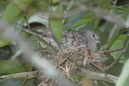
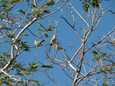
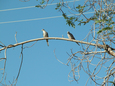
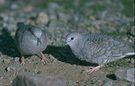
A small, brownish-gray dove with a scaly appearance due to dark feather tips. It is buffy on the underside and has a long rounded tail with white outer tail feathers. Legs and feet are pinkish gray and the beak goes from gray to black coming out from the face. In flight, rusty red wing feathers are obvious. It is very similar to the ground dove, but the ground dove lacks the overall scaly appearance and has a square tail. Males and females very similar, as are juvenile and adult, except the adult iris is dark red and the juvenile iris is pale yellow. It has been noted that Columbina inca may be darker in southern areas. (Rappole, 2000; Mueller, 1992)
- Other Physical Features
- endothermic
- homoiothermic
- bilateral symmetry
-
- Range mass
- 30 to 58 g
- 1.06 to 2.04 oz
-
- Range length
- 16 to 23 cm
- 6.30 to 9.06 in
-
- Range wingspan
- 32 (high) cm
- 12.60 (high) in
-
- Average wingspan
- 28.5 cm
- 11.22 in
Reproduction
There is little information about the Inca dove's mating system but monogamy appears to be the prevalent system. Courtship displays and mate guarding are common in the Inca dove. Early courtship displays by males, such as head bobbing and mounting, help to distinguish the sexes. The female will return the head bob and ignore the mounting, whereas the male will not return the head bob and will dislodge the mount. Mutual preening is abundant and continous throughout the breeding period. Once a breeding territory is established more intensive displays such as tail fanning and calling are prevalent and may be cues to start breeding (Mueller, 1992).
- Mating System
- monogamous
The Inca dove is a year round breeder and nest builder. The male will bring the material to the nest and climb on the back of the female to deliver it. The female then builds the nest (Johnston, 1960). Copulation continues during this time and nests will be reused. Most construction takes place in the morning and for a duration of about three consecutive days (Mueller, 1992). They will build their nest in a wide variety of trees and shrubs but also use human structures such as houses and utility poles (Mueller, 1992).
Eggs have an incubation period of 13-15 days. The adults brood for 7-9 days and the hatchlings leave the nest in 12-16 days (Mueller, 1992).
- Key Reproductive Features
- iteroparous
- year-round breeding
- gonochoric/gonochoristic/dioecious (sexes separate)
- sexual
- fertilization
- oviparous
-
- Breeding season
- year round
-
- Range eggs per season
- 4 to 10
-
- Average eggs per season
- 6
-
- Average eggs per season
- 2
- AnAge
-
- Range time to hatching
- 13 to 15 days
-
- Range fledging age
- 12 to 16 days
Both parents take turns incubating the nest with the male sitting midday and the female sitting from late afternoon to the following midmorning (Mueller, 1992). Once the chicks have hatched it is assumed that like all Columbidae, milk produced in the crop of both parents is fed to the young (Riddle, 1963). This "pigeon milk" is the exclusive diet of the young for the first few days and has a very high fat and protein content. It does not contain carbohydrates or calcium so other solid food is also consumed (Perrins and Middleton, 1985). However, the amount of milk fed remains the same until the young are well grown. After the family leaves the nest they will usually roost together for about a week. During this time parental care continues but will cease when the adults renest. At this time the young leave the territory and join groups of other immatures (Mueller, 1992).
- Parental Investment
- altricial
- male parental care
- female parental care
Lifespan/Longevity
Columbia inca have a typical lifespan of 2-3 years however one banded individual has reached an age of 7 years and 9 months (Mueller, 1992). There is no information on their longevity in captivity.
-
- Range lifespan
Status: wild - 7.75 (high) years
- Range lifespan
-
- Typical lifespan
Status: wild - 2 to 3 years
- Typical lifespan
Behavior
The Inca dove spends its time foraging, roosting and sunning. In cold weather it will build living pyramids with other members by grouping together and standing on one another's backs. These pyramids will periodically collaspe and reform with different members on the interior. They can be social or territorial during feeding and display heavy defending of the territory during the breeding season (Mueller, 1992).
- Key Behaviors
- flies
- motile
- sedentary
- solitary
- territorial
- social
Communication and Perception
Food Habits
Inca doves can be seen foraging almost entirely on the ground in short vegetation. They are also frequent guests at household bird feeders. They eat seeds from grains, weeds, and grasses and will whisk their bill around in the dirt to uncover the seeds. They will forage individualy or in flocks of more than 100 birds, with the largest groupings in the late afternoon. They will also feed with poultry. They need to imbibe 9% of their body mass in water every day. This is accomplished by drinking from pools, dripping faucets or by eating moist fruits on cacti or hydrants (Mueller, 1992).
- Plant Foods
- seeds, grains, and nuts
- fruit
Predation
Inca doves will roost on small branches out of the reach of predators and the pyramiding for warmth may offer some protection. Incubating adults are not scared away from their nest very easily and they do no distraction displays (Mueller, 1992).
-
- Known Predators
-
- domestic cats (Felis silvestris)
- blue jays (Cyanocitta cristata)
- raccoons (Procyon lotor)
- ringtails (Bassariscus astutus)
Ecosystem Roles
Columbina inca, through its eating habits disperses seed.
- Ecosystem Impact
- disperses seeds
Economic Importance for Humans: Positive
The presence of Inca doves provides aesthetic enjoyment to bird watchers.
Economic Importance for Humans: Negative
Inca doves can be infected with Chlamydia psittaci that can also infect domestic turkeys. Doves feeding with domestic turkeys can also carry salmonella bacteria and three kinds of lice (Mueller, 1992).
- Negative Impacts
- causes or carries domestic animal disease
Conservation Status
The Inca dove is not in danger of becoming extinct. In fact, its range is growing. This is primarily due to coexistence with humans.
-
- IUCN Red List
-
Least Concern
More information
-
- IUCN Red List
-
Least Concern
More information
-
- US Migratory Bird Act
- Protected
-
- US Federal List
- No special status
-
- CITES
- No special status
-
- State of Michigan List
- No special status
Contributors
Janae Gatchell (author), University of Arizona, Todd McWhorter (editor), University of Arizona.
Glossary
- Nearctic
-
living in the Nearctic biogeographic province, the northern part of the New World. This includes Greenland, the Canadian Arctic islands, and all of the North American as far south as the highlands of central Mexico.

- Neotropical
-
living in the southern part of the New World. In other words, Central and South America.
- acoustic
-
uses sound to communicate
- agricultural
-
living in landscapes dominated by human agriculture.
- altricial
-
young are born in a relatively underdeveloped state; they are unable to feed or care for themselves or locomote independently for a period of time after birth/hatching. In birds, naked and helpless after hatching.
- bilateral symmetry
-
having body symmetry such that the animal can be divided in one plane into two mirror-image halves. Animals with bilateral symmetry have dorsal and ventral sides, as well as anterior and posterior ends. Synapomorphy of the Bilateria.
- causes or carries domestic animal disease
-
either directly causes, or indirectly transmits, a disease to a domestic animal
- chaparral
-
Found in coastal areas between 30 and 40 degrees latitude, in areas with a Mediterranean climate. Vegetation is dominated by stands of dense, spiny shrubs with tough (hard or waxy) evergreen leaves. May be maintained by periodic fire. In South America it includes the scrub ecotone between forest and paramo.
- chemical
-
uses smells or other chemicals to communicate
- desert or dunes
-
in deserts low (less than 30 cm per year) and unpredictable rainfall results in landscapes dominated by plants and animals adapted to aridity. Vegetation is typically sparse, though spectacular blooms may occur following rain. Deserts can be cold or warm and daily temperates typically fluctuate. In dune areas vegetation is also sparse and conditions are dry. This is because sand does not hold water well so little is available to plants. In dunes near seas and oceans this is compounded by the influence of salt in the air and soil. Salt limits the ability of plants to take up water through their roots.
- endothermic
-
animals that use metabolically generated heat to regulate body temperature independently of ambient temperature. Endothermy is a synapomorphy of the Mammalia, although it may have arisen in a (now extinct) synapsid ancestor; the fossil record does not distinguish these possibilities. Convergent in birds.
- female parental care
-
parental care is carried out by females
- fertilization
-
union of egg and spermatozoan
- granivore
-
an animal that mainly eats seeds
- herbivore
-
An animal that eats mainly plants or parts of plants.
- internal fertilization
-
fertilization takes place within the female's body
- iteroparous
-
offspring are produced in more than one group (litters, clutches, etc.) and across multiple seasons (or other periods hospitable to reproduction). Iteroparous animals must, by definition, survive over multiple seasons (or periodic condition changes).
- male parental care
-
parental care is carried out by males
- monogamous
-
Having one mate at a time.
- motile
-
having the capacity to move from one place to another.
- native range
-
the area in which the animal is naturally found, the region in which it is endemic.
- oviparous
-
reproduction in which eggs are released by the female; development of offspring occurs outside the mother's body.
- scrub forest
-
scrub forests develop in areas that experience dry seasons.
- sedentary
-
remains in the same area
- sexual
-
reproduction that includes combining the genetic contribution of two individuals, a male and a female
- social
-
associates with others of its species; forms social groups.
- solitary
-
lives alone
- suburban
-
living in residential areas on the outskirts of large cities or towns.
- tactile
-
uses touch to communicate
- temperate
-
that region of the Earth between 23.5 degrees North and 60 degrees North (between the Tropic of Cancer and the Arctic Circle) and between 23.5 degrees South and 60 degrees South (between the Tropic of Capricorn and the Antarctic Circle).
- terrestrial
-
Living on the ground.
- territorial
-
defends an area within the home range, occupied by a single animals or group of animals of the same species and held through overt defense, display, or advertisement
- tropical
-
the region of the earth that surrounds the equator, from 23.5 degrees north to 23.5 degrees south.
- urban
-
living in cities and large towns, landscapes dominated by human structures and activity.
- visual
-
uses sight to communicate
- year-round breeding
-
breeding takes place throughout the year
References
Johnston, R. 1960. Behavior of the Inca Dove. Condor, 62: 7-24.
Mueller, A. 1992. Inca Dove. Pp. 1-11 in F Gill, A Poole, eds. The Birds of North America, No. 28. Washington, D.C.: Academy of Natural Sciences, Philadelphia, PA , and American Ornithologists Union.
Perrins, C., A. Middleton. 1985. The encyclopedia of birds. New York: Facts on File Publishing.
Rappole, J. 2000. Birds of the Southwest. College Station: Texas A&M University Press.
Riddle, O. 1963. Prolactin in vertebrate function and organization. J. Natl. Cancer Institute, 31: 1039-1110.