Coendou prehensilisBrazilian porcupine(Also: prehensile-tailed porcupine)



Geographic Range
Arboreal Brazilian porcupines (Coendou prehensilis) are neotropical organisms found from northern Colombia eastward through northern South America and southward through most of the forested cis-Andean lowlands. The extremes of this range include eastern Bolivia, northern Argentina, and eastern Paraguay. (Roberts, et al., 1985; Voss, 2011)
- Biogeographic Regions
- neotropical
Habitat
Brazilian porcupines occupy a diverse selection of environments, but are not found at elevations exceeding 1,500 meters. Though they mostly occupy old growth forests where trees for foraging and dwelling are abundant, they also inhabit humid mountainous highlands, riverine llanos (vast tropical grasslands), and even a few croplands. (Roberts, et al., 1985; Voss, 2011; Wilson and Reeder, 2005)
- Habitat Regions
- tropical
- terrestrial
- Terrestrial Biomes
- savanna or grassland
- forest
- rainforest
- Other Habitat Features
- agricultural
-
- Range elevation
- 1,500 (high) m
- ft
Physical Description
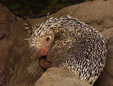
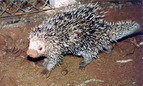
Brazilian porcupines are considered large with a long, muscular, prehensile tail; well adapted to live and move in trees. Adult body sizes ranges from 300 to 600 millimeters in length with the tail measuring an additional 330 to 485 millimeters. Full grown adult males and females may weigh up to 4.55 and 5 kilograms, respectively. The young average 500 millimeters in length from nose to tail tip and 415 grams at birth with no significant difference between males and females. The young have a dense covering of reddish brown guard hairs (each about 35 millimeters in length) on their heads and bodies that will later harden to quills. Adult Brazilian porcupines have skin varying in hue from yellow-orange rust to brownish-black and is covered with long quills on the dorsal side. The yellow-orange hue is due to a pungent waxy substance exuded from the sebaceous glands of both males and females. The semi-hollow quills are tricolored with white tips terminating in a barbed end. This makes the 60 to 100 millimeter quills effective at penetrating the flesh of predators and difficult to remove. The prehensile tails are unspined and used for stabilization and grasping while climbing as well as a means of hanging. In addition to being very muscular, this prehensile tail has a callus pad near the ventral tip to aid in grasping branches and vines. Another characteristic that has developed as a result of arboreal life is the specialized foot with its long-clawed digits, which are ideal for moving and foraging among trees. Brazilian porcupines have small ears, long whiskers, wide nasal openings and specialized procumbent upper incisors. The eyes are encircled by a thin band of bare skin in the coat of spines that extends all the way to the nose. ("Prehensile-tailed Porcupine", 2011; "Spotlight on Vet Medicine: A Tale of a Porcupine Tail", 2011; Lewis, 1964; Roberts, et al., 1985; Voss, 2011)
Prehensile-tailed porcupines differ from North American porcupines in many respects. In addition to having smaller young that require an extended developmental period, Brazilian porcupines lack a distinct mantle of longer quills covering the nape, shoulders and upper backs of the adults. Also differing are the characteristics that mark them as arboreal porcupines, such as its prehensile tail and lack of emergent fur. North American porcupines are adapted to terrestrial as well as arboreal life and has an entirely fur covered body. Size is the most distinguishing feature however, with Brazilian porcupines rarely exceeding 5 kilograms in mass and 600 millimeters in length. In contrast, North American porcupines commonly range from 10 to 12 kilograms and 600 to 900 millimeters respectively. (Roberts, et al., 1985; Voss, 2011)
Brazilian porcupines can be distinguished from bicolor-spined porcupines by their predominantly inflated frontal sinuses. The two Neotropical porcupines are fairly similar in size and color. (Voss, 2011)
- Other Physical Features
- endothermic
- homoiothermic
- bilateral symmetry
- Sexual Dimorphism
- female larger
-
- Range mass
- 2 to 5 kg
- 4.41 to 11.01 lb
-
- Range length
- 300 to 600 mm
- 11.81 to 23.62 in
-
- Average basal metabolic rate
- 5.123 W
- AnAge
Reproduction
Little is documented on the mating system of Brazilian porcupines both in the wild and in captivity. In captive settings, there have been observed occurrences of males spraying females and their young to mark them; once usually during a suspected courtship period, and again once the young are born. After the young are born, the male may continue to mark both the adult female and the young. Females were never observed spaying males or young. Though there are times when the males and females are together, they seem to sleep and forage separately. (Roberts, et al., 1985)
- Mating System
- monogamous
Though there is no breeding season, females observed in captivity have fertile postpartum estrus. They are able to copulate and conceive just 3 to 18 days after birthing a litter. This is a common trait among other hystricognath rodents without a breeding season. After a gestation period ranging from 195 to 210 days, one young is born on the ground. The precocial young of Brazilian porcupines are born with their eyes open, tail strongly prehensile, and claws well-developed. Despite being able to move and climb, the young does not wander far from where it is born for the first 2 to 3 weeks of life, besides climbing trees when disturbed. In addition to being born with a dense coat of guard hairs, natal quills up to 15 millimeters in length protect the young and will reach adult length after about 10 weeks. Weaning occurs between 10 and 15 weeks. It is not known when males reach maturity, but females reach their sexual maturity at 19 months of age. The limits of the reproductive lifespan of Brazilian porcupines are unknown, but those in captivity have been documented to produce young for more than 10 years. (Roberts, et al., 1985)
- Key Reproductive Features
- iteroparous
- year-round breeding
- gonochoric/gonochoristic/dioecious (sexes separate)
- sexual
- fertilization
- viviparous
- post-partum estrous
-
- Breeding interval
- Brazilian porcupines do not have a breeding season and can breed as early as 3 days after giving birth.
-
- Breeding season
- Brazilian porcupines can breed year round.
-
- Range number of offspring
- 1 (high)
-
- Average number of offspring
- 1
- AnAge
-
- Range gestation period
- 195 to 210 days
-
- Range weaning age
- 10 to 15 weeks
-
- Average time to independence
- 15 weeks
-
- Average age at sexual or reproductive maturity (female)
- 19 months
-
- Average age at sexual or reproductive maturity (female)
Sex: female - 578 days
- AnAge
- Average age at sexual or reproductive maturity (female)
-
- Average age at sexual or reproductive maturity (male)
Sex: male - 578 days
- AnAge
- Average age at sexual or reproductive maturity (male)
Though Brazilian porcupine young are highly developed at birth, there is a substantially prolonged maternal dependence. Females may lactate for 70 days or more during three main stages of infant development. From birth to 4 weeks, the young is completely dependent on the mother for nutrition. The mother nurses every 4 to 6 hours for 1 to 3 minutes at a time, at the mother's discretion. From 4 to 15 weeks, the young are slowly introduced to outside food sources. The young suckles from its mother in addition to foraging for solids. Complete nutritional independence occurs at 15 or more weeks, when the young becomes completely self-sufficient, foraging for food. Excluding suckling, there is little maternal care. Neither males nor females in wild or captive environments were observed defending or removing their young from potential dangers. Young are often left to fend for themselves by climbing trees to escape danger. In captivity, juveniles occasionally engage in play with the father, but little to no paternal care is evident in the wild. Despite limited interaction and care, neither adult shows aggression towards the young. After adult females give birth to a new litter, they will even remain tolerable of the offspring from their previous litter. (Roberts, et al., 1985)
- Parental Investment
- precocial
- female parental care
-
pre-weaning/fledging
-
provisioning
- female
-
provisioning
- post-independence association with parents
Lifespan/Longevity
Brazilian porcupines have been known to live up to 27 years in captivity. Life expectancy in the wild is likely less and limited by tooth wear caused by diet. (Gorbunova, et al., 2008)
-
- Range lifespan
Status: captivity - 27 (high) years
- Range lifespan
-
- Average lifespan
Status: captivity - 17.3 years
- Max Planck Institute for Demographic Research
- Average lifespan
-
- Average lifespan
Status: wild - 17.0 years
- Max Planck Institute for Demographic Research
- Average lifespan
-
- Average lifespan
Status: captivity - 9.0 years
- Max Planck Institute for Demographic Research
- Average lifespan
Behavior
Brazilian porcupines are socially tolerant, especially when mates and food are abundant, but prefer small groups or a completely solitary lifestyles. These arboreal porcupines spend over 85% of their time in trees where they sleep, forage, and interact with other porcupines. High branches, forks, and hollow trunks are the preferred places for dens and for sleeping in during the day. They rarely venture to the ground where they mates, give birth, defecate, and intermittently forage. Being nocturnal, peak activity times for prehensile-tailed porcupines are between 4 PM to 2 AM, and are dependent on the time of year. ("Prehensile-tailed Porcupine", 2011; "Spotlight on Vet Medicine: A Tale of a Porcupine Tail", 2011; Roberts, et al., 1985)
Home Range
There is no information about Brazilian porcupines home range.
Communication and Perception
Brazilian porcupines communicate in a variety of ways including acoustic, chemical, and visual forms. When relaxed and at ease, the quills of Brazilian porcupines rest flat against the skin. If threatened, irritated, or faced by an unknown individual, Brazilian porcupines will stand its quills up perpendicular to its body. The speed of piloerection can indicate the intensity of the perceived threat or annoyance. To appear even larger and more dangerous in the face of a threat, prehensile-tailed porcupines will turn themselves sideways to the direction of the threat. The last defensive display before attacking, is to turn towards the threat with its head lowered, exhibiting the head and neck spines, then lunging forward. (Roberts, et al., 1985)
Long moans, yelps, grunts, clicks, mews, hisses and squeaks are the main auditory communications of Brazilian porcupines. Extended moans may be utilized to communicate over long distances to other individuals and yelps are used usually when entering into or withdrawing from close interactions with other porcupines. Clicks or grunts are used just prior to an attack or to indicate a threat. Tooth chattering, posturing, and quill rattling is used to ward off potential threats. Quill rattling also occurs after grooming or when porcupines are startled, which brings on some debate about this behavior’s specific meaning. (Roberts, et al., 1985)
Chemical communication includes sniffing and scent marking done by both sexes. Scent marking is done by “anal rubbing”, where prehensile-tailed porcupines use a large, naked glandular patch surrounding the anogenital region to mark a substrate. Males are more likely to rub than females and also mark their mates and offspring by spraying urine. Females are not known to mark with urine. All prehensile-tailed porcupines produce a pungent waxy substance from sebaceous glands along their flanks and lower backs that leave a distinct odor in areas frequented by the porcupines. This indicates that there may be some territory distinction amongst individuals, but more information needs to be gathered in order to be certain. (Roberts, et al., 1985)
- Other Communication Modes
- scent marks
Food Habits
Brazilian porcupines are obligate herbivores who forage primarily among trees. In its natural habitat, Brazilian porcupines feed on the bark and cambium layer of some trees, buds, fruits, roots, stems, leaves, blossoms, unripened seeds, and agricultural crops like corn and bananas. Brazilian porcupines use their long claws to peel bark from trees and to open fruits. A favorite food source is the seeds of queen or cocos palms (Syagrus romanzoffiana). In captivity, the diet of Brazilian porcupine diets are supplemented with corn, rat pellets, apples, dried grain, kale, oranges, sweet potato and Monkey Chow. ("Prehensile-tailed Porcupine", 2011; Roberts, et al., 1985)
- Plant Foods
- leaves
- roots and tubers
- wood, bark, or stems
- seeds, grains, and nuts
- fruit
- flowers
Predation
With a covering of barbed quills that are effective at penetrating the flesh of predators, there are relatively few animals that prey on Brazilian porcupines. However, in the rural areas, people eat prehensile-tailed porcupines. During the summer months, free-ranging and feral dogs occasionally catch and consume prehensile-tailed porcupines. Their dark coloring and nocturnal and arboreal lifestyle also limits most predation by concealment. Though kissing bugs or assassin beetles do not kill Brazilian porcupines, they feed on their blood. ("Prehensile-tailed Porcupine", 2011; Campos, et al., 2007; Gaunt and Miles, 2000)
- Anti-predator Adaptations
- cryptic
-
- Known Predators
-
- humans (Homo sapiens)
- domestic dogs (Canis lupus familiaris)
- kissing bugs (Eratyrus mucronatus)
Ecosystem Roles
Brazilian porcupines are primary consumers of plant life in their geographic range. There is some evidence that their foraging aids in the dispersal of some tree seeds. In turn, Brazilian porcupines are preyed upon by a select number of animals. Since the true bugs (Eratyrus mucronatus) feed on their blood, Brazilian porcupines are a reservoir for parasitic euglenoid trypanosomes (Trypanosoma cruzi). (Gaunt and Miles, 2000; Roberts, et al., 1985; Valente, et al., 1998)
- Ecosystem Impact
- disperses seeds
- Eratyrus mucronatus
- Trypanosoma cruzi
Economic Importance for Humans: Positive
Besides functioning as an occasional food source, prehensile-tailed porcupines are not of great economical importance to humans. ("Prehensile-tailed Porcupine", 2011)
- Positive Impacts
- food
Economic Importance for Humans: Negative
In addition to some agricultural damage, Brazilian porcupines act as a reservoir for Trypanosoma cruzi, which causes Chagas disease in humans. However, the porcupines themselves are not infectious to humans. ("Prehensile-tailed Porcupine", 2011; Valente, et al., 1998)
- Negative Impacts
-
injures humans
- carries human disease
- crop pest
Conservation Status
Brazilian porcupines are considered of least concern. It is suspected (though not confirmed) that a large population of porcupines is distributed over a wide range that includes many protected areas. Brazilian porcupines also exhibit a tolerance to habitat modification by humans and have not been declining at a rate necessary to qualify for higher risk listing. (Marinho-Filho, et al., 2011)
-
- IUCN Red List
-
Least Concern
More information
-
- IUCN Red List
-
Least Concern
More information
-
- CITES
- No special status
Contributors
Sarah Andres (author), University of Wisconsin-Stevens Point, Christopher Yahnke (editor), University of Wisconsin-Stevens Point, Alecia Stewart-Malone (editor), University of Wisconsin-Stevens Point, Laura Podzikowski (editor), Special Projects.
Glossary
- Neotropical
-
living in the southern part of the New World. In other words, Central and South America.

- acoustic
-
uses sound to communicate
- agricultural
-
living in landscapes dominated by human agriculture.
- arboreal
-
Referring to an animal that lives in trees; tree-climbing.
- bilateral symmetry
-
having body symmetry such that the animal can be divided in one plane into two mirror-image halves. Animals with bilateral symmetry have dorsal and ventral sides, as well as anterior and posterior ends. Synapomorphy of the Bilateria.
- chemical
-
uses smells or other chemicals to communicate
- cryptic
-
having markings, coloration, shapes, or other features that cause an animal to be camouflaged in its natural environment; being difficult to see or otherwise detect.
- endothermic
-
animals that use metabolically generated heat to regulate body temperature independently of ambient temperature. Endothermy is a synapomorphy of the Mammalia, although it may have arisen in a (now extinct) synapsid ancestor; the fossil record does not distinguish these possibilities. Convergent in birds.
- female parental care
-
parental care is carried out by females
- fertilization
-
union of egg and spermatozoan
- food
-
A substance that provides both nutrients and energy to a living thing.
- forest
-
forest biomes are dominated by trees, otherwise forest biomes can vary widely in amount of precipitation and seasonality.
- frugivore
-
an animal that mainly eats fruit
- granivore
-
an animal that mainly eats seeds
- herbivore
-
An animal that eats mainly plants or parts of plants.
- iteroparous
-
offspring are produced in more than one group (litters, clutches, etc.) and across multiple seasons (or other periods hospitable to reproduction). Iteroparous animals must, by definition, survive over multiple seasons (or periodic condition changes).
- monogamous
-
Having one mate at a time.
- motile
-
having the capacity to move from one place to another.
- native range
-
the area in which the animal is naturally found, the region in which it is endemic.
- nocturnal
-
active during the night
- rainforest
-
rainforests, both temperate and tropical, are dominated by trees often forming a closed canopy with little light reaching the ground. Epiphytes and climbing plants are also abundant. Precipitation is typically not limiting, but may be somewhat seasonal.
- scent marks
-
communicates by producing scents from special gland(s) and placing them on a surface whether others can smell or taste them
- sexual
-
reproduction that includes combining the genetic contribution of two individuals, a male and a female
- social
-
associates with others of its species; forms social groups.
- solitary
-
lives alone
- tactile
-
uses touch to communicate
- terrestrial
-
Living on the ground.
- tropical
-
the region of the earth that surrounds the equator, from 23.5 degrees north to 23.5 degrees south.
- tropical savanna and grassland
-
A terrestrial biome. Savannas are grasslands with scattered individual trees that do not form a closed canopy. Extensive savannas are found in parts of subtropical and tropical Africa and South America, and in Australia.
- savanna
-
A grassland with scattered trees or scattered clumps of trees, a type of community intermediate between grassland and forest. See also Tropical savanna and grassland biome.
- temperate grassland
-
A terrestrial biome found in temperate latitudes (>23.5° N or S latitude). Vegetation is made up mostly of grasses, the height and species diversity of which depend largely on the amount of moisture available. Fire and grazing are important in the long-term maintenance of grasslands.
- visual
-
uses sight to communicate
- viviparous
-
reproduction in which fertilization and development take place within the female body and the developing embryo derives nourishment from the female.
- year-round breeding
-
breeding takes place throughout the year
- young precocial
-
young are relatively well-developed when born
References
2011. "Prehensile-tailed Porcupine" (On-line). Smithsonian National Zoological Park. Accessed August 23, 2011 at http://nationalzoo.si.edu/Animals/SmallMammals/fact-porcupine.cfm.
2011. "Spotlight on Vet Medicine: A Tale of a Porcupine Tail" (On-line). Smithsonian National Zoological Park. Accessed August 23, 2011 at http://nationalzoo.si.edu/scbi/SpotlightonVetMedicine/porcupinetale.cfm.
Campos, C., C. Esteves, K. Ferraz, P. Crawshaw Jr., L. Verdade. 2007. Dier of Free-Ranging Cats and Dogs in a Suburban and Rural Environment, South-Eastern Brazil. Journal of Zoology, 27/3: 16-17. Accessed August 23, 2011 at http://www.lcb.esalq.usp.br/lea/Artigos_pdf/Camposetal2007.pdf.
Gaunt, M., M. Miles. 2000. The Ecotopes and Evolution of Tratomine Bugs (Triatominae) and their Associated Trypanosomes. Mem. Inst. Oswald Cruz, 95/4: 557-565. Accessed August 22, 2011 at http://www.scielo.br/scielo.php?pid=S0074-02762000000400019&script=sci_arttext#menu.
Gorbunova, V., M. Bozzella, A. Selluanov. 2008. Rodents for Comparative Aging Studies: from Mice to Beavers. Age, 30/2-3: 111-119. Accessed August 23, 2011 at https://www.ncbi.nlm.nih.gov/pmc/articles/PMC2527635/.
Lewis, O. 1964. The Homologies of the Mammalian Tarsal Bones. Journal of Anatomy, 98/2: 195-208. Accessed August 22, 2011 at http://www.ncbi.nlm.nih.gov/pmc/articles/PMC1261275/pdf/janat00423-0073.pdf.
Marinho-Filho, J., D. Querirolo, J. Emmons. 2011. "Coendou prehensilis" (On-line). The IUCN Red List of Threatened Species(tm). Accessed August 22, 2011 at http://www.iucnredlist.org/apps/redlist/details/5085/0.
Roberts, M., S. Brand, E. Maliniak. 1985. The Biology of Captive Prehensial-Tailed Porcupines, Coendou prehensilis. Journal of Mammology, 66/3: 476-482. Accessed August 23, 2011 at http://nationalzoo.si.edu/scbi/SpotlightonVetMedicine/The%20Biology%20of%20Prehensile-tailed%20Porcupines.pdf.
Valente, V., S. Valente, F. Noireau, H. Carrasco, M. Miles. 1998. Chagas Disease in the Amazon Basin: Associated of Panstrongylus geniculatus (Hemiptera: Reduviidae) with Domestic Pigs. Journal of Medical Entomology, 35/2: 99. Accessed August 23, 2011 at http://iah.iec.pa.gov.br/iah/fulltext/pc/artigos/1998/jmedentomol1998v35n2p99-103.pdf.
Voss, R. 2011. Revisionary Notes on Neotropical Porcupines (Rodentia, Erethizontidae) 3. An Annotated Checklist of the Species of Coendou Lacépède, 1799. American Museum Novitates, 3720: 1-36. Accessed August 22, 2011 at http://digitallibrary.amnh.org/dspace/bitstream/handle/2246/6121/N3720.pdf?sequence=1.
Wilson, D., D. Reeder. 2005. Mammal Species of the World: a Taxonomic and Geographic Reference, Volume 1. Baltimore: Johns Hopkins University Press. Accessed August 22, 2011 at http://www.google.com/books?id=JgAMbNSt8ikC&pg=PA1547#v=onepage&q&f=false.