Cingulataarmadillos
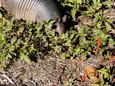

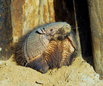
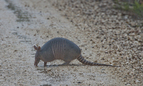
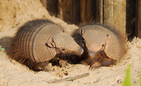
Xenarthrans radiated in South America during the Tertiary, when that continent was isolated by sea from other continents. The group currently includes armadillos, 2-toed sloths, 3-toed sloths, and anteaters, placed in four families containing 29 species. These animals are mostly insectivores and herbivores of small to medium body size (up to around 60 kg). In the past, however, xenarthrans were much more diverse and numerous. They radiated into around a dozen families, including not only the groups known today, but also such animals as giant ground sloths, some of which were larger than elephants; glyptodonts, reaching 3 m in length and the most heavily armored vertebrates that ever existed; and a large number of smaller grazing and browsing forms. Several groups of xenarthrans successfully crossed the Central American land bridge to North America when it formed in the Pliocene; these included a number of kinds of ground sloths and armadillos. Only one species, however, an armadillo (Dasypus novemcinctus), is still alive today.
Xenarthrans lack incisors or canines, and if present, their molars and premolars are simply cylinders without the covering of enamel that is found on the teeth of most other mammals. These teeth have a single root. Xenarthrans have small brains, and some have an unusually long and cylindrical braincase. Their tympanic bone is ring-shaped. The most notable feature of their postcranial skeleton are the special articulations ( xenarthrous processes) on the lumbar vertebrae. These are found in no other mammals. The number of cervical vertebrae varies from five to nine, depending on the species; this degree of variation is extremely unusual in mammals (almost all other mammals have seven). The forefeet have five toes (with a few exceptions), but two or three predominate and have long, sharp, curved claws. Xenarthrans also have a clavicle and an unusually well-developed coracoid process.


Xenarthrans can be found throughout Central and South America, ranging northwards to the central United States. They are sometimes referred to as edentates (order Edentata). Their fossil record extends to the Paleocene.
Click on a term below to find out more about that family:
Family Dasypodidae (armadillos)
Family Myrmecophagidae (anteaters)
Family Bradypodidae (sloths)
Family Megalonychidae (sloths)
Literature and references cited
Barlow, J. C. 1984. Xenarthrans and pholidotes. Pp. 219-239 in Anderson, S. and J. K. Jones, Jr. (eds). Orders and Families of Recent Mammals of the World. John Wiley and Sons, N.Y. xii+686 pp.
Paradiso, J. L. 1975. Walker's Mammals of the World, Third Edition. Johns Hopkins University Press, Baltimore.
Savage, R. J. G. and M. R. Long. 1986. Mammal Evolution, an Illustrated Guide. Facts of File Publications, New York. 259 pp.
Vaughan, T. A. 1986. Mammalogy. Third Edition. Saunders College Publishing, Fort Worth. vii+576 pp.
Wilson, D. E., and D. M. Reeder. 1993. Mammal Species of the World, A Taxonomic and Geographic Reference. 2nd edition. Smithsonian Institution Press, Washington. xviii+1206 pp.
Contributors
Phil Myers (author), Museum of Zoology, University of Michigan-Ann Arbor.
Glossary
- bilateral symmetry
-
having body symmetry such that the animal can be divided in one plane into two mirror-image halves. Animals with bilateral symmetry have dorsal and ventral sides, as well as anterior and posterior ends. Synapomorphy of the Bilateria.
- chemical
-
uses smells or other chemicals to communicate
- endothermic
-
animals that use metabolically generated heat to regulate body temperature independently of ambient temperature. Endothermy is a synapomorphy of the Mammalia, although it may have arisen in a (now extinct) synapsid ancestor; the fossil record does not distinguish these possibilities. Convergent in birds.
- motile
-
having the capacity to move from one place to another.
- sexual
-
reproduction that includes combining the genetic contribution of two individuals, a male and a female
- tactile
-
uses touch to communicate