Cinclus cincluswhite-throated dipper
Geographic Range
White-throated dippers are found throughout the Palearctic. There are ten subspecies in the western Palearctic and three in the eastern Palearctic. They are relatively sedentary, and their lack of dispersal may contribute to the accumulation of local variation. White-throated dippers are always found near fast flowing rivers and streams, most often in mountains. Population estimates are from 330,000 to 660,000 individuals and the range is massive. (BirdLife International, 2008; Hourlay, et al., 2008; Robinson, 2005)
White-throated dippers are found in the following countries: Afghanistan, Albania, Algeria, Andorra, Armenia, Austria, Azerbaijan, Belarus, Belgium, Bhutan, Bosnia and Herzegovina, Bulgaria, China, Croatia, Czech Republic, Denmark, Estonia, Finland, France, Georgia, Germany, Greece, Hungary, India, Iran, Iraq, Ireland, Italy, Kazakhstan, Kyrgyzstan, Latvia, Lebanon, Liechtenstein, Lithuania, Luxembourg, Macedonia, Mongolia, Montenegro, Morocco, Myanmar, Nepal, Netherlands, Norway, Pakistan, Poland, Portugal, Romania, Russian Federation, Serbia, Slovakia, Slovenia, Spain, Sweden, Switzerland, Tajikistan, Turkey, Turkmenistan, Ukraine, United Kingdom, Uzbekistan. White-throated dippers have been extirpated from Cyprus and vagrants have been seen in the Faroe Islands, Malta, and Tunisia. (BirdLife International, 2008)
- Biogeographic Regions
- palearctic
Habitat
White-throated dippers live near fast flowing rivers or streams in temperate and subarctic regions of Europe and Asia. They prefer cold climates and mountains, including rocky places like cliffs and peaks. They are also found near waterfalls and lakes. (BirdLife International, 2008; Hourlay, et al., 2008; Robinson, 2005)
- Habitat Regions
- temperate
- terrestrial
- freshwater
- Aquatic Biomes
- lakes and ponds
- rivers and streams
- Other Habitat Features
- riparian
Physical Description
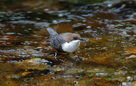
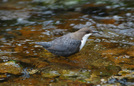
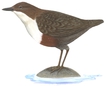
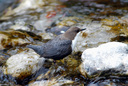
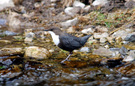
White-throated dippers are small, round birds with short, pointed beaks and stubby, blunt tails. Most of the body is dark brown, almost black, and the feathers on their backs have pale edges, producing a scalloped effect. They have white bibs running from below the beak to the middle of the chest. The bibs have clear boundaries in adults, but in juveniles, the edges blur into the rest of the brown on the body. In adults, the feathers caudoventral to the bib often appear reddish, as do the feathers on their heads, but their heads are darker and browner. White-throated dippers have special white eyelids which they use to protect their eyes while foraging underwater. Their legs and feet are black and thin, with three toes forward and one backward, like most passerines. Females are smaller than males. (BirdGuides, Ltd., 2008; Bryant and Newton, 1994; Robinson, 2005)
Basal metabolic rates were studied in correlation with dominance. It was found that more dominant animals have high BMRs. Males generally have BMRs between 49 and 57 J/g/h, and females have BMRs between 52 and 64 J/g/h. (Bryant and Newton, 1994)
- Other Physical Features
- endothermic
- homoiothermic
- bilateral symmetry
- Sexual Dimorphism
- male larger
-
- Average mass
- 64 g
- 2.26 oz
-
- Average length
- 18 cm
- 7.09 in
-
- Average wingspan
- 28 cm
- 11.02 in
Reproduction
White-throated dippers are usually monogamous, though a percentage (8 to 50%) of males are polygynous. Infanticide is known to occur; unmated birds will attack and kill the eggs or young of a pair in order to gain copulations with the opposite sex parent. (Vickery, 1992; Wilson, 1991)
- Mating System
- monogamous
- polygynous
When white-throated dippers reach one year old they begin to reproduce. Males defend the pair's territory. Nests are built strategically to impair predator access, but otherwise females do not help with nest defense. Females generally lay eggs in April. Eggs are laid at a rate of one per day until the clutch reaches 4 to 5 eggs. Hatching occurs 15 to 16 days later. The young are tended through the summer. Eggs are about 26 mm long and 19 mm wide and weigh about 4.6 g, of which 5% is the shell. In highly productive breeding territories, second clutches may be laid up to 18% of the time. Territories with acidic water result in second clutch attempts in only 1.9% of nests (Vickery, 1992). Young are born in an altricial state and with some downy feathers. When they are ten days old, they weigh about 46 grams. Pairs usually raise about four chicks per year to an age of ten days. (Robinson, 2005; Vickery, 1992; Wilson, 1991)
- Key Reproductive Features
- iteroparous
- seasonal breeding
- gonochoric/gonochoristic/dioecious (sexes separate)
- sexual
- oviparous
-
- Breeding interval
- White-throated dipper pairs raise one or two clutches per season.
-
- Breeding season
- White-throated dippers lay their first clutches in early to mid March.
-
- Average eggs per season
- 4-5
-
- Range time to hatching
- 15 to 16 days
-
- Range fledging age
- 18 to 23 days
-
- Range time to independence
- 9.5 to 15 days
-
- Average age at sexual or reproductive maturity (female)
- 1 years
-
- Average age at sexual or reproductive maturity (male)
- 1 years
Soon after fledging, the young begin learning to forage. Adults continue to feed them while they are learning. Young begin foraging in shallow areas and catch larvae instead of the larger prey their parents retrieve while diving. The amount of food provided by parents was found to have little effect on age of independence. However, young which begged more spent less time learning to forage, which negatively impacted their ability to become independent. Because foraging ability plays such a large role in independence, birds raised along the same river and even within the same clutch can vary widely in time to independence. The fastest learners leave their parents after 9.5 days, birds that take more time learning to forage become independent after about 15 days. (Yoerg, 1998)
- Parental Investment
- altricial
-
pre-fertilization
- provisioning
-
protecting
- male
-
pre-hatching/birth
-
provisioning
- female
-
protecting
- male
- female
-
provisioning
-
pre-weaning/fledging
-
provisioning
- male
- female
-
protecting
- male
- female
-
provisioning
-
pre-independence
-
provisioning
- male
- female
-
protecting
- male
- female
-
provisioning
Lifespan/Longevity
Many studies have shown that white-throated dippers are excellent bio-indicators, suggesting their lifespans can be affected by pollution. They typically live 3 years. The oldest bird recorded in the UK was 8 years, 4 months, though in Finland another bird reached the age of 10 years, 7 months. These ages were determined through bird banding. (Buckton, et al., 1998; Logie, 1995; Sorace, et al., 2002; Robinson, 2005)
-
- Range lifespan
Status: wild - 88 (high) months
- Range lifespan
-
- Average lifespan
Status: wild - 3 years
- Average lifespan
Behavior
White-throated dipper pairs are territorial during the breeding season. Dominance is normally established by site familiarity, but Bryant and Newton (1994) did a study to determine the metabolic costs of the initial settlement of dominance questions. They collected 131 birds in Scotland and introduced them individually to a tank with flowing water and a brick. The brick was the only object in the tank that was above the water. After a short period of individual familiarization, they introduced five birds at a time which then competed to be able to perch on the brick. Birds would accost a bird on the brick perch by pushing them, flying at them, or swimming at them. The bird which spent the most time on the brick was considered the most dominant bird. They found a high basal metabolic rate was correlated with high dominance and more singing. (Bryant and Newton, 1994)
- Key Behaviors
- flies
- natatorial
- diurnal
- motile
- sedentary
- territorial
- dominance hierarchies
Home Range
Most white-throated dippers form monogamous pairs and establish a territory together. Their territories run along rivers or streams and are about 0.5 to 2 kilometers long. They defend their territory vigorously during breeding season and relax a little during the rest of the year. (Wilson, 1991)
Communication and Perception
White-throated dippers communicate with songs and calls. Physical contact, like pushing, is an effective way to establish dominance between two birds. (Bryant and Newton, 1994)
Food Habits
White-throated dipper forage by walking underwater, rather than swimming like other water birds. They use their wings to stabilize themselves as water flows over them. Once they capture their prey, they surface and eat while their heads are out of the water. Occasionally they capture food outside of the water, but this appears to opportunistic rather than intentional foraging. White-throated dippers eat mostly larvae of aquatic insects, like mayflies (Ephemeroptera), caddisflies (Trichoptera), stoneflies (Plecoptera), and blackflies (Simuliidae). They also eat small fish, like sculpins (Cottidae), when the season is right. Their specific diet changes as they age. Nestlings have a preference for caddisfly larvae (Trichoptera). Juveniles begin foraging in shallow water, eating mostly blackfly larvae (Simuliidae). As they mature into adults, they become more adept at gripping the rocks and maneuvering in deeper water, so they begin diving and eating larger prey. Adults prefer mayflies (Ephemeroptera) and stoneflies (Plecoptera), and only rarely do they forage in shallow water and pick off blackfly larvae from the rocks found there. Adults also eat more prey that requires post-capture handling, like caddisfly larvae, while juveniles prefer food that is easier to eat. (Jenkins and Ormerod, 1996; Ormerod, 1985; Robinson, 2005; Yoerg, 1994; Yoerg, 1998)
- Primary Diet
- carnivore
- Animal Foods
- fish
- insects
Predation
White-throated dipper nests are vulnerable, so they are positioned in hard to reach places like rock faces, under cliffs or overhangs, and on bridge supports. Rats, jackdaws, crows, and mustelids all raid dipper nests. Unmated dippers may also kill young in order to gain access to a mate. (Wilson, 1991)
- Anti-predator Adaptations
- cryptic
-
- Known Predators
-
- rats (Rattus)
- jackdaws (Corvus monedula)
- carrion crows (Corvus corone)
- mustelids (Mustelidae)
Ecosystem Roles
Cinclus cinclus is a valuable bio-indicator species in several countries. Its sedentary lifestyle allows it to indicate problems in specific areas, something a migratory species could not do as well. They also show high correlations between their presence/absence in a place and its level of pollution. In a study done in Italy, dippers were present in 93.3% of unpolluted streams and absent from 93.7% of the polluted ones. They are also useful because they are predators, so their absence or lack of health may indicate a cumulation of negative factors in an ecosystem. Coniferous foresting decreases the pH of streams, and overly acidic conditions can be detected by the breeding success of dipper pairs in a particular area. Many of their prey items have difficulty living under acidic conditions, so poor breeding and low foraging success by dippers can indicate too much foresting is occurring upstream. (Buckton, et al., 1998; Logie, 1995; Sorace, et al., 2002; Nybo, et al., 1996)
Economic Importance for Humans: Positive
Cinclus cinclus is a valuable bio-indicator species in several countries. The sedentary lifestyle of white-throated dippers makes them indicators of local habitat problems. There is a high correlation between their presence or absence in an aquatic system and the level of pollution present. In a study done in Italy, white-throated dippers were present in 93.3% of unpolluted streams and absent from 93.7% of the polluted ones. They are also useful because they are predators, so their absence or lack of health may indicate a cumulation of negative factors in an ecosystem. Coniferous forests decrease the pH of streams and overly acidic conditions can be detected through breeding success of dipper pairs in a particular area. Many of their prey items have difficulty living under acidic conditions, so poor breeding and low foraging success by dippers can indicate too much coniferous reforestation is occurring upstream. (Buckton, et al., 1998; Logie, 1995; Sorace, et al., 2002; Nybo, et al., 1996)
- Positive Impacts
- research and education
Economic Importance for Humans: Negative
There are no known adverse effects of white-throated dippers on humans.
Conservation Status
Population trends are difficult to determine for this species, but they appear to be relatively stable. They are listed as Least Concern by the IUCN red list. (BirdLife International, 2008)
-
- IUCN Red List
-
Least Concern
More information
-
- IUCN Red List
-
Least Concern
More information
-
- US Migratory Bird Act
- No special status
-
- US Federal List
- No special status
-
- State of Michigan List
- No special status
Other Comments
Cinclus cinclus comes from the Greek word kinklos, which means "small." In Britain, these dippers also called "water ousels." The common name which probably contains the most Z's comes from Poland: "pluszcz zwyczajny." (Robinson, 2005)
Contributors
Tanya Dewey (editor), Animal Diversity Web.
Aqua Nara Dakota (author), Special Projects.
Glossary
- Palearctic
-
living in the northern part of the Old World. In otherwords, Europe and Asia and northern Africa.

- acoustic
-
uses sound to communicate
- altricial
-
young are born in a relatively underdeveloped state; they are unable to feed or care for themselves or locomote independently for a period of time after birth/hatching. In birds, naked and helpless after hatching.
- bilateral symmetry
-
having body symmetry such that the animal can be divided in one plane into two mirror-image halves. Animals with bilateral symmetry have dorsal and ventral sides, as well as anterior and posterior ends. Synapomorphy of the Bilateria.
- carnivore
-
an animal that mainly eats meat
- chemical
-
uses smells or other chemicals to communicate
- cryptic
-
having markings, coloration, shapes, or other features that cause an animal to be camouflaged in its natural environment; being difficult to see or otherwise detect.
- diurnal
-
- active during the day, 2. lasting for one day.
- dominance hierarchies
-
ranking system or pecking order among members of a long-term social group, where dominance status affects access to resources or mates
- endothermic
-
animals that use metabolically generated heat to regulate body temperature independently of ambient temperature. Endothermy is a synapomorphy of the Mammalia, although it may have arisen in a (now extinct) synapsid ancestor; the fossil record does not distinguish these possibilities. Convergent in birds.
- forest
-
forest biomes are dominated by trees, otherwise forest biomes can vary widely in amount of precipitation and seasonality.
- freshwater
-
mainly lives in water that is not salty.
- insectivore
-
An animal that eats mainly insects or spiders.
- iteroparous
-
offspring are produced in more than one group (litters, clutches, etc.) and across multiple seasons (or other periods hospitable to reproduction). Iteroparous animals must, by definition, survive over multiple seasons (or periodic condition changes).
- monogamous
-
Having one mate at a time.
- motile
-
having the capacity to move from one place to another.
- mountains
-
This terrestrial biome includes summits of high mountains, either without vegetation or covered by low, tundra-like vegetation.
- natatorial
-
specialized for swimming
- native range
-
the area in which the animal is naturally found, the region in which it is endemic.
- oviparous
-
reproduction in which eggs are released by the female; development of offspring occurs outside the mother's body.
- polygynous
-
having more than one female as a mate at one time
- riparian
-
Referring to something living or located adjacent to a waterbody (usually, but not always, a river or stream).
- seasonal breeding
-
breeding is confined to a particular season
- sedentary
-
remains in the same area
- sexual
-
reproduction that includes combining the genetic contribution of two individuals, a male and a female
- tactile
-
uses touch to communicate
- temperate
-
that region of the Earth between 23.5 degrees North and 60 degrees North (between the Tropic of Cancer and the Arctic Circle) and between 23.5 degrees South and 60 degrees South (between the Tropic of Capricorn and the Antarctic Circle).
- terrestrial
-
Living on the ground.
- territorial
-
defends an area within the home range, occupied by a single animals or group of animals of the same species and held through overt defense, display, or advertisement
- visual
-
uses sight to communicate
References
BirdGuides, Ltd., 2008. "Dipper (Cinclus cinclus)" (On-line). BirdGuides. Accessed December 23, 2008 at http://www.birdguides.com/species/species.asp?sp=126001.
BirdLife International, 2008. "Cinclus cinclus" (On-line). The IUCN Red List of Threatened Species. Accessed December 23, 2008 at http://www.iucnredlist.org/details/147141.
Bryant, D., A. Newton. 1994. Metabolic costs of dominance in dippers, Cinclus cinclus. Animal Behavior, 48: 447-455.
Buckton, S., P. Brewin, A. Lewis, P. Stevens, S. Ormerod. 1998. The distribution of dippers, Cinclus cinclus (L.), in the acid-sensitive region of Wales, 1984-95. Freshwater Biology, 39: 387-396.
Hourlay, F., R. Libois, F. D'Amico, M. Sara, J. O'Halloran, J. Michaux. 2008. Evidence of a highly complex phylogeographic structure on a specialist river bird species, the dipper (Cinclus cinclus). Molecular Phylogenetics and Evolution, 49: 435-444.
Jenkins, R., S. Ormerod. 1996. The influence of a river bird, the dipper (Cinclus cinclus), on the behavior and drift of its invertebrate prey. Freshwater Biology, 35: 45-56.
Logie, J. 1995. Effects of stream acidity on non-breeding Dippers Cinclus cinclus in the south-central highlands of Scotland. Aquatic Conservation: Marine and Freshwater Ecosystems, 5: 25-35.
Nybo, S., P. Fjeld, K. Jerstad, A. Nissen. 1996. Long-range air pollution and its impact on heavy metal accumulation in dippers Cinclus cinclus in Norway. Environmental Pollution, 94: 31-38.
Ormerod, S. 1985. The diet of breeding Dippers Cinclus cinclus and their nestlings in the catchment of the River Wye, mid-Wales: a preliminary study by faecal analysis. IBIS, 127: 316-331.
Robinson, R. 2005. "BirdFacts: species profiles of birds occurring in Britain and Ireland" (On-line). Dipper Cinclus cinclus. Accessed December 23, 2008 at http://blx1.bto.org/birdfacts/results/bob10500.htm.
Sorace, A., P. Formichetti, A. Boano, P. Andreani, C. Gramegna, L. Mancini. 2002. The presence of a river bird, the dipper, in relation to water quality and biotic indices in central Italy. Environmental Pollution, 118: 89-96.
Vickery, J. 1992. The reproductive success of the dipper Cinclus cinclus in relation to the acidity of streams in south-west Scotland. Freshwater Biology, 28: 195-205.
Wilson, J. 1991. A probable case of sexually selected infanticide by a male Dipper Cinclus cinclus. IBIS, 134: 188-190.
Yoerg, S. 1994. Development of foraging behavior in the Eurasian dipper, Cinclus cinclus, from fledgling until dispersal. Animal Behavior, 47: 577-588.
Yoerg, S. 1998. Foraging behavior predicts age at independence in juvenile Eurasian dippers (Cinclus cinclus). Behavioral Ecology, 9: 471-477.