Chlidonias nigerblack tern
Geographic Range
The black tern can be found from central eastern Alaska, central Manitoba and Ontario south to northern California, Colorado, northern Missouri and Tennessee, also to the lakeshores of northern Ohio, Pennsylvania and New York; winters spent from Surinam to Peru and Chile. Forbush & May, 1955.
- Biogeographic Regions
- nearctic
- neotropical
Habitat
The preferred summer habitats of the black tern are inland marshes and sloughs with fairly dense cattail or other marsh vegetation and pockets of open water. These wetlands are often shallow in nature. Its winter home is on the coasts of South America and it appears in considerable numbers on the South Atlantic and Gulf coast of North America during its periodic migrations, but all other times it a bird of the interior. Forbush & May, 1955; http://www.npsc.nbs.gov/resource/distr/others/nddanger/species/chlinige.htm
- Terrestrial Biomes
- savanna or grassland
- Aquatic Biomes
- lakes and ponds
- rivers and streams
Physical Description
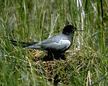
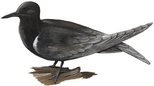
This bird has an approximate length of 9 to 10.25 inches and a wing spread of about 25 inches. In breeding season, this tern has a black head, neck and underparts with generally dark plumage. In the fall, it becomes lighter with gray wings. The young are a grayish-white color with dark patches on either side of their head. The tail is small and is only slightly notched compared with other terns. Its bill is very sharp and slender, shorter than the head; wings are long and pointed; and feet are webbed only to the middle of the toes. Forbush & May, 1955.
- Other Physical Features
- endothermic
- bilateral symmetry
-
- Average mass
- 60 g
- 2.11 oz
- AnAge
Reproduction
The black terns's courtship ritual is elaborate with much flying. Males often fly with fish in their mouth to attract females. They nest in small colonies in upland marshes and sloughs. Their nests can be found on muskrat bouse or floating masses of dead plants, usually over water 4 to 34 inches deep. The typical nest has 3 eggs that are laid from May to early August. Incubation lasts 22 days. The successful hatching rates of nests is very low because of predation and other disturbances. The young terns that do hatch leave the nests very early often swimming first, but flying within 24 days. Black terns do not breed until fully mature at two years of age. http://www.npsc.nbs.gov/resource/distr/others/nddanger/species/chlinige.htm)
- Key Reproductive Features
- iteroparous
- gonochoric/gonochoristic/dioecious (sexes separate)
- sexual
- oviparous
Lifespan/Longevity
-
- Average lifespan
Status: wild - 101 months
- Bird Banding Laboratory
- Average lifespan
Behavior
This species is quite gregarious and usually nests in colonies; in its migrations the birds gather in large flocks. Its flight is bouyant and erratic. They are often observed hovering above marshes. When feeding, it circles low over foraging areas with slow, shallow wingbeats and its bill pointed down. The bird may then hover briefly before a sudden drop or swoop to the surface, next it dips its bill into the water or picks an insect off vegetation. These birds have even been recorded chasing minnows cast by fishermen. Parents are very solicitous when their home is approached. They dart about screaming and make angry swoops at the head of the intruder, often striking hard with their bills. The young remain well to the south, not migrating north to any considerable extent until fully mature. Pearson, 1936; Dunn & Agro, 1995.
- Key Behaviors
- flies
- motile
Communication and Perception
Food Habits
During the breeding season, these birds eat insects and freshwater fish such as damselflies and dragonflies, grubs and larvae and other small mollusks. The rest of the year, meals are usually of small marine fish. Some examples are anchovies, silversides and plankton. The average fish taken during breeding season is 2.5 to 3.0 cm and 3 grams. Dunn & Argo, 1995.
Economic Importance for Humans: Positive
Black terns feed on insects that may be potentially harmful to humans.
Economic Importance for Humans: Negative
Humans approaching the nest of a black tern may come with a serious headache because these birds have been known to attack humans that come too close. Pearson, 1936.
Conservation Status
As of February 28, 1996, the black tern is no longer a candidate species. There is no legal requirement to help candidate species, however it is in the spirit of the Endangered Species Act to consider these species as having significant value and to be worth protecting. Candidate species are species which may warrant official listing as endangered or threatened; however data are not conclusive at the present time. The continuing loss of habitat due to wetland drainage is the main reason for the decline in black tern populations. Reduced hatching success in the midwestern United States may be due to agricultural pesticides. It has been recommended that marshes and sloughs used annually by black terns be protected for the birds and other wetland values. Black terns are a species of special concern in Michigan. http://www.npsc.nbs.gov/resource/distr/others/nddanger/species/chlinige.htm.
-
- IUCN Red List
-
Least Concern
More information
-
- IUCN Red List
-
Least Concern
More information
-
- US Migratory Bird Act
- Protected
-
- US Federal List
- No special status
-
- CITES
- No special status
-
- State of Michigan List
- Special Concern
Other Comments
The blakc tern has been reported from the Pleistocene in dry lake beds of Fossil Lake, Lake Co., Oregon. Other names for the black tern are short-tailed tern, semipalmated tern and sea pigeon. Dunn & Agro, 1995; Forbush & May, 1955.
Contributors
Stephanie Null (author), University of Michigan-Ann Arbor.
Glossary
- Nearctic
-
living in the Nearctic biogeographic province, the northern part of the New World. This includes Greenland, the Canadian Arctic islands, and all of the North American as far south as the highlands of central Mexico.

- Neotropical
-
living in the southern part of the New World. In other words, Central and South America.
- acoustic
-
uses sound to communicate
- bilateral symmetry
-
having body symmetry such that the animal can be divided in one plane into two mirror-image halves. Animals with bilateral symmetry have dorsal and ventral sides, as well as anterior and posterior ends. Synapomorphy of the Bilateria.
- chemical
-
uses smells or other chemicals to communicate
- endothermic
-
animals that use metabolically generated heat to regulate body temperature independently of ambient temperature. Endothermy is a synapomorphy of the Mammalia, although it may have arisen in a (now extinct) synapsid ancestor; the fossil record does not distinguish these possibilities. Convergent in birds.
- iteroparous
-
offspring are produced in more than one group (litters, clutches, etc.) and across multiple seasons (or other periods hospitable to reproduction). Iteroparous animals must, by definition, survive over multiple seasons (or periodic condition changes).
- motile
-
having the capacity to move from one place to another.
- native range
-
the area in which the animal is naturally found, the region in which it is endemic.
- oviparous
-
reproduction in which eggs are released by the female; development of offspring occurs outside the mother's body.
- sexual
-
reproduction that includes combining the genetic contribution of two individuals, a male and a female
- tactile
-
uses touch to communicate
- tropical savanna and grassland
-
A terrestrial biome. Savannas are grasslands with scattered individual trees that do not form a closed canopy. Extensive savannas are found in parts of subtropical and tropical Africa and South America, and in Australia.
- savanna
-
A grassland with scattered trees or scattered clumps of trees, a type of community intermediate between grassland and forest. See also Tropical savanna and grassland biome.
- temperate grassland
-
A terrestrial biome found in temperate latitudes (>23.5° N or S latitude). Vegetation is made up mostly of grasses, the height and species diversity of which depend largely on the amount of moisture available. Fire and grazing are important in the long-term maintenance of grasslands.
- visual
-
uses sight to communicate
References
Dunn, E.H. and Agro, D.J. 1995. The Birds of North America, No.147 (Excerpts). http://www.acnatsci.org/bna/excerpts/blktern.html.
Forbush, E.H and May, J.B. 1955. A Natural History of American Birds of Eastern and Central Notrh America. Commonwealth of Massachusetts, U.S.A.
North Dakota's Federally Listed Edangered, Threatened and Candidate Species. 1995. http://www.npsc.nbs.gov/resource/distr/others/nddanger/species/chlinige.htm.
Pearson, G.T. 1936. Birds of America. Garden City Books, New York.