Chlamydosaurus kingiiFrilled Lizard

Geographic Range
The frilled lizard is found across northern Australia and southern New Guinea (Greer, 1989).
- Biogeographic Regions
- australian
Habitat
The frilled lizard lives in the subhumid to semi-arid grassy woodlands and dry sclerophyll forests. The lizard is arboreal and spends most of its time on trunks and limbs of standing trees. Due to its excellent camouflage, it is usually observed only when it descends to the ground after a rainfall or to search for food (Wilson and Knowles, 1988).
- Terrestrial Biomes
- forest
Physical Description
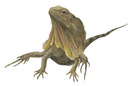
Chlamydosaurus kingii is one of Australia's most distinctive and familiar dragon lizards. It is a large lizard, averaging 85 cm (33 inches) in length. C. kingii is moderately robust with long limbs and a moderately long tail. The general coloring of this lizard is grey-brown. The tail is obscurely striped with a dark grey tip. The tongue and mouth lining are pink or yellow. But its most distinguishable feature is the large Elizabethan-like ruff or frill that it raises abruptly around its neck when it becomes alarmed. The neck frill is simply a thin but extensive fold of skin surrounding the throat, which when fully erected may measure almost 12 inches across. The frill lies like a cape over its shoulders until erected. Frilled Lizards are sexually dimorphic with adult males reaching a snout vent length (SVL) of 290 mm, and a mass of at least 870 g. Females are much smaller, reaching a SVL of 235 mm and a mass of 400g. (Bustard, 1970; Greer 1989; Wilson and Knowles, 1988)
Reproduction
This species is oviparous. The mating season for C. kingii corresponds to the wet season, beginning in October or November and lasting until February or March. Male C. kingii are territorial and seem to use their frill to attract potential mates. However, there hasn't been any conclusive information collected that shows mate selection is related to the size of the frill.
Females lay eggs during the wet season, and the eggs must incubate for about 70 days. Clutch size ranges from 4-13, with an average of 8 eggs per clutch. The nest is located in areas of flat, coarse-grained sandy soil surrounded by sparse grass and leaf litter, with no vegetation directly over the nest, allowing the nest to receive sunlight for most of the day. There are notable differences in frilled lizard clutch sizes between geographic regions (Shrine and Lambeck, 1989).
Lifespan/Longevity
-
- Average lifespan
Status: captivity - 9.9 years
- AnAge
- Average lifespan
Behavior
The Frilled Lizard is a diurnal lizard that spends most of its time resting on tree trunks and low branches. C. kingii undergo seasonal changes with respect to diet, growth, habitat use, and activity. The dry season is characterized by a decrease in activity and Frillneck Lizards prefer large trees with canopy perches. The wet season is characterized by an increase in activity, and the selection of shorter trees with small diameters. The species is well known for its bipedal locomotion when running. When disturbed, this bipedal lizard usually dashes to the nearest tree, but as an alternative, it may hide beneath low vegetation or go into a "freeze" mode. This predator response of resting absolutely motionless has been adopted by C. kingii as part of its "bluffing" plan. If the lizard is cornered, it usually turns to face its aggressor and enacts the defense mechanism for which frilled lizards are most famous. The lizard erects the frill by opening its brightly colored pink or yellow mouth. This sudden apparent increase in size and bright mouth color is sometimes accompanied by hissing, standing up on its hind legs, and leaping at or chasing the predator. If the "bluffing" doesn't work, the lizard usually runs up the nearest tree (Greer 1989; Wilson and Knowles 1988).
Food Habits
Frilled lizards are arboreal, spending 90% of their time in trees. Usually, they only descend to the ground to feed. They are insectivores and most commonly eat small invertebrates, but have been known to eat small mammals and pieces of meat (Wilson and Knowles, 1988).
Economic Importance for Humans: Positive
The frilled lizard experienced widespread fame in Japan during the early 1980s, and for a short time, became a prominent symbol of Australia -- as much as the koala and kangaroo. The reason for this "fame" was that it was featured by a popular automobile commercial on television. The lizard is also featured on the Australian two-cent coin, which was sold for a dollar a piece in Japan while the frilled lizard was so popular (Greer, 1989).
Conservation Status
The frilled lizard does not survive well in captivity. It seldom displays its well-known frill under captive conditions and is therefore a poor exhibit for zoological gardens. The lizard is best observed in its natural surrounding (Bustard, 1970).
-
- IUCN Red List
-
Least Concern
More information
-
- IUCN Red List
-
Least Concern
More information
-
- US Federal List
- No special status
-
- CITES
- No special status
Other Comments
Chlamydosaurus kingii is also known as the frilled lizard, the Australian frilled lizard, and the frillneck lizard.
Only one species of Chlamydosaurus is currently recognized, but the color differences between the Queensland populations and the Western Australia-Northern Territory populations have given many scientists a reason to believe that there may be two separate species (Greer, 1989).
Many authors state that the frilled lizard cannot erect its frill without opening its mouth as well.
Images are at
http://www.jcu.edu.au/dept/Zoology/herp/trept/frill.html
and
Contributors
Melissa Savage (author), University of Michigan-Ann Arbor.
Glossary
- Australian
-
Living in Australia, New Zealand, Tasmania, New Guinea and associated islands.

- forest
-
forest biomes are dominated by trees, otherwise forest biomes can vary widely in amount of precipitation and seasonality.
- native range
-
the area in which the animal is naturally found, the region in which it is endemic.
References
Bustard, Robert. 1970. Australian lizards. Collins, Australia.
Greer, Allen E. 1989. The Biology and Evolution of Australian Lizards. Surrey Beatty & Sons, Australia.
Shine, R., and R. Lambeck. 1989. Ecology of frillneck lizards, Chlamydosaurus kingii (Agamidae), in tropical Australia. Collins, Australia.
Christian, K., A. Griffiths. 1996. Diet and habitat use of frillneck lizards in a seasonal tropical environment. Oecologia, 106: 39-48.
Christian, K., A. Griffiths, G. Bedford. 1996. Physical ecology of frillneck lizards in a seasonal tropical environment. Oecologia, 106: 49-56.
Christian, K., A. Griffiths, G. Bedford. 1993. Preliminary investigations on the reproduction of the frillneck lizard Chlamydosaurus kingii in the Northern Territory. Pp. 127-131 in D Lunney, D Ayers, eds. Herpetology in Australia: A Diverse Discipline. Chipping Norton, NSW, Australia: Royal Zoological Society of New South Wales.
Wilson, S., D. Knowles. 1988. Australia's Reptiles : A Photographic Reference to the Terrestrial Reptiles of Australia. Sidney, NSW, Australia: Collins Publishers Australia.