Chelydridae

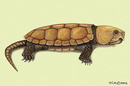
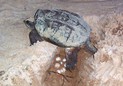
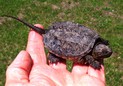
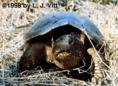
Chelydridae is composed of three species in monotypic genera- Macrochelys temminckii (alligator snapping turtle), Chelydra serpentina (common snapping turtle), and Platysternon megacephalum (big-headed turtle). Members of the family are distributed throughout North America, northern South America, and southeastern Asia.
The members of this family are united in having very large heads and limbs that cannot be fully retracted within the shell. The jaws are very strong (hence, the name), and the upper jaw is hooked. The tails are long, equaling the length of the carapace in Platysternon. Skeletal synapomorphies include: (1) lateral processes of the nuchal bone are extensive, (2) the plastron and carapace maintain a ligamentous connection, and (3) The caudal (tail) vertebrae have the following pattern: a single procoelous vertebra is most anterior, followed by a single amphicoelous vertebra; all remaining vertebrae are opisthocoelous. Ecologies are divisive, and generalization is difficult. For example, alligator snappers spend nearly their entire existence in water, while big-headed turtles forage on land and are skilled climbers. Aspects of diet, reproduction, and habitat are better summarized in species-level accounts.
The status of Chelydridae is somewhat tenuous. Some previous investigators have placed Platysternon in a family of its own (Platysternidae) or grouped it in the larger family Testudinidae, but current consensus places it with the snappers. Even so, the contemporary Chelydridae is divided into two subfamilies (Chelydrinae and Platysterninae). This split reflects the many differences between the New World species (Chelydra and Macrochelys) and the Old World species (Platysternon).
Paleontologists recognize four fossil chelydrids. The species date as far back as the Paleocene (~ 65 million years ago). The distributions of these extinct forms included North America, Europe, Asia, and possibly Africa. Among extant species, Macrochelys and Chelydra date from the Miocene and Pleistocene, respectively.
References:
Ernst, C.H., and Barbour, R.W. 1989. Turtles of the World. Smithsonian Inst. Press, Washington, D.C.
Ernst, C.H., Lovich, J.E., and Barbour, R.W. 1994. Turtles of the United States and Canada. Smithsonian Inst. Press, Washington, D.C.
Pough, F.H., Andrews, R.M., Cadle, J.E., Crump, M.L., Savitzky, A.H., and Wells, K.D. 2000. Herpetology, 2nd ed. Prentice Hall, Upper Saddle River, NJ.
Shaffer, H.B., Meylan, P., and McKnight, M.L. 1997. Tests of turtle phylogeny: Molecular, morphological, and paleontological approaches. Systematic Biology 46:235-268.
Contributors
Keith Pecor (author).
Glossary
- bilateral symmetry
-
having body symmetry such that the animal can be divided in one plane into two mirror-image halves. Animals with bilateral symmetry have dorsal and ventral sides, as well as anterior and posterior ends. Synapomorphy of the Bilateria.
- ectothermic
-
animals which must use heat acquired from the environment and behavioral adaptations to regulate body temperature
- motile
-
having the capacity to move from one place to another.