Charina trivirgataRosy Boa
Geographic Range
Rosy boas occur in the southwestern United States and in adjacent areas of Mexico, specifically from Hanaupah Canyon (Death Valley area) in California south through Baja California, southwestern Arizona, and western Sonora, Mexico. (Bartlett and Tennant, 2000; Californiaherps.com, 2008; Ernst and Ernst, 2003; rosyboa.com, 2008)
Three subspecies are traditionally recognized: Lichanura t. gracia, desert rosy boas (found from southern California to southwestern Arizona to northeastern Baja California), L.t. roseofusca, coastal rosy boas (found from coastal southwestern California into northern Baja California), and L.t. trivirgata, Mexican rosy boas (found from the extreme southwestern corner of Arizona into western Sonora, Mexico and southern Baja California). These subspecies designations have been repeatedly challenged. Spiteri (1991) decided that the two "subspecies" in California interbreed so freely that they could be lumped into a new subspecies, L. t. myriolepis. This designation has not been widely used. Wood et. al (2008) analyzed mitochondrial DNA in rosy boas across their range and suggested that two evolutionary species could be provisionally recognized: Charina trivirgata would encompass most of the USA portion of the ranges of L. t. gracia and L. t. roseofusca. Charina trivirgata would occur in southern San Diego County, California, extreme SW Arizona south of the Gila River, and through the Baja peninsula and NW Sonora, Mexico. Additional genetic and morphological studies may confirm or refute this arrangement. (Bartlett and Tennant, 2000; Californiaherps.com, 2008; Ernst and Ernst, 2003; rosyboa.com, 2008; Spiteri, 1991; Wood, et al., 2008)
Kluge (1993) placed rosy boas into the genus Charina along with rubber boas, Charina bottae due to shared characters; however, this arrangement has been questioned, and most recent checklists retain rosy boas in the genus Lichanura (Bartlett and Tennant, 2000; Crother and et al., 2008; Kluge, 1993)
Habitat
Rosy boas live in dry shrublands, desert, and near-desert areas. They are found among scattered rocks and boulders or on talus slopes. Preferred habitat is often on south-facing hillsides at elevations from sea level to over 2,000 meters. Rosy boas are rarely found far from rock cover. They seem to prefer habitats near free water, such as canyon or desert streams, but are not restricted to such areas. (Bartlett and Tennant, 2000; Californiaherps.com, 2008; Ernst and Ernst, 2003)
- Habitat Regions
- terrestrial
- Terrestrial Biomes
- desert or dune
- chaparral
- scrub forest
- mountains
- Aquatic Biomes
- coastal
- Other Habitat Features
- caves
-
- Range elevation
- 0 to 2000 m
- 0.00 to 6561.68 ft
Physical Description
Rosy boas are one of the smaller members of the family Boidae. Adults range in total length from 43 to 112 cm (17 inches to 44 inches). These are fairly heavy-bodied snakes with smooth scales. The tail is short, tapered, and slightly prehensile, with a blunt tip. The head shape is elongated, slightly broader then the neck and covered dorsally with small scales. The pupil is vertically elliptical. The dorsal scales are smooth, pitless, and occur in 33 to 49 rows in populations north of Mexico. Rosy boas have between 216 and 245 ventral scutes, 38 to 52 undivided subcaudals, and an undivided anal plate. There are no chin shields. In the mouth, each maxilla has 14 to 20 (mean 17) teeth. Male rosy boas tend to be smaller than females, have more prominent anal spurs, and tails averaging 14% of total body length. Females are larger, have shorter, less conspicuous anal spurs that barely break the skin's surface, and the tail averages 13% of total length. (Bartlett and Tennant, 2000; Brennan and Holycross, 2006; Ernst and Ernst, 2003; rosyboa.com, 2008)
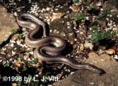
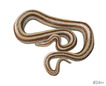
The normal color pattern presents as three dark stripes against a lighter background. The stripes can be sharply defined or have irregular edges, and range from black or brown to reddish-brown, orangish, or rose in color. The background color ranges from gray, bluish-gray or tan to yellow, cream, or white. Spots of darker pigment may invade the lighter background in some local variants. Occasional specimens are unicolored and lack obvious striping. The chin, throat and venter ranges from cream to grayish white. The named subspecies have been defined by trends in coloration. Desert rosy boas tend to have well-defined stripes and lighter background color. Coastal forms are darker overall with less well-definded stripes, and Mexican rosy boas often have dark brown, sharp-edged stripes on a cream or yellowish background. However, much intergradation and variation occurs both between and within subspecies ranges. The name "rosy" was apparently derived from the pinkish ventral color of some specimens from the Baja peninsula; since this is atypical for the species, the more logical common name "three-lined boa" has been suggested. (Bartlett and Tennant, 2000; Ernst and Ernst, 2003; rosyboa.com, 2008; Stebbins, 2003)
Rubber boas (Charina bottae) are sympatric with rosy boas in parts of Southern California and might be confused with some of the more heavily pigmented rosy boas. Rubber Boas differ in having enlarged scales on the head and tend to be uniformly colored, without trace of striping. (Bartlett and Tennant, 2000)
- Other Physical Features
- heterothermic
- Sexual Dimorphism
- female larger
-
- Range length
- 43 to 112 cm
- 16.93 to 44.09 in
-
- Average length
- 76 cm
- 29.92 in
Development
The newborn young, from 18 to 36 cm long, are basically miniatures of the adults in shape and color pattern, though they may have more contrasting patterns (darker striping on lighter backgrounds) than their parents. Sex determination is genetic. (Bartlett and Tennant, 2000; Californiaherps.com, 2008; Ernst and Ernst, 2003)
- Development - Life Cycle
- indeterminate growth
Reproduction
Territorial behavior and male competition or fighting in wild rosy boas has apparently not been described. In courtship the male flicks his tongue over the female's body, and the female may tongue-flick the male in return. The male then slowly crawls over the female and strokes her posterior sides with erected anal spurs. If receptive, the female will turn her body to one side and elevate her tail. This allows the male to insert a hemipenis into her cloaca for fertilization. (Ernst and Ernst, 2003; rosyboa.com, 2008)
- Mating System
- polygynandrous (promiscuous)
Courtship and mating occur from May through July and gestation requires 103 to 143 days. This is a viviparous species; females incubate fertilized eggs within their bodies and then give birth to live, independent young between August and November. Litters average 3 to 8 young, with a range of 1 to 14. Males apparently reach sexual maturity at 2 to 3 years of age, at a total length of 43 to 58 cm; females also mature in 2 or 3 years, at a length of about 60 cm. (Ernst and Ernst, 2003; rosyboa.com, 2008)
- Key Reproductive Features
- iteroparous
- seasonal breeding
- sexual
- fertilization
- ovoviviparous
-
- Breeding interval
- Females in the wild may breed only every other year; breeding frequency may depend on food supply and physical condition.
-
- Breeding season
- Breeding occurs from spring to early summer.
-
- Range number of offspring
- 1 to 14
-
- Average number of offspring
- 5-8
-
- Range gestation period
- 103 to 143 days
-
- Range age at sexual or reproductive maturity (female)
- 2 to 3 years
-
- Range age at sexual or reproductive maturity (male)
- 2 to 3 years
A female rosy boa must acquire and store sufficient energy to provision her eggs (mostly in yolk) and then carry the developing embryos to birth. Once the young are born they are independent immediately, and the female's investment in that brood is over. (Ernst and Ernst, 2003)
- Parental Investment
-
pre-fertilization
- provisioning
-
protecting
- female
-
pre-hatching/birth
-
provisioning
- female
-
protecting
- female
-
provisioning
Lifespan/Longevity
The average and maximum lifespan of rosy boas in the wild is unknown. Average lifespan for captive specimens ranges from 18 to 22 years, although some have been documented to live over 30 years. (Ernst and Ernst, 2003; rosyboa.com, 2008; Slavens and Slavens, 1999)
-
- Range lifespan
Status: captivity - 30 (high) years
- Range lifespan
-
- Typical lifespan
Status: captivity - 15 to 30 years
- Typical lifespan
-
- Average lifespan
Status: captivity - 18 years
- Average lifespan
Behavior
Because of their secretive lifestyle, few studies have focused on natural behavior of rosy boas in the wild. Like all snakes, these boas are dependent on external temperatures to promote their physiological functions such as embryonic development within females and digestion of prey. Rosy boas tend to be primarily nocturnal during the hot, summer months but activity patterns depend on weather. They can be crepuscular at times, and in late winter and early spring they can be diurnal. During cold weather rosy boas seek refuge underground in rock crevices or rodent burrows. At other times they prefer to shelter under surface objects such as rocks and vegetation. The yearly activity period in the northern parts of the range and at higher elevations may last from April to October, while in warmer, more southerly parts of their range activity may extend from March to November. Rosy boas can be active year-round if the weather is mild enough. Rosy boas are slow-moving animals, tending to use rectilinear (caterpillar-like) motion. They are generally found on or under the ground, but can climb well. (Bartlett and Tennant, 2000; Brennan and Holycross, 2006; Californiaherps.com, 2008; Ernst and Ernst, 2003; rosyboa.com, 2008)
- Key Behaviors
- terricolous
- fossorial
- diurnal
- nocturnal
- crepuscular
- sedentary
- hibernation
- aestivation
- solitary
Home Range
No information on home range or territoriality in the wild is available. (Ernst and Ernst, 2003)
Communication and Perception
Rosy boas, like all snakes, make good use of the vomeronasal (Jacobson's) organ for chemosensory input, facilitated by the extensible tongue. They also have appear to have good visual acuity, at least for close distances. Observations of courting animals suggests the use of chemical, tactile, and visual cues. (Ernst and Ernst, 2003)
- Other Communication Modes
- pheromones
Food Habits
Rosy boas eat rodents, nestling birds, bats, lizards, amphibians, and other snakes. The majority of the diet consists of small mammals such as kangaroo rats, deer mice, wood rats, and baby rabbits. Rosy boas may slowly stalk their prey or ambush it from a hidden location. The prey animal is struck with great accuracy, then the snake's recurved teeth hold it securely while several body coils are wrapped around it, and it is then constricted. Once the captured prey is dead or incapacitated, the boa slowly releases the carcass by unwrapping its body and swallows the prey head first. Two prey animals can be constricted at a time, and one prey item can be consumed while another is still held in a body coil. (Bartlett and Tennant, 2000; Bartlett, 2006; Ernst and Ernst, 2003; rosyboa.com, 2008)
- Primary Diet
-
carnivore
- eats terrestrial vertebrates
- Animal Foods
- birds
- mammals
- amphibians
- reptiles
Predation
Rosy boas are undoubtedly killed and eaten by numerous predators, but no reports of predation in nature were found. Potential predators known to eat other snake species include carnivorous mammals (such as raccoons, ringtails, weasels, skunks, and coyotes), birds (hawks, shrikes), and other snakes, such as king snakes (Lampropeltis). Anti-predator behaviors in this snake include hiding the head in body coils, releasing a musky smelling substance from the cloaca, and biting. These snakes are usually rather docile and are not considered aggressive towards human handlers. (Bartlett and Tennant, 2000; Brennan and Holycross, 2006; Californiaherps.com, 2008; Ernst and Ernst, 2003; rosyboa.com, 2008)
- Anti-predator Adaptations
- cryptic
Ecosystem Roles
Rosy boas are predators that eat mainly nestling rodents in arid and semi-arid habitats. They undoubtedly serve as hosts for various parasites, but these are unreported in wild snakes. (Bartlett and Tennant, 2000; Brennan and Holycross, 2006; Ernst and Ernst, 2003; rosyboa.com, 2008)
- Ecosystem Impact
- keystone species
Economic Importance for Humans: Positive
Rosy boas may contribute to the control of rodent numbers but may not be sufficiently abundant to have a large impact. These boas are one of the most popular snakes in the pet trade due to their docile temperament, small size, low maintenance cost, and general ease of care. They have been collected throughout their range for the pet trade in the past, but these snakes are easily bred in captivity and most of the demand for these snakes can now be met by captive-bred animals. (Bartlett and Tennant, 2000; Bartlett, 2006; Californiaherps.com, 2008; Ernst and Ernst, 2003; rosyboa.com, 2008)
- Positive Impacts
- pet trade
- controls pest population
Economic Importance for Humans: Negative
There are no known adverse effects of rosy boas on humans or human interests. If handled they may bite, but these inconspicuous snakes certainly do not seek confrontation with people. (Bartlett and Tennant, 2000; Ernst and Ernst, 2003; rosyboa.com, 2008)
Conservation Status
The Bureau of Land Management in the State of California has this species listed as "sensitive" status (2008). Otherwise, populations are considered stable. (California Dept of Fish & Game, 2008)
-
- IUCN Red List
-
Least Concern
More information
-
- IUCN Red List
-
Least Concern
More information
-
- US Federal List
- No special status
-
- CITES
- No special status
Other Comments
The karyotype of rosy boas consists of 36 chromosomes with 44 arms: 16 macrochromosomes (8 acrocentric, 8 metacentric) and 20 microchromosomes (Gorman and Gress 1970, cited in Ernst and Ernst 2003). (Ernst and Ernst, 2003)
Contributors
Tanya Dewey (editor), Animal Diversity Web.
Kevin Dacres (author), Michigan State University, James Harding (editor, instructor), Michigan State University.
Glossary
- Nearctic
-
living in the Nearctic biogeographic province, the northern part of the New World. This includes Greenland, the Canadian Arctic islands, and all of the North American as far south as the highlands of central Mexico.

- carnivore
-
an animal that mainly eats meat
- chaparral
-
Found in coastal areas between 30 and 40 degrees latitude, in areas with a Mediterranean climate. Vegetation is dominated by stands of dense, spiny shrubs with tough (hard or waxy) evergreen leaves. May be maintained by periodic fire. In South America it includes the scrub ecotone between forest and paramo.
- chemical
-
uses smells or other chemicals to communicate
- coastal
-
the nearshore aquatic habitats near a coast, or shoreline.
- crepuscular
-
active at dawn and dusk
- cryptic
-
having markings, coloration, shapes, or other features that cause an animal to be camouflaged in its natural environment; being difficult to see or otherwise detect.
- desert or dunes
-
in deserts low (less than 30 cm per year) and unpredictable rainfall results in landscapes dominated by plants and animals adapted to aridity. Vegetation is typically sparse, though spectacular blooms may occur following rain. Deserts can be cold or warm and daily temperates typically fluctuate. In dune areas vegetation is also sparse and conditions are dry. This is because sand does not hold water well so little is available to plants. In dunes near seas and oceans this is compounded by the influence of salt in the air and soil. Salt limits the ability of plants to take up water through their roots.
- diurnal
-
- active during the day, 2. lasting for one day.
- fertilization
-
union of egg and spermatozoan
- fossorial
-
Referring to a burrowing life-style or behavior, specialized for digging or burrowing.
- heterothermic
-
having a body temperature that fluctuates with that of the immediate environment; having no mechanism or a poorly developed mechanism for regulating internal body temperature.
- hibernation
-
the state that some animals enter during winter in which normal physiological processes are significantly reduced, thus lowering the animal's energy requirements. The act or condition of passing winter in a torpid or resting state, typically involving the abandonment of homoiothermy in mammals.
- indeterminate growth
-
Animals with indeterminate growth continue to grow throughout their lives.
- iteroparous
-
offspring are produced in more than one group (litters, clutches, etc.) and across multiple seasons (or other periods hospitable to reproduction). Iteroparous animals must, by definition, survive over multiple seasons (or periodic condition changes).
- keystone species
-
a species whose presence or absence strongly affects populations of other species in that area such that the extirpation of the keystone species in an area will result in the ultimate extirpation of many more species in that area (Example: sea otter).
- mountains
-
This terrestrial biome includes summits of high mountains, either without vegetation or covered by low, tundra-like vegetation.
- native range
-
the area in which the animal is naturally found, the region in which it is endemic.
- nocturnal
-
active during the night
- ovoviviparous
-
reproduction in which eggs develop within the maternal body without additional nourishment from the parent and hatch within the parent or immediately after laying.
- pet trade
-
the business of buying and selling animals for people to keep in their homes as pets.
- pheromones
-
chemicals released into air or water that are detected by and responded to by other animals of the same species
- polygynandrous
-
the kind of polygamy in which a female pairs with several males, each of which also pairs with several different females.
- scrub forest
-
scrub forests develop in areas that experience dry seasons.
- seasonal breeding
-
breeding is confined to a particular season
- sedentary
-
remains in the same area
- sexual
-
reproduction that includes combining the genetic contribution of two individuals, a male and a female
- solitary
-
lives alone
- tactile
-
uses touch to communicate
- terrestrial
-
Living on the ground.
- visual
-
uses sight to communicate
References
Bartlett, R. 2006. The 25 Best Reptile and Amphibian Pets. Hauppauge, NY: Barron's.
Bartlett, R., A. Tennant. 2000. Snakes of North America: Western Region. Houston, Texas: Gulf Publishing Co..
Brennan, T., A. Holycross. 2006. A Field Guide to Amphibians and Reptiles in Arizona. Phoenix: Arizona Game and Fish Department.
California Dept of Fish & Game, 2008. "CA.gov Department of Fish and Game" (On-line). Accessed December 18, 2008 at http://www.dfg.ca.gov/wildlife/species/.
Californiaherps.com, 2008. "California Reptiles and Amphibians" (On-line). Accessed December 17, 2008 at http://www.californiaherps.com/index.html.
Crother, B., et al.. 2008. Scientific and Standard English Names of Amphibians and Reptiles of North America North of Mexico, with Comments Regarding Confidence In Our Understanding. St. Louis: Society for the Study of Amphibians and Reptiles.
Ernst, C., E. Ernst. 2003. Snakes of the United States and Canada. Washington and London: SMITHSONIAN BOOKS.
Granger, , Kurfess, Markx, Norrie, Rossi & Rossi. 2003. Snakes of the United States and Canada. Washington and London: Smithsonian Books.
Kluge, A. 1993. Calabaria and the phylogeny of erycine boas. Zool. J. Linn. Soc., 107: 293-351.
Slavens, F., K. Slavens. 1999. Reptiles and Amphibians in Captivity: Breeding—Longevity and Inventory. Seattle, WA: Slaveware.
Spiteri, D. 1991. The subspecies of Lichanura trivirgata. Bulletin of the Chicago Herpetological Society, Vol. 26: 153-156.
Stebbins, R. 2003. A Field Guide to Western Reptiles and Amphibians (Third Edition). New York: Houghton Mifflin.
Wood, D., R. Fisher, T. Reeder. 2008. Novel patterns of historical isolation, dispersal, and secondary contact across Baja California in the Rosy Boa (Lichanura trtivirgata). Molecular Phylogenetics and Evolution, Vol. 46: 484-502.
rosyboa.com, 2008. "rosyboa.com: basking site for rosy boa enthusiasts" (On-line). Accessed December 17, 2008 at http://www.rosyboa.com/index.htm.