Charadrius vociferuskilldeer


Geographic Range
Killdeer are native to the Nearctic and Neotropical regions. They can be found over much of North America and in parts of South America. From the Gulf of Alaska coastline the range extends southward throughout the United States and reaches the Atlantic and Pacific coasts. Distribution continues through the Nearctic zone and into South America, runs along the Andes Mountain Range and terminates at the southern border of Peru. (Hayman, et al., 1986)
- Biogeographic Regions
- nearctic
- neotropical
Habitat
Killdeer live in terrestrial biomes including savannas, taiga and deciduous forest regions, preferring open areas within these biomes, especially sandbars, mudflats and pastures. Their preferred topographical features range greatly (shorelines, savannas, high altitude regions), with temperature being the critical factor of environment choice. With its large year-round distribution range (and as a result, a small wintering range), C. vociferus remain within their habitats year-round, migrating only when temperature becomes extremely cold, which for the killdeer, is approximately 10 degrees Celsius and below. Killdeer are highly adaptive to climate and environmental variations, and as a consequence, have effectively settled into human altered environments including parks and agricultural zones. (Hayman, et al., 1986; Root, 1988)
- Habitat Regions
- temperate
- tropical
- terrestrial
- Terrestrial Biomes
- taiga
- savanna or grassland
- forest
- Other Habitat Features
- urban
- suburban
- agricultural
- riparian
Physical Description
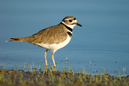
Adult killdeer reach a length ranging between 23-27cm, with an average wingspan of 17.5 cm. Distinguishing characteristics include a dark, double-banded breast, with the top band completely encircling the upper body/breast. Another band is located at the head, resembling a mask absent of the facial portion. The band is continuous, thinning while going across the face along the forehead region and above the bill, and thickening at the supercilium; extending around the eye and onward around the back of the head. Plumage is relatively absent of complexity with the exception of a vividly colored, reddish-orange rump that is visible during flight and behavioral displays. The rest the body consists of a grayish-brown coloration along the dorsal side, crown and nape, while the ventral region is white. Characteristic of species in the same order, C. vociferus possess a lengthened tarsus and a pointed, extended bill, suitable for its foraging habits.
Male and female killdeer are similar in appearance, though breeding females may have additional brown on their face. Juvenile killdeer are similar in appearance to adults, with the exception of buffed fringes and the (uncommon) presence of tail-down.
There are three recognized subspecies of Charadrius vociferus. These subspecies are differentiated on the basis of differences in coloration and pattern of rufous edgings on their back and wing coverts. ("National Geographic Society. Field Guide to the Birds of North America", 1987; Hayman, et al., 1986; Jackson and Jackson, 2000)
- Other Physical Features
- endothermic
- bilateral symmetry
- polymorphic
- Sexual Dimorphism
- sexes alike
-
- Average mass
- 88 g
- 3.10 oz
- AnAge
-
- Range length
- 23 to 27 cm
- 9.06 to 10.63 in
-
- Range wingspan
- 17.5 (low) cm
- 6.89 (low) in
Reproduction
Killdeer are monogamous. Breeding pairs form on the breeding grounds in the spring. Male killdeer claim a territory in which to nest, and then attempt to attract a mate using aerial displays and a series of two-noted calls. Non-migratory breeding pairs may remain together year-round, and may breed together for several years. ("New Hampshire Public Television", 2000; "Plovers and Sandpipers", 1985; "United States Geological Survey", 2000; Jackson and Jackson, 2000)
- Mating System
- monogamous
Killdeer usually begin breeding in early spring, depending on their location. Nesting may begin as early as March in the southern United States, to as late as June in central Canada. In the Caribbean, killdeer can nest year-round. In most temperate localities, killdeer may lay up to three broods per season, but most often only raise one brood successfully. However, in the southern part of their range, successful hatching of two broods may be common.
The male and female work together to "build" their nest, which is simply a depression scraped into the bare earth, or other substrate. Nests are typically located in open areas with sparse vegetation, often in farm fields, road shoulders, parking lots and flat graveled rooftops. Females lay an average clutch of 4 eggs, though the clutch may be as few as 2 eggs and as many as 6. Eggs are incubated for 24 to 28 days, with both parents performing this duty. The chicks are precocial at hatching; they are down-covered and active, and are able to leave the nest soon after their down dries. Unlike most birds, killdeers do not feed their chicks in the nest. Soon after hatching, the parents lead the chicks to a feeding area. The chicks remain with the parents until they are able to fly, 20 to 31 days after hatching. They are able to breed the next year. ("New Hampshire Public Television", 2000; "Plovers and Sandpipers", 1985; "United States Geological Survey", 2000)
- Key Reproductive Features
- iteroparous
- seasonal breeding
- year-round breeding
- gonochoric/gonochoristic/dioecious (sexes separate)
- sexual
- oviparous
-
- Breeding interval
- In the northern part of their range, killdeer breed once per year, raising one to two broods per season. In the southern part of their breeding range, killdeer can breed year-round.
-
- Breeding season
- Killdeer usually begin breeding in early spring, depending on their location. Nesting may begin as early as March in the southern United States, to as late as June in central Canada. In the Caribbean and Mexico, killdeer can nest year-round.
-
- Range eggs per season
- 2 to 6
-
- Average eggs per season
- 4
- AnAge
-
- Range time to hatching
- 24 to 28 days
-
- Range fledging age
- 3 to 24 days
-
- Range time to independence
- 20 to 31 days
-
- Average age at sexual or reproductive maturity (female)
- 1 years
-
- Average age at sexual or reproductive maturity (male)
- 1 years
Both members of a killdeer breeding pair participate in nest preparation and incubation. Unlike most birds, killdeer parents do not feed their chicks in the nest. Instead, after the last egg has hatched, they lead the chicks to a feeding area. The chicks stay with the parents until they are able to fly. ("New Hampshire Public Television", 2000; "Plovers and Sandpipers", 1985; "United States Geological Survey", 2000; Jackson and Jackson, 2000)
- Parental Investment
- precocial
-
pre-fertilization
- provisioning
-
protecting
- female
-
pre-hatching/birth
-
protecting
- male
- female
-
protecting
-
pre-weaning/fledging
-
protecting
- male
- female
-
protecting
-
pre-independence
-
protecting
- male
- female
-
protecting
Lifespan/Longevity
The oldest known wild killdeer lived at least 10 years and 11 months. (Jackson and Jackson, 2000)
-
- Range lifespan
Status: wild - 12 (high) years
- Range lifespan
-
- Average lifespan
Status: wild - 131 months
- Bird Banding Laboratory
- Average lifespan
Behavior
Killdeer are usually solitary or in breeding pairs, though they occasionally gather in a loose flock during non-breeding periods. They are easily heard throughout their habitat due to their extremely loud, piercing call, mimicking the expression "kill-dee(r)," (the origin of their common name).
Killdeer are largely non-migratory, though they do migrate south when temperatures drop below 10 degreed Celsius. Killdeer are active during the day and at night. ("National Geographic Society. Field Guide to the Birds of North America", 1987; "New Hampshire Public Television", 2000; Hayman, et al., 1986; Jackson and Jackson, 2000)
Home Range
Average home ranges during the breeding season ranged from 0.23 to 0.68 ha in two studies. (Jackson and Jackson, 2000)
Communication and Perception
Killdeer communicate using vocalizations and physical displays. Their common name comes from the loud, piercing "kill-dee(r)" call. Killdeer calls often serve as an alert system for other individuals, including animals of different species. (Jackson and Jackson, 2000)
Food Habits
Charadrius vociferus can be considered omnivorous since berries are known to be included within the diet. Primarily though, the diet consists of various aquatic and terrestrial invertebrates, insects and crustaceans. ("Plovers and Sandpipers", 1985)
- Primary Diet
- omnivore
- Animal Foods
- insects
- aquatic crustaceans
- Plant Foods
- fruit
Predation
Killdeer adults, chicks and eggs are vulnerable to predation by a wide assortment of predators. These include birds of prey, gulls, crows and ravens snakes, foxes, coyotes, domestic cats, domestic dogs, raccoons, skunks and Virginia opossums.
Killdeers typically try to draw predators that come near the nest by distracting them. An adult killdeer sitting on eggs will lie still during the approach of an intruder. When the intruder comes too near, the adult will leave the nest and perform an "injured bird" routine, hobbling away and dragging its wings. After drawing the unwelcome visitor far enough from the nest, the adult killdeer takes off in flight and eludes the potential danger. ("National Geographic Society. Field Guide to the Birds of North America", 1987; "New Hampshire Public Television", 2000; Hayman, et al., 1986)
-
- Known Predators
-
- birds of prey (Falconiformes)
- gulls (Larus)
- crows and ravens (Corvus)
- snakes (Serpentes)
- red foxes (Vulpes vulpes)
- coyotes (Canis latrans)
- domestic cats (Felis silvestris)
- domestic dogs (Canis lupus familiaris)
- raccoons (Procyon lotor)
- striped skunks (Mephitis mephitis)
- Virginia opossums (Didelphis virginiana)
Ecosystem Roles
Killdeer affect the populations of the insects and crustaceans they eat. They also provide a valuable source of food for their predators. Killdeer also host at least 13 different species of parasites. (Jackson and Jackson, 2000)
Economic Importance for Humans: Positive
Any economic/agricultural contribution from killdeer is most likely the result of their ability to control crop pests. Since insects comprise a large majority of the their diet, killdeer eat pests such as mosquitoes, ticks, and locusts. ("Plovers and Sandpipers", 1985)
- Positive Impacts
- controls pest population
Economic Importance for Humans: Negative
There are no known adverse effects of killdeer on humans.
Conservation Status
Killdeer are neither endangered nor threatened according any of the organizations involved with biodiversity and conservation. They are, however, protected under the U.S. Migratory Bird Act.
Killdeer are highly adaptable and able to thrive in many human-altered habitats. Because of this, they are a very common species, with an estimated worldwide population of 1,000,000 individuals.
-
- IUCN Red List
-
Least Concern
More information
-
- IUCN Red List
-
Least Concern
More information
-
- US Migratory Bird Act
- Protected
-
- US Federal List
- No special status
-
- CITES
- No special status
-
- State of Michigan List
- No special status
Contributors
Tanya Dewey (author), Animal Diversity Web.
Kari Kirschbaum (editor), Animal Diversity Web.
Hugh Chung (author), University of Michigan-Ann Arbor, Terry Root (editor), University of Michigan-Ann Arbor.
Glossary
- Nearctic
-
living in the Nearctic biogeographic province, the northern part of the New World. This includes Greenland, the Canadian Arctic islands, and all of the North American as far south as the highlands of central Mexico.

- Neotropical
-
living in the southern part of the New World. In other words, Central and South America.
- acoustic
-
uses sound to communicate
- agricultural
-
living in landscapes dominated by human agriculture.
- bilateral symmetry
-
having body symmetry such that the animal can be divided in one plane into two mirror-image halves. Animals with bilateral symmetry have dorsal and ventral sides, as well as anterior and posterior ends. Synapomorphy of the Bilateria.
- chemical
-
uses smells or other chemicals to communicate
- diurnal
-
- active during the day, 2. lasting for one day.
- endothermic
-
animals that use metabolically generated heat to regulate body temperature independently of ambient temperature. Endothermy is a synapomorphy of the Mammalia, although it may have arisen in a (now extinct) synapsid ancestor; the fossil record does not distinguish these possibilities. Convergent in birds.
- forest
-
forest biomes are dominated by trees, otherwise forest biomes can vary widely in amount of precipitation and seasonality.
- iteroparous
-
offspring are produced in more than one group (litters, clutches, etc.) and across multiple seasons (or other periods hospitable to reproduction). Iteroparous animals must, by definition, survive over multiple seasons (or periodic condition changes).
- monogamous
-
Having one mate at a time.
- motile
-
having the capacity to move from one place to another.
- native range
-
the area in which the animal is naturally found, the region in which it is endemic.
- nocturnal
-
active during the night
- omnivore
-
an animal that mainly eats all kinds of things, including plants and animals
- oviparous
-
reproduction in which eggs are released by the female; development of offspring occurs outside the mother's body.
- polymorphic
-
"many forms." A species is polymorphic if its individuals can be divided into two or more easily recognized groups, based on structure, color, or other similar characteristics. The term only applies when the distinct groups can be found in the same area; graded or clinal variation throughout the range of a species (e.g. a north-to-south decrease in size) is not polymorphism. Polymorphic characteristics may be inherited because the differences have a genetic basis, or they may be the result of environmental influences. We do not consider sexual differences (i.e. sexual dimorphism), seasonal changes (e.g. change in fur color), or age-related changes to be polymorphic. Polymorphism in a local population can be an adaptation to prevent density-dependent predation, where predators preferentially prey on the most common morph.
- riparian
-
Referring to something living or located adjacent to a waterbody (usually, but not always, a river or stream).
- seasonal breeding
-
breeding is confined to a particular season
- sedentary
-
remains in the same area
- sexual
-
reproduction that includes combining the genetic contribution of two individuals, a male and a female
- solitary
-
lives alone
- suburban
-
living in residential areas on the outskirts of large cities or towns.
- tactile
-
uses touch to communicate
- taiga
-
Coniferous or boreal forest, located in a band across northern North America, Europe, and Asia. This terrestrial biome also occurs at high elevations. Long, cold winters and short, wet summers. Few species of trees are present; these are primarily conifers that grow in dense stands with little undergrowth. Some deciduous trees also may be present.
- temperate
-
that region of the Earth between 23.5 degrees North and 60 degrees North (between the Tropic of Cancer and the Arctic Circle) and between 23.5 degrees South and 60 degrees South (between the Tropic of Capricorn and the Antarctic Circle).
- terrestrial
-
Living on the ground.
- territorial
-
defends an area within the home range, occupied by a single animals or group of animals of the same species and held through overt defense, display, or advertisement
- tropical
-
the region of the earth that surrounds the equator, from 23.5 degrees north to 23.5 degrees south.
- tropical savanna and grassland
-
A terrestrial biome. Savannas are grasslands with scattered individual trees that do not form a closed canopy. Extensive savannas are found in parts of subtropical and tropical Africa and South America, and in Australia.
- savanna
-
A grassland with scattered trees or scattered clumps of trees, a type of community intermediate between grassland and forest. See also Tropical savanna and grassland biome.
- temperate grassland
-
A terrestrial biome found in temperate latitudes (>23.5° N or S latitude). Vegetation is made up mostly of grasses, the height and species diversity of which depend largely on the amount of moisture available. Fire and grazing are important in the long-term maintenance of grasslands.
- urban
-
living in cities and large towns, landscapes dominated by human structures and activity.
- visual
-
uses sight to communicate
- year-round breeding
-
breeding takes place throughout the year
- young precocial
-
young are relatively well-developed when born
References
1987. National Geographic Society. Field Guide to the Birds of North America. Washington, D.C.: National Geographic Society.
2000. "New Hampshire Public Television" (On-line). Accessed September 2000 at http://www.nhptv.org/natureworks/killdeer.htm.
1985. Plovers and Sandpipers. Pp. 160-177 in The Encyclopedia of Birds. New York: Facts on File, Inc.
2000. "United States Geological Survey" (On-line). Accessed Sept. 2000 at http://www.mbr-pwrc.usgs.gov/id/mlist/h2730.html.
Hayman, P., J. Marchant, P. Tony. 1986. Shorebirds. An Identification Guide to the Waders of the World. Boston: Houghton Mifflin Co.
Jackson, B., J. Jackson. 2000. Killdeer (Charadrius vociferus). Pp. 1-28 in A Poole, F Gill, eds. The Birds of North America, Vol. 517. Philadelphia, PA: The Birds of North America, Inc.
Root, T. 1988. Atlas of Wintering North American Birds: An Analysis of Christmas Bird Count Data. Chicago: The University of Chicago Press.